
Table of Contents
The Missile Claim That Changed the Narrative
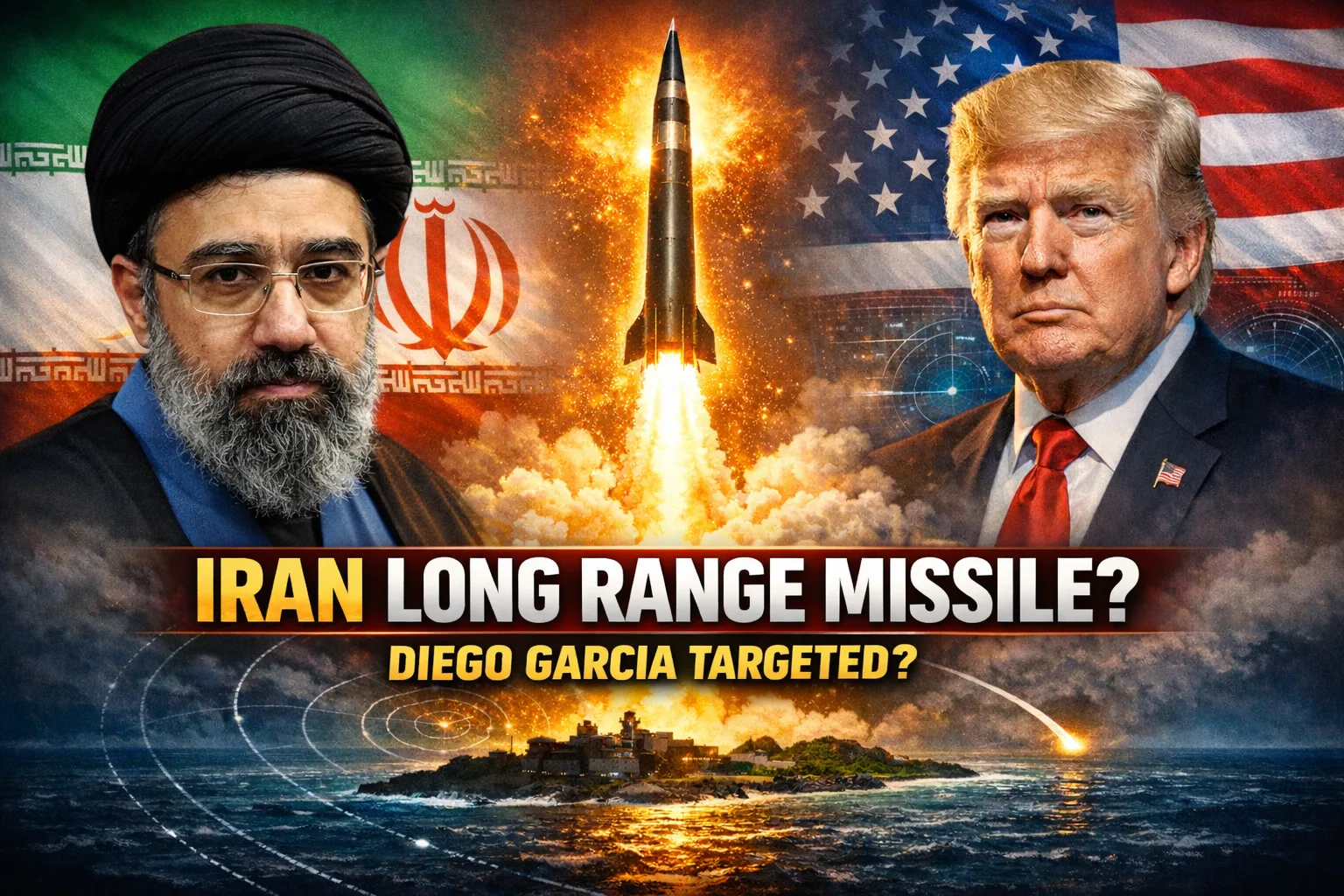
Iran long range missile capability has suddenly become one of the most debated questions in global geopolitics.
Reports began circulating that Iran had targeted the US military base at Diego Garcia—a location more than 4,000 kilometers away.
That claim alone was enough to shift the conversation.
Because if true, it changes everything.
But here’s where it gets complicated.
Iran itself denied carrying out any such missile strike.
That contradiction is where the real story begins.
Sources: The Wall Street Journal, Times of India
Did Iran Really Target Diego Garcia?
Initial reports suggested that Iran launched long-range ballistic missiles toward Diego Garcia.
Some narratives even claimed interception mid-air.
But then came a surprising development.
Iran officially denied the attack.
This is unusual.
In warfare, countries typically highlight successful long-range capabilities. They don’t deny them—especially if it strengthens deterrence.
So why deny it?
That question matters.
Because it suggests either:
- The attack never happened
- Or the outcome didn’t serve Iran’s strategic narrative
This was deliberate.
Sources: The Economic Times, Hindustan Times
Why Would Iran Deny a Military Achievement?
Think about the logic.
If Iran had successfully demonstrated Iran long range missile capability beyond 4,000 km, it would:
- Boost its global military image
- Increase deterrence
- Strengthen internal political messaging
Yet, Iran chose denial.
That signals something deeper.
Iran has consistently maintained that its missile range is limited—often below 2,000 km.
Admitting a longer range contradicts its own diplomatic positioning.
And more importantly—it strengthens its adversaries’ arguments.
How Ballistic Missiles Actually Work
To understand the debate, you need to understand the mechanics.
A ballistic missile:
- Launches into space
- Travels along a high arc
- Re-enters the atmosphere at extreme speed
This is key.
Once a country can reliably send missiles into space trajectories, scaling range becomes a matter of technological progression.
That’s why analysts are concerned.
Because even if 4,000 km is achieved today, future extensions could follow.
Narrative Warfare: The Invisible Battlefield
This is where things shift.
The debate is no longer just about missiles.
It is about perception.
United States and Israel have consistently argued that Iran represents a growing long-term threat.
Highlighting a 4,000 km strike—even if intercepted—serves that narrative.
Surprise! Iranian regime caught lying again trying to hide that Iran developed missiles to threaten all of Europe.
— Israel Foreign Ministry (@IsraelMFA) March 21, 2026
Feb 28, 2026 – Iran’s FM:
"We kept the range of our missiles below 2,000 km."
March 21, 2026 – Iran targets Diego Garcia, ~4,000 km away.
4,000 km from Iran… pic.twitter.com/wDIoVFpHYm
It sends a message:
👉 “This threat is real—and expanding.”
Meanwhile, Iran pushes the opposite narrative:
👉 “We are not a global threat. This war is unnecessary.”
Two narratives.
Same event.
Completely different interpretations.
When the Narrative Breaks From Within
Joe Kent, Director of U.S. National Counterterrorism Center, stepped down from his role, stating that he could not support the ongoing war against Iran.
He argued that Iran posed no imminent threat to the United States, and suggested that the conflict was influenced by pressure from Israel rather than direct necessity.
This complicates the narrative.
After much reflection, I have decided to resign from my position as Director of the National Counterterrorism Center, effective today.
— Joe Kent (@joekent16jan19) March 17, 2026
I cannot in good conscience support the ongoing war in Iran. Iran posed no imminent threat to our nation, and it is clear that we started this… pic.twitter.com/prtu86DpEr
Sources: The Guardian, The Irish Times
Can Iran Actually Threaten Europe?
This is the central fear being amplified.
If Iran can reach 4,000 km, what stops it from reaching 10,000+ km?
Some European analysts argue that once space-capable trajectories are achieved, longer distances are only a matter of time.
Countries like:
- France
- Germany
- United Kingdom
…are now being indirectly pulled into this narrative.
The U.K. has no permanent land-based system to intercept high-altitude ballistic missiles, Sky News reports, as Iran demonstrates potential range of 4000 km in launches targeting the U.K. base (used by the U.S. military) at Diego Garcia in the Indian Ocean. pic.twitter.com/dhgBx2Ui0l
— Furkan Gözükara (@FurkanGozukara) March 21, 2026
But here’s the key distinction:
Capability ≠ Intent
And that distinction often gets blurred in geopolitical messaging.
Truth vs Propaganda: Who Should You Believe?
This is where clarity breaks down.
On one side:
- Iran claims it does not possess such extended capabilities
- Denies attacking Diego Garcia
On the other:
- Western narratives suggest capability is already emerging
- Frame Iran as an imminent long-range threat
So what is the truth?
It may not be binary.
Geopolitics rarely is.
Some information may be exaggerated.
Some may be concealed.
You are not being given a full picture by either side.
That silence matters.
What This Means for the Global Order
The implications go far beyond one missile claim.
If the narrative of Iran long range missile capability continues to expand:
- More countries may justify military involvement
- NATO-aligned nations could increase presence in the region
- Energy routes like the Strait of Hormuz become more volatile
And that leads to a larger shift.
From regional conflict → global alignment pressure
This is not just about missiles.
It is about shaping the justification for future escalation.
Conclusion
The debate around Iran long range missile capability is not just technical—it is strategic.
Whether Iran actually targeted Diego Garcia may remain unclear.
But the narrative built around it is already having real consequences.
One side is trying to prove a growing threat.
The other is trying to contain that perception.
And somewhere in between lies the truth.
In modern geopolitics, wars are not only fought with weapons.
They are fought with narratives.
And whichever narrative wins—often determines what happens next.
FAQs
What is Iran long range missile capability?
Iran long range missile capability refers to its ability to strike targets thousands of kilometers away using ballistic missile technology. The debate intensified after reports of a possible strike on Diego Garcia.
Did Iran attack Diego Garcia?
Iran has officially denied launching any missile attack on Diego Garcia, despite reports suggesting otherwise. This contradiction is central to the current geopolitical debate.
Why is this issue controversial?
Because it involves conflicting narratives. While some claim Iran is expanding its missile reach, Iran itself denies possessing such capabilities beyond a certain range.
Can Iran target Europe with missiles?
There is no confirmed evidence yet, but some analysts argue that if current capabilities expand, future long-range reach could become possible.
What Do You Think This Means for the Conflict?
If Iran long range missile capability is being amplified globally, is it a genuine security concern—or a strategic narrative to justify escalation?
- Should Europe prepare for a real threat?
- Or is this shaping perception before a larger military move?
- And who benefits the most from this narrative shift?
Share your perspective.
Because in today’s world, what people believe often shapes what nations do next.
Explore more about Defense & Security and World Affairs.