

Table of Contents
Why Is Golden Horizon in the News?
Recent defense reports suggest India is evaluating Israel’s advanced Golden Horizon missile — a system described as faster and structurally different from the BrahMos.
The comparison has triggered headlines:
“Faster than Brahmos”
Is this really a superior alternative — or a different category altogether?
To understand the debate, we must first understand what kind of missile Golden Horizon actually is.
Sources: Deccan Herald
What Is the Golden Horizon Missile?
The Golden Horizon is reportedly an Air-Launched Ballistic Missile (ALBM) developed by Israel.
Open-source assessments suggest it may be linked to Israel’s Sparrow missile family — possibly an advanced derivative with operational strike capability rather than just testing functions.
Key characteristics attributed in reports:
- Air-launched platform
- Ballistic flight trajectory
- Designed for hardened, high-value targets
- Estimated range: 1500–2000 km (unconfirmed publicly)
- Capable of striking deep underground structures
Unlike traditional battlefield missiles, this system is reportedly designed to eliminate strategic leadership, underground command centers, and fortified infrastructure.
That is a different mission profile entirely.
Sources: News18
Golden Horizon Missile vs BrahMos: The Core Difference
The key comparison in the debate — Golden Horizon missile vs BrahMos — requires understanding missile categories.
BrahMos
- Type: Supersonic cruise missile
- Flight path: Low-altitude, terrain-hugging
- Speed: Around Mach 3
- Range: ~800–900 km (latest variants)
- Role: Anti-ship, land attack, tactical strike
Golden Horizon (Air-Launched Ballistic Missile)
- Type: Air-Launched Ballistic Missile
- Flight path: High-altitude ballistic arc
- Speed: Likely Mach 5+ during descent
- Range: 1500–2000 km (reported estimates)
- Role: Deep strike on hardened strategic targets
BrahMos is a precision cruise missile.
Golden Horizon is a strategic ballistic strike system.
They are not competitors.
They are different tools.
Ballistic vs Cruise Missile — Why Trajectory Matters
The trajectory defines survivability and interception difficulty.
A cruise missile:
- Flies low
- Avoids radar
- Moves horizontally
- Ideal for tactical precision
A ballistic missile:
- Climbs high into the atmosphere
- Travels in an arc
- Descends at extremely high velocity
- Harder to intercept during terminal phase
An Air-Launched Ballistic Missile adds another advantage:
It is released from an aircraft, increasing launch flexibility and extending effective strike radius.
India currently does not possess an operational ALBM system in this class.
That gap explains the strategic interest.
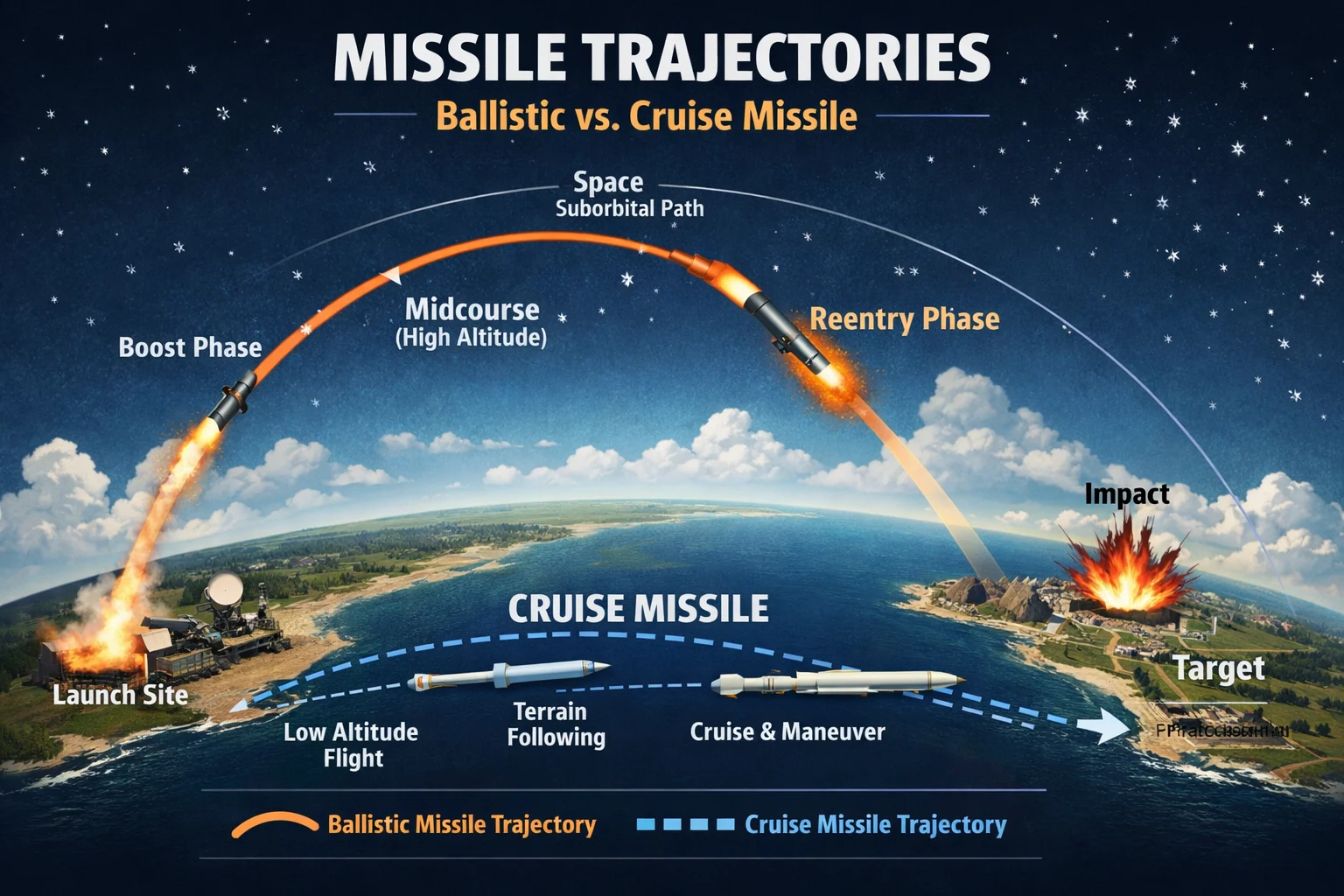
Image credit: AI-generated using ChatGPT by OpenAI
Range, Speed and Target Profile
Reports indicate Golden Horizon may have:
- 1500–2000 km strike capability
- Deep penetration ability
- Bunker-buster functionality
It is reportedly designed to destroy:
- Underground command bunkers
- Reinforced military infrastructure
- Nuclear-related facilities
- Deeply buried strategic assets
This makes it a leadership-targeting weapon, not a battlefield support missile.
In modern warfare, disabling command structure quickly can shorten conflict duration dramatically.
That is its core value proposition.
Golden Horizon is tailored for hardened and deeply buried targets, such as underground command bunkers, reinforced military infrastructure and nuclear-related facilities#GoldenHorizon #Military https://t.co/Q9a0DUOxWb
— News18 (@CNNnews18) February 23, 2026
Can India Buy Golden Horizon?
Israel has historically shown willingness to share advanced defense technologies with India.
After the United States, India is widely regarded as one of Israel’s most trusted defense partners.
There is growing speculation that during Prime Ministerial-level visits, defense agreements may expand to include:
- Ballistic missile defense cooperation
- Advanced laser systems
- Long-range missile collaboration
- UAV and drone platforms
Whether Golden Horizon is directly offered or co-developed remains speculative.
But strategic trust exists.
That is the enabling factor.
Sources: Money Control
India–Israel Defense Cooperation: The Bigger Picture
India and Israel already collaborate on:
- Missile defense systems
- UAV technology
- Surveillance systems
- Radar and avionics
If Golden Horizon is integrated, likely platforms could include India’s Sukhoi Su-30MKI fleet.
There is also broader geopolitical context.
Israel has floated concepts such as expanded regional cooperation frameworks, sometimes described as new alliance geometries. India’s participation in strategic groupings such as I2U2 demonstrates existing diplomatic alignment.
Defense cooperation could deepen further.
Strategic Impact on Indian Air Power
If acquired, Golden Horizon would:
- Give India long-range precision strike without entering hostile airspace
- Enable leadership decapitation capability
- Enhance deterrence against hardened underground targets
- Expand strategic strike envelope beyond BrahMos
For example:
In a hypothetical conflict scenario, destroying nuclear command infrastructure quickly becomes crucial. An ALBM offers that option.
This is not about replacing BrahMos.
It is about expanding the strike ladder.
Deterrence is layered.
Cruise missiles for tactical precision.
Ballistic ALBMs for strategic knockout.
Conclusion: Evolution, Not Replacement
The Golden Horizon missile vs BrahMos debate should not be framed as competition.
BrahMos remains one of the world’s most effective supersonic cruise missiles.
Golden Horizon represents a different strategic class — an air-launched ballistic strike platform aimed at hardened, high-value targets.
If India proceeds, it would mark:
- A shift toward advanced ALBM capability
- Deepened Israel–India strategic trust
- Expanded long-range air power
- Strengthened deterrence architecture
Modern warfare increasingly focuses on speed, precision, and command disruption.
Golden Horizon fits that doctrine.
The final decision will depend on cost, technology transfer, geopolitical considerations, and operational integration.
But one thing is clear:
Air power evolution is underway.
FAQs
What is Golden Horizon missile?
Golden Horizon is an Israeli Air-Launched Ballistic Missile designed for deep, hardened, high-value strategic targets.
What is Golden Horizon Missile Vs BrahMos Difference?
BrahMos is a cruise missile that flies low and fast. Golden Horizon follows a ballistic arc and descends at very high speed to destroy fortified targets.
What is an air-launched ballistic missile?
An ALBM is a ballistic missile launched from an aircraft instead of the ground, giving greater flexibility and extended strike range.
Does India have an ALBM?
India currently does not publicly operate an ALBM comparable to Golden Horizon.
Is Golden Horizon faster than BrahMos?
Golden Horizon Missile Vs Brahmos : Likely yes during terminal descent, as ballistic missiles can exceed Mach 5, while BrahMos operates around Mach 3.
What is the range of Golden Horizon?
Reports suggest 1500–2000 km, though official confirmation is limited.
Will this transform the Indian Air Force?
If integrated effectively, it would significantly expand long-range strategic strike capability.
Strategic Question for You
If India gets access to Golden Horizon:
Should it prioritize immediate procurement?
Or pursue joint development and technology transfer?
Do you see this as deterrence enhancement — or escalation risk?
Share your perspective in the Comments below.
Explore more about Defense & Security, World Affairs and Indian Affairs.