Table of Contents
Why India Is Suddenly Central to the Iran War
The India role in Iran war is no longer theoretical—it is becoming active and visible.
On Day 26 of the conflict involving Iran, United States, and Israel, a key development emerged:
A direct conversation between PM Narendra Modi and Donald Trump.
This signals something important:
- India is no longer just observing
- India is being consulted
And that changes the geopolitical equation.
PM Modi–Trump Call: What Was Discussed
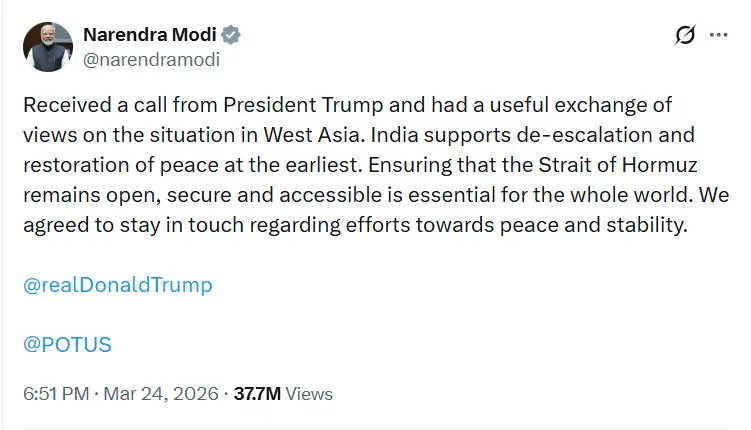
Screenshot of X Post BY PM Narender Modi
According to PM Modi’s Tweet, the discussion focused on:
- The situation in West Asia
- The urgent need for de-escalation
- Ensuring stability in global energy routes
Most importantly, India made its stance clear:
- The Strait of Hormuz must remain open
This is not just diplomacy.
This is a strategic message.
Because whoever controls the Strait influences global energy—and by extension, global stability.
Why the Strait of Hormuz Matters to the World
The Strait of Hormuz is one of the most critical chokepoints in the world.
- A significant portion (20%) of global oil passes through it
- Major economies like India, China, and Japan depend on it
- Even minor disruptions can spike global oil prices
If tensions continue:
- Shipping slows down
- Insurance costs rise
- Oil prices surge
This directly impacts inflation worldwide.
Economic Shock: How the War Is Hitting India
The fallout of the war is already visible in India:
- Manufacturing activity slowing down
- Private sector growth weakening
- Inflation pressures rising
India, as a major energy importer, is especially vulnerable.
Even early signs—like LPG supply disruptions—indicate a deeper economic ripple effect.
If the conflict continues:
- GDP growth could be affected
- Supply chains could tighten
- Consumer prices could rise further
Sources: Times of India,
US Strategy vs Ground Reality
There is a visible gap between statements and reality.
While Donald Trump has suggested:
- Peace talks are underway
- Progress is being made
At the same time:
- Massive war funding (hundreds of billions) has been approved
- Military deployments are increasing
Trump says 'it's always nice to have' $200 billion when asked if Pentagon needs it now that Iran war is supposedly ending
— RT (@RT_com) March 23, 2026
'It's a very inflamed world… You know, largely, the Democrats inflame it' pic.twitter.com/iq1Y2h1ZLJ
Meanwhile, Iran continues:
- Active military operations
- Public rejection of negotiation claims
This contradiction raises serious questions about the direction of the conflict.
Pakistan’s Role in Backchannel Diplomacy
Pakistan has emerged as a communication bridge.
Reports suggest:
- The US is sending proposals to Iran via Pakistan
- A multi-point peace framework is being explored
However, this approach has limitations:
- Pakistan lacks trust with Israel
- It is not neutral in perception
Which creates a diplomatic gap.
Sources: Times of India
Why India Can Be a Unique Mediator
India’s biggest advantage is balance.
It maintains working relations with:
- Iran
- Israel
- United States
- Saudi Arabia
This is rare.
Few countries can talk to all sides simultaneously.
That is why even Iranian diplomats have hinted that India could play a stabilizing role.
A possible path forward could include:
- Hosting multilateral talks in India
- Temporary agreements (not permanent solutions)
- Guaranteeing open shipping routes
This is where diplomacy matters more than force.
Sources: NDTV
Risks If India Stays Passive
If India chooses to stay on the sidelines:
- Economic damage could deepen
- Strategic opportunity could be lost
- Other powers may shape outcomes without India
There is also a long-term risk:
- Losing influence in global crisis management
In geopolitics, timing matters.
And this is a moment of opportunity.
Final Analysis
The India role in Iran war is reaching a critical point.
- The conflict is not ending quickly
- Global economic pressure is rising
- Diplomatic space is opening
India is uniquely positioned to act.
Not as a superpower imposing decisions—
But as a trusted intermediary enabling dialogue.
The real question now is:
Will India step forward—or stay cautious?
FAQs
What is India’s role in the Iran war?
India is emerging as a potential mediator, especially after high-level discussions with US President Donald Trump.
Why is the Strait of Hormuz important for India?
India depends heavily on oil imports passing through this route, making its stability critical for the economy.
Can India actually stop the war?
India may not “stop” the war alone, but it can play a major role in de-escalation and negotiation.
Why is Pakistan involved in diplomacy?
Pakistan is acting as a communication channel, but lacks trust with all parties, limiting its effectiveness.
What Should India Do Next?
Should India step in as a mediator in the Iran war?
- Should India host peace talks?
- Or stay cautious and avoid deeper involvement?
- Can diplomacy actually succeed here?
Share Your Perspective in the Comments below.
Because decisions made now won’t just affect the Middle East—they could reshape global power dynamics for years to come.
Explore more about World Affairs, Defense & Security and Indian Affairs.