Table of Contents
Introduction: A Different Kind of Power
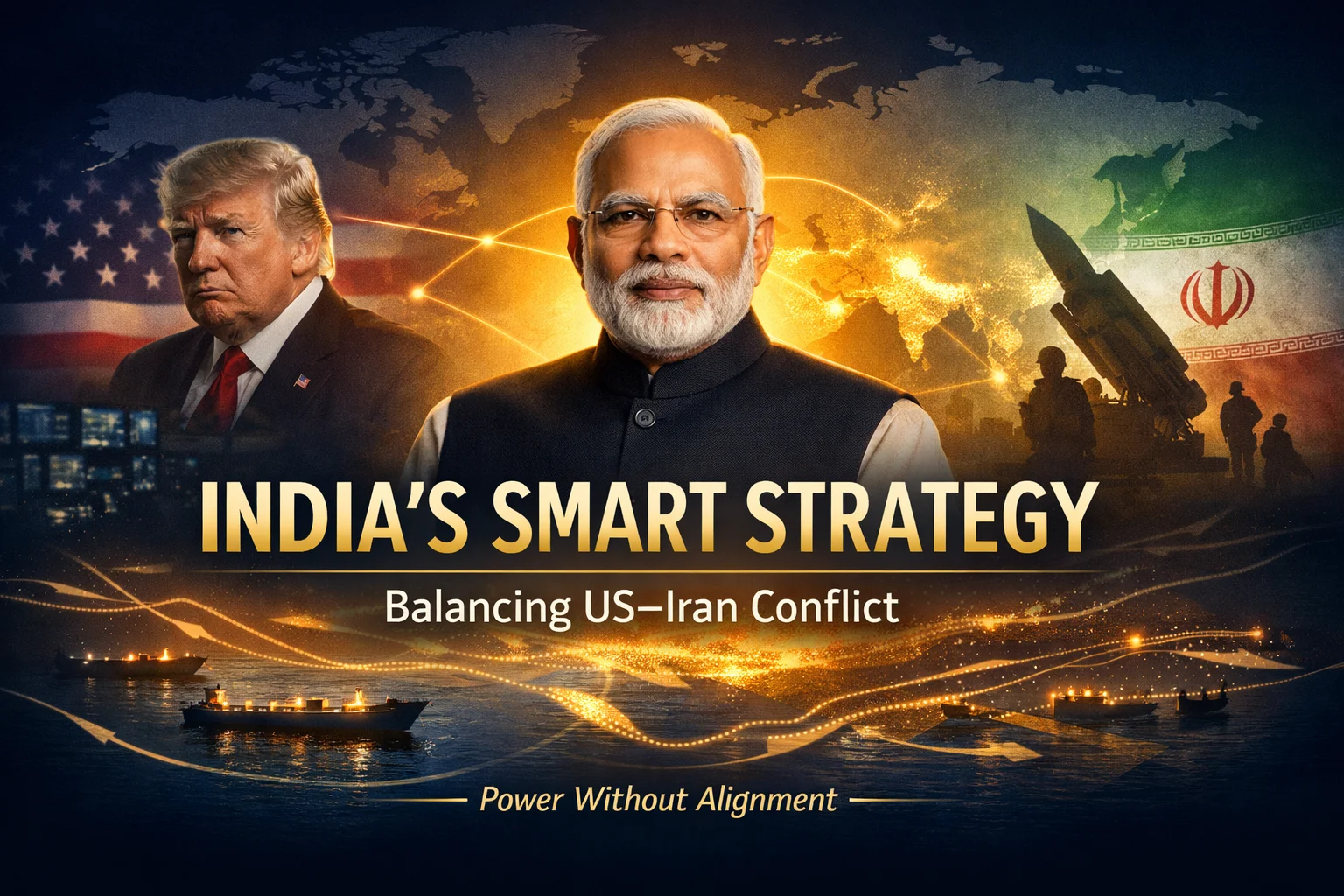
The India role in US Iran conflict stands out not because of dramatic interventions—but because of restraint. This defines the India role in US Iran conflict at a moment when global alignments are hardening.
As global powers align into predictable camps, India has chosen a different path. Not isolation. Not alignment. But calibrated independence.
That distinction matters.
At a time when rhetoric is escalating and military signaling dominates headlines, India’s approach reflects a quieter form of influence—one rooted in balance, dialogue, and strategic clarity.
This is not accidental.
It is policy.
Strategic Autonomy as India’s Core Doctrine
At the heart of India’s response lies a long-standing principle: strategic autonomy.
India has consistently avoided becoming part of rigid geopolitical blocs. Instead, it prioritizes decision-making based on national interest rather than alliance pressure.
This doctrine has gained sharper execution.
The emphasis is clear—conflicts cannot be resolved through force alone. Dialogue remains central.
This clarity at the top shapes everything that follows.
It ensures that India does not get pulled into binary choices between the United States and Iran. Instead, it retains maneuvering space—diplomatic, economic, and strategic.
The result is not neutrality in the passive sense.
It is controlled positioning.
Active Diplomacy, Not Passive Neutrality
India’s stance is often described as neutral.
That is only partially true.
What stands out is the level of engagement behind that neutrality.
This is where India role in US Iran conflict becomes more active than it appears on the surface.
Under the execution of External Affairs Minister S. Jaishankar, India has maintained continuous diplomatic contact with both sides of the conflict. Engagement with Iran, in particular, has produced tangible outcomes—most notably ensuring safe passage for Indian shipping through the Strait of Hormuz.
In a region where maritime disruption has affected global trade, this is significant.
Quiet, but effective.
This is where India’s diplomatic maturity becomes visible. It is not about public positioning—it is about outcomes.
Protecting Interests: Energy and Diaspora
The conflict is not distant for India.
It is immediate.
Nearly 10 million Indians live across West Asia. Their safety becomes a top priority during any regional escalation. The government has responded with advisories, evacuation coordination, and direct engagement with regional authorities.
At the same time, energy security remains critical.
A large share of India’s oil imports flows through the conflict zone, particularly via the Strait of Hormuz. Any disruption directly impacts domestic inflation, economic stability, and industrial activity.
The response, therefore, is deeply pragmatic:
- Secure sea routes
- Maintain supply continuity
- Protect citizens abroad
This is not abstract diplomacy.
It is operational.
The Logic of Multi-Alignment
India’s foreign policy today operates on a principle that is often misunderstood: multi-alignment.
It maintains:
- Strategic partnership with the United States
- Historical and functional ties with Iran
- Defence cooperation with Israel
- Economic engagement with Gulf nations
These relationships are not contradictory.
They are complementary.
This is where the shift becomes visible.
Instead of choosing sides, India builds parallel relationships across competing blocs. This allows it to retain flexibility while maximizing influence.
It also reduces vulnerability.
Because dependence on any single partner is minimized.
India as a Potential Bridge Power
There is a reason global observers increasingly view India as a potential mediator.
Its credibility comes from balance.
Unlike actors directly involved in the conflict, India maintains working relationships with all major stakeholders. This creates space—not for intervention—but for facilitation.
That possibility is subtle.
But important.
India does not project itself as a mediator. Yet its positioning makes such a role conceivable if conditions evolve.
This is influence without assertion.
Global Significance of India’s Approach
India’s strategy reflects a broader shift in how power is exercised.
Traditional models rely on military projection or alliance systems.
India’s model is different:
- Balance over alignment
- Dialogue over escalation
- Interests over ideology
The consequence is not immediate dominance.
It is long-term relevance.
In an increasingly fragmented global system, countries that can engage across divides gain strategic advantage.
India fits that description.
Conclusion
The India role in US Iran conflict is not defined by dramatic moves—but by disciplined strategy.
Strategic autonomy provides the foundation.
Active diplomacy delivers results.
Multi-alignment expands influence.
Pragmatism protects national interests.
Each element reinforces the other. That is what defines India role in US Iran conflict today.
This is where the real strength lies.
While others demonstrate power through confrontation, India demonstrates it through balance and precision.
The long-term implication is clear: in a world moving toward fragmentation, countries that can operate across divides—not within them—will shape outcomes.
India is positioning itself accordingly.
FAQs
Why is India neutral in the US-Iran conflict?
India follows a policy of strategic autonomy, which prioritizes national interest over alliance commitments. This allows it to engage with both sides without taking rigid positions. Neutrality, in this context, is active rather than passive. It enables flexibility and sustained diplomatic engagement.
What is India’s strategic autonomy policy?
Strategic autonomy means India makes independent foreign policy decisions without external pressure. It avoids being tied to military or political blocs. This approach allows India to balance relationships across competing powers. It has been a core principle of Indian diplomacy for decades.
How does the conflict affect India’s energy security?
India imports a significant portion of its oil from the Middle East. Disruptions in the Strait of Hormuz can affect supply and increase prices. This impacts inflation and economic stability domestically. Ensuring uninterrupted energy flow is therefore a key priority.
Can India mediate between the US and Iran?
While India has not officially taken on a mediator role, its relationships with both sides make it a potential bridge. Its balanced approach gives it credibility. However, mediation depends on willingness from both parties. India’s current focus remains on safeguarding its interests.
What is multi-alignment in India’s foreign policy?
Multi-alignment refers to maintaining strong relations with multiple global powers simultaneously. India engages with the US, Iran, Israel, and Gulf nations without exclusivity. This approach increases strategic flexibility. It also reduces dependence on any single partner.
How is India role in US Iran conflict different from other countries?
India’s approach is based on strategic autonomy and multi-alignment, unlike countries that align strictly with one bloc. It maintains relationships with both the US and Iran while focusing on national interests such as energy security and diaspora safety. This allows India to remain flexible and credible across competing power centers. The result is a more balanced and outcome-driven diplomatic posture.
What Do You Think About India’s Strategy?
India is navigating a complex crisis with balance and precision.
Do you see this approach as the future of global diplomacy—or will rising conflicts force countries to eventually choose sides?
Share Your Views in the Comments below.
Explore more about Strategic Depth, Indian Affairs and World Affairs.
Sources: Reuters, Times of India, Financial Express, The Economic Times, The Guardian, Times of India