Table of Contents
A Statement That Triggered Global Alarm
Recent remarks by the US envoy to Israel, Mike Huckabee, have reignited debate over the long-discussed “Greater Israel” idea.
During an interview, when asked whether it would be acceptable if Israel eventually controlled the entire Middle East, Huckabee responded: “It would be fine if they took it all.”
BREAKING: US Ambassador to Israel Mike Huckabee tells Tucker Carlson that Israel has the Biblical right to take over all of the Middle East.
— Tucker Carlson Network (@TCNetwork) February 20, 2026
“It would be fine if they took it all.” pic.twitter.com/BN4fXh03ga
That line changed the tone of the conversation.
Because it was not framed as opposition.
It sounded permissive.
Given Huckabee’s proximity to Donald Trump, observers across the Middle East interpreted the statement as a possible signal of long-term US backing for Israeli territorial expansion.
And that possibility has triggered regional alertness.
Sources: Indian Express, Financial Express, Times of India
What Is the “Greater Israel” Concept?
The “Greater Israel” idea draws from historical and biblical references suggesting that ancient Israel extended from the Nile to the Euphrates.
In modern political terms, it refers to territorial expansion beyond current internationally recognized borders — potentially including parts of:
- West Bank
- Gaza
- Jordan
- Southern Lebanon
- Portions of surrounding regions
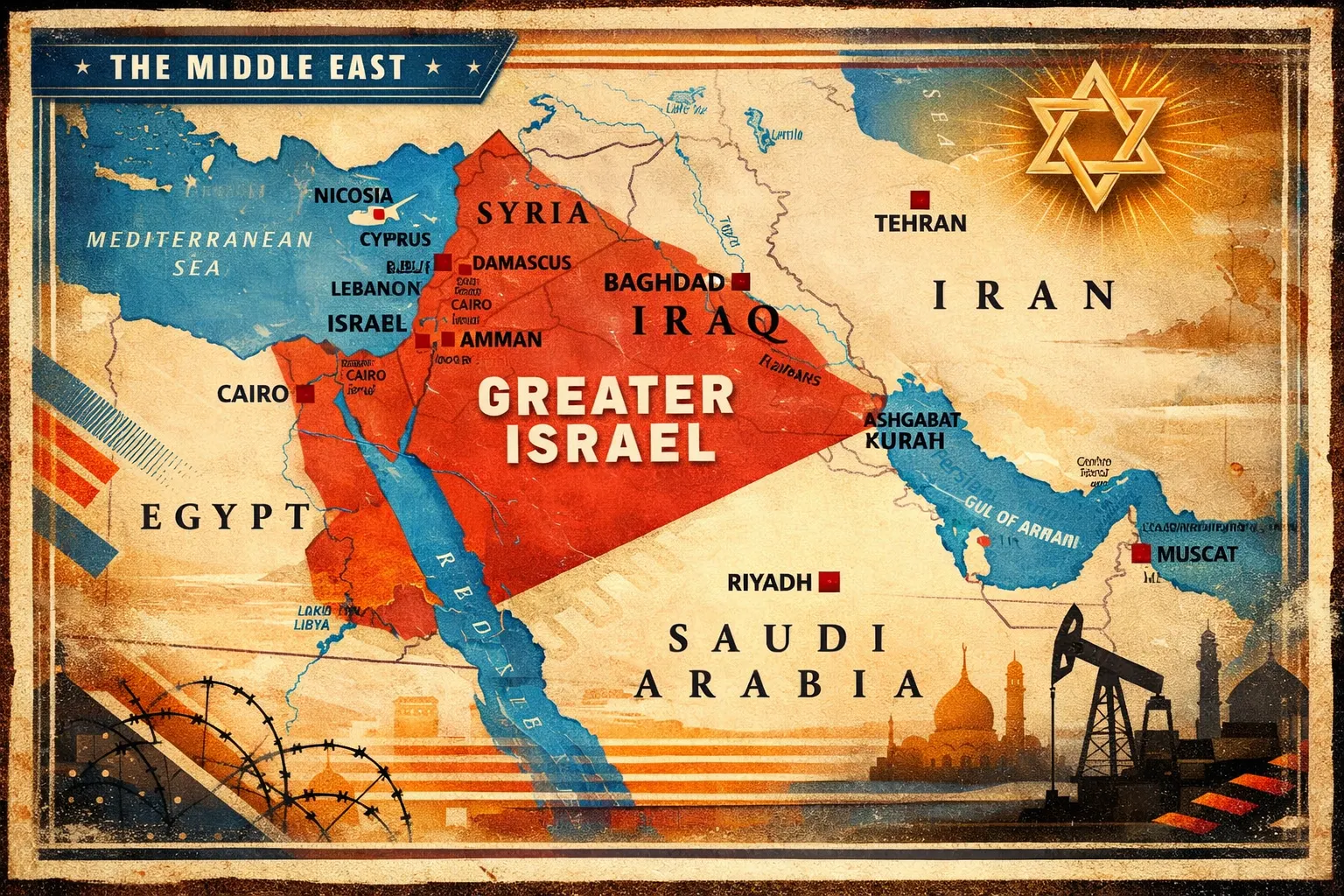
Image credit: AI-generated using ChatGPT by OpenAI
Israeli Prime Minister Benjamin Netanyahu has publicly stated that he connects strongly to the vision of a greater Israel.
When directly asked whether he connects with the concept, he replied: “Very much.”
That matters.
Because when a sitting Prime Minister expresses alignment with a historic territorial vision, it stops being abstract theory.
It becomes strategic language.
Sources: Times of Israel
West Bank Moves and Gaza Control: Expansion on the Ground
On the ground, developments reinforce the concern.
Israel has expanded control over large parts of Gaza following recent conflict cycles. Now attention has shifted toward the West Bank.
According to statements cited by United Nations Secretary-General António Guterres, Israel’s move to resume land registration processes in parts of the West Bank could place up to 60% of the territory under Israeli control.
Over 100 countries — including India — have criticized these plans.
Yet Israeli policy direction appears unchanged.
This is where expansion concerns shift from rhetoric to administrative action.
Land registration is not symbolic.
It institutionalizes control.
Sources: Firstpost, The Hindu, UN – Palestine
Netanyahu’s Strategic Vision and IMEC
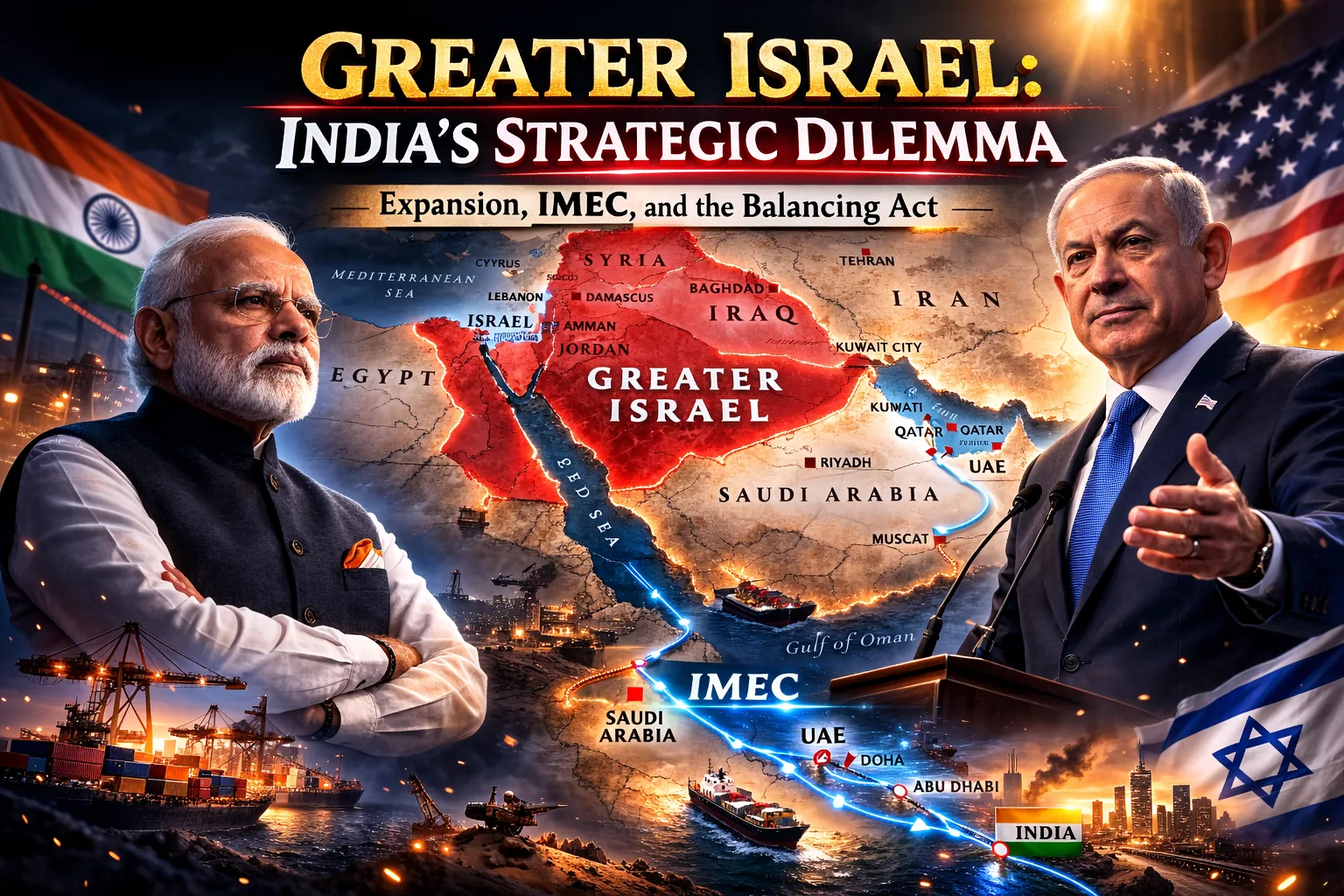
Netanyahu has outlined a broader geopolitical vision: a coalition of countries stretching from the Mediterranean into the Middle East and Europe, including India, Greece, Cyprus, and key Arab states.
This aligns with the India–Middle East–Europe Economic Corridor (IMEC).
The IMEC project aims to connect India to Europe through Gulf states and Israel via ports, rail, and logistics networks.
If Israel strengthens territorial dominance, it could position itself as a central node in this corridor.
This is not only about territory.
It is about infrastructure influence.
And that is long-term power.
Netanyahu:
— Clash Report (@clashreport) February 22, 2026
In the vision that I see before my eyes, we are creating an entire system — essentially a kind of alliance — around and within the Mediterranean, within the Middle East.
This includes India, Arab countries, African countries, and Mediterranean countries such as… pic.twitter.com/aFSiTbGEhP
Does the US Support Greater Israel?
Officially, the US continues to speak in favor of negotiated settlements.
But political realities matter.
Within US domestic politics, strong evangelical Christian blocs actively support Israeli territorial claims based on biblical narratives.
This aligns ideologically with some Republican constituencies.
At the same time, strategically, the US benefits from having a strong pro-Western anchor in the Middle East to counter Iran and manage regional security.
So while formal policy language may remain cautious, rhetorical signals like Huckabee’s create strategic ambiguity.
Ambiguity itself is powerful.
It keeps allies hopeful and adversaries uncertain.
India Stance on Greater Israel: Doctrine vs Strategy
Now comes the central question: What is India’s position?
India’s geopolitical doctrine has historically opposed territorial expansionism.
Consider 1971.
After defeating Pakistan, India did not annex East Pakistan. Instead, it allowed the creation of Bangladesh.
India has never pursued territorial expansion into Nepal, Sri Lanka, Bhutan, or Maldives — despite overwhelming strategic superiority.
That pattern is consistent.
India does not endorse expansionism as a doctrine.
At the same time, India maintains strong defense and economic ties with Israel. During Prime Minister Narendra Modi’s visits, discussions have included advanced military procurement such as long-range air-to-air missile systems.
Defense cooperation will continue.
IMEC cooperation will continue.
Joint manufacturing may expand.
But in multilateral forums like the UN, India is unlikely to support territorial annexation or unilateral expansion.
Because India also maintains deep ties with:
- Saudi Arabia
- UAE
- Iran
Balancing is the strategy.
Not alignment with expansionism.
Sources: The New Indian Express
Could Iran Be the Next Flashpoint?
One major variable remains: Iran.
If Israel expands operations or if US-Israel coordination intensifies against Iran, the region could enter a broader conflict phase.
Any escalation involving Iran would have ripple effects:
- Energy markets
- Gulf stability
- Shipping routes
- India’s oil imports
The Middle East remains interconnected.
And a Greater Israel trajectory, if pursued aggressively, could trigger counter-alliances.
Conclusion: Expansion, Alignment, and India’s Strategic Line
The “Greater Israel” concept is no longer confined to fringe discussions.
Senior political figures have referenced it.
Administrative actions in the West Bank reflect structural changes.
Regional states are alert.
The US position remains strategically ambiguous.
India’s stance, however, is clearer.
India will:
- Continue defense cooperation with Israel
- Support IMEC economic integration
- Oppose territorial expansionism in principle
- Maintain balanced ties with Gulf and Iran
India’s geopolitical DNA does not favor annexation politics.
It favors multi-alignment and strategic autonomy.
If the Middle East undergoes structural transformation, India will engage pragmatically — but not ideologically.
And that distinction will define India’s diplomacy in the years ahead.
FAQs
What is the Greater Israel concept?
It refers to a historical or biblical idea suggesting Israel’s territorial reach once extended beyond its current borders. In modern politics, it implies potential expansion into surrounding areas.
Does the US officially support Greater Israel?
There is no formal declaration supporting it. However, statements by figures like Mike Huckabee have raised questions about long-term US alignment.
What is India’s position on Israel-Palestine conflict?
India supports a two-state solution while maintaining strong defense ties with Israel and close relations with Arab states.
Has Israel annexed the West Bank?
Israel has not formally annexed the entire West Bank, but administrative steps like land registration are viewed by many as moves toward expanded control.
What is IMEC corridor and why is it important?
IMEC (India–Middle East–Europe Economic Corridor) aims to enhance trade connectivity between India, Gulf nations, Israel, and Europe through integrated logistics networks.
How would Israel expansion affect Middle East?
It could reshape alliances, intensify tensions with Iran, and alter regional economic and security dynamics.
Is Greater Israel a conspiracy theory or policy?
It is a historical-religious concept referenced in political discourse. Whether it translates into formal policy depends on future actions and international response.
Track the Middle East Realignment Carefully
The Greater Israel debate is not just about maps.
It is about power architecture.
Watch:
- West Bank administrative decisions
- US political signaling
- Iran escalation indicators
- IMEC infrastructure milestones
Because if territorial ambition, strategic corridors, and regional rivalries intersect at full force, the Middle East could enter a transformative era.
And India’s balancing strategy will be tested in real time.
Share your Views in the Comments below.
Explore more about World Affairs, Indian Affairs and Strategic Depth.