Table of Contents
Iran Missile Strikes Middle East: What Happened
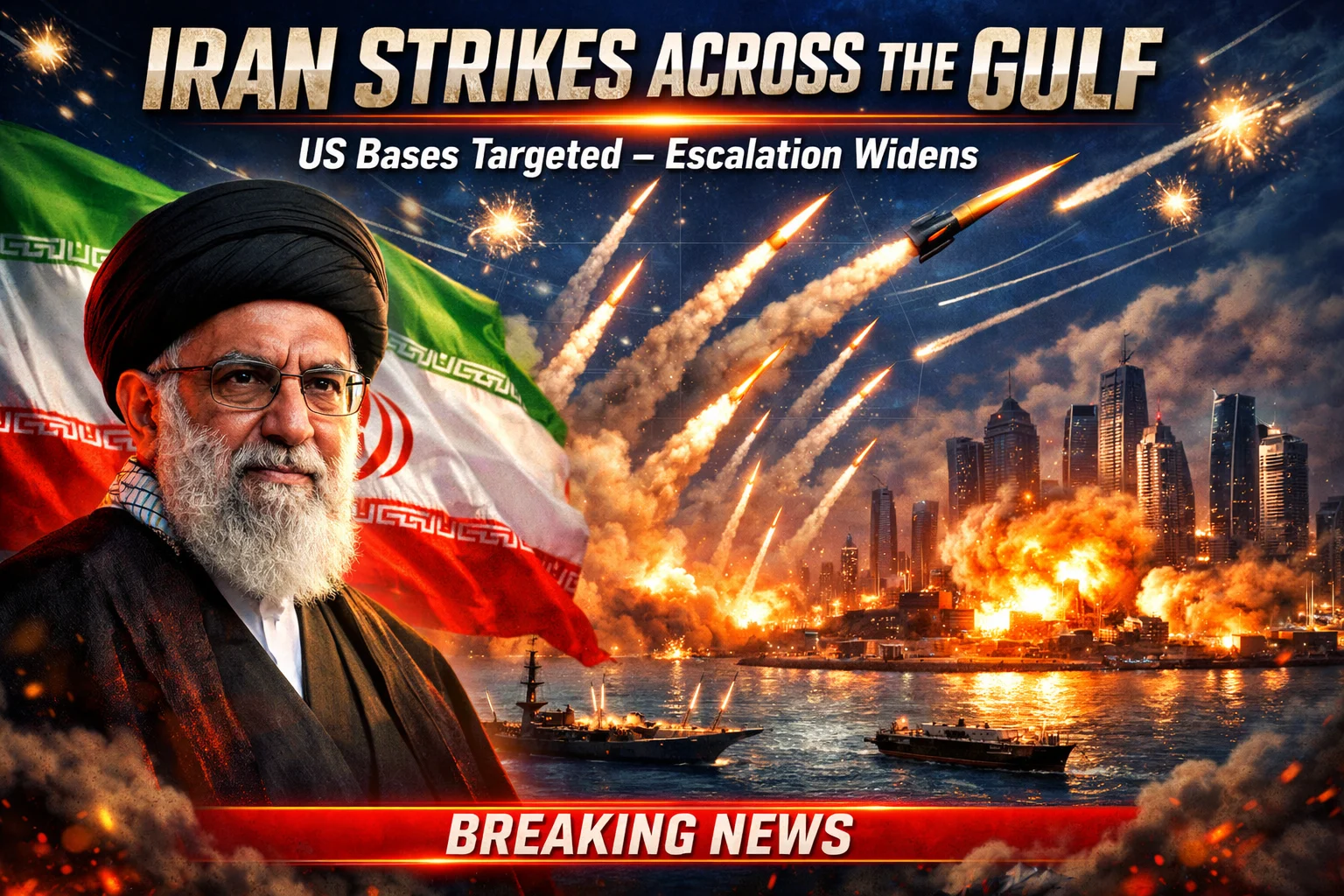
The Iran missile strikes Middle East escalation marks a dramatic expansion of the US–Israel–Iran conflict.
Following Israeli and US strikes on Tehran earlier in the day, Iran launched a wave of missile attacks targeting multiple Gulf locations:
- Doha in Qatar
- US naval facilities in Bahrain
- Areas near Abu Dhabi and Dubai in the UAE
- Riyadh in Saudi Arabia
- Kuwait City
Video footage circulating online shows missiles impacting near strategic sites, with explosions reported near US-linked military facilities.
BREAKING: Iranian missile attacks on U.S. bases in Bahrain. pic.twitter.com/EAAgPiwGPZ
— Clash Report (@clashreport) February 28, 2026
Iran’s message appears clear:
If Tehran burns, the region will feel it.
That is escalation by design.
Sources: Al Jazeera, WION
US Bases Targeted in Qatar and Bahrain
Missiles reportedly struck near a US naval installation in Bahrain, home to the US Fifth Fleet.
Footage of an Iranian ballistic missile slamming into the headquarters of the US Navy's 5th Fleet at Naval Support Activity (NSA) Bahrain earlier today. pic.twitter.com/6omkCrLy2u
— OSINTtechnical (@Osinttechnical) February 28, 2026
In Doha, explosions were reported as projectiles crossed airspace near sensitive infrastructure.
🇮🇱💥🇮🇷| Impactantes imágenes de un misil balístico iraní cayendo en un área residencial en Qatar luego de ser interceptado. pic.twitter.com/m7EnkTMMvS
— The Political Room (@Political_Room) February 28, 2026
Air defense systems in several Gulf states intercepted some missiles — but not all.
That detail matters.
Because Gulf security architecture has long depended on layered missile defense systems.
When even a few projectiles penetrate, the psychological impact is massive.
Air Defense Failures and Shockwaves
Reports suggest that in multiple locations across the UAE and Saudi Arabia, missiles either landed or passed dangerously close to urban centers.
Iran has apparently managed to hit Dubai. pic.twitter.com/ymZC0TmEjt
— Clash Report (@clashreport) February 28, 2026
Dubai — one of the world’s most globalized cities — experienced flight disruptions. Airports in Abu Dhabi issued advisories and suspended inbound and outbound flights.
For residents and expatriates, including large Indian communities, the shock was immediate.
Missile warfare is no longer confined to distant front lines.
It is hitting financial hubs.
And that shifts risk perception overnight.
Sources: Financial Express, Gulf News
Saudi Arabia’s Angry Response
Saudi Arabia issued a strong condemnation of Iran’s actions.
The Saudi statement described the attacks as violations of sovereignty and regional stability, explicitly naming Qatar, Bahrain, the UAE, Kuwait, and Jordan.
#Statement | The Kingdom of Saudi Arabia expresses its condemnation and denunciation of the military targeting of the Islamic Republic of Iran, which is a violation of its sovereignty and a violation of international laws and norms. The Kingdom also affirms its unwavering… pic.twitter.com/3iLuGlmiwM
— Foreign Ministry 🇸🇦 (@KSAmofaEN) October 26, 2024
The subtext was blunt:
Your conflict is with Israel and the US.
Why are Gulf capitals under fire?
Saudi Arabia signaled readiness to support “necessary measures” in defense of regional security.
That opens the possibility of broader alignment against Iran.
If Gulf states move from condemnation to participation, escalation deepens rapidly.
Hypersonic Missile Claims and the Carrier Question
IRGC General Ebrahim Jabbari claimed that the missiles used so far were not their most advanced systems.
#Iran will soon unveil weapons 'You have never seen before' says #IRGC General Ebrahim Jabbari '#Trump should know we are equipped to fight you for Years' pic.twitter.com/OCRTGht9eM
— IDU (@defencealerts) February 28, 2026
They suggested more powerful capabilities remain unused — including hypersonic missiles allegedly acquired or developed with support from Russia and China.
These claims remain unverified.
But the strategic conversation has already shifted to one critical question:
Could Iran strike a US aircraft carrier?
Former CIA officer John Kiriakou warned that if a US carrier were successfully hit, the consequences would be historic.
Ballistic and hypersonic missiles traveling at extreme speeds are difficult to intercept. If even one were to damage or sink a carrier, it would represent an unprecedented military event.
पूर्व अमेरिकी CIA ऑफिसर John Kiriakou कहा रहा-
— Sadaf Afreen صدف (@s_afreen7) February 27, 2026
"अगर ईरान किसी अमेरिकी Aircraft कैरियर को डुबो देता है, तो तीसरा विश्व युद्ध शुरू हो जाएगा"
Iran को दशको से चले आ रहे अमेरिकी दबाव और प्रतिबंधों के खिलाफ अपनी संप्रभुता की रक्षा करने का पूरा अधिकार है!#Iran pic.twitter.com/R7zd5GHVgH
Such an event would likely trigger overwhelming US retaliation.
And potentially pull additional actors into the conflict.
Could This Trigger a Wider War?
The risk matrix is expanding.
- Israel has already struck high-value Iranian targets.
- Iran is striking US-linked infrastructure and Gulf cities.
- Gulf states are condemning Iran.
- The US has carrier groups deployed in the region.
If escalation continues along this ladder, the threshold for miscalculation lowers dramatically.
Some analysts warn that if a US aircraft carrier is sunk or heavily damaged, escalation could reach a global level.
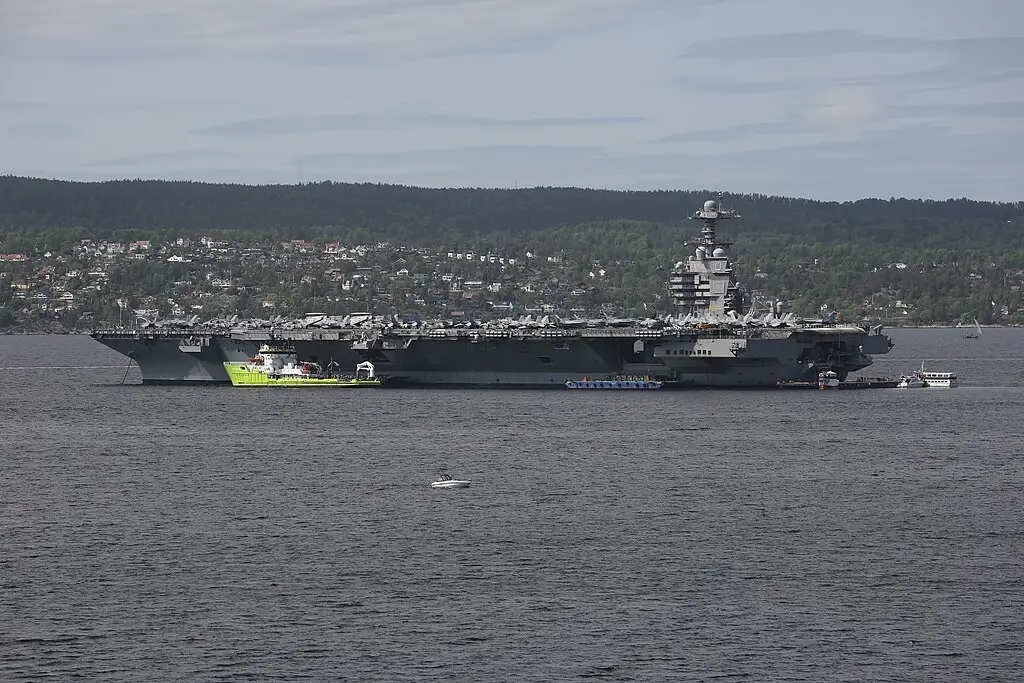
Image Credit: Hans A. Rosbach, CC BY-SA 4.0 via Wikimedia Commons
Image used for Illustrative purpose only.
That is not a prediction.
It is a scenario assessment.
But scenarios like this are now openly discussed in Western strategic circles.
And that alone signals danger.
What This Means for India and the Diaspora
India is not a combatant in this conflict.
But the implications are real:
- Millions of Indian expatriates live in Gulf states.
- Oil supply routes through the Strait of Hormuz are at risk.
- Energy prices could spike.
Compared to the Gulf’s missile exposure, India’s geography and air defense posture provide relative insulation.
No regional actor currently has incentive to target India in this escalation.
But economic ripple effects — particularly energy prices — could be significant.
Investors are already watching markets closely.
Yet beyond stock volatility, the deeper risk is geopolitical instability.
Conclusion: A Dangerous Phase Has Begun
The Iran missile strikes Middle East escalation is no longer symbolic retaliation.
It is a multi-theater demonstration of reach.
Missiles over Doha.
Explosions near Bahrain’s US base.
Flight suspensions in Abu Dhabi.
Saudi condemnation.
The next critical variable is whether Iran expands targeting toward US carrier groups.
If that line is crossed, retaliation dynamics change fundamentally.
For now, the region stands on edge.
The second wave of decisions — not the first wave of missiles — will determine whether this remains a contained conflict or becomes a generational turning point.
FAQs
Did Iran attack US bases in Qatar or Bahrain?
Missiles reportedly struck near US-linked facilities in Bahrain and crossed airspace near Doha. Full damage assessments are still emerging.
Can Iran destroy a US aircraft carrier?
Analysts debate this. Hypersonic and ballistic missiles are difficult to intercept, but carriers operate with layered defense systems.
What are hypersonic missiles?
They are missiles that travel at speeds above Mach 5 and can maneuver during flight, making interception challenging.
Is this the start of a larger war?
It depends on escalation choices, especially whether US naval assets are targeted directly.
How does this affect oil prices?
Missile strikes near Gulf infrastructure and the Strait of Hormuz increase the risk premium in energy markets.
Strategic Watchpoint
Three signals will determine the next phase:
- Confirmation of damage to US naval assets
- Whether Gulf states join military operations
- Escalation to advanced missile deployment
Because once carriers are hit, diplomacy narrows.
And history accelerates.
Share Your Views in the Comments below.
Explore more about Defense & Security and World Affairs.