Table of Contents
Pakistan Protests at US Embassy in Karachi: What Happened
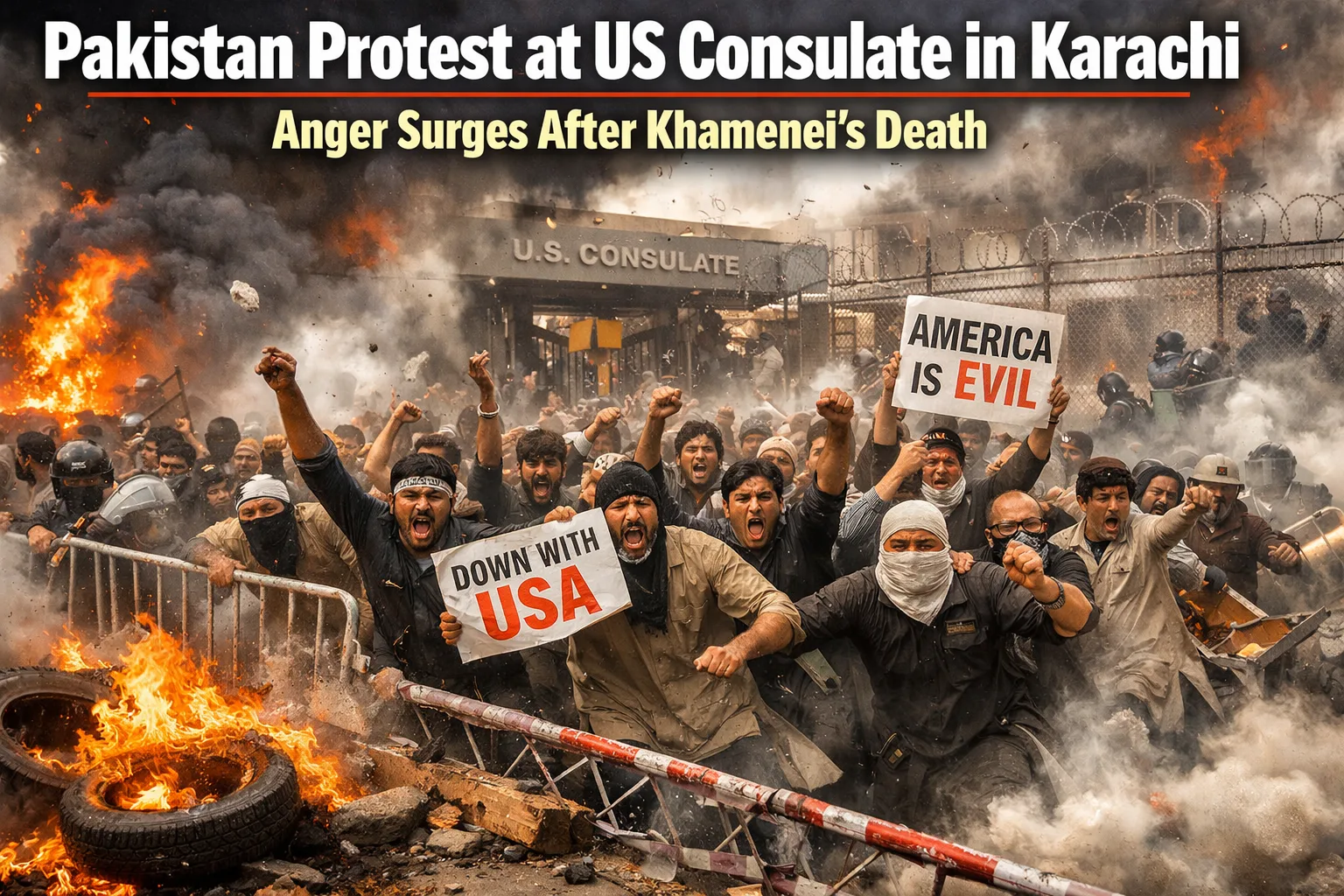
The Pakistan protests at US embassy in Karachi incident marks a dramatic spillover of the escalating US–Iran confrontation into South Asia.
Following reports that Iran’s Supreme Leader Ali Khamenei was killed in a US–Israel missile strike, large crowds gathered outside the US diplomatic compound in Karachi.
🚨 Pakistan losing its mind!!!
— Nabila Jamal (@nabilajamal_) March 1, 2026
Protesters outside the US Consulate in Karachi smashing windows and defacing the compound after US-Israel attacks on Iran that killed Supreme leader Ali #Khamenei
Police fired tear gas & warning shots to disperse crowds as tensions spiralled near… pic.twitter.com/d0Du1M05sJ
Protesters — including members of Pakistan’s Shia community and some Sunnis angered by US actions — stormed the premises. Hezbollah flags were reportedly visible in the crowd. Windows were smashed. Fires were set.
What began as protest turned into direct confrontation.
That escalation changed everything.
In Pakistan, protesters are attacking the U.S. Consulate in Karachi. pic.twitter.com/yqvZXrfP5L
— Clash Report (@clashreport) March 1, 2026
Why Anger Exploded in Pakistan
Pakistan is home to the world’s second-largest Shia population after Iran. Estimates place the Shia share at roughly 10–15% of the country’s population.
For many within that community, Khamenei was not just a political leader but a religious authority figure.
The reported killing triggered immediate emotional backlash.
Some American observers appeared surprised by the scale of anger, especially given recent US diplomatic engagement with Pakistan’s leadership.
Anger is boiling over in Pakistan, as protesters storm and burn the US consulate in Karachi. Pakistan is the home to the world's second largest Shia population in the world. The killing of Khamenei will have repercussions for the US. pic.twitter.com/lg9ch8mxp1
— Glenn Diesen (@Glenn_Diesen) March 1, 2026
But state-level alignment does not automatically translate into public sentiment alignment.
That misunderstanding matters.
Gunfire at the US Consulate and Casualties
As protesters breached outer barriers and allegedly attempted to enter deeper into the compound, gunfire was reported from inside.
According to reports cited by regional media outlets including Al Jazeera, approximately nine to ten Pakistani protesters were killed.
Initial accounts suggest US personnel held fire until compound security was visibly compromised. Once protesters attempted forced entry and arson escalated, defensive fire was reportedly used.
BREAKING 🚨
— Oxomiya Jiyori 🇮🇳 (@SouleFacts) March 1, 2026
The US Marines killed 12 Pakistani protestors outside the US consulate in Karachi…
This killing shows, how valueless the Pakistanis are for US, they can be killed inside their own country by US. pic.twitter.com/DpwYR1IgtL
The incident has now internationalized the crisis further.
Because once casualties occur on foreign soil, diplomatic consequences multiply.
Sources: Al Jazeera, Reuters
The US–Pakistan Policy Contradiction
President Donald Trump has recently expressed support for Pakistan’s right to defend itself in its border conflict with the Taliban.
Simultaneously, Pakistan officially criticized US–Israel strikes on Iran and stated that Iran has a right to retaliate.
This creates an unusual triangle:
- US supports Pakistan against Taliban
- Pakistan criticizes US strikes on Iran
- Pakistani citizens attack US diplomatic property
This policy contradiction raises serious questions.
Can strategic cooperation survive public hostility?
That tension is now visible.
Sources: Financial Express, Times of India, WION
Trump’s Retaliation Warning to Iran
Trump also issued a warning stating that if Iran launches a stronger wave of missile strikes than before, the United States would respond with force “never seen before.”
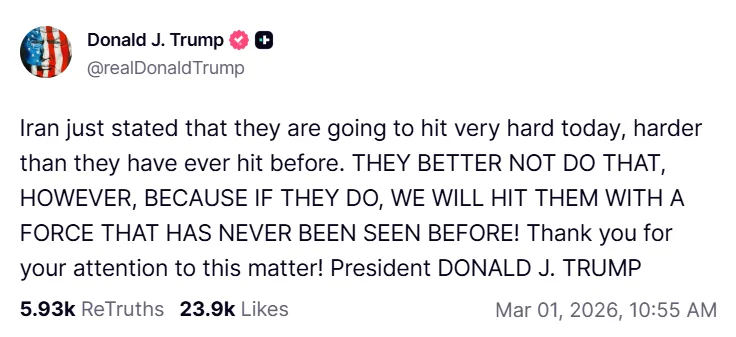
Screenshot of a Truth Social post by Donald Trump
That phrase has sparked speculation.
Is it rhetorical escalation?
Or signaling deployment of advanced capabilities?
Meanwhile, Iran has hinted that future missile waves could be more intense.
The next strike window is being watched closely.
Netanyahu’s Next Phase Strategy
Benjamin Netanyahu has stated that operations against Iran are not over.
He signaled plans to target thousands of additional objectives tied to what Israel calls the “terrorist regime.”
Beyond military strikes, Netanyahu directly addressed Iranian citizens, encouraging them not to “miss the moment” and to rise against their government.
This messaging suggests that regime destabilization remains part of the broader strategic objective.
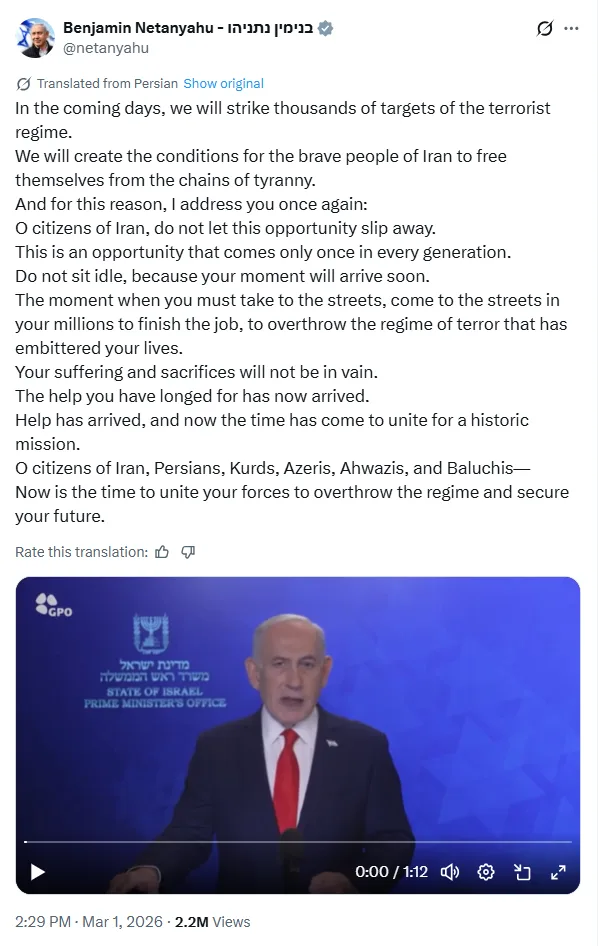
Screenshot of a X post by Benjamin Netanyahu
Is Iran Fragmentation Being Encouraged?
One of the most controversial theories circulating is whether external actors may attempt to encourage fragmentation within Iran.
Messaging directed at Persians, Kurds, Azeris, Arabs, and Baloch communities has fueled speculation that ethnic divisions could be leveraged.
Iran’s security chief Ali Larijani has already warned that “Groups seeking to divide Iran should know that we will not tolerate it”.
Historical precedent exists.
Major powers have, at times, divided regions, creating prolonged instability. Comparisons are often drawn to divided regions such as the Korean Peninsula or historical partition scenarios in South Asia.
Whether such a strategy is feasible inside Iran remains uncertain.
But the conversation has begun.
And that alone signals the seriousness of the moment.
Sources: The Times of Israel
What This Means for South Asia
The Karachi incident highlights how quickly West Asia’s instability can spill into South Asia.
Key implications include:
- Increased risk to US diplomatic missions in Pakistan
- Internal sectarian tensions
- Potential pressure on Pakistan’s military leadership to reinforce security
- Wider regional instability affecting India’s strategic environment
If unrest spreads within Pakistan, it could further complicate South Asian security calculations.
For India, the concern is indirect but real:
- Energy markets
- Diaspora safety
- Regional stability
The Iran crisis is no longer geographically contained.
Conclusion: A Conflict Expanding in Rings
The Pakistan protests at US embassy in Karachi episode shows how escalation radiates outward.
First Tehran.
Then Gulf cities.
Now Karachi.
Each layer adds complexity.
If Iran intensifies retaliation and the US responds with greater force, instability will not remain confined to one region.
And if fragmentation narratives inside Iran gain traction, the geopolitical map of West Asia could face long-term disruption.
This is no longer a two-country confrontation.
It is a widening arc of instability.
FAQs
Why are there protests in Pakistan against the US?
Protests erupted after reports that Iran’s Supreme Leader was killed in a US–Israel strike. Many in Pakistan’s Shia community reacted strongly.
What happened at the Karachi US consulate?
Protesters reportedly damaged property and attempted forced entry. Gunfire from inside the compound led to casualties.
Did Trump warn Iran about retaliation?
Yes, President Trump warned that if Iran escalates further, the US would respond with unprecedented force.
Is Israel planning further strikes on Iran?
Israel’s Prime Minister Benjamin Netanyahu has indicated that operations are ongoing and not yet complete.
Could Iran be divided internally?
Some theories suggest fragmentation strategies could be attempted, but Iran’s security establishment has vowed to resist any such effort.
Strategic Watchpoint
Three developments require close monitoring:
- Whether Pakistan increases military protection around US facilities
- Whether Iran launches a significantly larger missile wave
- Whether fragmentation rhetoric inside Iran gains organized traction
Because when protests cross borders, escalation becomes systemic.
And systemic crises are far harder to contain.
Share your Views in the Comments below.
Explore more about Defense & Security and World Affairs.