Table of Contents
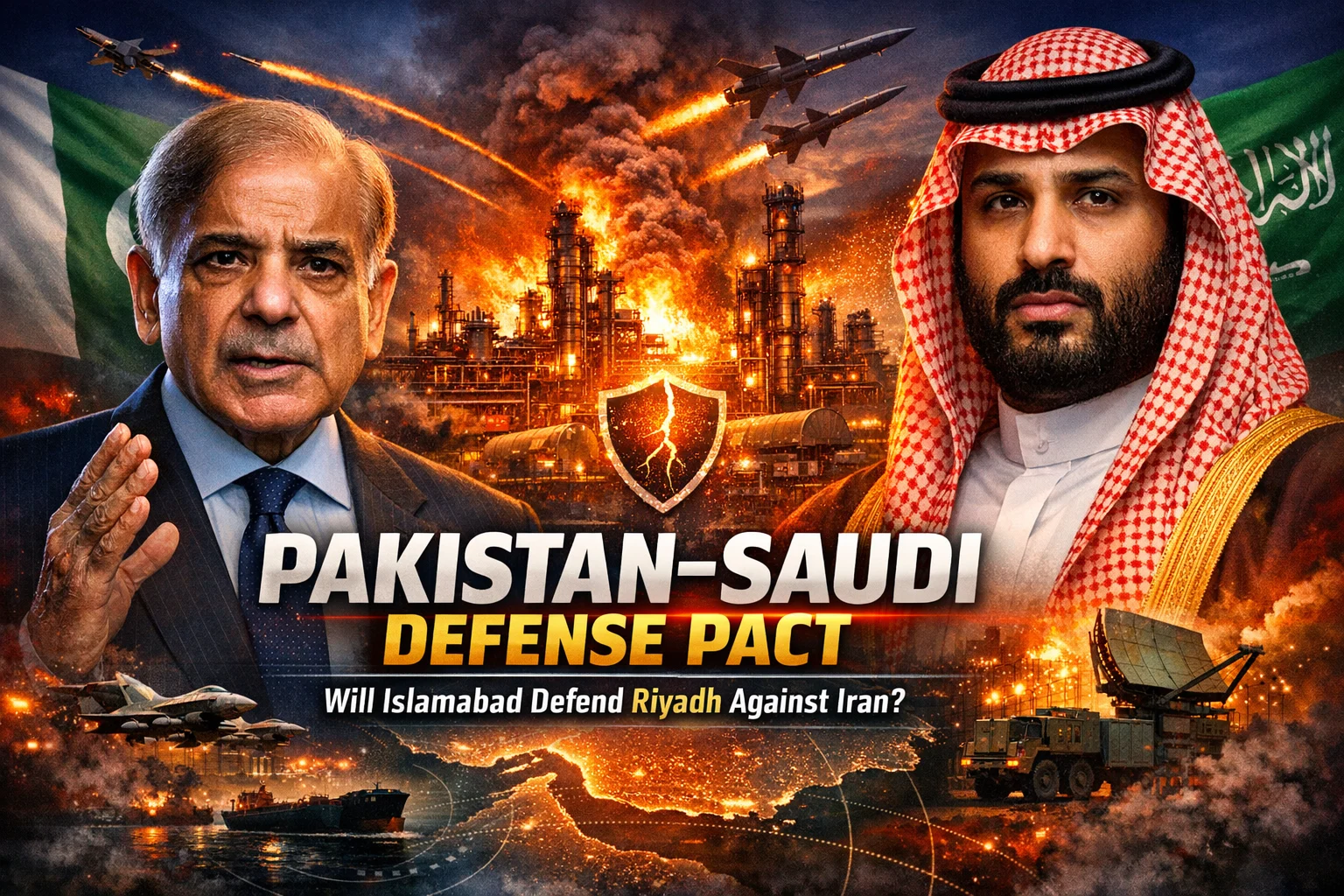
Pakistan Saudi Defense Pact Explained Amid Iran Attacks
The Pakistan Saudi defense pact is suddenly under intense scrutiny as Iran expands strikes across the Gulf region. Reports of attacks on Saudi infrastructure, US-linked facilities, and energy sites have raised a simple but critical question:
If Saudi Arabia faces repeated attacks, where is Pakistan’s military response?
For years, Pakistan has claimed a strategic defense understanding with Riyadh. But as Iranian drone strikes reportedly hit Saudi oil facilities and regional tensions escalate, the gap between alliances on paper and alliances in action is becoming increasingly visible.
This moment matters.
Because it reveals how geopolitical agreements are truly tested only during crises.
Sources:
The Pakistan Saudi Defense Pact Faces a Real-Time Test
The Pakistan Saudi defense pact has long been presented as a strategic military understanding between the two countries.
The logic seemed straightforward:
- Saudi Arabia possesses immense financial resources.
- Pakistan possesses one of the largest militaries in the Muslim world.
- Both countries share security cooperation dating back decades.
But when Iran allegedly targeted Saudi infrastructure, including oil refineries, the situation exposed an uncomfortable reality.
There has been no visible Pakistani military intervention.
That silence matters.
And it has triggered debate across geopolitical circles.
Sources: Gulf Insider
Iran’s Strikes on Saudi Infrastructure Raise New Questions
Reports circulating across media platforms show satellite imagery of damaged Saudi oil infrastructure following Iranian strikes.
New satellite imagery shows damage and smoke at Saudi Arabia’s Ras Tanura oil refinery following yesterday’s Iranian drone attack, NBC reports. pic.twitter.com/GuIOpUKuTs
— Open Source Intel (@Osint613) March 3, 2026
These incidents have increased speculation that the conflict between Iran and its regional adversaries is widening.
At the same time, Gulf states—including Saudi Arabia and the United Arab Emirates—are reportedly considering stronger responses.
Possible options being discussed include:
- Air force retaliation against Iranian targets
- Coordinated Gulf military responses
- Expanded US-led operations in the region
If such escalation occurs, the question surrounding the Pakistan Saudi defense pact becomes unavoidable.
Would Pakistan actually join a military confrontation with Iran?
Or would the agreement remain largely symbolic?
Sources: Times of India
Pakistan’s Warning to Iran: Threat or Diplomacy?
Amid rising tensions, Pakistan’s Deputy Prime Minister Ishaq Dar issued a statement claiming Pakistan had warned Iranian leadership about the defense pact.
According to the statement, Pakistan informed Iran that continued attacks on Saudi Arabia could force Islamabad to respond.
The claim suggested that Pakistan had played a role in preventing further escalation.
Now we know Why's Pakistan ranked above Bharat in 'Happiness Index'. Living in 'Fool's Paradise' helps😂
— BhikuMhatre (@MumbaichaDon) March 3, 2026
Ishaq Dar claims that he reminded Iran of Pakistan’s defence pact with Saudi Arabia. AFTER THAT Iran’s attacks on Saudi Arabia & Oman reduced.
Iran Pakistan se darr gaya😂 pic.twitter.com/dldYs2EOP9
But there is a major problem.
There has been no official confirmation from:
- Saudi Arabia
- Iran
Without verification from the countries directly involved, the statement remains diplomatically ambiguous.
And ambiguity is common in geopolitics.
Sources: The News Pakistan, The Eurasian Times
Why the Defense Pact Looks Mostly Symbolic
Several factors explain why the Pakistan Saudi defense pact appears limited in practice.
First, Pakistan is currently dealing with multiple security pressures along its borders.
These include tensions with:
- Taliban forces near the Afghan border
- Regional instability involving Iran
- Domestic security concerns
Second, Saudi Arabia itself has not publicly invoked the pact.
If Riyadh truly required military assistance, there would likely be:
- Formal diplomatic requests
- Visible military coordination
- Joint operational announcements
None of those signals have appeared.
The absence is telling.
The Wider War: US Pressure and Gulf Escalation
The broader regional conflict complicates the situation further.
The United States has increased pressure on Iran as part of ongoing military operations in the region.
One of the most sensitive developments reported recently involves an alleged drone strike near a CIA-linked compound in Riyadh.
If confirmed, such an attack could significantly escalate the crisis.
🚨🇺🇸🇸🇦🇮🇷 ÚLTIMA HORA: Foi confirmou que um drone iraniano ATINGIU uma estação da CIA na capital da Arábia Saudita, Riad.
— Leo Kasura (@LeoKasura) March 4, 2026
Nenhum americano ficou ferido! pic.twitter.com/u1kKrv4lfy
Because the moment American casualties enter the equation, the strategic calculation changes.
This is where global escalation risks rise sharply.
And Pakistan could face pressure from the United States to align more clearly.
Information Warfare and the Spread of Fake Narratives
Another dimension of this conflict is information warfare.
Social media platforms have seen an explosion of:
- AI-generated war videos
- Fake battlefield footage
- Misleading geopolitical claims
Some investigations have revealed coordinated networks operating dozens of accounts simultaneously to push specific narratives.
According to Nikita Bier, Head of Product X, Pakistani individuals managing multiple accounts have circulated fabricated war footage designed to influence public perception.

Screenshot of a X post by Nikita Bier
This highlights a major challenge of modern conflict.
The battlefield is no longer just physical.
It is digital.
And controlling the narrative has become a strategic weapon.
Sources: The Tribune
What This Means for Regional Power Dynamics
The current crisis reveals deeper structural realities in Middle Eastern geopolitics.
First, alliances are often conditional rather than automatic.
Second, regional powers are cautious about entering direct war with Iran.
Third, external powers—especially the United States—remain decisive in shaping military responses.
Meanwhile, Pakistan faces a complex balancing act.
It must maintain relations with:
- Saudi Arabia
- Iran
- China
- The United States
Navigating these relationships during wartime escalation is extremely difficult.
Which explains the cautious posture Islamabad appears to be taking.
Conclusion
The crisis surrounding the Pakistan Saudi defense pact reveals how geopolitical agreements are truly tested.
Iran’s attacks on Gulf infrastructure, rising US involvement, and regional military pressure have forced the pact into the spotlight.
But so far, the response has been mostly rhetorical rather than operational.
That distinction is critical.
Because in international relations, credibility is measured not by agreements signed—but by actions taken when those agreements are tested.
And in this case, the test is still unfolding.
FAQs
What is the Pakistan Saudi defense pact?
The Pakistan Saudi defense pact refers to security cooperation agreements between Pakistan and Saudi Arabia involving military coordination, training, and potential support during external threats. Under this pact, any attack on Saudi Arabia will be considered as an attack on Pakistan and vice-versa.
Does Pakistan defend Saudi Arabia in war?
Pakistan has historically provided military training and advisory roles in Saudi Arabia. However, whether Pakistan would directly join a war on Saudi Arabia’s behalf remains uncertain.
Why is Iran attacking Gulf countries?
Iran’s strategy often aims to pressure regional rivals and influence broader conflicts involving the United States and Israel.
What is the Strait of Hormuz crisis?
The Strait of Hormuz is a critical global oil shipping route. Military tensions in this area can disrupt energy markets and global trade.
How does Gulf conflict affect India?
India can be indirectly affected through oil price volatility, shipping disruptions near the Strait of Hormuz, and risks to the large Indian diaspora in Gulf countries.
What Does This Defense Pact Really Mean?
The debate around the Pakistan Saudi defense pact ultimately comes down to one question: will it translate into real military action if the crisis escalates further?
As tensions rise across the Gulf—with Iran targeting regional infrastructure and the United States increasing pressure—the coming weeks could reveal whether this agreement is strategic reality or diplomatic symbolism.
Consider these key questions:
- Would Pakistan actually intervene if Saudi Arabia faces sustained attacks?
- Could US pressure push Islamabad toward military involvement against Iran?
- Or will the pact remain a political signal rather than an operational alliance?
Share Your Analysis in the Comments below.
Because in geopolitics, the true strength of alliances is revealed only during moments of crisis.
Explore more about Defense & Security and World Affairs.