Table of Contents
The Remark That Sparked a Firestorm
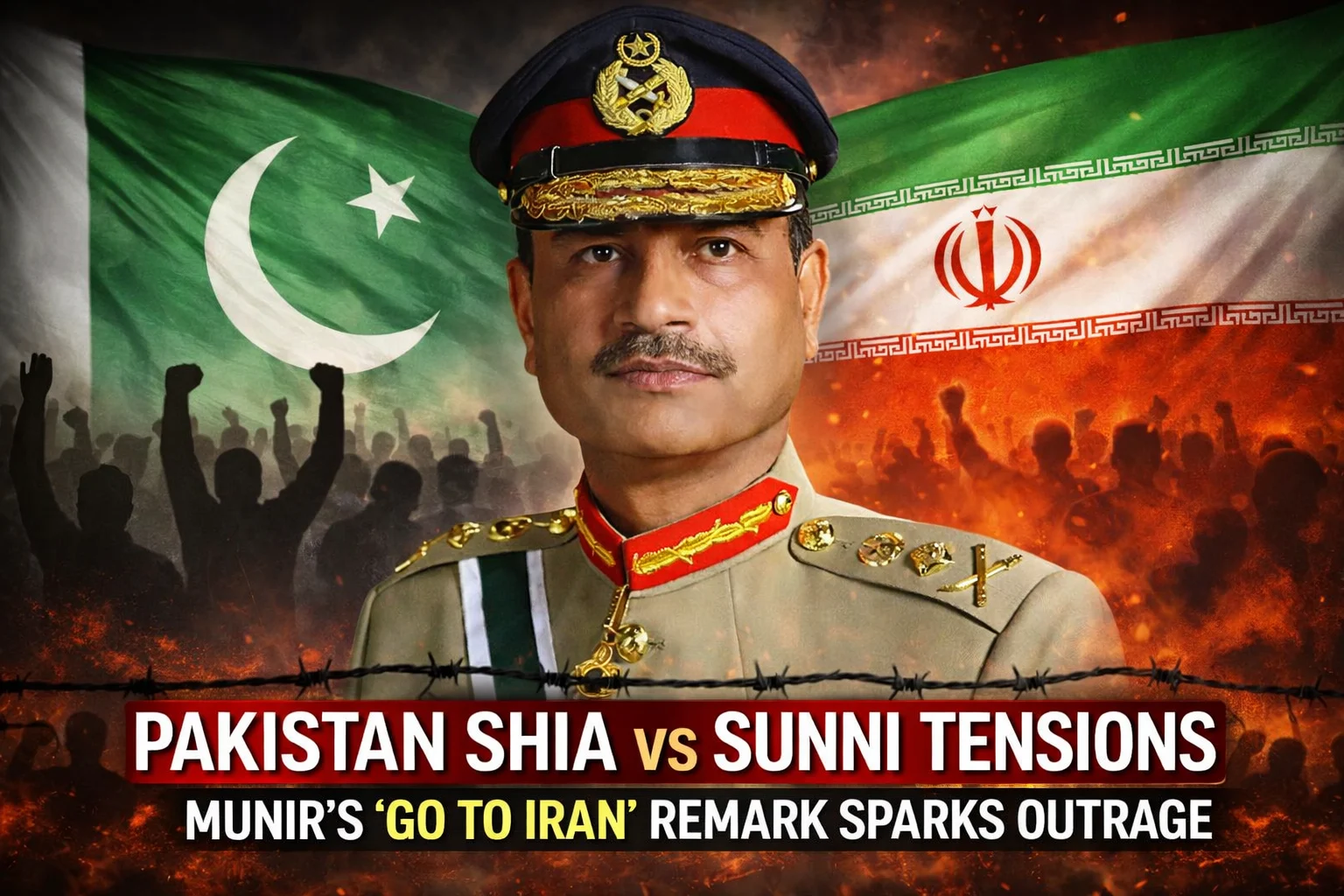
Pakistan Shia Sunni tensions have entered a sharper and more dangerous phase.
A leaked statement attributed to Asim Munir has triggered widespread backlash across Pakistan’s Shia community.
His message was blunt:
If you love Iran so much—go to Iran.
That line alone has reshaped the internal conversation inside Pakistan.
Because this wasn’t just rhetoric.
It was a signal.
Sources: News18, Money Control
What Did Asim Munir Actually Say?
Reports suggest that Asim Munir made the remark during a closed-door interaction in Rawalpindi, where Pakistan’s military leadership engaged with Shia clerics.
पाकिस्तान के शासक फेल्ड मार्शल जनरल असीम मुनीर ने शिया मौलवियों और मुस्लिम धर्म गुरुओं के बैठक में शिया मौलवियों को कह दिया कि जिस भी शिया मौलवी को अपने शिया धर्म या ईरान से मोहब्बत है वह ईरान चला जाए पाकिस्तान में रहकर अगर कोई धरना प्रदर्शन इसराइल या अमेरिका के खिलाफ करेगा तो वह… pic.twitter.com/3STU9x4kWq
— 🇮🇳Jitendra pratap singh🇮🇳 (@jpsin1) March 21, 2026
The core message:
Support Pakistan’s position.
Not Iran’s.
The implication was clear—expressing strong sympathy toward Iran during the ongoing conflict with the United States and Israel is not acceptable from the state’s perspective.
That tone matters.
Because it transforms a foreign policy issue into a domestic identity question.
The Deeper Shia–Sunni Divide in Pakistan
To understand why this triggered anger, you need to look at demographics.
In Pakistan:
- Around 80–85% are Sunni Muslims
- Around 15% are Shia Muslims
In Iran, the situation is reversed.
- 80–85% Shia majority
- Smaller Sunni population
This difference shapes political alignments.
Shia communities in Pakistan often feel a cultural and religious connection with Iran.
But the Pakistani state operates differently.
And that gap is widening.
Why Pakistan Is Taking a Tougher Line on Iran
From Islamabad’s perspective, this is not just about sectarian identity.
It is about strategic pressure.
Pakistan maintains close ties with Saudi Arabia—a key regional rival of Iran.
Recent discussions suggest that Pakistan may even extend a nuclear umbrella to Saudi Arabia under a defense understanding.
Saudi analyst in a recent interview confirms that " Saudi has Pakistan's nuclear umbrella over it under the defence pact signed in 2025"
— THE UNKNOWN MAN (@Theunk5555) March 22, 2026
After warning shia clerics against resistance to any attack in Iran, Asim Munir is planning to launch attacks in Iran. pic.twitter.com/nhBr9bE5l6
That changes the equation.
Because it places Pakistan firmly within a bloc that is aligned—directly or indirectly—against Iran.
At the same time, ties with the United States remain critical.
So the pressure is real.
And it is shaping internal messaging.
Sources: Al Jazeera
Internal Crisis: Why This Moment Is Dangerous
This is where things escalate.
Pakistan is not just dealing with external pressure.
It is dealing with internal fractures.
Already:
- A significant portion of the population supports Imran Khan
- There is dissatisfaction with military leadership
- Political tensions remain unresolved
Now, add a religious divide.
That combination is volatile.
This was avoidable.
But once a state frames loyalty in religious terms, the consequences tend to last longer than expected.
Gilgit-Baltistan: The Strategic Flashpoint
The situation becomes even more complex in Pakistan Illegally Occupied part of Ladakh (known as Gilgit-Baltistan in Pakistan).
This region has:
- A significant Shia population (around 45%)
- Strategic importance for both Pakistan and India
Recent protests in the region have directly challenged Pakistan’s military stance on Iran.
Local voices have questioned why Pakistan appears aligned against Iran despite shared religious connections.
This matters.
Because instability here is not just internal.
It has regional implications.
What This Means for India
From an Indian perspective, these developments are closely watched.
India has long maintained that regions like:
- Pakistan Illegally Occupied part of Ladakh (known as Gilgit-Baltistan in Pakistan)
- Parts of Jammu & Kashmir
- Ladakh
…are integral to its territory.
If internal divisions in Pakistan deepen—especially in sensitive regions—this could create strategic openings.
But timing matters.
And so does stability.
Because instability in one region often spills across borders.
The Bigger Geopolitical Picture
This issue is not isolated.
It connects multiple layers:
- Iran–US conflict
- Saudi–Iran rivalry
- Pakistan’s strategic balancing
- Internal sectarian dynamics
And here’s the key shift:
Pakistan is no longer just balancing external alliances.
It is managing internal alignment.
That is harder.
Much harder.
Conclusion
The rise in Pakistan Shia Sunni tensions is not just about one controversial remark.
It reflects a deeper shift in how the state is positioning itself—both externally and internally.
A single sentence from Asim Munir has:
- Exposed internal fault lines
- Triggered community backlash
- Raised questions about national cohesion
And this is only the beginning.
Because once identity and geopolitics start merging, the consequences rarely stay contained.
They expand.
Slowly at first.
Then all at once.
FAQs
Why are Pakistan Shia Sunni Tensions increasing?
Pakistan Shia Sunni Tensions are rising due to political statements, regional geopolitics, and perceived alignment against Iran, which many Shia communities feel connected to.
What did Asim Munir say about Iran?
He reportedly told Shia clerics that if they feel strong loyalty toward Iran, they should go there instead—triggering backlash and rise in Pakistan Shia Sunni tensions.
Why is Pakistan supporting Saudi Arabia?
Pakistan has strategic and defense ties with Saudi Arabia, including discussions around security cooperation, which influence its regional stance.
How does this affect India?
Internal instability in Pakistan, especially in regions like Gilgit-Baltistan, could have long-term strategic implications for India.
What Does This Mean for Pakistan’s Stability?
If internal divisions continue to widen, will Pakistan be able to maintain cohesion while managing external pressures?
- Can Pakistan Shia Sunni Tensions be contained?
- Will geopolitical alignments deepen internal divides?
- And how will this shape South Asia’s future?
Share Your Perspective in the Comments below.
Because sometimes, the most critical battles are not fought across borders—but within them.
Explore more about Defense & Security, World Affairs and Indian Affairs.