Table of Contents
Strait of Hormuz Oil Crisis: Why This Is Now India’s Problem
The Strait of Hormuz oil crisis is no longer just a Middle East issue.
After the reported killing of Iran’s Supreme Leader Ali Khamenei, Iran has escalated by targeting ships and threatening to choke maritime traffic through the Strait of Hormuz.
#BREAKING: Iran has attacked the oil tanker Skylight flying the flag of Palau, just as it was passing through the Strait of Hormuz near the coast of Oman. 4 sailors were injured in the attack. The entire crew has now been evacuated. pic.twitter.com/bDTfnLCDMg
— Aditya Raj Kaul (@AdityaRajKaul) March 1, 2026
This changes the equation.
India’s security interests are now directly exposed.
Prime Minister Narendra Modi has reportedly convened a Cabinet Committee on Security meeting, reflecting the seriousness of the situation.
Because if Hormuz closes, oil flows stall.
And if oil stalls, inflation rises.
Sources: NDTV, The Sunday Guardian
What Happened: Tanker Strike and Shipping Disruption
Iran reportedly struck an oil tanker transiting the Strait of Hormuz. The vessel carried 20 crew members, including 15 Indians. Four individuals were reported injured.
Additionally, Iran blocked multiple vessels from entering the strait, including Pakistani ships.
This is not symbolic escalation.
It is economic warfare signaling.
By targeting shipping, Iran sends a message to the United States and its allies: escalation will carry global costs.
Sources: The New Indian Express, The Tribune
Why the Strait of Hormuz Is So Critical
The Strait of Hormuz is one of the world’s most important maritime choke points.
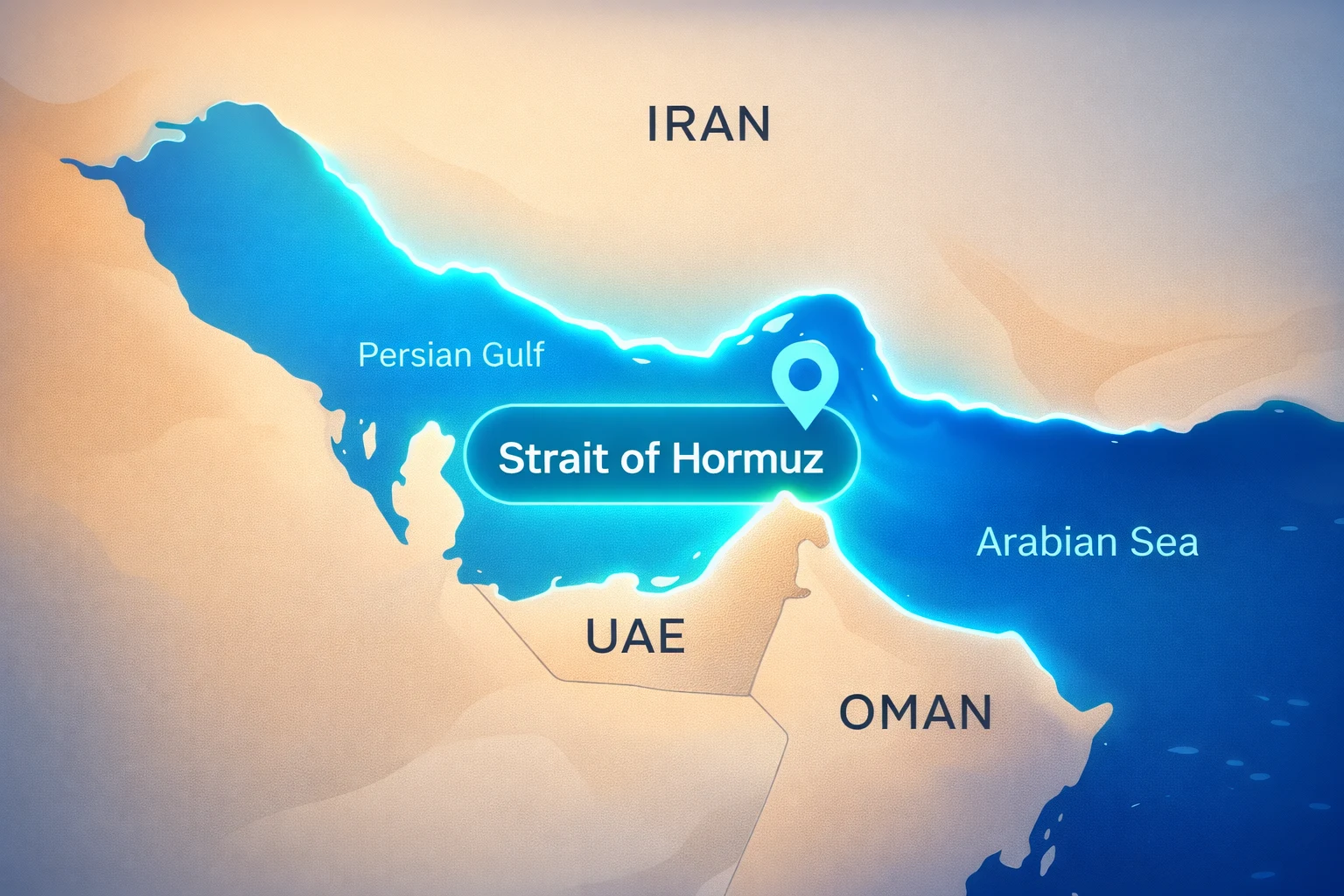
Image credit: AI-generated using ChatGPT by OpenAI
Around 20% of global oil supply passes through this narrow waterway connecting the Persian Gulf to the Arabian Sea.
Energy exports from:
- Kuwait
- Saudi Arabia
- Iraq
- UAE
- Qatar
all transit through Hormuz before reaching major buyers like India, China, and Japan.
Because the channel is narrow, Iran can disrupt it by:
- Deploying naval vessels
- Launching missiles
- Creating perception of unsafe passage
Even limited disruption can spike global oil prices.
And fear alone can freeze shipping.
Oil Prices, Markets, and the $110 Scenario
Financial institutions, including global market observers cited in international reporting, have warned that prolonged disruption could push oil prices toward $110 per barrel.
If the Strait remains unstable:
- Brent crude surges
- Shipping insurance premiums rise
- Emerging markets face currency pressure
- Stock markets react negatively
India imports a significant share of its crude from Gulf suppliers via Hormuz.
An oil spike would feed directly into:
- Fuel prices
- LPG costs
- Inflation
- Fiscal pressure
The shock would not remain external.
It would enter household budgets.
Sources: The Guardian, The Economist, NDTV
The $1.1 Billion Radar Strike in Qatar
Iran reportedly neutralized a major US early-warning radar installation at Al Udeid in Qatar.
Reports suggest the radar system, valued at over $1 billion, had long-range missile detection capability up to 5,000 km.
Notably, it was reportedly destroyed using a low-cost kamikaze drone.
US Radar site is hit by Iran in Bahrain pic.twitter.com/ra8ryXUwQc
— Bharat Rises (@BharatRises) February 28, 2026
That asymmetry matters.
It signals that Iran can impose high-cost damage at relatively low expense.
Such capability shifts escalation psychology.
Sources: Defense Security Asia, Defense Mirror
India’s Energy Security Calculation
India’s refineries reportedly hold around 10–15 days of crude stock.
In the immediate term, supply disruption has not yet materialized.
But contingency planning must happen early.
Key questions include:
- Will Iranian actions expand further?
- Will the US escalate operations?
- Will Saudi Arabia directly enter the conflict?
If Saudi Arabia joins militarily, escalation deepens.
And if escalation deepens, Hormuz becomes harder to stabilize.
Sources: Economic Times
The Russia Option — Strategic Pivot or Diplomatic Risk?
If the Strait remains unstable, India may increase purchases from Russia.
But Russian oil shipments take significantly longer — roughly 20–30 days transit time compared to about 5 days from Gulf suppliers.
That creates a timing challenge.
There is also a diplomatic variable.
If India pivots heavily toward Russian crude during escalation, would Washington respond with tariff or sanctions pressure?
This is the balancing act.
Energy security versus diplomatic alignment.
Evacuations and Indian Citizens in the Gulf
Indian students in Iran and Indian workers across Gulf cities are expressing concern amid ongoing missile exchanges.
Evacuation planning may become necessary if:
- Gulf cities face sustained strikes
- Commercial aviation remains disrupted
- Maritime routes grow unsafe
India has conducted complex evacuations before.
But scale matters.
And timing matters even more.
Sources: Free Press Journal
Conclusion: A Choke Point That Shapes the Global Economy
The Strait of Hormuz oil crisis is not a theoretical risk.
It is unfolding in real time.
Iran’s strategy appears aimed at imposing economic cost on the US and its allies. But the ripple effects extend far beyond Washington.
They reach:
- Mumbai’s fuel pumps
- Delhi’s inflation data
- Global stock exchanges
If the Strait remains open, markets may stabilize.
If it closes — even partially — the shock could be severe.
India must now prepare for volatility while hoping diplomacy prevails.
Because in energy geopolitics, geography is destiny.
And Hormuz sits at the center of it.
FAQs
Why is the Strait of Hormuz so important?
It carries roughly 20% of global oil supply. Disruption affects global energy markets immediately.
What happens if Iran blocks Hormuz?
Oil prices could surge sharply. Shipping halts would disrupt supply chains and raise inflation globally.
How dependent is India on Gulf oil?
A significant portion of India’s crude imports comes from Gulf producers whose exports pass through Hormuz.
Will oil prices cross $100 again?
If disruption persists, price spikes toward $100–$110 are possible according to market projections.
Can India switch back to Russian oil?
Yes, but shipping timelines are longer and diplomatic consequences must be considered.
How long can India’s oil reserves last?
Current refinery stocks are estimated at roughly 10–15 days, requiring timely policy decisions if disruption continues.
What Should India Do Next?
The Strait of Hormuz oil crisis is unfolding fast — and the decisions taken in the next few days could shape India’s economic stability for months.
Should India immediately diversify oil sourcing toward Russia?
Should it push harder for diplomatic de-escalation?
Or should it prioritize rapid evacuation planning for Indian citizens in the Gulf?
Energy security, inflation control, and strategic balance are now tightly linked.
Share your Views about Strait of Hormuz oil crisis in the Comments below.
Because in moments like this, informed public debate matters just as much as government policy.
Explore more about Defense & Security, World Affairs and Indian Affairs.