Table of Contents
Trump India Pakistan Nuclear War Claim: What Did He Actually Say?
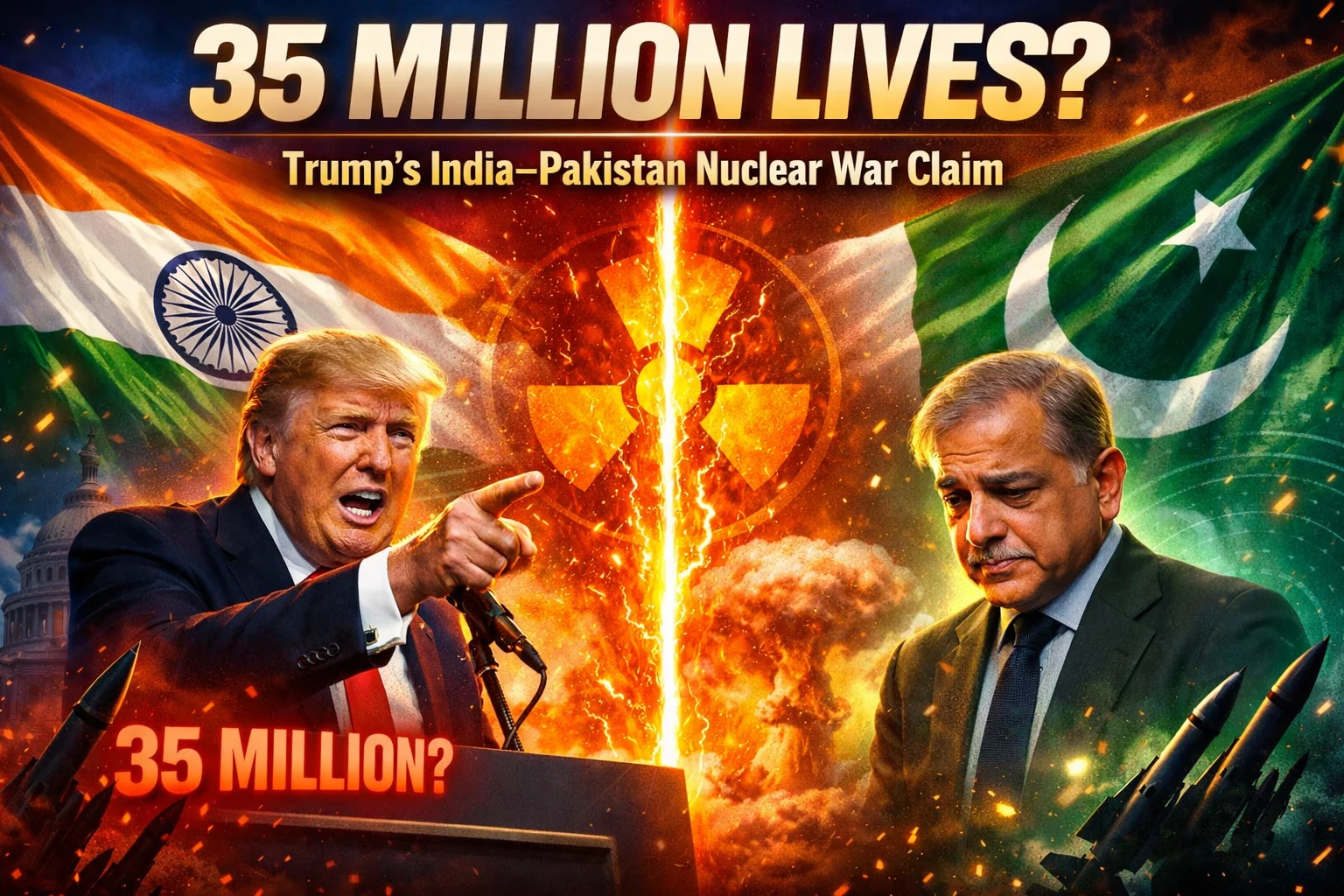
The Trump India Pakistan nuclear war claim emerged during a major address resembling a State of the Union setting, where Donald Trump asserted that he prevented a nuclear war between India and Pakistan.
In the speech, he repeated that “35 million people” could have died if the conflict had escalated.
At one point, his phrasing appeared to suggest that Pakistan’s Prime Minister “would have died” if he had not intervened.
#WATCH | Addressing the 2026 State of the Union, United States President Donald Trump says, "… In my first 10 months, I ended eight wars… Pakistan and India would have had a nuclear war. 35 million people said the Prime Minister of Pakistan would have died if it were not for… pic.twitter.com/GnrgJKtjID
— ANI (@ANI) February 25, 2026
Whether this was a slip in wording or deliberate rhetorical escalation is now being debated.
But the headline moment was clear: Trump positioned himself as the decisive force preventing nuclear catastrophe in South Asia.
That is a very large claim.
The “35 Million” Nuclear War Narrative
Trump has previously stated that an India–Pakistan conflict could have turned nuclear and killed tens of millions.
The figure of 35 million deaths has been repeated multiple times in his speeches.
The implication is that Washington’s intervention stopped a catastrophic escalation.
However, there has been no publicly acknowledged nuclear mobilization between India and Pakistan at the scale implied in the speech.
This makes the claim politically powerful — but strategically controversial.
Nuclear rhetoric carries weight.
And when numbers are introduced, scrutiny follows.
Sources: Hindustan Times
Did Trump Say Shehbaz Sharif Would Have Died?
Shehbaz Sharif was mentioned in the speech.
Trump’s phrasing suggested that the Pakistani Prime Minister would not be alive if the conflict had continued.
Some observers believe he meant that Sharif told him millions could die. Others interpret it as Trump implying direct personal danger to Sharif.
The distinction matters.
Because one is a paraphrased diplomatic warning.
The other is a dramatic personal rescue narrative.
Ambiguity in political speech often creates viral headlines.
This appears to be one such moment.
Why No Public Pushback From Pakistan?
One reason this narrative continues is the absence of strong public contradiction from Islamabad.
When a global leader claims to have “saved” another head of government, silence becomes part of the story.
Critics argue that Trump feels comfortable making such statements because there is little expectation of open rebuttal from Pakistan.
Diplomatically, challenging a US President publicly carries consequences.
Strategically, silence avoids escalation.
But politically, it leaves the claim uncontested.
The “Stand Up” Moment at the Peace Meeting
During a recent “Board of Peace” meeting initiative, Trump reportedly asked Shehbaz Sharif to stand up while referencing him.
Observers noted visible differences in body language between various world leaders present.
Some described the moment as awkward. Others called it symbolic of diplomatic imbalance.
It became part of a broader narrative: Trump positioning himself as arbiter of global peace settlements.
India, notably, has not formally joined such initiatives and remains only an observer in certain peace forums.
That distinction matters.
Trump to Pak PM- Stand up
— Frontalforce 🇮🇳 (@FrontalForce) February 20, 2026
Shahbaz Sharif immediately stands up 🤣🤣pic.twitter.com/YwMljX6gsF
Sources: Times of India, The Indian Express
Trump’s Falling Approval Ratings
Domestic context is crucial to understanding the Trump India Pakistan nuclear war claim.
Recent polls suggest Trump’s approval rating has dipped below 40%, with some surveys placing it closer to the mid-30s.
Trump himself has acknowledged that support may now be “silent.”
JUST IN:
— Megatron (@Megatron_ron) February 23, 2026
🇺🇸 Trump complains about low support:
“It just amazes me that there is not more support out there. We actually have a silent support.” pic.twitter.com/lyb6RnGuJ6
Economic issues dominate domestic criticism:
- Inflation concerns
- Job market anxieties
- Trade policy controversies
- Visa restrictions, including H-1B concerns
When domestic approval falls, foreign policy achievements become political capital.
Claiming to have stopped a nuclear war is powerful messaging.
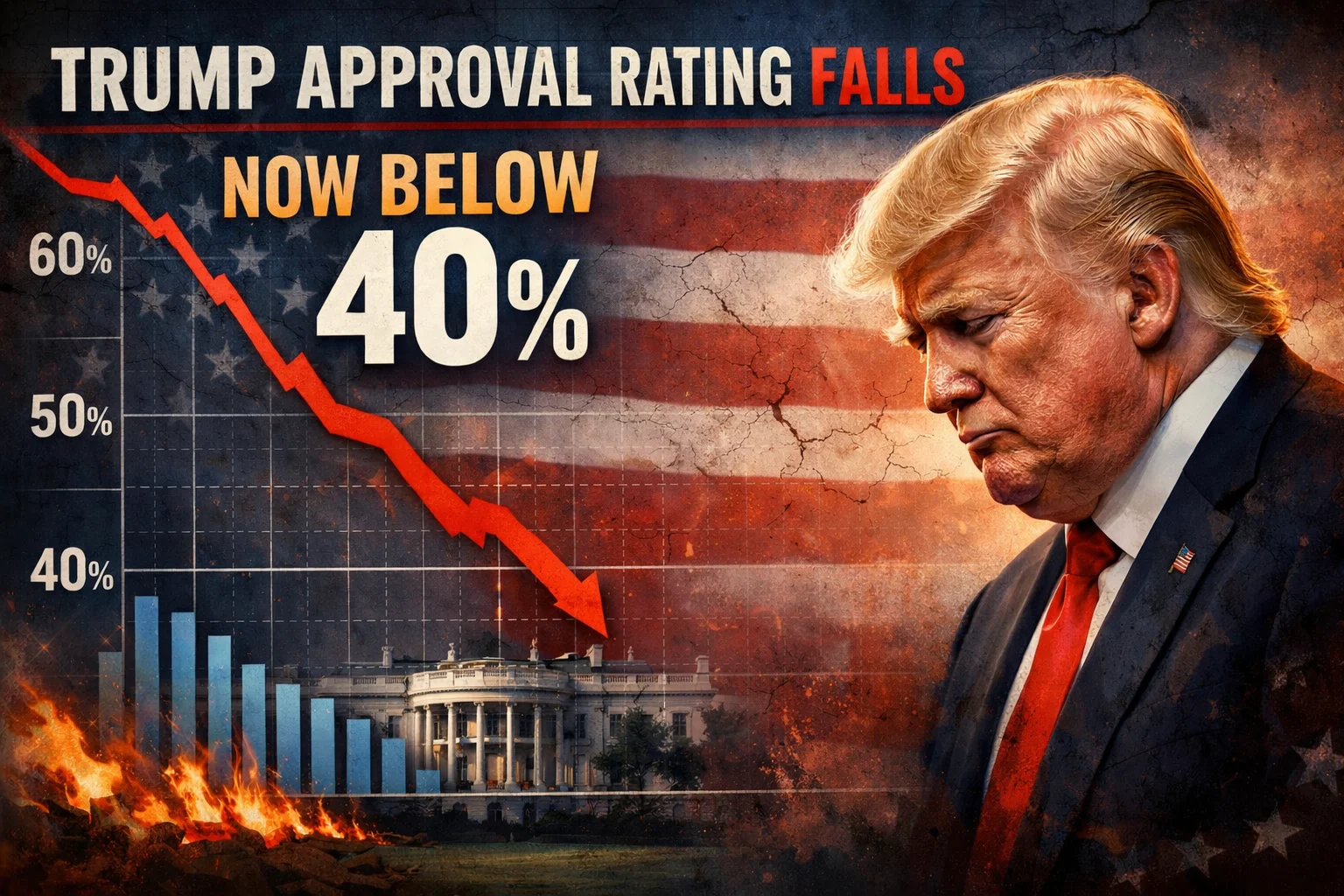
Image credit: AI-generated using ChatGPT by OpenAI
Sources: CNN, NBC News, CNN, NDTV
Russia–Ukraine and the Foreign Policy Contrast
Trump has repeatedly stated that the Russia–Ukraine war would not have begun under his leadership.
PRESIDENT TRUMP: We’re working very hard to end a ninth war: the killing and slaughter between Russia and Ukraine. This is a war that never would have happened if I were president. pic.twitter.com/CM1liFteqX
— Department of State (@StateDept) February 25, 2026
However, the conflict continues.
In that context, highlighting a supposedly prevented India–Pakistan war provides a counterbalance narrative:
“If I cannot stop an ongoing war, I can at least prove I stopped another.”
It is a strategic communication pivot.
Foreign policy credibility often rests on demonstrable outcomes.
And in political messaging, perception can matter as much as reality.
Why India Is Mentioned Repeatedly
India enters the speech primarily as a strategic reference point.
By invoking India–Pakistan nuclear escalation, Trump situates himself as a global mediator capable of influencing two nuclear-armed rivals.
However, India has not publicly confirmed external mediation in bilateral matters.
Historically, India maintains that disputes with Pakistan are bilateral.
That doctrinal position shapes the interpretation of such claims.
Strategic Reading of the Speech
This episode must be viewed through three lenses:
- Domestic Politics — Approval ratings, midterm elections, economic performance.
- Foreign Policy Positioning — Russia–Ukraine comparison, Iran decisions ahead.
- Diplomatic Leverage — Demonstrating influence over South Asia.
Trump’s statement may be exaggerated.
It may be rhetorical.
It may be partially paraphrased.
But it serves a clear function: projecting strength and decisive leadership at a time of domestic vulnerability.
Conclusion: Narrative vs. Reality
The Trump India Pakistan nuclear war claim is less about historical verification and more about political positioning.
By invoking:
- 35 million potential deaths
- Personal risk to Shehbaz Sharif
- Nuclear escalation scenarios
Trump reinforces an image of himself as crisis preventer.
Yet key questions remain:
- Was there imminent nuclear mobilization?
- Was external mediation formally acknowledged?
- Or was this rhetorical amplification?
Ultimately, domestic US politics may determine how long this narrative sustains.
Because foreign policy claims endure only as long as political capital supports them.
FAQs
Did Trump stop a war between India and Pakistan?
Trump claims he prevented escalation. There has been no official confirmation from India of external mediation.
What did Trump say about Shehbaz Sharif?
He suggested that Pakistan’s Prime Minister would not have survived had the conflict escalated, though wording interpretation varies.
Was there a nuclear threat?
India and Pakistan are nuclear-armed states, but there is no public confirmation of imminent nuclear launch preparations.
What is Trump’s current approval rating?
Recent polls place his approval rating below 40%, though figures vary by survey.
Did Trump exaggerate foreign policy achievements?
Critics argue that some claims are amplified for political effect, especially ahead of elections.
How does US politics affect India–Pakistan relations?
US domestic politics can shape diplomatic messaging, but bilateral India–Pakistan dynamics remain primarily regional.
Share Your Perspective
Do you believe Trump genuinely prevented a nuclear crisis?
Or is this primarily political messaging ahead of US elections?
Should Pakistan publicly clarify the record?
And how should India respond to repeated mediation claims?
Share your Views in the Comments below.
Explore more about World Affairs, Indian Affairs and Strategic Depth.