Table of Contents
A War That Isn’t Going as Planned
The narrative around US losing Iran war is gaining traction—and not just among analysts, but increasingly in global public discourse.
What was expected to be a swift demonstration of American military dominance has instead turned into a prolonged and uncertain conflict with Iran.
Here’s what that means.
This is no longer just about battlefield outcomes.
It’s about perception.
And perception is shifting.
Sources: Times of India
Iran Publicly Challenges Trump’s Claims
One of the most striking developments is how openly Iran is challenging Donald Trump.
Trump has repeatedly suggested that:
- Productive peace talks are underway
- A ceasefire could be near
But Tehran has directly rejected these claims.
Officials from Tehran have stated that no direct negotiations are taking place.
That contradiction matters.
Because when one side claims diplomacy and the other denies it entirely, credibility begins to erode.
The Strait of Hormuz Confusion
Then came a particularly unusual statement.
Trump suggested that the Strait of Hormuz could be controlled jointly—possibly by me and whoever the Ayatollah is.
"If this (negotiations) works, Strait of Hormuz will be jointly controlled by me and whoever the Ayatollah is."
— News Arena India (@NewsArenaIndia) March 23, 2026
– US President Donald Trump pic.twitter.com/V1R09DIyr8
This raised immediate questions.
Was this a shift in strategy?
Or a sign of uncertainty?
Earlier, the message had been clear:
The US and its allies would secure and control the Strait.
Now, the language had changed.
This inconsistency did not go unnoticed.
Psychological Warfare: Iran’s Direct Mockery
This is where the situation becomes unprecedented.
Iran has not just responded diplomatically.
It has mocked.
Publicly.
Iranian messaging has portrayed Trump as a symbolic “driver” with no real control—suggesting that even if the US appears involved, actual power in the region remains with Iran.
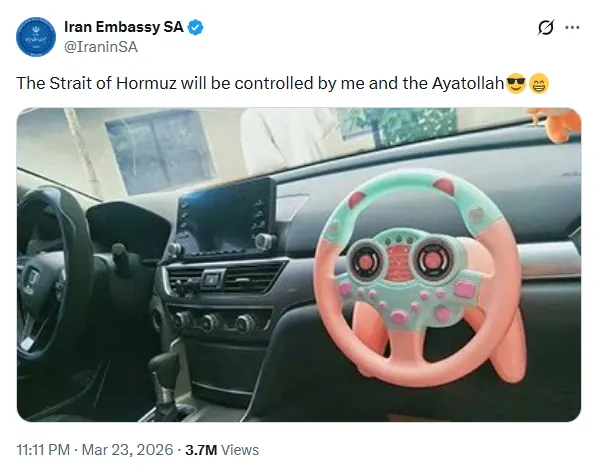
Screenshot of X Post by Embassy of I.R.Iran in South Africa
More strikingly, Iranian military messaging directly referenced Trump’s famous phrase from The Apprentice:
- “You’re fired.”
JUST IN: 🇮🇷🇺🇸 IRGC Spokesman mocks US President Trump in English
— BRICS News (@BRICSinfo) March 22, 2026
"Hey Trump, you're fired. You are familiar with this sentence. Thank you for your attention to this matter." pic.twitter.com/MaVENoHmdw
This was deliberate.
Because it targets not just policy—but personality.
Such direct mockery of a US president by a state military apparatus is rare.
And it signals confidence.
Why the US Is Struggling to Achieve Its Goals
Despite overwhelming military strength, the United States has not achieved its core objectives:
- No regime change in Iran
- No decisive military victory
- No confirmed strategic breakthrough
This is the key distinction:
Military power ≠ strategic success
Even with superior capabilities, outcomes depend on:
- Geography
- Local resistance
- Political constraints
And right now, those factors are limiting US effectiveness.
The Strait of Hormuz Power Game
The real leverage lies in the Strait of Hormuz.
Iran has demonstrated that it can:
- Disrupt shipping routes
- Influence global oil prices
- Selectively allow or restrict movement
Reports suggest that while some ships face restrictions, others—such as those linked to China—may pass with fewer obstacles.
That creates economic pressure.
And pressure creates leverage.
This is strategic.
Sources: Reuters
Global Reactions: A Shift in Confidence
Here’s where the impact widens.
As the perception of US losing Iran war grows, other countries are watching closely.
Leaders like Kim Jong Un have already reinforced their stance—declaring their nuclear status as irreversible.
That matters.
Because global deterrence is built on credibility.
If that credibility weakens, others act more boldly.
This is a structural shift.
Trump’s Limited Options Now
At this stage, the US faces difficult choices:
Option 1: Escalation
Deploy ground forces into Iran
→ High casualties
→ Domestic backlash
Option 2: Withdrawal
Scale back operations
→ Perception of failure
Option 3: Prolonged Conflict
Continue without clear resolution
→ Economic strain
→ Strategic fatigue
None of these options are easy.
And that is the real challenge.
Final Analysis
The discussion around US losing Iran war is not just about who is stronger.
It is about who is achieving their objectives.
Right now:
- Iran is holding its ground
- The US is adjusting its messaging
- Global perception is shifting
And that shift matters more than any single battle.
Because in modern geopolitics, power is not only measured by weapons.
It is measured by outcomes.
And increasingly—by perception.
FAQs
Is US losing Iran war?
The situation is complex. While the US remains militarily stronger, it has not achieved key strategic goals, which is why this narrative is emerging.
Why is Iran mocking Trump?
Iran is using psychological and narrative warfare to challenge US credibility and influence global perception.
What is happening in the Strait of Hormuz?
Iran is exerting strategic control over the Strait, affecting global oil routes and increasing pressure on Western economies.
What could happen next in the conflict?
Possible outcomes include escalation, prolonged conflict, or partial withdrawal—each with significant global consequences.
What Does This Shift Mean for Global Power?
If perception of US losing Iran war continues, does it signal a deeper shift in global power balance?
- Will other nations challenge US dominance more openly?
- Can the US recover strategic credibility?
- Or is this the beginning of a long-term realignment?
Share Your Perspective in the Comments below.
Because in geopolitics, losing control of the narrative can be as significant as losing control of the battlefield.
Explore more about Strategic Depth and World Affairs