Table of Contents
US Sanctions on RSS and RAW: Why This Debate Matters
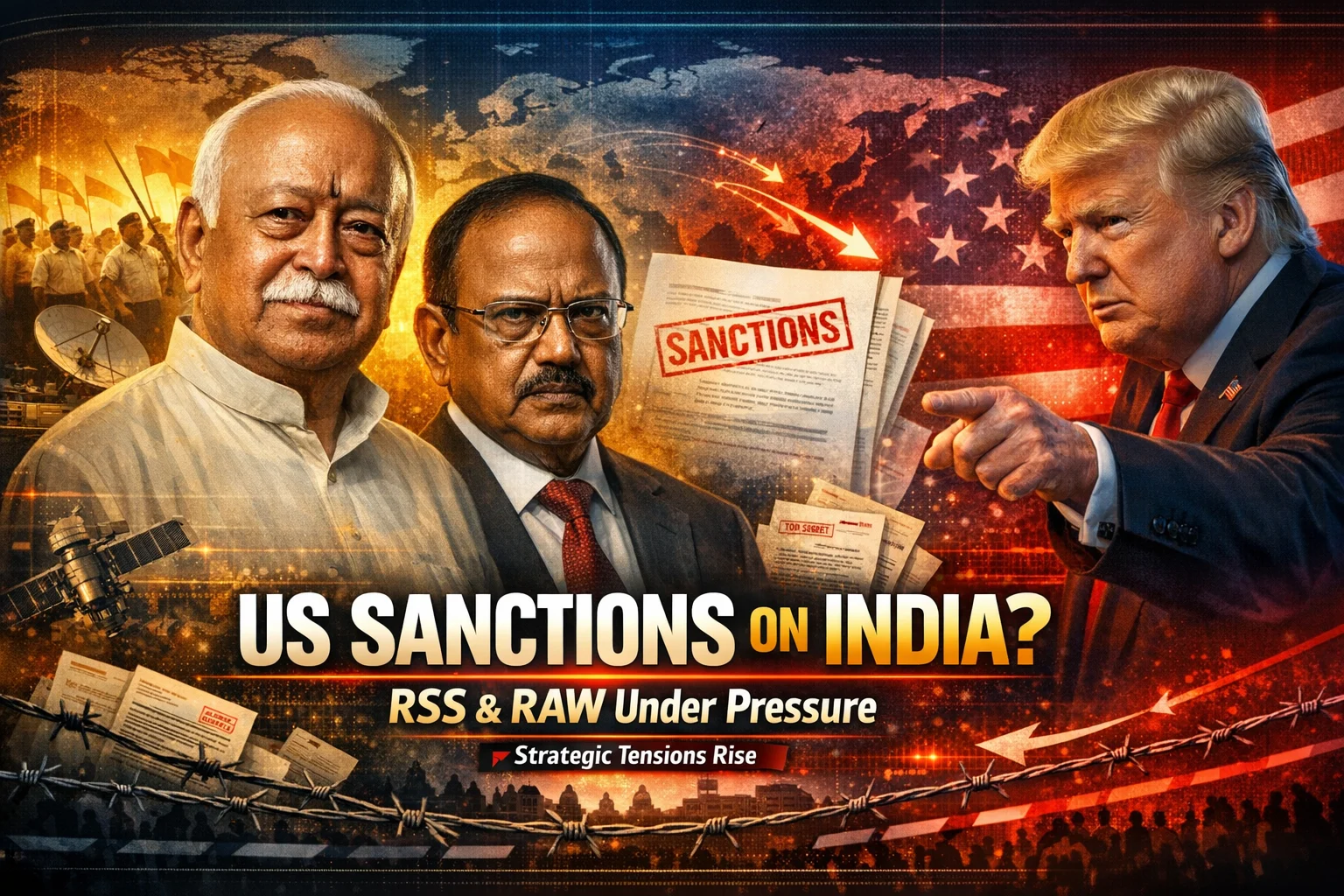
The discussion around US sanctions on RSS and RAW has triggered a major geopolitical debate at a sensitive moment in India-US relations.
A recommendation submitted to Donald Trump suggests that the United States could consider targeted sanctions on two key Indian entities:
- Rashtriya Swayamsevak Sangh (RSS)
- Research and Analysis Wing (RAW)
This comes at a time when the US itself is dealing with multiple global challenges, including tensions with Iran and the need for broader international cooperation.
That timing matters.
Because it raises a key question:
Why apply pressure on India when strategic alignment is needed the most?
Sources: Hindustan Times
What the US Panel Has Recommended
The recommendation originates from the US Commission on International Religious Freedom (USCIRF).
In its report, the panel suggests:
- Targeted sanctions on RSS
- Potential sanctions on RAW
- Freezing of assets within the US
- Travel bans preventing associated individuals from entering the United States
These measures are similar to sanctions the US has used against other foreign entities, including those linked to Russia.
But this is not just about sanctions.
The report goes further.
It also raises the possibility of designating India as a “country of particular concern”, a classification typically used for nations accused of serious religious freedom violations.
That escalation would carry broader implications.
Including potential restrictions on arms exports.
Sources: Business Today
Why RSS and RAW Are Being Targeted
According to the report, the justification revolves around concerns related to religious freedom.
The USCIRF argues that the RSS poses a threat to minority rights and recommends immediate action.
The debate has also entered domestic Indian politics.
Members of the Indian National Congress have publicly supported the idea of action against RSS, describing it as harmful to national unity.
"𝐓𝐡𝐞 𝐔𝐒 𝐬𝐡𝐨𝐮𝐥𝐝 𝐢𝐦𝐩𝐨𝐬𝐞 𝐚 𝐛𝐚𝐧 𝐨𝐧 𝐑𝐒𝐒."
— Congress (@INCIndia) March 16, 2026
This recommendation was made to the Donald Trump administration by the USCIRF, an official US government body.
The USCIRF has warned that the RSS (Rashtriya Swayamsevak Sangh) poses a threat to people's religious… pic.twitter.com/sKQWjsDuwt
At the same time, the inclusion of RAW in the recommendation significantly raises the stakes.
Unlike RSS, RAW is India’s external intelligence agency.
Sanctioning such an entity would represent a serious escalation in diplomatic tensions.
Sources: Republic
India’s Response: Strategic Autonomy First
India’s broader position in such matters has remained consistent.
Strategic autonomy.
India has historically resisted external pressure on internal or institutional matters.
This is not a new pattern.
From trade policy to defense partnerships, India has emphasized decision-making based on national interest rather than external approval.
And this situation is no different.
The idea that a foreign government could impose sanctions on a national intelligence agency raises fundamental sovereignty concerns.
That line is rarely crossed in international relations.
Could the US Actually Impose These Sanctions?
Technically, yes.
The United States has legal mechanisms to impose sanctions on foreign entities, including asset freezes and travel bans.
But in practice, the situation is far more complex.
Consider the implications:
- India is a key strategic partner in the Indo-Pacific
- Defense cooperation between the two countries is expanding
- US companies like Lockheed Martin and Boeing have major stakes in India
Imposing sanctions could disrupt these relationships.
That makes such a move unlikely—but not impossible.
And with Trump, unpredictability becomes part of the equation.
The Bigger Geopolitical Context Behind the Timing
This development cannot be viewed in isolation.
It comes at a time when:
- The US is facing challenges in the Middle East
- The Strait of Hormuz remains unstable
- Oil prices are rising
- Washington is seeking broader international support
At the same time, India has not fully aligned with US expectations on several fronts.
This includes:
- Energy purchases
- Military positioning
- Direct involvement in regional conflicts
That creates friction.
And pressure tools—such as reports and recommendations—often emerge in such phases.
This was strategic.
Sources: Hindustan Times
What Happens Next in India-US Relations
The key uncertainty now is political.
Will Donald Trump act on these recommendations?
Or will they remain on paper?
Historically, Republican administrations have not always acted on USCIRF recommendations.
But Trump’s approach has often been different.
Less predictable.
More transactional.
There is also a possibility that such recommendations are used as leverage rather than policy.
A signal.
A negotiating tool.
And that distinction matters.
Because in geopolitics, not every threat is meant to be executed.
Some are meant to shape behavior.
Conclusion
The debate over US sanctions on RSS and RAW reflects a deeper reality within global geopolitics.
Partnerships do not eliminate pressure.
Even close strategic relationships can involve moments of friction, negotiation, and signaling.
For India, the core principle remains unchanged:
Strategic autonomy.
For the United States, the challenge is balancing pressure with partnership.
And for observers, the situation highlights how quickly narratives can shift—from cooperation to confrontation—depending on global circumstances.
The coming weeks will determine whether this remains a recommendation—or evolves into a real policy dispute.
FAQs
Can the US sanction RSS and RAW?
Technically, yes. The US has legal tools to impose sanctions on foreign entities. However, doing so against major Indian organizations would have significant diplomatic consequences.
What is USCIRF?
The US Commission on International Religious Freedom is an advisory body that monitors religious freedom globally and makes policy recommendations to the US government.
Why is RAW included in the sanctions discussion?
RAW is India’s external intelligence agency. Its inclusion raises concerns because targeting such an institution would be a major escalation in diplomatic relations.
Will this affect India-US relations?
If US sanctions on RSS and RAW implemented, such sanctions could strain India-US relations. However, given the strategic partnership, actual enforcement remains uncertain.
Why is this happening now?
The timing suggests a mix of geopolitical pressure, global tensions, and policy signaling rather than a purely standalone decision.
What Does This Mean for India’s Strategic Future?
The discussion around US sanctions on RSS and RAW raises larger questions about global power dynamics.
Should India adjust its policies under external pressure?
Or continue prioritizing strategic autonomy in a rapidly shifting geopolitical landscape?
Consider this:
- Can major powers maintain partnerships without applying pressure?
- Will India’s independent stance strengthen or strain global alliances?
- And how should countries respond when cooperation and coercion appear together?
Share your Perspective in the Comments below.
Because in geopolitics, true power is often measured by the ability to make independent choices.
Explore more about Strategic Depth and Indian Affairs.