Table of Contents
A Warning That Signals More Than Just Concern
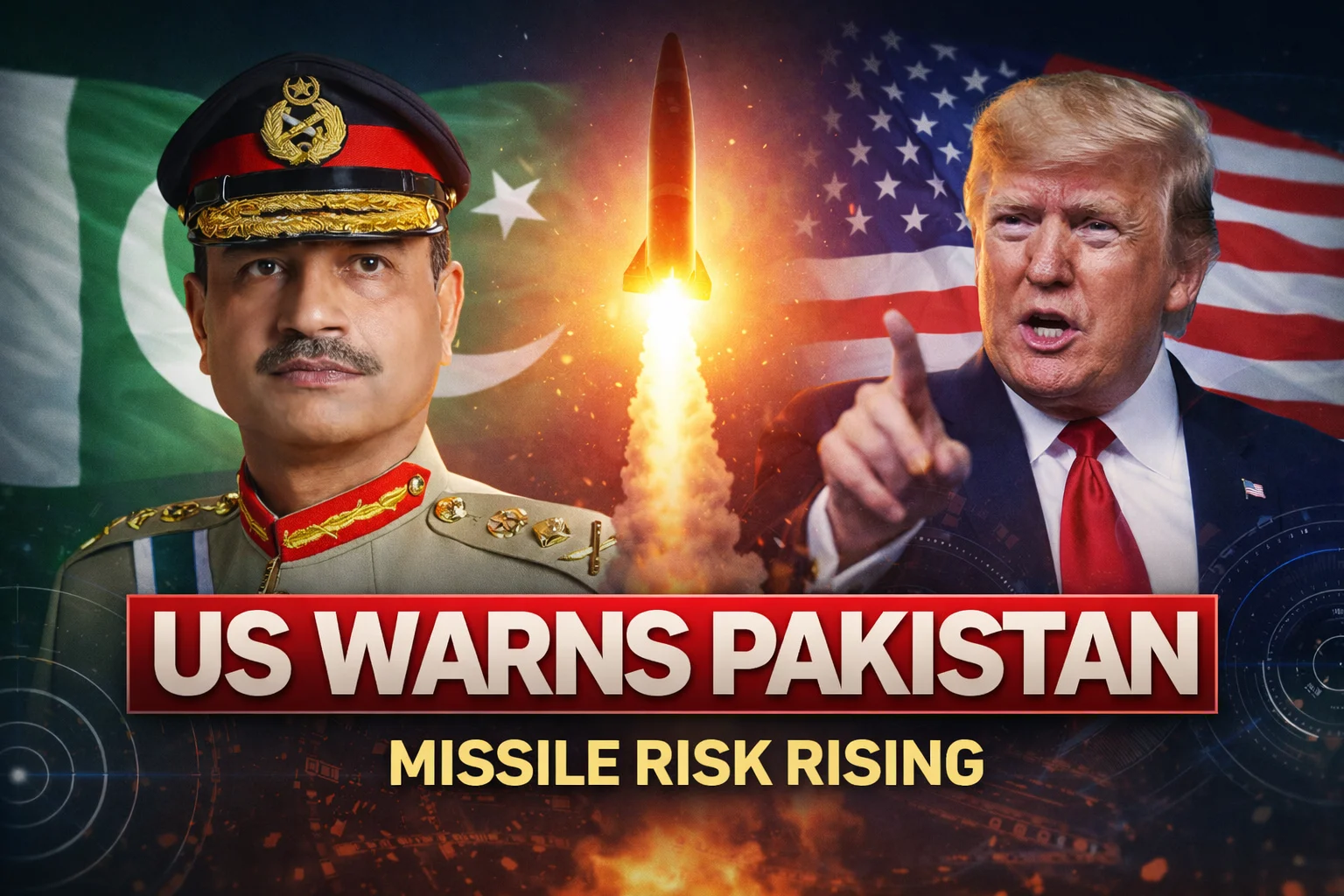
The moment the US warns Pakistan nuclear threat, it does more than just highlight risk—it sends a message.
A recent Annual Threat Assessment from the U.S. Intelligence Community has placed Pakistan among countries raising serious nuclear concerns. The report also includes nations like China, Russia, Iran, and North Korea.
That grouping is not random.
It reflects how the United States currently maps long-term strategic risks.
Sources: Al Jazeera, The Economic Times
What the US Intelligence Report Actually Says
According to the report, multiple countries are:
- Developing advanced missile delivery systems
- Increasing range and accuracy
- Expanding both nuclear and conventional payload capabilities
The key concern is not just capability—but reach.
This concern has also been echoed by Tulsi Gabbard, who described Pakistan along with Russia, China , North Korea and Iran as among the most serious nuclear threats facing the United States.
🚨 BIG BREAKING
— Megh Updates 🚨™ (@MeghUpdates) March 18, 2026
US Director of National Intelligence Tulsi Gabbard names Pakistan, China, Russia and North Korea as BIGGEST NUCLEAR threat to the US. pic.twitter.com/jG8XPWQlnt
By around 2035, these systems could potentially:
- Target the US mainland
- Overwhelm defense systems through volume
- Reduce response time for interception
This is where things shift.
The concern is no longer theoretical.
It is becoming structural.
Sources: 2026 (U) Annual Threat Assessment of the U.S. Intelligence Community – Report
Why Pakistan Is Emerging as a Nuclear Concern
The phrase US warns Pakistan nuclear threat is rooted in multiple factors.
First, Pakistan’s ongoing missile development programs.
Second, regional instability.
Tensions with Afghanistan have increased unpredictability along its western border. At the same time, historical friction with India continues to define its eastern posture.
Pressure from multiple fronts matters.
Because under pressure, decision-making becomes less predictable.
And nuclear strategy depends heavily on predictability.
India’s Position: Capability Without Classification as Threat
One of the most revealing parts of the report is what it does not say.
While India is acknowledged for developing long-range delivery systems, it is not placed in the same threat category.
That distinction matters.
India is viewed differently—not because it lacks capability, but because of how that capability is perceived.
The United States appears to treat India as:
- A long-term strategic partner
- A stable actor in regional security
- A country with predictable military doctrine
This is not permanent.
It is contextual.
And context can change.
India vs Pakistan Missile Reality
The contrast in missile capability is significant.
Pakistan’s longest-range systems are estimated around:
- 2700–2800 km
India, on the other hand, operates the Agni missile series with much higher potential reach.
Actual capabilities are often underreported.
That is deliberate.
Because strategic ambiguity itself is a deterrent.
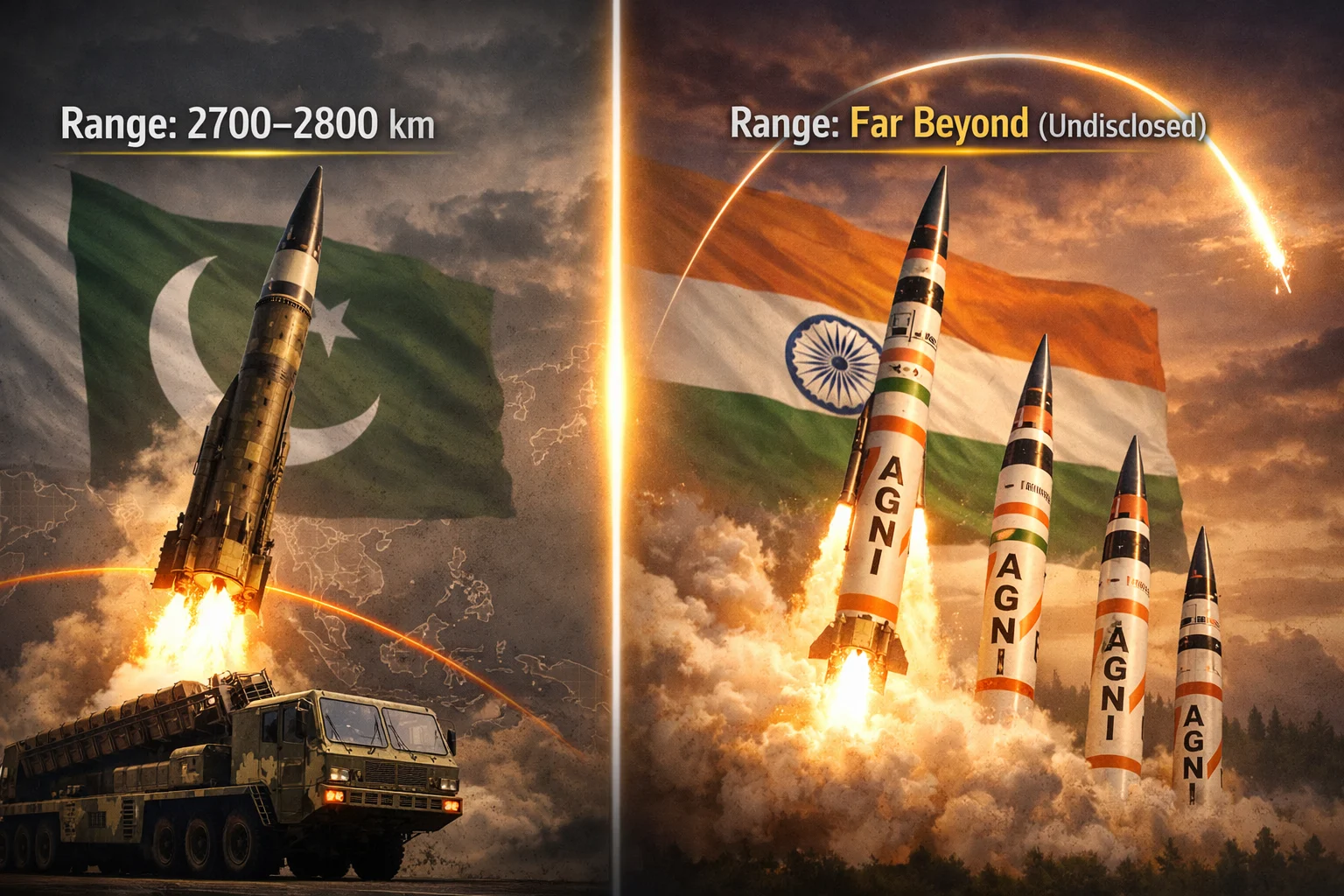
Image credit: AI-generated using ChatGPT by OpenAI
Why the US Is Strategically Worried
This is not just about who has missiles.
It’s about how they are used.
US planners are increasingly concerned about a cost-based asymmetry:
- Offensive missiles can be made relatively cheaper
- Defensive interception systems are extremely expensive
That creates a dangerous equation.
If multiple missiles are launched simultaneously:
- Even advanced defense systems may struggle
- The cost of interception becomes unsustainable
This is not a technological gap.
It is a strategic imbalance.
Pakistan’s Response: Shift the Focus to India
The moment the US warns Pakistan nuclear threat, the narrative inside the region also begins to shift.
After the report, Pakistan responded quickly.
Its position was clear:
Focus should be on India’s missile capabilities—not Pakistan’s.
This argument is not new.
But it faces a structural limitation.
The US assessment already differentiates between:
- Capability
- Intent
- Strategic alignment
Pakistan’s attempt to redirect attention highlights concern—but does not change classification.
Sources: Hindustan Times
The Larger Geopolitical Game
This report is not just analysis.
It is signaling.
By placing Pakistan alongside China, Russia, Iran, and North Korea, the US is:
- Defining strategic competitors
- Issuing early-stage warnings
- Setting the tone for future policy
This was deliberate.
Because such reports are read globally—not just domestically.
And every country mentioned understands the implication:
“We are watching.”
What Comes Next
Several paths are possible.
Pakistan could:
- Adjust its missile program
- Reduce escalation risk
- Recalibrate its strategic posture
Or it could continue on its current trajectory.
That decision matters.
Because in geopolitical strategy, leverage can either:
- Strengthen position
- Or trigger containment
At the same time, regional dynamics remain volatile.
India’s growth trajectory, China’s influence, and global conflict trends will all shape what happens next.
FAQs
Why did the US warn about Pakistan nuclear threat?
The US intelligence report highlights concerns over Pakistan’s missile development, regional instability, and the potential for escalation in South Asia. These factors collectively raise long-term security risks.
Is India considered a nuclear threat by the US?
No. While India has advanced missile capabilities, it is not classified as a threat in the same way. The US views India as a strategic partner with stable military intent.
Could India and Pakistan enter a nuclear conflict?
The risk exists, particularly during periods of heightened tension. However, past actions suggest efforts have been made to avoid prolonged escalation.
What makes missile systems a global concern now?
Modern missile systems are becoming more accurate, longer-range, and harder to intercept. This increases the risk of rapid escalation and reduces response time during crises.
Final Thought
When the US warns Pakistan nuclear threat, it is not predicting immediate conflict.
It is shaping future perception.
And in geopolitics, perception often becomes reality.
What This Means Going Forward
The real question is no longer just about missiles.
It is about decisions.
Because the path Pakistan chooses next will not just define its own future—it will influence the stability of an entire region.
And once such trajectories are set, they are rarely easy to reverse.
Share Your Views in the Comments below.
Explore more about Defense & Security, Indian Affairs and World Affairs.