Table of Contents
Why a Train Blast in Quetta Changed the Entire Reko Diq Story
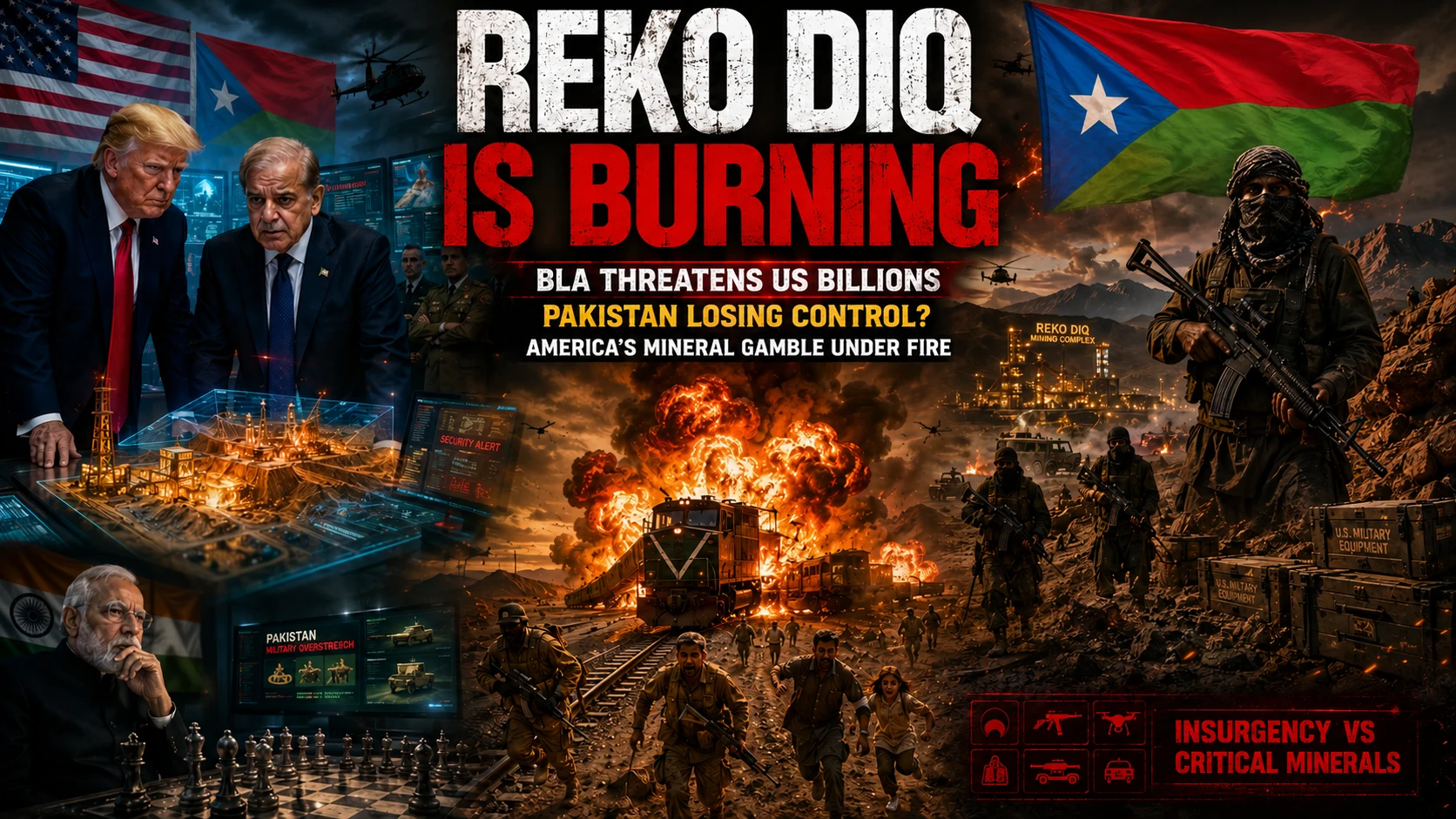
The US investment in Reko Diq suddenly looks far more dangerous after the May 2026 Quetta train bombing killed between 20 and 25 people and injured around 100, most of them Pakistani military personnel. The attack targeted a train near Quetta carrying soldiers and their families, and the scale of destruction immediately became global news. The Balochistan Liberation Army (BLA) claimed responsibility and described the attack as a strike against “Pakistan’s occupying forces.” That phrase is central to the group’s narrative because the insurgency increasingly presents itself not merely as an anti-state militant movement, but as a separatist force fighting what it calls military occupation inside Balochistan.
🚨 BREAKING: Deadly Train Blast Carrying Pakistan Army Personnel Rocks Quetta, Pakistan
— Netram Defence Review (@NetramDefence) May 24, 2026
At least 24 people were killed and over 50 injured after a powerful bomb explosion targeted a train in Quetta, Balochistan, causing a derailment and chaos at the railway station.
Emerging… pic.twitter.com/sv5h4sqzOe
But the bigger story is not the bombing itself. It is what the attack exposed.
At the exact moment the United States is trying to invest billions into the reconstruction of Balochistan and expand mining activity around copper and gold reserves, the region is becoming more unstable. The US and Pakistan had reached an understanding where American money and companies would increasingly move into Balochistan. Yet within days of renewed attention on these plans, attacks intensified again.
This is why international media has started calling the insurgency a “project-defining risk” rather than just another security problem. And the contradiction behind that risk is even more striking.
Sources: BBC
How America’s Afghanistan Exit Came Back to Haunt Its Pakistan Strategy
The most damaging irony in this entire crisis is that militants attacking Pakistan’s US-backed plans are allegedly using American weapons left behind in Afghanistan.
Pakistani think tanks and officials increasingly argue that the hurried US withdrawal from Afghanistan under Joe Biden flooded the region with abandoned military hardware. Weapons reportedly moved from Afghanistan to Tehrik-e-Taliban Pakistan (TTP), and from there into the hands of the BLA. American-origin military equipment entered insurgent networks after 2021 and fundamentally altered the scale of violence inside Balochistan.
That changes the security equation completely.
The BLA is no longer being treated as a small peripheral insurgent outfit that can be controlled by adding checkpoints or deploying extra troops. The attacks have become more frequent, more coordinated, and more ambitious. Around 500 militants have reportedly carried out attacks across different locations while killing large numbers of Pakistani soldiers. Near the end of April alone, the BLA claimed responsibility for 27 attacks, followed by reports of more than 40 Pakistani soldiers killed within just 10 days.
An attempted attack was later carried out in Islamabad as well, although it was unsuccessful. That detail matters because it suggests the insurgency is no longer being viewed only as a remote Balochistan problem.
This was deliberate.
America’s own geopolitical plans are now colliding with the unintended consequences of its Afghanistan withdrawal. And that collision becomes even more important when viewed from India’s perspective.
Sources: The Times of India, Scroll.in, The New York Times, U.S. Department of War
Why This Crisis Could Become a Strategic Opening for India
Pakistan’s internal military stretch is becoming impossible to ignore, and that has direct implications for India’s strategic environment.
The Pakistani military is being pulled in multiple directions simultaneously. It is trying to maintain force posture against India, carry out operations in Balochistan, and continue pressure along the Afghanistan frontier at the same time. At some point, this could become a very important opportunity for India as Pakistan’s military gets increasingly stretched internally.
That matters because the insurgency is no longer confined to isolated attacks in remote tribal zones. Violence has expanded across Quetta, Gwadar, and wider Balochistan. Pakistani officials also believe that after the US attack in Iran, more people may start joining the Balochistan Liberation Army. Separatist sentiment could spread further among tribal groups across the region.
The situation goes even further than that. Some groups may eventually push for an independent Balochistan that combines both Pakistani and Iranian Baloch regions into a single state. That possibility dramatically increases the geopolitical sensitivity of the crisis because it transforms the insurgency from a domestic security issue into a regional territorial question.
At the same time, Pakistani officials often avoid fully publicizing these attacks. Casualties are allegedly downplayed, and public mourning remains limited because authorities fear panic and instability narratives spreading across the country. But suppressing visibility does not reduce the strategic pressure. If anything, it increases uncertainty around whether Islamabad can actually secure long-term stability in Balochistan.
And yet, the deeper issue may not even be military capability anymore.
Sources: The New York Times
The Real Problem Is No Longer “Terrorism” but State Control
American media coverage has increasingly started acknowledging something Pakistan has struggled to publicly admit: the insurgency is escalating despite years of military pressure.
Authorities routinely downplay attacks in Balochistan, avoid amplifying casualty figures, and often do not publicly mourn these attacks much either because they fear panic and instability narratives spreading across the country. But the frequency curve is moving in the opposite direction. After violence levels declined in 2023, attacks increased again in 2024. By July 2025 alone, around 150 attacks had already been recorded, and 2026 is now expected to surpass even those levels.
The key shift is psychological.
The BLA is increasingly being described not as a local disturbance or a peripheral challenge that can be solved simply by increasing security, but as a structural threat capable of disrupting the entire investment model behind Reko Diq. These attacks are no longer isolated incidents but part of a steadily intensifying trajectory.
Right now, the core problem is that violence continues to spread despite years of military operations. Pakistan now faces the possibility that securing Balochistan could require a massive internal deployment of troops and resources for years.
And that raises an uncomfortable question for the United States itself.
Sources: The New York Times
Why America’s Billion-Dollar Bet Now Looks Structurally Unsafe
The United States viewed Balochistan as a region where large-scale mining investment and economic cooperation with Pakistan could expand rapidly. Washington planned to invest $1.25 billion into the province because of its vast copper and gold reserves.
But the security assumptions behind those plans are collapsing faster than expected.
International media has begun openly questioning whether the United States has any realistic plan to deal with the BLA threat. The concern is no longer theoretical. The Quetta bombing demonstrated that even heavily protected military-linked transport can be hit with devastating force.
At the same time, attacks are no longer limited to one district. Violence has continued spreading across Quetta, Gwadar, and multiple areas of Balochistan. The trajectory itself has become the story.
And perhaps the most important detail is this: even Pakistani analysts reportedly expect the intensity of attacks to continue increasing through 2026.
Either the United States will shelve its plans for investing in Balochistan, or the Pakistani military will have to carry out a very large operation in the province. Neither path suggests quick stability.
Sources: US Embassy & Consulates in Pakistan
What Happens If Pakistan Chooses Military Escalation Over Stability
Pakistan now appears trapped between economic ambition and growing internal instability.
If the investment plans continue, the Pakistani military will eventually have to launch a much larger operation across Balochistan. But such an operation would require enormous resources at a time when Pakistan is already stretched across multiple security fronts.
And every escalation risks producing the opposite effect.
The more instability grows, the harder it becomes for Pakistan to project confidence about the region. The more military force is used, the more separatist narratives may spread among tribal groups already demanding autonomy or independence. That creates a dangerous cycle where the state responds to insecurity with more force, while attacks continue rising year after year.
The central warning is not simply about terrorism. It is about whether Pakistan can realistically maintain control over a strategically important province while simultaneously facing intensifying insurgent attacks, rising separatist sentiment, and increasing military overstretch.
Because once violence begins shaping the future of an entire region, the consequences stop remaining local.
FAQs
What is the US investment in Reko Diq?
The United States has shown growing investment interest in Balochistan, especially around the Reko Diq copper and gold mining region. Billions of dollars in investment and the involvement of American companies are being linked to broader economic cooperation with Pakistan.
Why is the BLA targeting Pakistani military personnel?
The Balochistan Liberation Army views the Pakistani state as an occupying force and is intensifying attacks to push for an independent Balochistan. The organization has increasingly targeted military convoys, trains, and security infrastructure, especially after renewed focus on foreign investment in the province.
How did US weapons reportedly reach militant groups?
Weapons abandoned during the 2021 US withdrawal from Afghanistan allegedly moved through regional militant networks. Pakistani analysts claim some of these weapons reached Tehrik-e-Taliban Pakistan and were later supplied to the BLA. American-origin military equipment is now reportedly being used in attacks.
Why does Balochistan matter strategically?
Balochistan matters because of both geography and resources. The province contains major copper and gold reserves while also sitting near Afghanistan and Iran. That combination makes the region economically attractive and geopolitically volatile at the same time.
Why could this situation matter for India?
Pakistan’s military is becoming internally stretched due to simultaneous pressure from Balochistan, Afghanistan, and the Indian border. This could eventually become a very important opportunity for India if Pakistan is forced to divert more military resources inward.
Closing Question
If attacks in Balochistan continue rising while Pakistan’s military resources keep getting stretched internally, could the crisis eventually reshape the regional balance in ways India may quietly benefit from?
Share Your Views in the Comments below.
Explore more about World Affairs and Defense & Security.