Table of Contents
Why the World Suddenly Wants BrahMos
The most important story in global defense exports today is not who is building missiles—it is who is buying them, and the Brahmos Missile export strategy sits at the center of that trend. What began as a successful India-Russia missile program is increasingly becoming a case study in how military credibility translates into international demand.
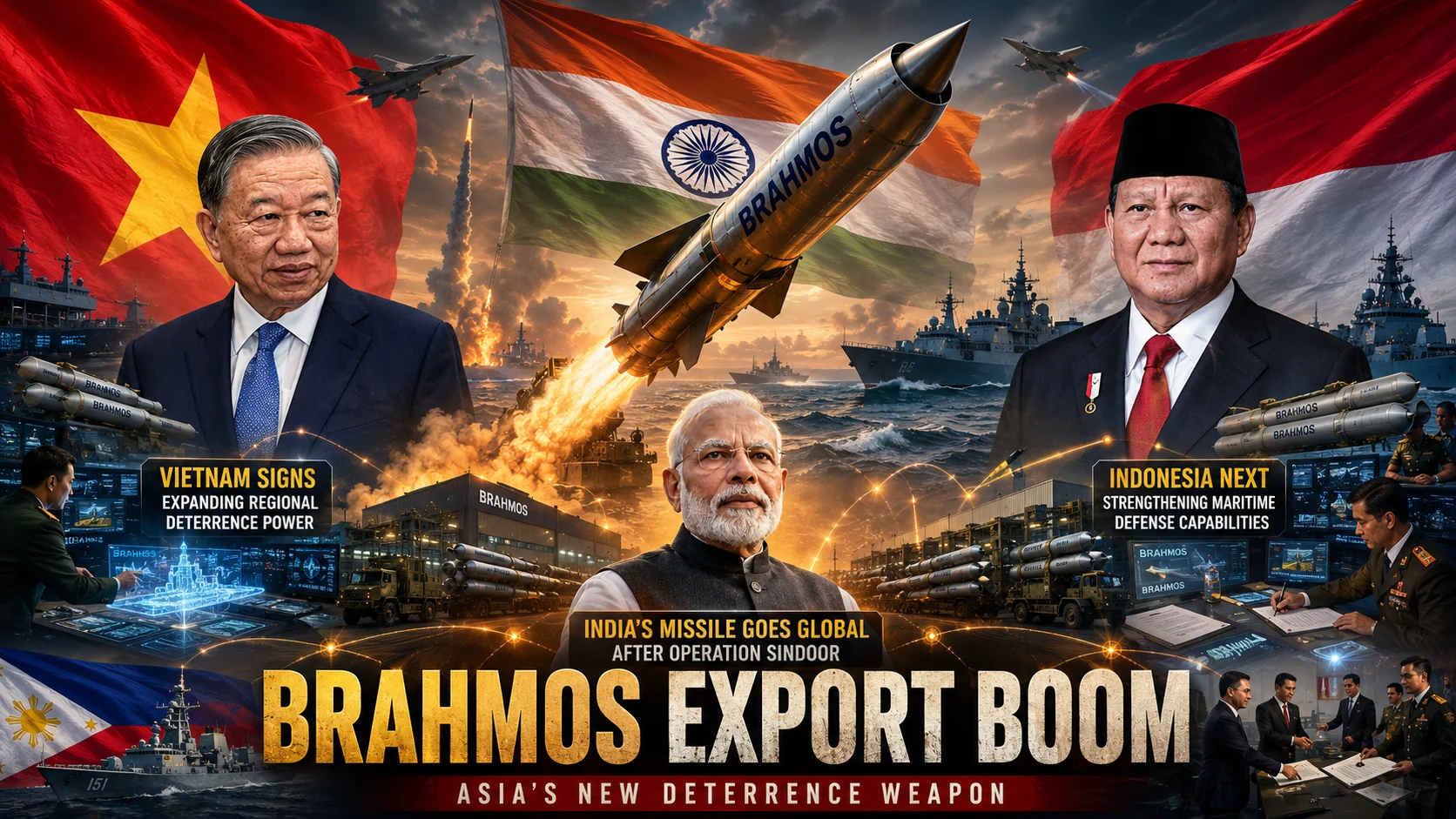
Vietnam has signed a BrahMos deal valued at roughly ₹5,800 crore, while Indonesia is in the final stages of a similar agreement. The Philippines had already become the first foreign buyer after signing a contract for three BrahMos batteries in 2022. Together, these deals demonstrate that demand for the India-Russia joint venture missile is expanding rapidly across Southeast Asia.
🇮🇳Indian-🇷🇺Russian BrahMos finalizes deal with 🇻🇳Vietnam, similar pact with 🇮🇩Indonesia in final stages — Defence secretary Rajesh Kumar Singh confirmed
— Lisa Singh (@YakushinaLisa) May 30, 2026
BrahMos is expanding across the continent 💪 pic.twitter.com/sTE0RIcsuU
The scale of that demand is one of the most striking aspects of the story. Russian media has actively highlighted the growing international interest in BrahMos, even publishing videos showing countries lining up to acquire the system. Beyond the Philippines, Vietnam, and Indonesia, countries such as Thailand, Brunei, and Malaysia have shown interest in Southeast Asia. In South America, Brazil, Venezuela, Chile, and Argentina have all been discussed as potential buyers. In the Middle East, Egypt, Saudi Arabia, the UAE, and Oman have emerged as interested states, while South Africa has been mentioned in Africa.
Few missiles in the world can claim active interest across Asia, the Middle East, Africa, South America, and parts of Europe at the same time. In fact, there is one notable exception to this global spread of demand: North America. The United States, Canada, and Mexico are not prospective BrahMos buyers, but interest appears to exist almost everywhere else.
The financial implications are equally significant. Vietnam’s deal is estimated at roughly $629 million, while Indonesia’s expected agreement could be worth another $200–350 million. Combined with the Philippines contract ($375 million), India is moving toward more than a billion dollars in BrahMos-related exports across these three countries alone.
Yet the most important question is not why countries are interested today. The more revealing question is why that interest accelerated so dramatically after Operation Sindoor.
Sources: Brahmos Aerospace, Hindustan Times, Deccan Herald
What Changed After Operation Sindoor?
The turning point was not a marketing campaign or a diplomatic summit—it was operational performance.
For years, some Western analysts argued that BrahMos looked impressive on paper but had limited practical value. The missile’s supersonic speed and payload capacity were acknowledged, yet questions remained about its usefulness in real-world conflict scenarios. Among the voices expressing skepticism was Indian-origin U.S. defense analyst Ashley Tellis, who repeatedly questioned the practical value of the system during the 2023–24 period.
Then came Operation Sindoor.
During the May 2025 conflict, the Indian Air Force reportedly used approximately 15 air-launched BrahMos missiles fired from Su-30MKI fighters against Pakistani military infrastructure. The operation was later credited with degrading 11 of Pakistan’s 12 major airbases, demonstrating a level of operational effectiveness that dramatically changed international perceptions of the platform.
Operation Sindoor did more than demonstrate military capability. It triggered a surge in international inquiries. Countries that had previously observed BrahMos from a distance suddenly became far more interested in acquiring it. Once governments saw reports of the missile being used in an actual conflict, the discussion shifted from theoretical performance to demonstrated performance.
This was not merely a military event. It became a proof-of-concept demonstration for potential buyers who had been watching from the sidelines.
The contrast becomes even sharper when compared with the China-Pakistan JF-17 Thunder program. While BrahMos was generating new contracts and attracting fresh interest, the JF-17 struggled to achieve comparable export momentum. Azerbaijan and Myanmar are among the operators, while Pakistan remains the principal user. Nigeria has also operated the platform, and Libya and Somalia have been mentioned as possible future buyers.
The comparison goes further. Myanmar remains under military rule and is widely viewed through that lens internationally. Pakistan’s economic difficulties are also frequently cited. More importantly, no major or strategically significant country has emerged as a flagship export success story for the JF-17 in the way that Vietnam, Indonesia, and the Philippines have for BrahMos. One system is producing expanding international demand and signed deals, while the other is struggling to build a comparable global customer base.
But if BrahMos is winning contracts and attracting buyers, why does India still face a perception problem abroad?
Sources: Wikipedia – CAC/PAC JF-17 Thunder, Stimpson Center, The EurAsian Times
Why This Matters Far More for India Than Most People Realize
The real significance of Brahmos Missile export strategy is not simply the revenue generated from Vietnam, Indonesia, or the Philippines. It is the strategic message these deals send about India’s place in the international security system.
For decades, India was primarily viewed as one of the world’s largest defense importers. Today, the conversation is increasingly about India as a supplier of advanced military technology. BrahMos has become one of the clearest symbols of that transition. Every new contract tells regional governments that India can provide sophisticated military systems that other countries are willing to trust.
This matters especially in Southeast Asia. Countries facing growing security concerns in maritime regions are not simply buying a missile. They are buying access to a deterrence capability. The spread of coastal defense missile systems across multiple countries creates a wider security architecture in which India becomes an increasingly important partner.
The strategic implications go beyond economics or exports. They affect how governments evaluate Indian technology, Indian reliability, and Indian influence. Actual deals provide the clearest evidence that this trust already exists. Money is being transferred, agreements are being signed, and procurement programs are moving forward.
Yet there is a paradox. While countries across Asia, the Middle East, Africa, and South America are expressing interest in BrahMos, much of the international conversation remains focused elsewhere. Success in defense exports does not automatically translate into success in shaping global perceptions.
That disconnect becomes impossible to ignore once we look at how the story is being told outside India.
The Strange Gap Between Reality and Global Perception
The most striking aspect of the BrahMos story is that success and recognition are not the same thing.
Actual contracts are being signed. Money is being transferred. Countries are moving from expressions of interest to finalized procurement agreements. Yet international perception often appears disconnected from those developments. Commercial success and narrative success are not necessarily the same thing.
A revealing example involves Serbian President Aleksandar Vučić. Serbia is neither a NATO member nor part of the European Union, making it an interesting observer of global military developments. Vučić referenced reports suggesting that Chinese missiles had successfully targeted India’s S-400 systems during the India-Pakistan conflict. He also referred to Chinese missile capabilities with reported ranges of around 400 kilometers.
Serbian President Vučić says Serbia operates Chinese missiles with ranges up to 400km and is acquiring more.
— Clash Report (@clashreport) May 28, 2026
He praised China's weapons performance in the India-Pakistan conflict, claiming Chinese systems destroyed India's S-400 radar.pic.twitter.com/WR6NAgn8Hh
Whether those reports reflected reality is not the central issue here. The larger issue is how such narratives spread internationally. Most world leaders learn about distant conflicts the same way ordinary citizens do: through articles, television reports, social media posts, and online commentary.
The example illustrates a broader problem. When political leaders thousands of kilometers away form opinions about a conflict, they are usually relying on media coverage rather than firsthand information. If misleading narratives dominate that coverage, those narratives can shape international perceptions regardless of what actually happened.
This creates a dangerous gap between reality and perception. While BrahMos contracts were expanding and satellite imagery was reportedly telling a different story, international discussions often focused on claims that favored Chinese and Pakistani narratives.
If people around the world remember allegations but remain unaware of contracts, export successes, and growing demand, then a serious information problem exists.
Sources: The Hindu
How China and Pakistan Won a Narrative They Didn’t Win on the Ground
The sharpest argument is that China and Pakistan have been more effective at shaping perceptions than India has been at promoting achievements.
Narratives travel faster than procurement documents. Most world leaders, policymakers, journalists, and citizens learn about distant conflicts through media coverage rather than direct observation. A president in Europe follows developments in South Asia much like an Indian reader would follow a conflict between US and Iran —through headlines, articles, videos, and commentary.
That creates a powerful advantage for whoever controls the story.
There is a contradiction at the heart of this debate. On one side are signed contracts, growing international demand, and operational use during a conflict. On the other side are media narratives that often focus on dramatic battlefield claims. Satellite imagery suggested one story, while widely circulated reports promoted another.
The concern is not simply that alternative narratives exist. The concern is that unverified claims, false perceptions, and misleading stories often travel faster than procurement agreements, operational results, or publicly observable developments. In information warfare, repetition can sometimes shape perception more effectively than evidence.
While BrahMos contracts were progressing, reports emphasizing alleged Chinese military successes gained attention internationally. The result is a paradox. A missile system attracting buyers across continents may still struggle to dominate public discussion in the same way as dramatic claims published during a conflict.
The challenge is no longer proving capability. The challenge is ensuring that capability becomes part of the global conversation. That leads directly to the final problem India and Russia now face together.
Why BrahMos Faces a Visibility Problem, Not a Capability Problem
BrahMos does not suffer from a performance deficit—it suffers from a storytelling deficit.
Defense enthusiasts represent only a small fraction of the global population. Even within the global defense community, many analysts and enthusiasts remain surprisingly unfamiliar with BrahMos despite its growing export footprint and expanding international demand. As a result, successful contracts and operational performance do not automatically translate into international influence.
That creates a strange contradiction. Countries are actively evaluating the missile. Vietnam has already signed. Indonesia is nearing completion of its own agreement. The Philippines has deployed the system, and countries across Southeast Asia, the Middle East, Africa, and South America have expressed interest. Even countries such as Bulgaria have appeared in conversations surrounding potential future acquisitions.
Yet many international audiences remain far more familiar with dramatic battlefield claims than with the details of these procurement successes.
The answer is straightforward. India and Russia must communicate BrahMos success stories more aggressively and more consistently. Every export deal, every operational milestone, and every major deployment should become part of a broader international narrative. If countries around the world are considering purchases, then global audiences should understand why.
The issue is not whether BrahMos has achieved success. The issue is whether the world fully understands the scale of that success.
That challenge becomes even more important when viewed through the broader competition for influence and perception.
Conclusion
The BrahMos story is increasingly becoming a story about perception as much as performance.
Vietnam has signed, Indonesia is approaching the finish line, and the Philippines has already established itself as a pioneering customer. Beyond those confirmed buyers, interest stretches across Southeast Asia, the Middle East, Africa, South America, and parts of Europe. Few defense systems can claim that level of international attention.
The commercial momentum is equally striking. Vietnam’s agreement and Indonesia’s expected deal alone move the value of recent BrahMos exports into the billion-dollar range. At the same time, Operation Sindoor transformed the missile from a system admired largely for its technical specifications into one associated with operational use and battlefield credibility.
Yet the central lesson is not simply that BrahMos is selling well.
Military success alone does not guarantee narrative success. Contracts, battlefield performance, and international demand create credibility, but credibility must still be communicated. If international audiences primarily remember allegations, rumors, and contested battlefield claims while remaining unaware of expanding export deals, then a significant part of the strategic battle remains unfinished.
The debate is therefore larger than one missile system. It is about whether military achievements, commercial success, and international demand can be translated into influence before competing narratives define those achievements for the rest of the world.
For India and Russia, the challenge is no longer proving that BrahMos works. The challenge is winning the narrative battle that follows. If the missile is becoming one of the most sought-after defense exports in the world, then that story must be communicated with the same intensity as competing narratives promoted by rivals. Potential buyers should understand not only that countries are purchasing BrahMos, but also why governments continue to evaluate it as a credible military option. Otherwise, perception risks lagging behind reality.
FAQs
What is the BrahMos missile?
BrahMos is a supersonic cruise missile developed through an India-Russia joint venture. It has become one of India’s most prominent defense exports and is attracting interest from countries across Asia, the Middle East, Africa, and South America.
Which countries have bought the BrahMos missile?
The Philippines became the first foreign buyer after signing a contract in 2022. Vietnam has signed a deal, while Indonesia is reported to be in the final stages of reaching a similar agreement. Several other countries have also expressed interest in acquiring the system.
What was the role of the BrahMos missile in Operation Sindoor?
Reports following Operation Sindoor indicated that BrahMos missiles were used against Pakistani military infrastructure. The operation significantly increased international attention on the missile and was followed by growing interest from potential buyers.
Why are Southeast Asian countries interested in BrahMos?
The missile offers a long-range deterrence capability and is increasingly viewed as a credible coastal defense option. This has made it attractive to countries seeking stronger defensive capabilities and greater security flexibility.
How does BrahMos compare with the JF-17 discussion in regional defense markets?
The comparison centers on export momentum and international demand. While BrahMos has attracted multiple buyers and interested countries across different regions, the JF-17 has seen more limited adoption, making the contrast an important part of discussions surrounding defense exports and reliability.
Closing Question
If BrahMos is already attracting buyers across Asia, Africa, the Middle East, South America, and parts of Europe, can India and Russia win the narrative battle as effectively as they are winning the export battle before competing information campaigns shape global perceptions first?
Share Your Views in the Comments below.
Explore more about Defense & Security.