Table of Contents
The Discovery That Changed the Conversation
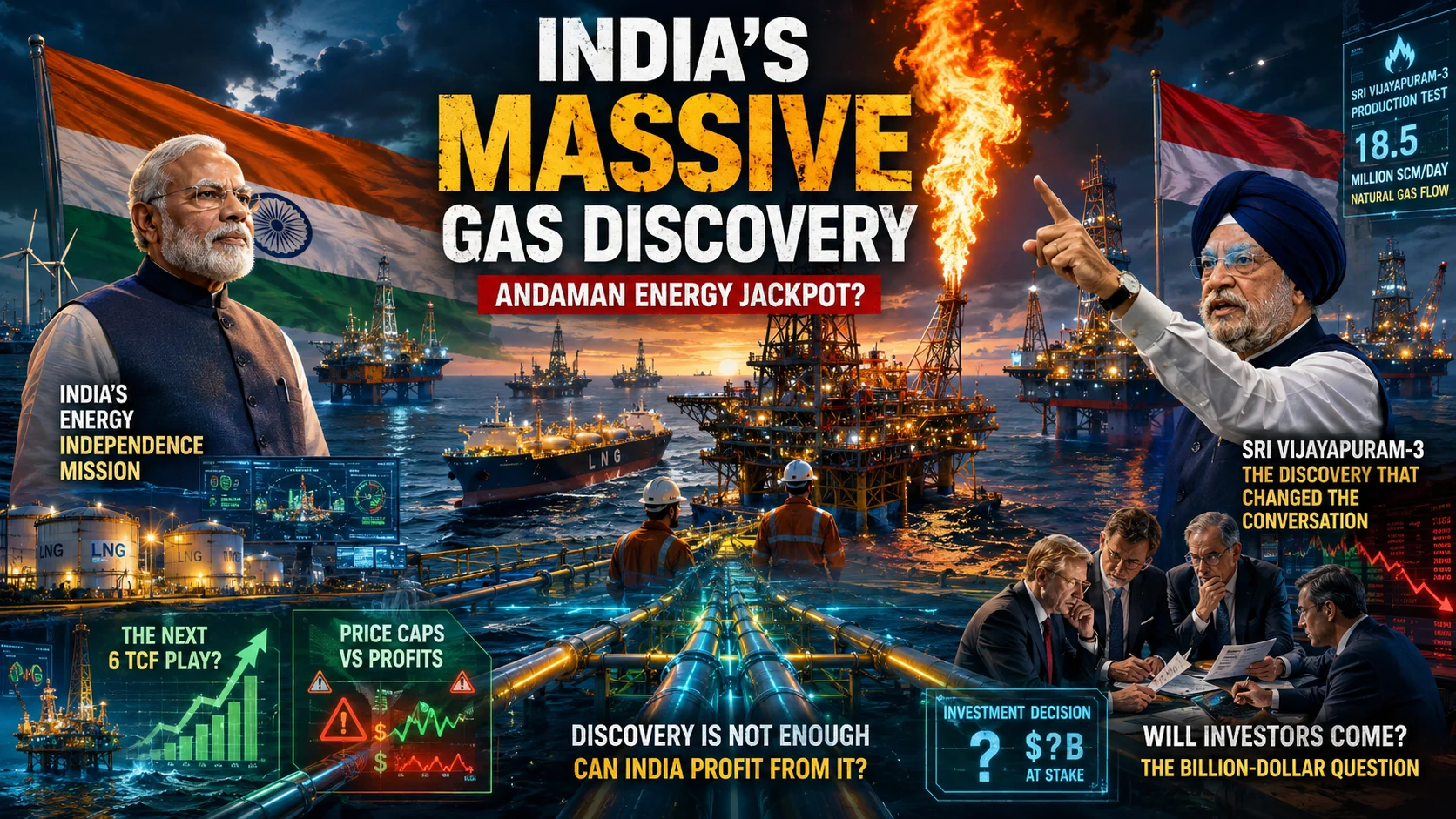
The Andaman Sea natural gas discovery is significant not because India found gas, but because it found evidence of a functioning deepwater petroleum system where many previously saw only geological potential.
On June 5, 2026, Union Petroleum Minister Hardeep Singh Puri announced that Oil India Limited (OIL) had confirmed natural gas at the Sri Vijayapuram-3 exploratory well. The well lies roughly 15 kilometers off the east coast of the Andaman Islands in 355 meters of water. Initial production testing from the Eocene formation at depths exceeding 1,900 meters established continuous flaring, confirming the presence of natural gas.
Congratulations @OilIndiaLimited !
— Hardeep Singh Puri (@HardeepSPuri) June 5, 2026
An ocean of energy opportunities reinforced in the Andaman Sea!
Very happy to report the presence of natural gas in Sri Vijayapuram-3 an exploratory well drilled by Oil India Ltd. 15 km off the east coast of the Andaman Islands at a water… pic.twitter.com/j6QvWqZkFx
This was not an isolated success. Two of the three exploratory wells drilled in OIL’s current Andaman campaign have now confirmed hydrocarbons. Earlier, the Sri Vijayapuram-2 discovery reported methane content of approximately 87%, strengthening confidence that the basin contains commercially relevant gas accumulations.
But finding gas is only the first chapter. The harder question is whether India can turn geology into economics.
Sources: Financial Express, ANI News, WION News
Why This Well Matters More Than the Headlines Suggest
The most important detail is not the flare at Sri Vijayapuram-3. It is the growing evidence that the Andaman Basin may be connected to a much larger regional hydrocarbon story.
Most coverage has treated the discovery as a standalone Indian event. That misses the broader context. Just across the maritime neighborhood, Mubadala Energy reported the Layaran-1 discovery in the South Andaman block offshore North Sumatra, with potential gas-in-place exceeding 6 trillion cubic feet. In 2024, the company’s Tangkulo-1 well added another potential 2 TCF discovery and flowed 47 million standard cubic feet per day during testing.
The geological significance is difficult to ignore. Multiple discoveries across the wider Andaman region suggest an active petroleum system extending beyond national boundaries. OIL’s success therefore matters not only because gas was found, but because it validates years of exploration assumptions about the basin itself.
The Andaman discoveries prove the resource exists; the real uncertainty is whether India’s policy framework allows anyone to profit from developing it.
Sri Vijayapuram-3, Sri Vijayapuram-2, Layaran-1 and Tangkulo-1 all point toward the same conclusion: geology is becoming less of a risk in the Andaman Basin. As exploration risk falls, commercial risk becomes the dominant factor. That shifts the strategic debate away from “Is there gas?” toward “Can India create conditions attractive enough for billion-dollar deepwater investments?” And that question has no easy answer.
Why India’s Biggest Opportunity Could Also Become Its Biggest Constraint
India celebrates this discovery as a step toward energy independence. The reality is more complicated.
India imports more than 85% of its crude oil requirements despite possessing 672.07 million tonnes of crude reserves and 1,073.01 BCM of natural gas reserves. The government launched the Samudra Manthan Mission in August 2025 specifically to change this equation, targeting $100 billion in exploration and production investment by 2030 while expanding exploration coverage to one million square kilometers.
🚨🇮🇳 India targets $100 billion oil and gas investment by 2030: PM Modi
— Sputnik India (@Sputnik_India) January 27, 2026
Under ‘Samudra Manthan’ deep sea exploration mission, India aims to expand oil and gas exploration efforts to one billion square kilometers. pic.twitter.com/iMysj2ylaE
Yet the Andaman Basin presents a difficult commercial challenge. Sri Vijayapuram-3 sits in a remote offshore region separated from mainland India by roughly 1,200 kilometers of ocean. Moving gas from offshore discoveries to consumers requires expensive infrastructure, and deepwater projects already rank among the most capital-intensive ventures in the energy industry.
This is where policy enters the picture. India’s Petroleum Planning and Analysis Cell (PPAC) set a deepwater gas price ceiling of $8.90/MMBTU for April–September 2026. Meanwhile, neighboring Bangladesh’s 2026 offshore production-sharing framework links deepwater gas prices directly to Brent crude within a defined range.
For Indian readers, this matters because energy security is not created by discoveries alone. If investors conclude returns are capped while costs remain uncapped, some of the basin’s most promising resources may remain stranded beneath the seabed.
What makes this challenge even more interesting is that India is simultaneously pursuing a second deep-sea strategy.
Sources: Press Information Bureau, PSU Watch
The Hidden Difference Between Samudra Manthan and Deep Ocean Mission
Many reports treat Samudra Manthan Mission and the Deep Ocean Mission as interchangeable. They are not.
Samudra Manthan focuses on hydrocarbons—oil and gas exploration across India’s vast Exclusive Economic Zone (EEZ) of 2.3 million square kilometers. The objective is energy production and investment attraction.
The Deep Ocean Mission, launched in 2021 under the Ministry of Earth Sciences with an investment of ₹4,077 crore, targets non-living marine resources and scientific capability. Under its Samudrayaan Project, India is developing the MATSYA 6000 manned submersible capable of carrying three people to depths of 6,000 meters.
The distinction matters because both missions strengthen India’s maritime position in different ways. Deep Ocean Mission surveys have already recovered over 100 kilograms of cobalt-rich polymetallic nodules from the Andaman Sea. Meanwhile, Indian aquanauts conducted dives reaching 5,000 meters in collaboration with IFREMER during 2025.
One mission seeks molecules. The other seeks minerals and technological capability. Together, they represent a broader attempt to transform the Andaman Sea into a strategic economic frontier.
But how does India’s progress compare with what neighboring countries are achieving?
Sources: Press Information Bureau, Wikipedia : Exclusive Economic Zone of India
What Indonesia’s Success Reveals About the Andaman Basin
The Andaman Basin story becomes far more compelling when viewed alongside Indonesia’s recent exploration successes.
Mubadala Energy’s Layaran-1 well was drilled to 4,208 meters in water depths of 1,207 meters—far more technically challenging than Sri Vijayapuram-3. The discovery’s estimated scale exceeded 6 TCF of gas-in-place, while Tangkulo-1 added further evidence of a highly productive regional system.
The key lesson is not that Indonesia found bigger discoveries. It is that the broader Andaman geological province continues delivering positive exploration results across multiple operators and jurisdictions.
That changes investor perception. Exploration companies typically fear geological uncertainty more than anything else. Every successful well reduces that uncertainty.
For India, OIL’s discoveries therefore accomplish something beyond reserve additions. They make future exploration campaigns easier to justify. The basin is slowly moving from speculative frontier acreage toward a proven hydrocarbon province.
The remaining question is whether this momentum can survive the long road from discovery to production.
The Real Test Starts After the Discovery
The Andaman Sea natural gas discovery is being celebrated as a breakthrough. It deserves recognition, but not for the reasons most headlines suggest.
The biggest achievement is not the gas itself. It is the confirmation that India’s eastern offshore frontier contains a functioning petroleum system capable of delivering repeated discoveries. Sri Vijayapuram-2 and Sri Vijayapuram-3 have changed the geological conversation.
Yet the commercial conversation is only beginning. Deepwater projects often require eight to seventeen years between discovery and first production. Infrastructure costs remain enormous. Regulatory pricing decisions will influence whether global capital views the basin as an opportunity or a challenge.
The popular assumption is that finding gas automatically improves energy security. The more difficult reality is that energy security depends on whether discovered resources can actually be produced economically. The Andaman Basin has largely solved the geological puzzle. The policy and commercialization puzzle remains open.
FAQ
What is the recent natural gas discovery in the Andaman Sea?
Oil India Limited confirmed natural gas at the Sri Vijayapuram-3 exploratory well on June 5, 2026. The discovery was verified through continuous flaring during production testing from the Eocene formation at depths exceeding 1,900 meters.
Who discovered natural gas at Sri Vijayapuram-3?
The discovery was made by state-run Oil India Limited (OIL). The well is located approximately 15 kilometers off the east coast of the Andaman Islands in water depths of 355 meters.
What is India’s Samudra Manthan Mission?
Samudra Manthan, officially known as the National Deep Water Exploration Mission, was announced by Prime Minister Narendra Modi in August 2025. The initiative seeks to expand offshore exploration and attract $100 billion in oil and gas investment by 2030.
What is the difference between Samudra Manthan and Deep Ocean Mission?
Samudra Manthan focuses on hydrocarbon exploration and energy production. The Deep Ocean Mission, launched in 2021 by the Ministry of Earth Sciences, focuses on deep-sea technology, scientific research, and mineral resources such as polymetallic nodules.
What is India’s current deepwater gas price ceiling?
The Petroleum Planning and Analysis Cell fixed a ceiling price of $8.90/MMBTU for gas produced from deepwater, ultra-deepwater, and HPHT fields for the period from April 1 to September 30, 2026.
Closing Question
If the Andaman Basin continues delivering discoveries while neighboring countries offer more flexible deepwater terms, will India adjust its pricing framework first—or risk watching global capital flow elsewhere despite having the resource?
Share Your Views in the Comments below.
Explore more about Economy & Trade.