Table of Contents
Why Norway’s Decision Signals a Much Bigger Shift
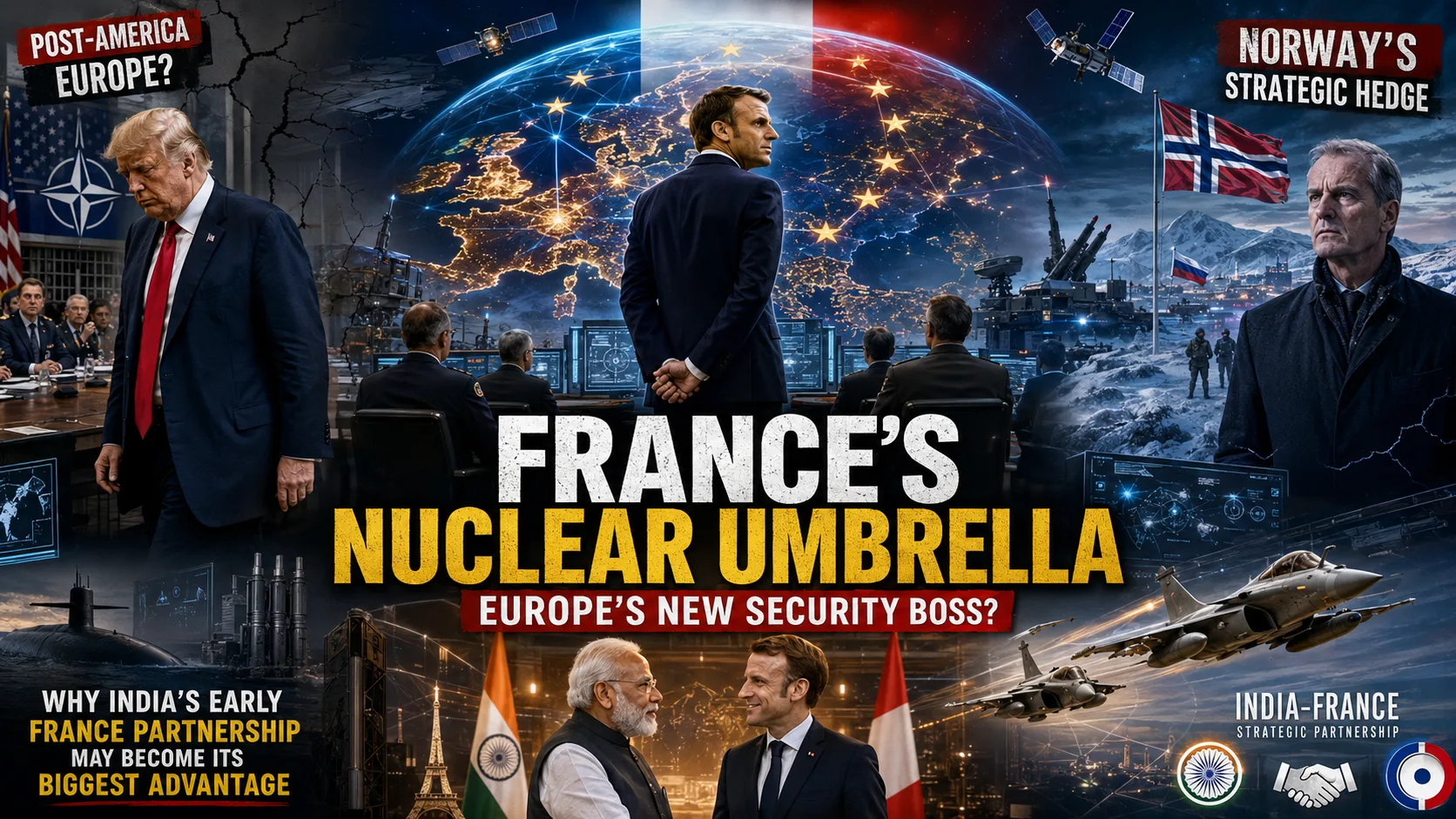
The biggest story behind the growing France nuclear umbrella Europe debate is not Norway itself—it is what many see as evidence that the power and influence of the United States in Europe are diminishing. European countries are increasingly preparing for a future where American protection cannot be assumed forever, creating one of the most significant geopolitical shifts in decades.
For decades, Europe’s security architecture rested on a simple understanding. If a European country faced a nuclear threat, the United States would stand behind its allies through its own nuclear deterrent. As part of that arrangement, American nuclear weapons remained deployed in countries such as Belgium, Germany, Italy, the Netherlands, and Turkey while remaining under US control.
The concern emerging today is that many European governments no longer view those guarantees with the same certainty. Another important reality is that security cooperation is increasingly being viewed beyond the traditional NATO framework. Countries are beginning to look for additional layers of protection rather than relying exclusively on existing arrangements.
Donald Trump played a major role in accelerating these concerns. He openly questioned what NATO had done for the United States and argued that America had often acted alone when confronting challenges involving Iran. Statements like these strengthened the belief among many Europeans that NATO could no longer be treated as an unquestioned security guarantee.
That uncertainty has created an opening for a country that possesses both nuclear weapons and a permanent seat on the UN Security Council: France. But why has Norway become one of the most important examples of this shift?
Sources: rfi, Bloomberg, The EurAsian Times, BBC
The Security Fear Driving Norway Toward France
Norway’s concern begins with geography.
The country shares a border of roughly 200 kilometers with Russia. Concerns are heightened by the fact that Russia continues to maintain military forces near both the Norwegian and Finnish borders. For countries situated close to Russia, those deployments remain a constant security consideration.
Norway’s challenge is that it is a relatively small country. Its population is only around 5 to 5.5 million people, and its military is comparatively limited in size. Large portions of the country are mountainous, extremely cold, and contain very little agricultural land. These geographic realities contribute to a sparse population spread across difficult terrain.
The example of Ukraine has also shaped Norwegian thinking. Many analysts therefore believe that Norway would face serious challenges if confronted by a much larger military power.
This is where France’s offer becomes strategically important. Emmanuel Macron’s message has been straightforward: European countries should not panic if American protection becomes less reliable because France possesses its own nuclear arsenal and is willing to extend protection to friendly states.
The practical example is simple. If Russia were to launch a nuclear attack against Norway, France’s nuclear umbrella would mean France could respond against Russia on Norway’s behalf. That promise of retaliation forms the core of the deterrence being offered. But France is not making this offer without expecting something in return.
Sources: TRT World, Worldometer
Why This Story Matters More for India Than Most People Realize
For India, the most important part of this development is not Norway’s security—it is France’s growing position inside Europe.
France is steadily positioning itself to become Europe’s primary power center as American influence gradually declines. If that happens, India’s long-term investment in its relationship with France could prove highly valuable.
India and France have already built strong ties through defense cooperation. India continues to acquire Rafale fighter aircraft from France, and cooperation is expected to deepen in areas such as nuclear energy and space. Over time, France has emerged as one of India’s most important strategic partners in Europe.
If Paris increasingly becomes the center from which major European strategic decisions are shaped, India gains an advantage because it already enjoys strong relations with France. This development therefore extends far beyond military cooperation.
But the benefit is not limited to defense. If France’s influence continues expanding across Europe, India’s existing relationship with Paris could make engagement with the broader European market easier. Stronger India-France ties may eventually translate into smoother trade, stronger diplomatic access, and deeper strategic cooperation across Europe as a whole.
That is why this story is not simply about Norway. It is also about where future influence inside Europe may be concentrated.
France Sees an Opportunity Others Cannot Ignore
France sees a power vacuum emerging, and it appears determined to fill it.
As Washington gradually pulls back from its traditional role as Europe’s unquestioned security provider, Paris has identified a historic opportunity to place itself at the center of European decision-making. Under Emmanuel Macron, France has made it clear that its nuclear capabilities can provide protection for other European countries.
The strategic calculation is straightforward. Security creates influence. But the reality is even more direct: nobody helps anyone for free. Every major power pursues its own interests, and France is no exception.
Norway’s enormous oil resources are also a major factor. France would naturally prefer a situation where a country receiving French security guarantees also remains a reliable long-term energy partner. In this interpretation, security and economic interests move together rather than separately.
France’s ambitions are not limited to military influence. A long-standing perception across Europe is that France already exercises enormous cultural influence through fashion, brands, and broader social trends. Ideas that become popular in France often spread across the rest of Europe soon afterward.
Under Emmanuel Macron, that cultural influence is now being paired with a much clearer security strategy. Where the United States is stepping back, France is attempting to step forward. Paris appears determined to become not merely a major European power but the central power around which future European security decisions are organized.
This was a power play, not a charitable exercise.
But Norway is far from the only country moving in this direction.
Why Norway Is Only Part of the Story
Norway receives attention because it shares a border with Russia, but it is not the first country to move closer to France’s deterrence framework.
Norway is the ninth country overall to join France’s nuclear deterrence arrangement. Before Norway, Belgium, Denmark, Germany, Greece, the Netherlands, Poland, Sweden, and even the United Kingdom had already aligned themselves with the French scheme.
The inclusion of the United Kingdom is particularly noteworthy. Britain already possesses its own nuclear weapons, yet it has still chosen to participate in France’s framework. That fact alone highlights how much influence France’s deterrence network is beginning to accumulate.
Norway attracts headlines because every major security decision made by a country bordering Russia carries immediate geopolitical significance. But the broader story is that French influence is steadily expanding across Europe.
The question now is what all these developments mean for NATO itself.
Sources: France24
Is Europe Entering a Post-American Security Era?
What makes this moment significant is the belief that Europe is witnessing a historic shift in its security architecture.
The point is not that NATO disappears tomorrow. Rather, European countries increasingly appear to be preparing for a future where NATO alone may not be enough. They are creating additional security arrangements because they are uncertain about the long-term reliability of American commitments.
France’s rise and America’s relative pullback are being presented as two sides of the same process. Washington increasingly wants to focus its strategic attention on the Indo-Pacific rather than carry the same level of responsibility for European security indefinitely.
The result could shape the geopolitical foundations of the next fifty years. France would gain greater strategic influence, European countries would diversify their security dependencies, and the balance of power inside Europe could move toward an entirely different structure from the one that dominated previous generations.
Norway’s decision therefore matters for reasons far beyond Norway itself. It represents a glimpse into a future where NATO’s dominance weakens, France’s influence grows, and Europe reorganizes itself around a new security reality.
FAQs
What is the France nuclear umbrella Europe initiative?
It refers to France extending the protection of its nuclear deterrent to other European countries. The basic idea is that France would use its nuclear capabilities to deter attacks against participating states.
Why is Norway interested in France’s nuclear protection?
Norway shares a border with Russia, has a relatively small population and military, and remains concerned about long-term regional security. Additional deterrence is therefore viewed as valuable.
Why does France want a larger security role in Europe?
France sees an opportunity to expand its influence as confidence in American security guarantees declines. Security leadership can translate into broader political and economic influence.
How could this benefit India?
India already has strong defense, strategic, and technological ties with France. If France becomes more influential across Europe, India’s existing relationship could provide wider opportunities.
Is this a sign that NATO is declining?
NATO’s dominance may be weakening as countries seek additional security arrangements. The broader trend is diversification rather than immediate replacement.
Closing Question
If France continues expanding its nuclear umbrella across Europe while the United States shifts more attention toward the Indo-Pacific, could India’s early strategic partnership with France become one of New Delhi’s most important geopolitical advantages over the next fifty years?
Share Your Views in the Comments below.
Explore more about Defense & Security and World Affairs.