Table of Contents
A Strategic Statement at a Critical Moment
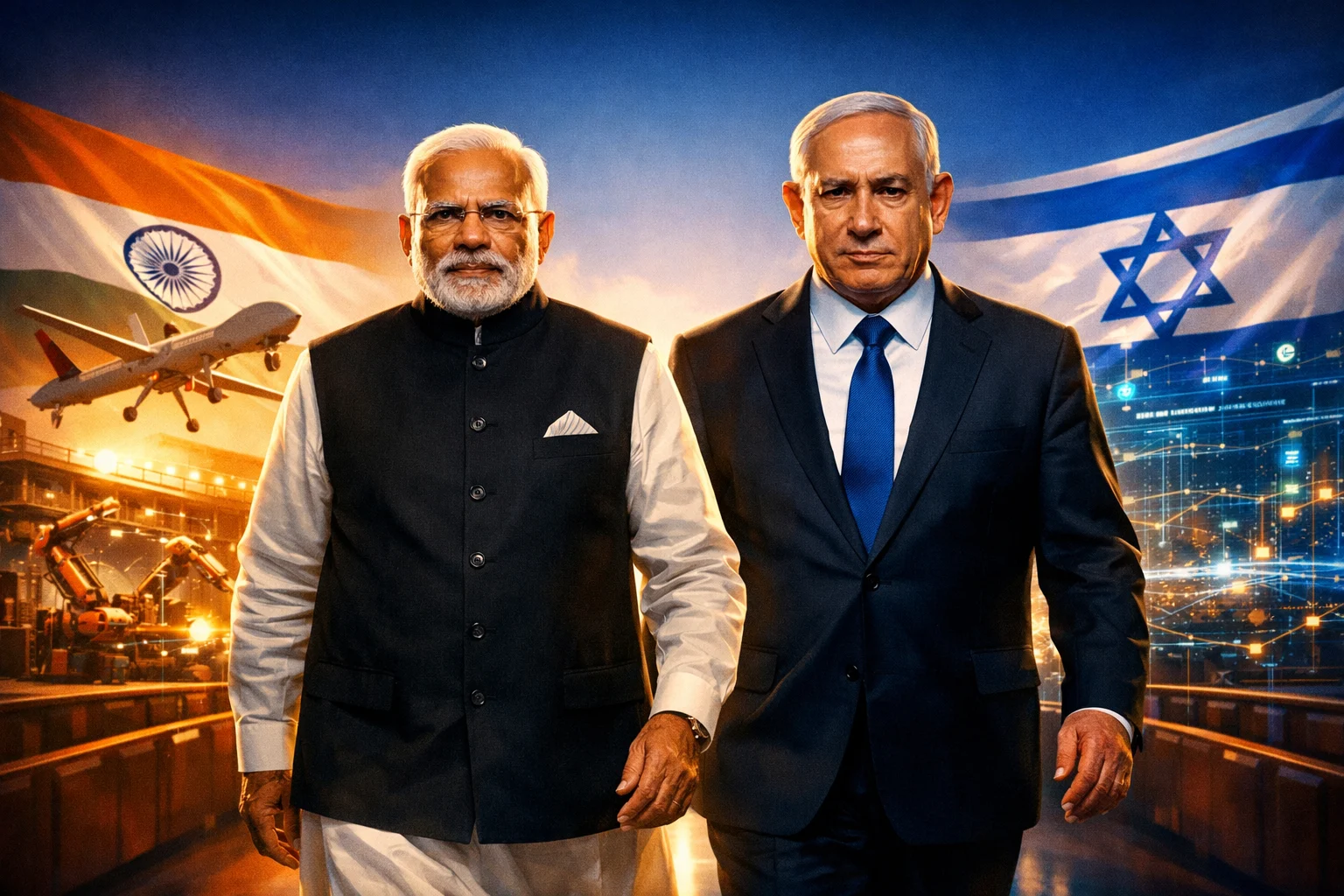
Recently, Israeli Prime Minister Benjamin Netanyahu publicly told his citizens something striking: Israel is “insanely popular” in India — a country of over 1.4 billion people — and India’s Prime Minister Narendra Modi will soon be visiting Israel.
This was not casual praise.
This was strategic messaging.
At a time when Israel is facing rising global criticism, the emphasis on the Israel India strategic partnership carries deep geopolitical meaning.
Why emphasize India now?
Because timing matters.
Israeli Prime Minister Benjamin Netanyahu:
— Megh Updates 🚨™ (@MeghUpdates) February 16, 2026
Who’s coming here next week? Narendra Modi. Tremendous alliance between Israel and India, and we are going to discuss all sorts of cooperation. Now, you know, India is not a small country. It has 1.5 billion people. In India, Israel is… pic.twitter.com/8AGpnZp0Vk
Why Netanyahu Highlighted India Now
Israel is navigating one of the most difficult diplomatic periods in recent years. Following the Gaza conflict, criticism has intensified across parts of Europe and the United States. Voices that historically supported Israel have become more cautious, and in some spaces openly critical.
Simultaneously, online narratives — especially across social media platforms like X — have amplified anti-Israel sentiment. Studies and reports have highlighted the spread of antisemitic rhetoric and disinformation in digital spaces.
At the Second International Conference on Combating Antisemitism in Jerusalem, initiated by Minister @AmichaiChikli, I made one thing clear: antisemitism is not just a Jewish problem. It is a threat to free societies, to democracy, and to our shared civilization.
— Benjamin Netanyahu – בנימין נתניהו (@netanyahu) January 27, 2026
History teaches… pic.twitter.com/h3pLDHOXJ6
The perception inside Israel is increasingly clear: global respect feels diminished.
That perception matters in geopolitics.
When Netanyahu reminded Israelis that India supports Israel — and that Israel remains popular among Indian citizens — he was addressing a psychological dimension of foreign policy: legitimacy and recognition.
This was not symbolic reassurance.
It was geopolitical positioning.
Sources: Report – ISD Global
Rising Global Criticism and the Respect Question
Public discourse in parts of the US and Europe has included criticism of Israel’s military conduct. Social media narratives have gone further, sometimes promoting conspiracy theories without verified evidence.
Such developments have had reputational consequences.
Some Israeli officials have faced legal or political hostility abroad. Certain jurisdictions have signaled that diplomatic visits could trigger legal complications.
This creates constraints.
And constraints force recalibration.
If traditional Western consensus weakens, Israel must diversify its diplomatic and economic anchors. That is where the Israel India strategic partnership becomes central.
Sources: UN News, The Guardian, MOFA Palestine
Israel’s Shift: From US Aid to Self-Reliance
One of the most significant declarations from Netanyahu concerns financial strategy.
He outlined a long-term plan: within approximately ten years, Israel intends to phase out the financial component of US military aid and transition toward a partnership model instead of an aid model.
That is a major shift.
The goal is clear:
- Build an independent arms industry
- Expand domestic defense manufacturing
- Move from “aid recipient” to “co-investment partner”
In his framing, the future relationship with the United States would evolve from financial assistance to joint investment and shared technological development.
This reflects a broader strategic ambition: a self-reliant Israel defense ecosystem.
And self-reliance requires markets.
Sources: US–Israel MoU- The White house,
The Defense Industry Expansion Model
Israel already possesses a strong defense technology base. The next phase involves scaling production, expanding exports, and creating steady revenue through global arms sales.
Instead of relying on predictable aid flows, the strategy aims to generate continuous revenue streams through weapons exports and industrial partnerships.
Here’s what that implies:
- Increased collaboration with foreign defense firms
- Co-production models
- Expanded export markets
- Joint ventures across continents
Large-scale global wars may be unlikely.
But localized conflicts persist — in Africa, South Asia, and elsewhere. Defense suppliers often benefit from these dynamics.
This is the structural shift.
Israel wants autonomy through industry.
Sources: Times of Israel
Where India Fits in This Transition
India is not just another diplomatic partner.
India is a large and rapidly growing economy. It is also modernizing its defense capabilities under its broader strategic autonomy framework.
For Israel’s self-reliance ambitions to succeed, partnerships with major economies become critical.
India fits that profile.
The Israel India strategic partnership increasingly includes:
- Defense co-development
- Technology sharing
- Industrial collaboration
- Expanding private sector ties
Unlike China, where geopolitical complexities limit deep security integration, India offers a more compatible strategic alignment.
That alignment is not accidental.
It has been built over years of diplomatic and defense cooperation.
But this moment elevates it.
If Israel transitions from aid dependence to export-led defense growth, India becomes a pivotal economic partner.
That’s the strategic pivot.
Sources: The Print, Embassy of India, Israel, Globes
The Pakistan Silence That Matters
An interesting geopolitical contrast emerges when considering Pakistan.
US President Donald Trump has at times praised Pakistan’s military capabilities. However, Israeli officials have not publicly embraced security roles for Pakistan in Gaza or elsewhere.
In fact, some Israeli ministers have expressed caution regarding trust in countries like Pakistan or Turkey.
That silence speaks volumes.
In geopolitics, endorsement matters.
Equally, non-endorsement matters.
While rhetoric around Pakistan exists in some US political circles, Israel’s practical focus appears directed elsewhere — notably toward India.
This reinforces the centrality of the Israel India strategic partnership in Israel’s evolving foreign policy.
What Changes From Here?
If Netanyahu’s outlined trajectory proceeds:
- Israel reduces dependence on US financial military aid.
- Defense manufacturing expands aggressively.
- Partnerships shift toward co-investment and joint development.
- India’s strategic role increases significantly.
For India, this presents opportunity:
- Greater defense co-production
- Expanded technology access
- Stronger geopolitical alignment in West Asia
But it also implies responsibility.
Deeper integration means closer alignment during periods of international controversy.
This is where it gets interesting.
As Israel seeks to counter diplomatic isolation, India’s engagement becomes more visible — and more consequential.
The move has been made.
Now the consequences unfold.
FAQs
Why did Netanyahu say Israel is popular in India?
He emphasized India’s support to reassure Israeli citizens during a period of rising global criticism. India represents a large democratic nation where Israel enjoys favorable perception, making it strategically significant.
Is Israel planning to stop taking US military aid?
Netanyahu indicated a long-term goal of phasing out the financial component of US military aid over roughly a decade and transitioning toward joint investment and partnership models.
How important is India for Israel’s defense industry?
India is increasingly important as Israel seeks industrial partnerships, co-production opportunities, and expanded defense exports. India’s large economy and defense modernization make it a key partner.
What is the significance of Modi’s visit to Israel?
The visit signals diplomatic backing at a time when Israel faces criticism. It also strengthens strategic and defense cooperation frameworks between the two nations.
Is Israel becoming self-reliant in defense manufacturing?
Israel aims to expand its domestic arms industry and reduce reliance on foreign financial aid. The focus is on exports, partnerships, and industrial growth to ensure long-term autonomy.
Conclusion
The Israel India strategic partnership is no longer just a diplomatic headline.
It is part of a structural shift.
Israel is recalibrating — from aid dependence to industrial self-reliance. From limited diplomatic circles to diversified partnerships. From financial assistance to strategic co-investment.
India stands at the center of that transformation.
The emphasis was deliberate.
The direction is clear.
History has entered a new phase — and this alignment may shape the next decade of West Asian geopolitics.
Strategic Reflection – Share Your Views
As the Israel India strategic partnership enters this decisive phase, the larger question is not whether the relationship is strengthening — it clearly is.
The real question is how far this transformation will go.
Will Israel successfully transition from aid dependence to defense self-reliance?
Will India deepen its industrial and geopolitical engagement?
And how will global power dynamics adjust to this emerging alignment?
The strategic shift has begun.
Now the world watches how it unfolds. Share Your Views
If you follow geopolitics closely, the Israel India Strategic partnership is worth tracking — because its implications will extend far beyond bilateral diplomacy.
Explore more about World Affairs , Indian Affairs and Strategic Depth.