Table of Contents
A Warm Welcome in Tel Aviv
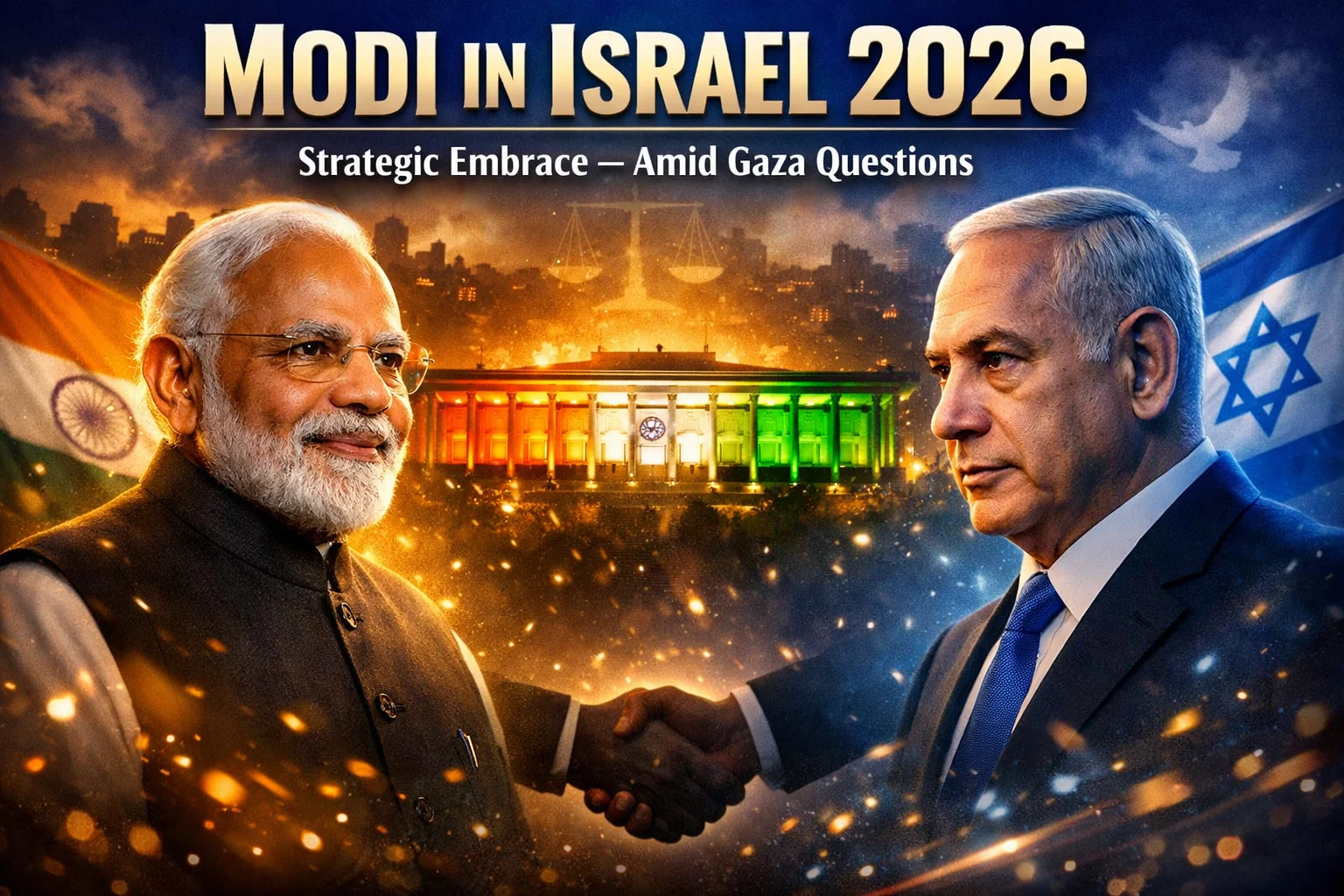
The PM Modi Israel visit 2026 is already being described as one of the most significant diplomatic engagements of the year. Prime Minister Narendra Modi is set to travel to Israel for the second time in nine years — a visit that carries symbolic and strategic weight.
Israeli media has signaled unusual enthusiasm. The front page of The Jerusalem Post featured Modi prominently, with “Namaste” displayed in Devanagari and Hebrew welcome messages highlighting “two ancient nations opening a new chapter.”
The tone is unmistakably warm.
It is indeed a historic visit to Israel. I’m confident it will add new momentum to the bilateral friendship between our nations. https://t.co/3dZpsf4Tqt
— Narendra Modi (@narendramodi) February 25, 2026
Why This Visit Is Symbolically Powerful
Israel’s parliament, the Knesset, has been illuminated in the colors of the Indian tricolor in tribute to the visit.
Honoured by the gesture. Looking forward to addressing the Knesset later today. @KnessetENG https://t.co/0PaG9Nutmy
— Narendra Modi (@narendramodi) February 25, 2026
This symbolism reinforces a narrative long emphasized by both sides:
- Two ancient civilizations
- Deepening defense cooperation
- Innovation partnerships
- Strategic alignment in West Asia
Israel traces historical roots to ancient kingdoms such as that of King Solomon. India, as one of the world’s oldest continuous civilizations, shares that civilizational narrative.
This framing is deliberate.
It elevates the visit beyond routine diplomacy.
The Gaza Question Hanging Over the Visit
However, the PM Modi Israel visit 2026 comes at a deeply sensitive moment.
The Gaza conflict continues to dominate international headlines. Prominent political figures in India, including Priyanka Gandhi, have urged Modi to raise the humanitarian situation in Gaza while addressing the Knesset.
I hope that the Hon Prime Minister @narendramodi ji mentions the genocide of thousands of innocent men, women and children in Gaza while addressing the Knesset on his upcoming trip to Israel and demands justice for them. India has stood for what is right throughout our history as…
— Priyanka Gandhi Vadra (@priyankagandhi) February 25, 2026
Her appeal centers on whether India should speak openly about civilian suffering during the visit.
That creates a diplomatic dilemma.
Should India prioritize strategic partnership?
Or emphasize humanitarian accountability?
This is where the visit becomes geopolitically complex.
Sources: Times of India, WION
Civilian Casualties and Global Legal Pressure
A study published in The Lancet Global Health suggested that the death toll in Gaza during the first 16 months of conflict may exceed 75,000, including a high proportion of women, children, and elderly individuals.
Meanwhile, investigations referenced by the United Nations Human Rights Council have raised serious allegations regarding conduct in the conflict.
Israel has rejected genocide allegations and maintains that it attempts to minimize civilian harm, though outcomes remain highly contested.
The humanitarian numbers are stark.
And they shape global perception.
Sources: The Lancet Global Health – Study, Middle East Eye, BBC
ICC Arrest Warrant and Diplomatic Complications
The International Criminal Court has reportedly issued an arrest warrant against Israeli Prime Minister Benjamin Netanyahu related to alleged war crimes.
On paper, ICC member states would be obligated to detain him if he entered their territory.
In practice, geopolitics complicates enforcement.
But the legal shadow exists.
This adds diplomatic baggage to any high-profile engagement with Israel.
Sources: International Criminal Court, ICC Member States
How Israelis View India
Despite controversy surrounding Gaza, public opinion data suggests Israel views India positively.
In several global perception surveys, Israel ranks among the top countries where India enjoys favorable ratings. In some findings, more than 60% of Israelis hold a favorable view of India, while negative views remain comparatively low.
This goodwill is not accidental.
It stems from:
- Defense cooperation
- Technology exchange
- Water management collaboration
- Shared counterterror narratives
Israel understands India’s domestic public sentiment remains largely positive toward bilateral ties.
Source: Pew Research Centre, Haaretz, NDTV
India’s Balancing Act: Strategy and Responsibility
The PM Modi Israel visit 2026 forces India into a classic diplomatic balancing act.
On one side:
- Advanced defense technology
- Missile collaboration
- Strategic West Asian positioning
- Innovation ecosystems
On the other:
- Gaza humanitarian crisis
- UN scrutiny
- ICC legal processes
- India’s historical support for Palestinian reconstruction
India has already contributed approximately $80 million in aid to Palestine over the past decade.
Future reconstruction efforts in Gaza may require expanded support.
So the question becomes: Can India deepen Israel ties while publicly supporting humanitarian reconstruction?
That balance defines strategic maturity.
Reconstruction, Aid, and the Road Ahead
India’s approach may focus on reconstruction rather than confrontation.
Calling for:
- Ceasefire frameworks
- Civilian protection
- Gaza rebuilding initiatives
would allow India to remain consistent with its historical foreign policy identity while preserving strategic ties.
Israel, however, is sensitive to external criticism during high-profile visits.
No leader wants a guest to lecture from their own parliament floor.
Whether Modi raises the issue directly — or frames it diplomatically — remains to be seen.
But silence and statement both carry consequences.
Sources: Times of India
Conclusion: A Visit Beyond Ceremony
The PM Modi Israel visit 2026 is not merely ceremonial.
It sits at the intersection of:
- Strategic defense alignment
- Civilizational symbolism
- Humanitarian controversy
- Global legal scrutiny
India today is not a peripheral actor. It is a major power navigating complex alignments.
How Modi addresses — or avoids — the Gaza issue may define not only this visit, but India’s evolving Middle East posture.
Diplomacy at this level is rarely black and white.
It is calibrated.
And calibration, in moments like this, matters.
FAQs
Why is PM Modi Israel Visit 2026?
PM Modi Israel Visit 2026 aims to deepen strategic, defense, and innovation ties between India and Israel while reinforcing bilateral partnership.
Will India condemn Israel over Gaza?
There is no confirmed position regarding a direct condemnation during the visit. India historically balances strategic ties with humanitarian concerns.
What is the ICC warrant against Netanyahu?
The ICC has reportedly issued an arrest warrant related to alleged war crimes. Israel disputes the allegations.
Does India support Palestine?
Yes. India has historically supported Palestinian reconstruction efforts and has provided financial aid over the years.
How strong are India–Israel relations?
Relations are robust, especially in defense, agriculture, water technology, and innovation sectors.
Share Your Perspective
Should India publicly raise the Gaza issue during the visit?
Or prioritize long-term strategic cooperation?
Can India maintain moral positioning while strengthening defense ties?
Your assessment matters in understanding India’s evolving global role.
Share Your Views in the Comments below.
Read more about India’s planned acquisition of the Israel’s Golden Horizon Missile and Explore more about World Affairs and Indian Affairs.