Table of Contents
A Historic Knesset Address
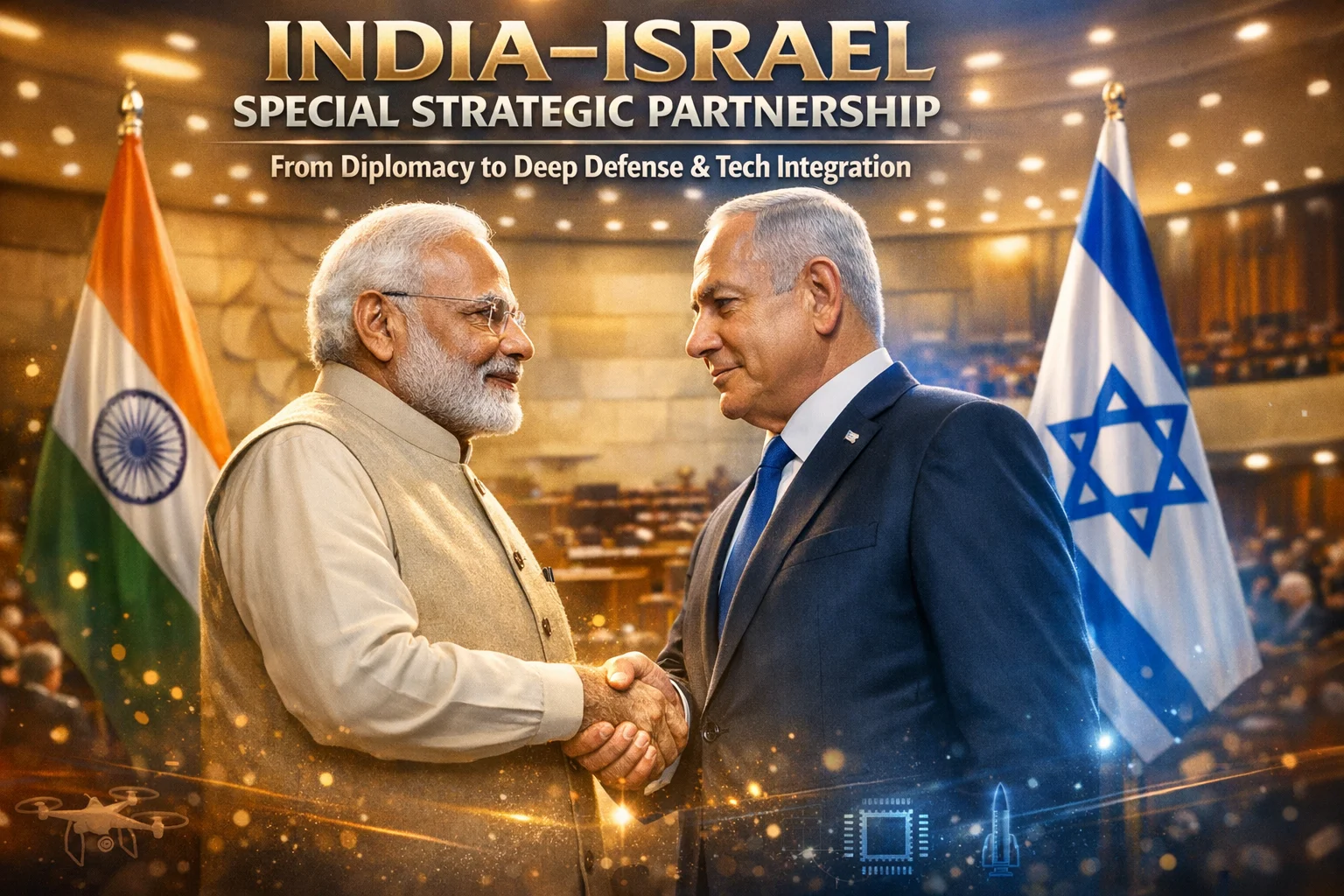
The India Israel special strategic partnership reached a new milestone during Prime Minister Narendra Modi’s recent visit to Israel. The trip concluded with a landmark address to the Knesset — making him the first Indian Prime Minister to speak in Israel’s parliament.
Israel has extended this honor to very few global leaders in recent years, including Donald Trump.
That context matters.
Parliamentary addresses are symbolic. They signal political trust at the highest institutional level.
Why the Opposition Walked Out — And Returned
One headline that generated confusion was the Israeli opposition “walkout” during Modi’s address.
In reality, it was a partial and temporary walkout.
Yair Lapid clarified that the protest was not directed at Modi or India. The opposition lawmakers briefly exited the chamber to protest the exclusion of Israel’s Supreme Court leadership from the session — a domestic judicial issue involving Prime Minister Benjamin Netanyahu.
They returned before Modi’s speech.
This was about Israeli internal politics — not India.
Context is critical.
A Friend In Tough Times!
— MyGovIndia (@mygovindia) February 26, 2026
Yair Lapid, Leader of the Opposition in Israel, praised PM @narendramodi, saying, “PM Modi was here in our time of trouble.” A heartfelt acknowledgment of India’s unwavering solidarity.#PMModiInIsrael pic.twitter.com/UgGg4Kt4k6
Sources: National Herald, India Today
From Strategic to Special Strategic Partnership
The central diplomatic development of the visit was the elevation of bilateral ties to a Special Strategic Partnership.
This is not rhetorical decoration.
It marks a formal upgrade from a “Strategic Partnership” to a deeper institutional alignment, covering:
- Defense
- Technology
- Innovation
- Economic integration
Such designations shape future policy frameworks.
They guide bureaucracies.
They unlock new projects.
What the 16 Agreements Signal
India and Israel signed 16 agreements during the visit.
These span:
- Joint development and production in defense
- Technology transfer mechanisms
- Scientific cooperation
- Trade facilitation discussions
While no major missile deal was finalized immediately, the groundwork has clearly been laid for future high-value defense announcements.
Foundation precedes execution.
Sources: DD News
Defense Cooperation: The Next Phase
Modi explicitly stated that India and Israel will pursue:
- Joint development
- Joint production
- Transfer of defense technology
That is a shift from buyer–seller dynamics toward co-development.
Israel currently faces strategic pressure in the region, including ongoing tensions involving Iran. For India, Israeli technology has long been critical in:
- Air defense
- UAV systems
- Missile technology
Expect major defense-related announcements in the coming months.
This trajectory appears structural, not temporary.
UPI, Workers, AI and FTA Talks
Beyond defense, practical cooperation expanded:
- Israel accepted India’s UPI system for payments.
- A quota of 500 additional Indian workers was approved.
- AI and scientific research collaboration was enhanced.
- Free Trade Agreement (FTA) discussions advanced.
These steps reflect economic and technological integration — not just symbolic alignment.
This partnership is multi-layered.
Sources: Ministry of External Affairs – Government of India
The October 7 Reference and Political Messaging
In his speech, Modi referenced the October 7, 2023 attack by Hamas on Israel and stated that India “stands firmly with Israel.”
That is a strong formulation.
Few global leaders use such direct language inside Israel’s parliament during a volatile regional moment.
For Israeli citizens — many of whom feel diplomatically isolated — this messaging carries emotional weight.
Geopolitics is not only transactional.
It is psychological.
Sources: News on Air, The Hindu
The “Fatherland” Controversy Explained
A clipped portion of Modi’s speech circulated online suggesting he called Israel a “fatherland.”
The full context clarifies otherwise.
He was referring specifically to the Indian-origin Jewish community that migrated to Israel in the 20th century. For that community, he said, Israel is their fatherland and India their motherland.
The statement was not a general declaration redefining India’s identity.
Selective clipping altered the perception.
Again, context is everything.
#WATCH | There was movement from India to Israel, too. When many Indian Jews migrated to Israel in the mid-20th century. Today, a vibrant Indian origin Jewish community lives here. They are contributing to the building of modern Israel in laboratories and hospitals, in… pic.twitter.com/NEFBC7MNkl
— DD News (@DDNewslive) February 25, 2026
What This Means for West Asia
The India Israel special strategic partnership strengthens India’s West Asia positioning at a sensitive time.
Key implications include:
- Deeper defense integration
- Stronger Mediterranean connectivity
- Increased technological collaboration
- Clear diplomatic signaling
Israel, for its part, signaled appreciation through high-level ceremonial gestures, including Netanyahu personally receiving and seeing off Modi.
Symbolism was matched by substance.
Thank you Israel, for the warmth and affection.
— Narendra Modi (@narendramodi) February 26, 2026
Deeply touched that Prime Minister Netanyahu and Mrs. Netanyahu personally came to the airport to see me off.
Confident that the India–Israel partnership will continue to reach new heights in the years to come.@netanyahu pic.twitter.com/TgGsIsXOJY
Conclusion: A Structural Shift, Not a Symbolic Visit
This visit was not ceremonial diplomacy.
It institutionalized a higher tier of partnership.
The elevation to a Special Strategic Partnership, combined with defense co-development language, UPI expansion, worker mobility, and AI collaboration, suggests a durable strategic alignment.
Domestic Israeli politics briefly intersected with the visit.
But the core trajectory is clear.
India and Israel are moving into a deeper phase of cooperation — particularly in defense and technology.
And that shift will likely define bilateral ties for years to come.
FAQs
Why did Israeli opposition boycott Modi’s speech?
It was a temporary walkout linked to Israeli judicial politics, not directed at Modi or India.
What is a India Israel Special Strategic Partnership?
India Israel Special Strategic Partnership is an upgraded diplomatic classification indicating deeper institutional cooperation across defense, technology, and economic sectors.
How many agreements were signed?
India and Israel signed 16 agreements during the visit under India Israel Special Strategic Partnership.
Did Modi officially support Israel?
In his speech, Modi stated that India stands firmly with Israel, referencing the October 7 attack.
Is India–Israel defense cooperation increasing?
Yes. Both sides committed to joint development, production, and technology transfer in defense.
Share Your Perspective
Do you believe the India Israel special strategic partnership marks a long-term strategic shift?
Or is this alignment primarily defense-driven and situational?
Write your assessment below — serious geopolitical transitions deserve serious analysis.
Explore more about World Affairs and Indian Affairs.