Table of Contents
Ayatollah Ali Khamenei Killed: The Announcement
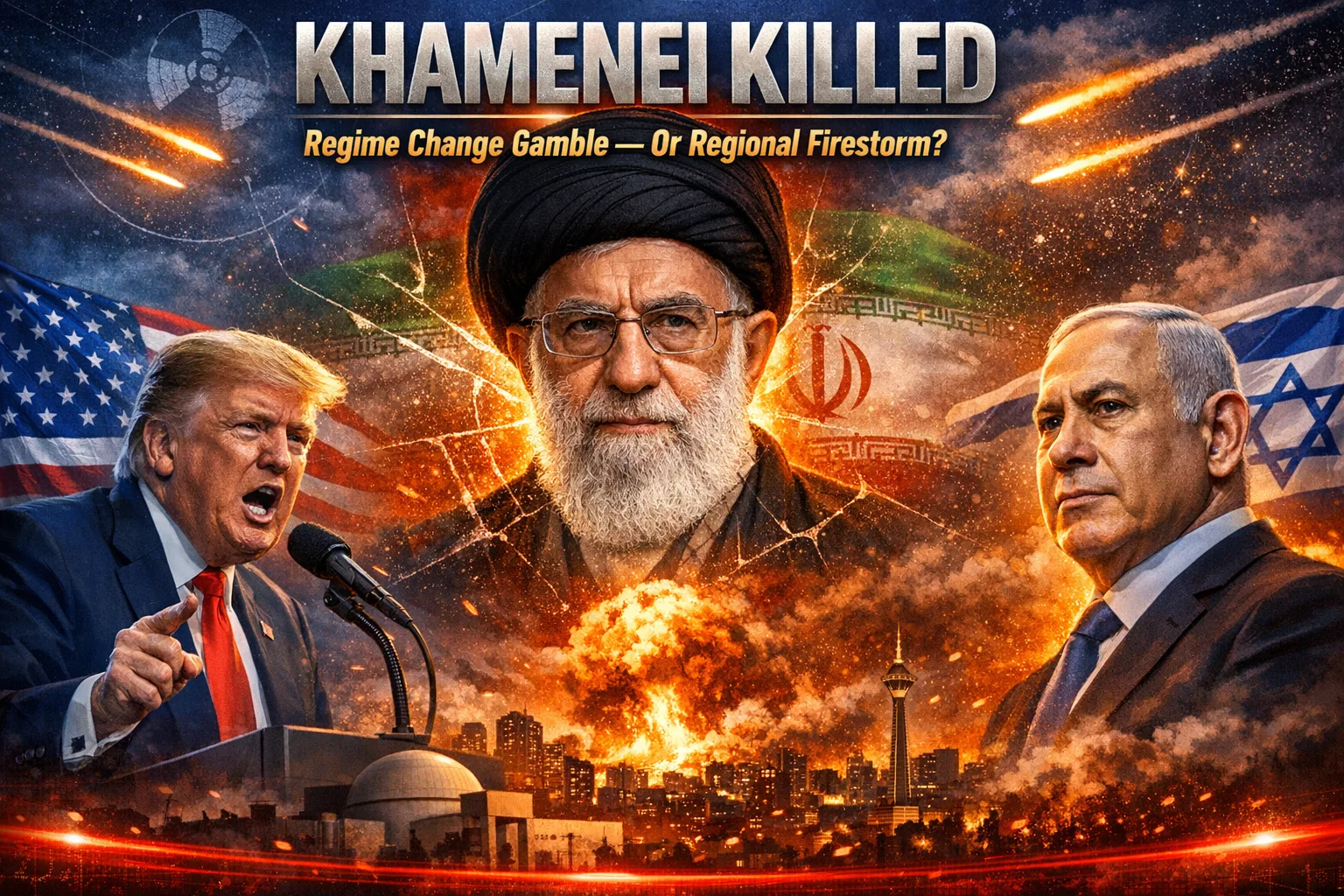
The claim that Ayatollah Ali Khamenei killed in a missile strike has triggered immediate geopolitical shockwaves.
Donald Trump and Benjamin Netanyahu both publicly announced that Iran’s Supreme Leader, Ayatollah Ali Khamenei, had been eliminated in a precision strike.
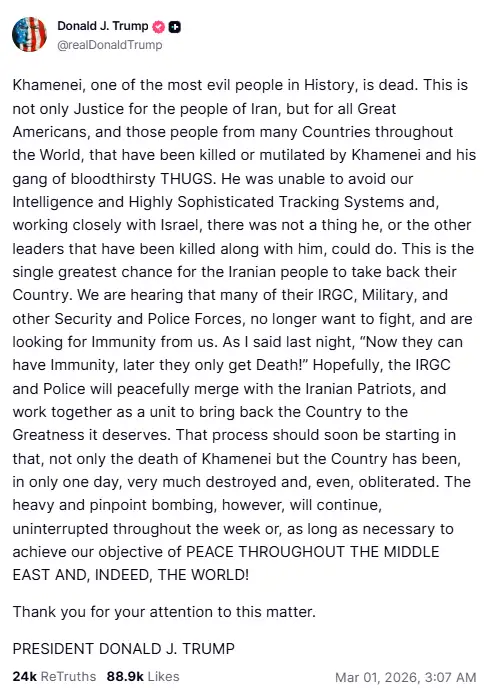
Screenshot of a Truth Social post by Donald Trump
Trump described him as “one of the most evil people in history” and framed the strike as a victory for the Iranian people. He further claimed US intelligence had tracked his location accurately and that there was nothing Khamenei or other leaders killed alongside him could have done to avoid the strike.
He went further.
Trump openly encouraged Iranian citizens to take to the streets and push for regime change. He also signaled potential immunity to security forces if they refused to suppress protests.
That is not a subtle message.
It is strategic signaling.
Immediate Reactions Inside Iran
Inside Iran, early visuals showed shock, mourning, and anger.
Mosques filled with grieving crowds.
अपने सर्वोच्च नेता खामेनेई के निधन के बाद उमड़े शोक के दृश्य ईरान के मीडिया में दिखाए जा रहे हैं।
— Dr. Sheetal yadav (@Sheetal2242) March 1, 2026
नेता के प्रति इतना प्रेम……ये तो अदभुद है।🤔#Tehran #Khameneidead pic.twitter.com/CfKDxDc0s8
State media anchors reportedly broke down while announcing the news. Background audio from studios suggested even production crews were emotional.
Anchor breaks down while announcing the death of Iran's supreme leader Ayatollah #Khameini #Khameini_ir pic.twitter.com/mtBBJhQZp0
— aditi tyagi (@aditi_tyagi) March 1, 2026
This reaction matters.
If the majority were strongly anti-government, messaging tone may have looked different. Instead, public broadcasts reflected grief and calls for revenge.
At the same time, unverified videos circulated allegedly showing isolated anti-government gatherings.
‘SEE IT: A crowd in southern Iran was seen toppling a statue of Supreme Leader Ali Khamenei. pic.twitter.com/fOAMwF6iBh
— Fox News (@FoxNews) March 1, 2026
Both narratives now exist simultaneously:
- Mourning and revenge
- Hope for regime change
Which one dominates will shape what comes next.
Trump and Netanyahu’s Strategic Messaging
Trump’s announcement did more than confirm a strike.
It attempted to shape Iran’s internal trajectory.
He called on citizens to reclaim their country and hinted that security forces could receive protection if they defected.
Meanwhile, Netanyahu has long positioned Iran’s leadership as the core threat in the region.
If regime change follows, this would represent a major US–Israel strategic win.
If not, the strike may unify factions inside Iran instead.
This is the gamble.
Precision Strike on Tehran Compound
Visual comparisons of Khamenei’s Tehran compound show targeted destruction.
Before-and-after imagery suggests high-precision impact focused on the specific complex.
Compound of Iran's supreme leader before and after strikes pic.twitter.com/kGwx9hKG4a
— OSZ (@OpenSourceZone) February 28, 2026
Earlier Israeli and US strikes across Tehran were already described as highly selective, aimed at military-linked targets.
This reinforces the message Washington and Tel Aviv want to project:
We can reach you anywhere.
Precision is not just tactical.
It is psychological.
Sources: News18
Iran’s Warning at the United Nations
Iran’s ambassador to the United Nations issued a firm response.
He advised the US representative to “be polite,” implying that arrogance would worsen consequences. Iran’s government has shown no signs of surrender.
🚨🇮🇷🇺🇸 Iran’s representative advises the U.S. envoy to be polite at the UN Security Council 🏛️ #Iran #USA #UNSC #TheGlobalJournal
— The Global Journal (@theglobaljourna) March 1, 2026
🎥Footage courtesy: @FoxNews pic.twitter.com/MCSkhjAqYv
Instead, messaging emphasizes retaliation.
That stance aligns with ongoing missile activity across Gulf cities in recent hours.
Retaliation, Missiles, and Escalation Signals
Iran has already demonstrated willingness to launch missile strikes across the region, including near Dubai, Kuwait, and Qatar.
The next escalation threshold being monitored closely is this:
Will Iran attempt to strike a US aircraft carrier?
Iranian officials have previously referenced advanced missile capabilities, including hypersonic systems allegedly linked to Russian and Chinese cooperation.
If such a strike were successful, escalation dynamics would change dramatically.
Some analysts warn that damage to a US carrier would trigger overwhelming retaliation.
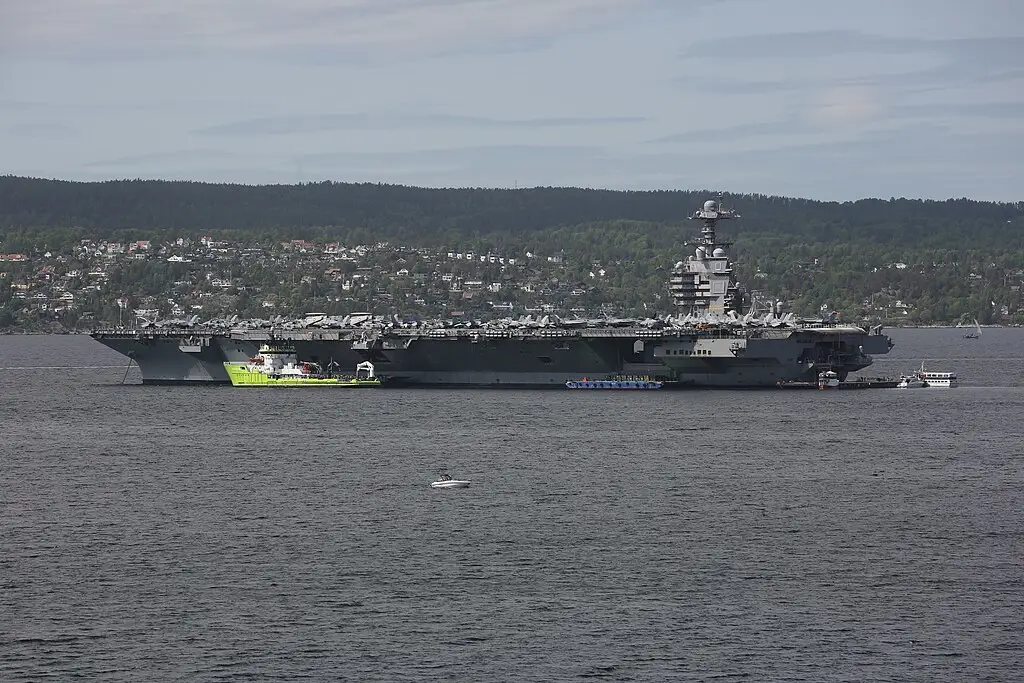
Image Credit: Hans A. Rosbach, CC BY-SA 4.0 via Wikimedia Commons
Image used for Illustrative and representational purpose only.
This is where the ladder becomes steep.
Very steep.
Russia, China, and the Strategic Balance
Russia has warned that ongoing strikes risk triggering a radiological catastrophe, hinting at nuclear escalation dangers.
If regime change occurs in Tehran, it would represent a geopolitical setback for both Russia and China, who have deepened ties with Iran in recent years.
If Iran survives and retaliates effectively, US credibility becomes the variable under scrutiny.
This is no longer just about one leader.
It is about strategic alignment in Eurasia.
Sources: Economic Times
What This Means for India and the Region
India is not directly involved.
But instability in Iran affects:
- Oil supply routes
- Indian diaspora safety in Gulf states
- Indian Ocean security dynamics
Protests have already been reported in parts of Jammu & Kashmir reacting to the news.
Energy markets will monitor developments closely. Any expansion of conflict toward the Strait of Hormuz would have global price implications.
India’s strategic posture remains cautious.
But exposure to economic ripple effects is real.
Conclusion: A Regime Change Gamble or Regional Firestorm?
The claim that Ayatollah Ali Khamenei killed marks a turning point.
Either:
- It accelerates regime instability inside Iran
- Or it consolidates national resistance and deepens retaliation
US leadership has framed this as an opportunity for transformation.
Iran’s leadership is framing it as a call for revenge.
The coming days will determine which narrative prevails.
If Iran escalates toward naval targets or nuclear signaling, the crisis widens.
If internal fracture emerges, the map of the Middle East may shift permanently.
History rarely pauses at moments like this.
It accelerates.
FAQs
Is Ayatollah Khamenei really dead?
US and Israeli leadership announced his death. Independent verification from Iranian state authorities would determine final confirmation.
Did Trump announce Khamenei’s death?
Yes, President Donald Trump publicly declared that Khamenei had been killed in a missile strike.
How will Iran respond?
Iran has signaled retaliation and has already launched missile strikes across parts of the Gulf region.
Could this lead to World War 3?
Escalation risks increase if US naval assets are targeted or nuclear signaling emerges, but outcomes remain uncertain.
Is regime change possible in Iran?
US messaging encourages public uprising, but internal unity versus fragmentation will determine feasibility.
Strategic Watchpoint
Three developments will define the trajectory:
- Verified confirmation from Iranian authorities
- Scope of Iranian retaliation
- Any targeting of US naval assets
Because once leadership decapitation meets open retaliation, containment becomes far more difficult.
And the Middle East enters uncharted terrain.
Share Your Views in the Comments below.
Explore more about Defense & Security and World Affairs.