Table of Contents
Why India Sends Aid to Iran During War Matters
The moment India sends aid to Iran, it signals more than just diplomacy—it reflects a deeper humanitarian and geopolitical calculation.
As the conflict involving Iran and the United States crosses the 20-day mark, thousands have already been killed. Many more are injured.
Here’s what that means.
This is no longer just a military conflict.
It is now a humanitarian crisis.
And India’s response is entering that space deliberately.
Sources: The Economic Times, Hindustan Times
India’s Humanitarian Response in a War Zone
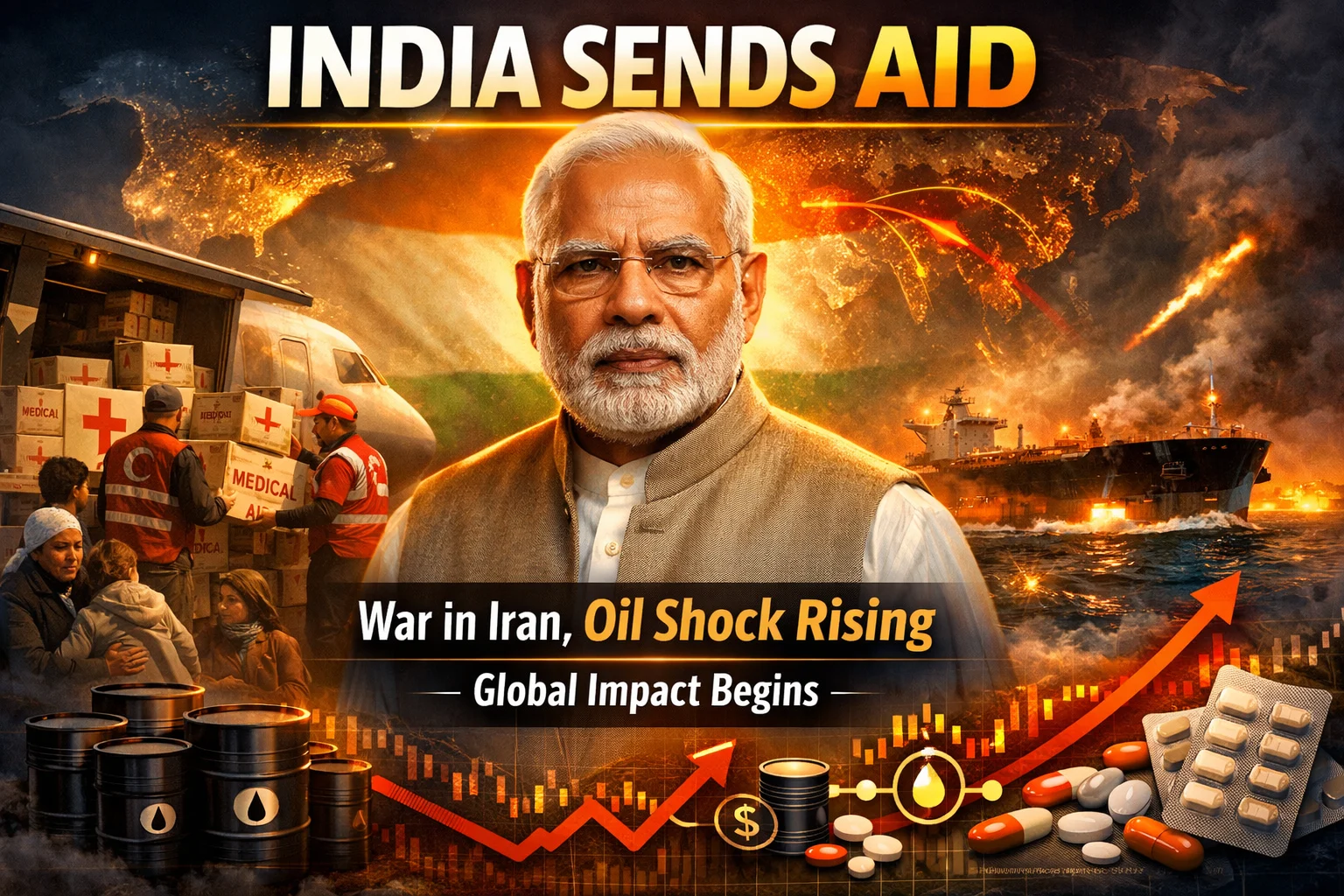
India has sent its first shipment of medical aid to Iran.
The supplies were delivered to the Iranian Red Crescent Society, the country’s equivalent of the Red Cross.
Iran officially thanked India, stating:
“We sincerely thank the kind people of India.”
Embassy of the Islamic Republic of Iran in India says, "The first shipment of medical aid from the esteemed people of India has been delivered to the Iranian Red Crescent Society. We sincerely thank the kind people of India."
— ANI (@ANI) March 18, 2026
(Video source: Embassy of the Islamic Republic of… pic.twitter.com/6LobbWCdmY
This was not symbolic.
It was operational.
India’s foreign policy has long followed a pattern:
- Help civilians during crises
- Separate humanitarian action from political disagreements
We’ve seen this before.
- Earthquake relief in Turkey
This was deliberate.
Even when geopolitical alignments are complex, India’s humanitarian posture remains consistent.
Sources: Times of India, Money Control, NDTV
What Is Happening Inside Iran Right Now
The situation inside Iran is deteriorating rapidly.
- Continuous bombing across multiple cities
- Thousands dead, many more injured
- Severe shortage of medicines
This creates a cascading crisis:
No medicines → untreated injuries → rising fatalities
And here’s the critical distinction:
This is not about governments anymore.
This is about civilians.
People with no role in nuclear policy or military strategy are bearing the consequences.
The Strait of Hormuz Pressure Point
Now look beyond the battlefield.
The real pressure point lies in the Strait of Hormuz.
This narrow passage connects the Persian Gulf to global shipping routes.
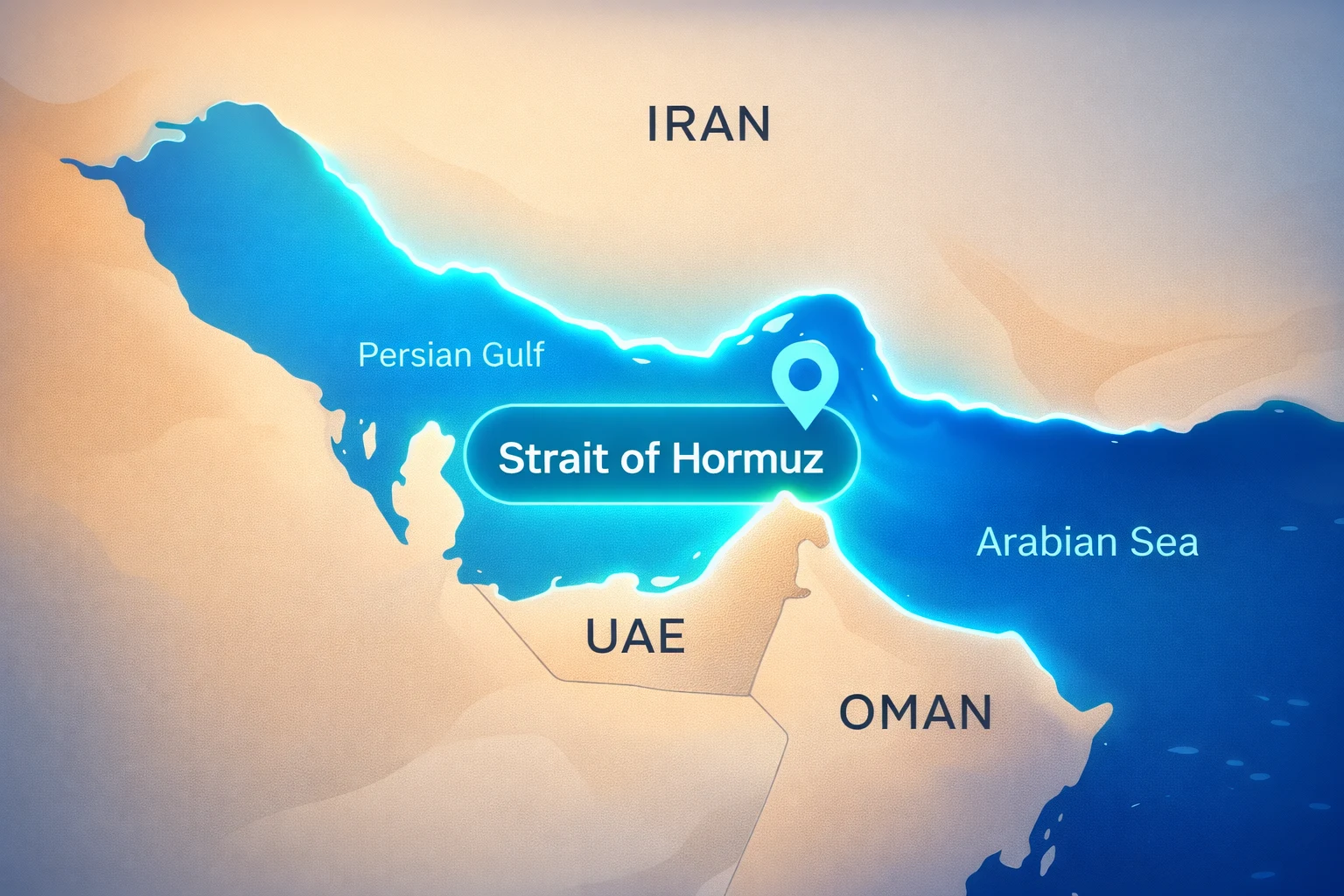
Image credit: AI-generated using ChatGPT by OpenAI
And it operates on just two active shipping lanes:
- One for outgoing oil tankers
- One for incoming vessels
That’s it.
This is where things shift.
Due to repeated attacks and rising tensions:
- Ships are avoiding the route
- Insurance costs are rising
- Oil transport is slowing
As a result:
Global oil prices have crossed $110 per barrel
Iran has even warned prices could reach $200 per barrel.
That’s not just a number.
That’s a global shock trigger.
Sources: The Wall Street Journal, Reuters
How Oil Prices Connect to Medicine Costs
At first glance, oil and medicine seem unrelated.
But they are deeply connected.
Here’s how:
Medicines are made using Active Pharmaceutical Ingredients (APIs).
And APIs depend—indirectly—on crude oil.
- Chemical synthesis processes use petroleum-based inputs
- Manufacturing and transport depend on fuel
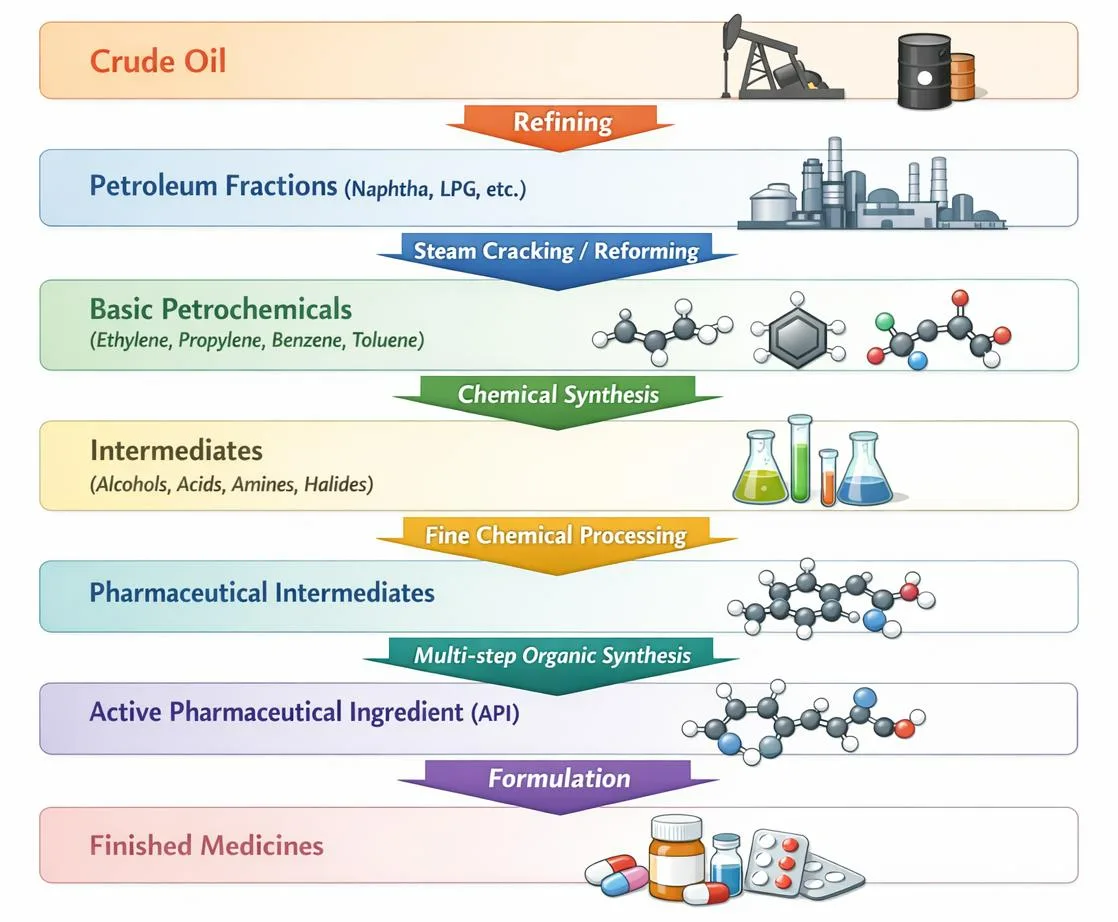
Image credit: AI-generated using ChatGPT by OpenAI
So when oil prices rise:
- ➡ API costs increase
- ➡ Production costs rise
- ➡ Medicine prices go up globally
This is a structural chain reaction.
The shift is structural.
And it affects everyone—not just conflict zones.
What This Means for India’s Economy
Interestingly, India has managed to keep domestic fuel prices relatively stable.
Compared to global spikes:
- Fuel prices in India remain controlled
- Inflation is still under 4% (around ~3.2%)
That matters.
Because stable fuel prices:
- Help control food inflation
- Reduce pressure on transport costs
- Support economic stability
But not everything can be contained.
If API prices rise globally:
- ➡ Medicine prices in India will increase
- ➡ Healthcare costs will rise
Even if fuel remains stable.
That detail matters.
Sources: Outlook Money, Money Control, The Economic Times
Why This Crisis Could Impact the Entire World
This is no longer a regional conflict.
It is a global economic trigger.
According to Jerome Powell:
- Rising energy prices will drive inflation
- Economic uncertainty will increase
Fed Chair Powell: The implications of events in the Middle East for the US economy are uncertain. In the near term, higher energy prices will push up overall inflation pic.twitter.com/qCoUsdbL5W
— Headquarters (@HQNewsNow) March 18, 2026
Let’s break it down:
- Oil prices rise → transport costs rise
- Manufacturing costs increase
- Food prices go up
- Medicines become expensive
This is a full-spectrum inflation cycle.
And it starts in one place:
A narrow waterway in the Middle East.
Sources: NBC News
What Happens Next
This is where the geopolitical stakes become clear.
If the conflict continues:
- Oil prices could spike further
- Inflation will spread globally
- Supply chains will destabilize
So the key question is:
Who pushes for de-escalation?
India may not be directly involved in the conflict.
But its actions—like sending aid—position it as a responsible global actor.
And potentially, a mediator.
Because if this continues:
The cost will not be limited to Iran.
It will be global.
FAQs
Why did India send aid to Iran?
India sent medical aid to support civilians affected by the ongoing war. The move reflects India’s consistent humanitarian approach, regardless of geopolitical tensions.
How does war increase medicine prices?
War disrupts oil supply routes, increasing crude oil prices. Since pharmaceutical ingredients (APIs) depend on oil-based processes, higher oil prices lead to higher medicine costs.
Why is the Strait of Hormuz so important?
Nearly 20% of global oil passes through the Strait of Hormuz. Any disruption here directly impacts global oil supply and prices.
Will inflation increase globally due to this war?
Yes. Rising oil prices increase production and transport costs worldwide, leading to inflation in fuel, food, and medicines.
What Should India Do Next?
India’s decision to send aid shows moral clarity.
But the bigger question remains:
Should India now step beyond humanitarian support and push for active mediation?
- Can India balance relations with Iran and the US?
- Should it take a stronger diplomatic role?
- Or remain focused only on humanitarian assistance?
Share your perspective.
Because in moments like this,
the difference between relief and resolution defines global leadership.
Explore more about Economy & Trade, Indian Affairs and World Affairs.