Table of Contents
The Moment That Went Viral
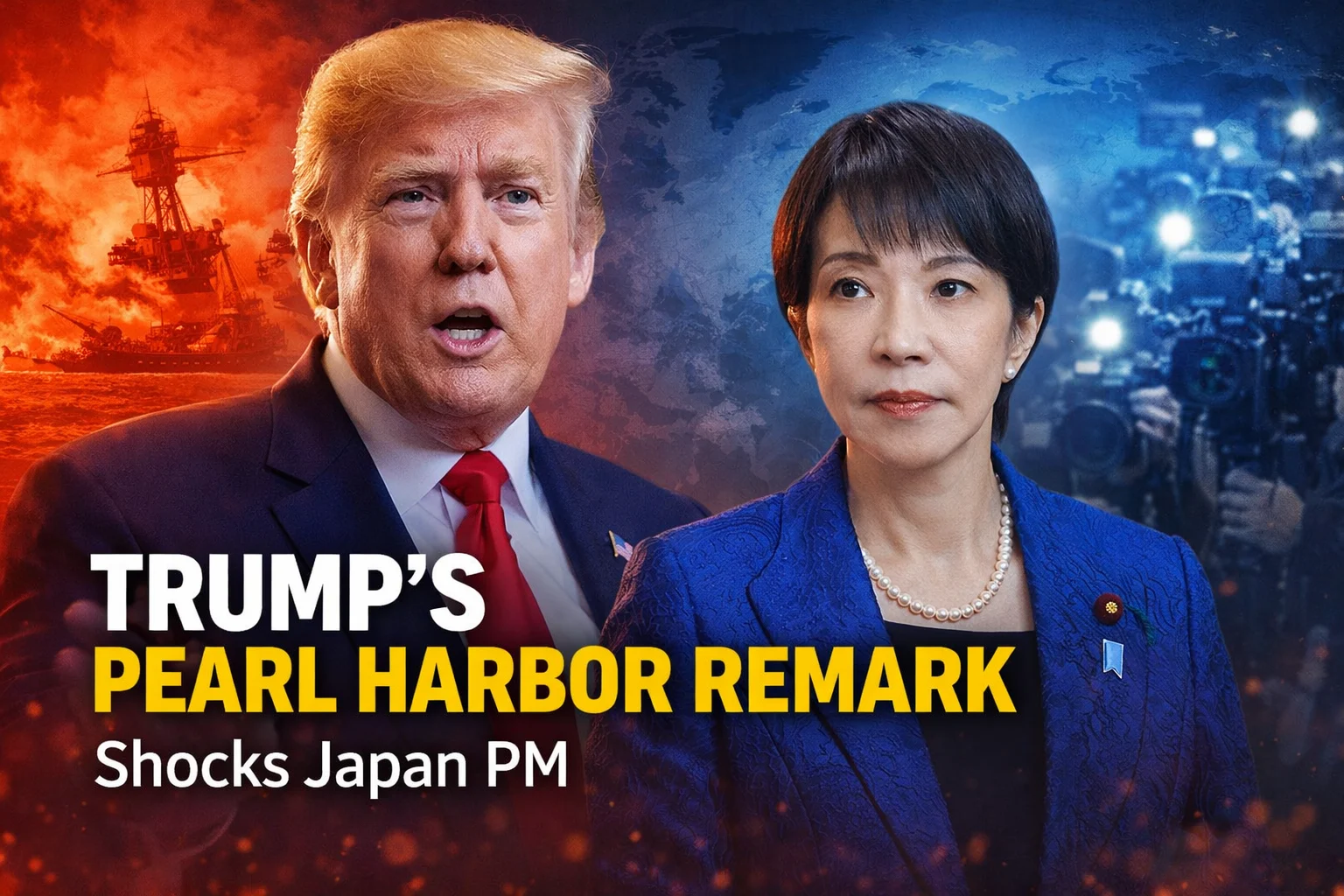
The Trump Pearl Harbor comment quickly became one of the most discussed diplomatic moments of the week.
During a high-level meeting at the White House, Donald Trump hosted Sanae Takaichi. What began as a routine diplomatic exchange turned into an unexpected—and controversial—moment.
A journalist asked a serious question: why were key allies like Japan not informed before US actions against Iran?
The response that followed caught everyone off guard.
And within minutes, it went global.
What Exactly Trump Said—and Why It Shocked
Instead of addressing the strategic concern directly, Donald Trump referenced the idea of “surprise” in warfare.
Then came the remark.
He suggested that Japan should understand surprise attacks—because of Pearl Harbor.
This might actually be Trump's funniest moment 😂
— Daily Wire (@realDailyWire) March 19, 2026
Japanese Reporter: Why didn't you tell us before you struck Iran?
Trump: "Why didn't you tell me about Pearl Harbor?" 💀🔥😂 pic.twitter.com/K1C85C4wzJ
This was not framed as a historical reflection.
It came across as a casual comparison.
That detail matters.
Because the original question was about modern alliance communication, not historical warfare.
Sources: The Guardian, Times of India
Why the Pearl Harbor Reference Matters
To understand the backlash, you have to revisit Attack on Pearl Harbor.
In 1941, Japan launched a surprise military strike against the United States.
- Thousands of Americans were killed
- It triggered US entry into World War II
- It led, eventually, to atomic bombings in Hiroshima and Nagasaki
This is not just history.
It is collective memory—for both nations.
So when the Trump Pearl Harbor comment surfaced in a diplomatic setting, it wasn’t seen as humor.
It was seen as misplaced context.
Japan’s Reaction: Silence That Spoke Volumes
The reaction from Sanae Takaichi was immediate—but subtle.
No laughter.
No acknowledgment.
Just silence.
That silence matters.
Because in diplomacy, reactions are often controlled. Carefully measured.
For a Japanese PM, publicly reacting—even with discomfort—can carry domestic consequences. Historical sensitivity around World War II remains strong within Japan.
So the absence of reaction became the reaction.
US–Japan Relations Under Strain?
On paper, the alliance remains strong.
The United States and Japan share:
- A formal defense agreement
- Strategic coordination in Asia
- Deep economic ties
But moments like the Trump Pearl Harbor comment introduce friction at a symbolic level.
And symbolism matters in diplomacy.
Why?
Because alliances are not just built on agreements—they are built on trust and communication.
The original question raised by the journalist still stands:
Why weren’t allies informed before major military actions?
That question hasn’t gone away.
Sources: Ministry of Foreign Affairs of Japan
The Bigger Context: Iran War and Energy Crisis
This exchange didn’t happen in isolation.
It came in the middle of escalating tensions involving Iran and the United States.
At the center of this crisis is the Strait of Hormuz—one of the world’s most critical energy routes.
Here’s what’s unfolding:
- Oil prices have surged globally
- Supply chains are under pressure
- Energy-importing nations like Japan face rising risk
That’s why the journalist’s question was serious.
Countries like Japan could have:
- Increased oil reserves
- Prepared for supply disruption
- Adjusted economic planning
But without prior communication, they were left reacting—not preparing.
Leadership Style or Strategic Signal?
This is where interpretation becomes complex.
Was this simply a moment of unscripted humor?
Or something more?
Donald Trump has long been known for:
- Unpredictable statements
- Direct, often unconventional communication
- A willingness to break diplomatic norms
Some see this as authenticity.
Others see it as instability.
Here’s the real question:
Can informal rhetoric coexist with high-stakes global diplomacy?
Because when conflicts involve energy markets, military alliances, and global stability—words are not just words.
They signal intent.
What Happens Next
Several scenarios are now emerging:
- Japan and Europe to join in securing Strait of Hormuz
- Energy cooperation could deepen within US-led alliances
- Diplomatic communication may come under closer scrutiny
At the same time, tensions around Iran are far from resolved.
There is growing discussion about:
- Possible ground operations
- Extended conflict timelines
- Continued pressure on global oil markets
This is where things shift.
What began as a viral moment may evolve into a larger diplomatic conversation about trust, coordination, and leadership style.
Sources: Deccan Herald, Time Magazine
FAQs
What did Trump say about Pearl Harbor?
The Trump Pearl Harbor comment referenced the idea of surprise attacks during a diplomatic exchange, linking it to Japan’s historical attack in 1941. The remark was made while responding to a question about communication with allies.
Why is the comment controversial?
The reference touches on a deeply sensitive historical event that led to massive loss of life and long-term consequences. Using it casually in diplomacy is widely seen as inappropriate.
How did Japan react to the statement?
Japan’s Prime Minister Sanae Takaichi maintained a neutral and composed response, avoiding visible reaction. However, the silence itself was interpreted as discomfort.
Will this affect US–Japan relations?
While formal ties remain strong, such moments can create symbolic strain. They raise concerns about communication, trust, and diplomatic tone between allies.
Final Thought
Diplomatic moments are rarely just moments.
They reveal patterns—of leadership, of communication, of priorities.
The Trump Pearl Harbor comment may fade from headlines.
But the questions it raises—about trust, coordination, and global stability—are only beginning to take shape.
What This Means Going Forward
Moments like these force a deeper question:
How should global leadership evolve in an era where every statement can shift alliances, markets, and perceptions instantly?
Because in today’s geopolitical environment, even a single remark can echo far beyond the room it was spoken in.
Share Your Views in the Comments below.
Explore more about Defense & Security and World Affairs.