Table of Contents
The Viral Moment That Sparked a Bigger Debate
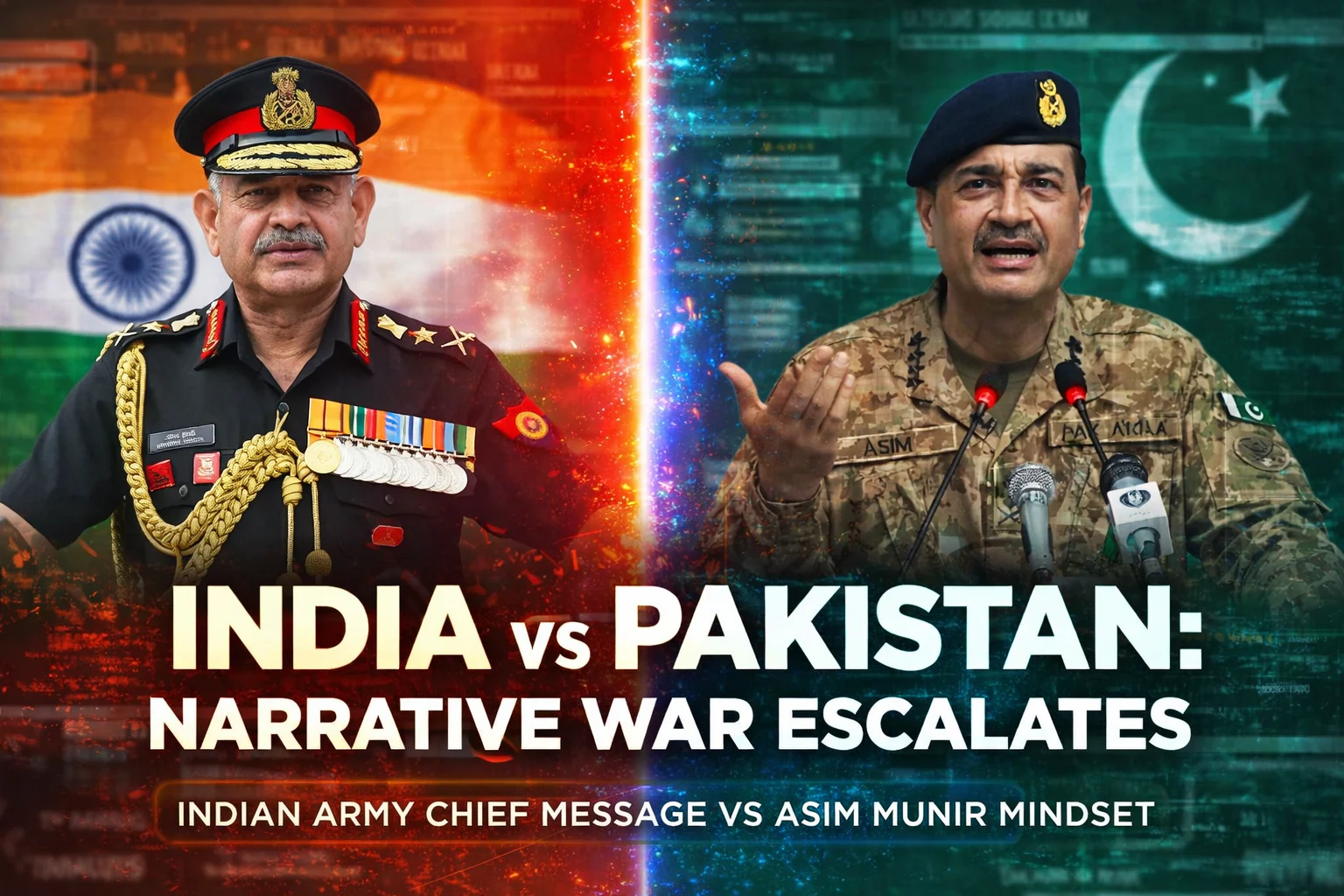
The phrase India vs Pakistan narrative warfare has suddenly become central to understanding modern conflict in South Asia.
Two videos began circulating widely:
- One featuring Asim Munir
- The other showing the Indian Army’s leadership, Chief of Army Staff, Gen Upendra Dwivedi
At first glance, these were just statements.
But look deeper—and you see a clash of ideologies.
This wasn’t just about military strategy.
This was about mindset.
One weaponzes religion to divide ..VS.. The other honours religion to protect
— OsintTV 📺 (@OsintTV) April 10, 2026
🇵🇰 "We are two nations. We are not one nation." – CoAS Asim Munir.
🇮🇳 "Every scripture has an answer for everything… we chose a time when we knew they would be praying… because SABKA MALIK EK." -… pic.twitter.com/oMDlvQ6Lko
What Asim Munir Actually Said
Asim Munir reinforced a long-standing ideological position rooted in the Two-Nation Theory.
His argument emphasized:
- Religious differences
- Cultural separation
- Distinct national identities
According to this view:
- Hindus and Muslims are fundamentally different in every aspect of life
- That difference justifies separation
This framing is not new.
But its revival in modern geopolitical discourse is significant.
That choice of words matters.
Indian Army Chief’s Message: A Different Approach
In contrast, the Chief of Army Staff, Gen Upendra Dwivedi highlighted a very different principle during operations like Operation Sindoor.
A key example:
- Attack timing was adjusted
- Religious prayer (namaz) timing was respected
The underlying message:
- “Sabka Malik Ek” — a belief in shared humanity
This wasn’t about weakness.
It was about signaling values.
And importantly:
- Targets were still successfully hit
- Terror infrastructure was neutralized
- Military objectives were achieved
No compromise on outcome.
But a difference in approach.
Sources: News18
India vs Pakistan Mindset Difference
This is where India vs Pakistan narrative warfare becomes clear.
On one side:
- Identity defined by separation
- Emphasis on differences
On the other:
- Identity defined by coexistence
- Emphasis on unity in diversity
Examples reinforce this contrast:
- Sundar Pichai leading Google
- Satya Nadella leading Microsoft
- A. P. J. Abdul Kalam shaping India’s scientific legacy
Different religions.
Same national identity.
That distinction is fundamental.
Is India Too Soft? The Strategic Debate
This is where the debate intensifies.
Critics argue:
- India should be more aggressive
- A softer tone may signal weakness
- Adversaries like Pakistan operate with harder rhetoric
But the counterpoint is equally strong:
- Military objectives were achieved without deviation
- Ethical signaling strengthens global perception
- Strategic restraint is not the same as weakness
Results matter. And results were delivered.
So the real question becomes:
Does perception of strength come only from aggression?
Narrative Warfare: The Real Battlefield
Modern conflict is no longer limited to the battlefield.
It has moved into:
- Social media
- News platforms
- Psychological influence
Pakistan’s strategy includes:
- AI-generated visuals
- Edited or fake videos
- Amplification through international media
🚨DEEPFAKE VIDEO ALERT!
— PIB Fact Check (@PIBFactCheck) April 10, 2026
Pakistani propaganda accounts are circulating a digitally altered video of Indian Army Chief General Upendra Dwivedi with false claims alleging that he said: 'I have now requested Prime Minister Modi to get me in touch with the director, Ranjan Agnihotri,… pic.twitter.com/vZb4SH9lno
Even after military setbacks, narratives are shaped to:
- Project strength
- Control perception
This is information warfare at scale.
Operation Sindoor and the Perception Gap
During Operation Sindoor:
- Terror targets were hit
- Military installations were damaged
- Strategic objectives were achieved
Yet, global narratives told a different story.
Focus shifted to:
- Aircraft losses
- Selective incidents
Instead of:
- Overall mission success
This is the power of narrative framing.
Perception can override reality.
Why Narrative Warfare Matters More Than Ever
Today, victory is not just about:
- Territory gained
- Targets destroyed
It is also about:
- Global opinion
- Media framing
- Digital influence
Recognizing this, the Indian Army has reportedly strengthened its approach:
- Establishing psychological defense mechanisms
- Engaging more actively in information warfare
This marks a shift.
A necessary one.
Sources: The New Indian Express
Final Analysis
The India vs Pakistan narrative warfare is not a side story.
It is the main story.
- One side emphasizes division
- The other emphasizes coexistence
- Both are now competing globally—not just regionally
India’s challenge is clear:
- Maintain its core values
- While strengthening its narrative power
Because in modern geopolitics:
Winning the battle is not enough. You must also win the story.
FAQs
What is India vs Pakistan narrative warfare?
India vs Pakistan narrative warfare refers to the battle of perception, messaging, and global opinion alongside traditional military conflict.
Why is Asim Munir’s statement important?
It reflects an ideological stance that shapes Pakistan’s national and strategic outlook.
Why did India avoid attacking during prayer time?
It was a deliberate operational and ethical decision without compromising military objectives.
Is India’s approach too soft?
This is debated—some see it as restraint, others as strategic strength combined with moral positioning.
What Do You Think About This Narrative Battle?
Is India’s approach of restraint and ethical signaling the right long-term strategy?
Or should it shift toward a more aggressive posture like its adversaries?
There’s no single correct answer here — and that’s exactly what makes this debate important.
Share your perspective:
- Do you support the “Sabka Malik Ek” approach in modern warfare?
- Or do you believe narrative strength requires harder messaging?
Write your thoughts in the comments below — Because in today’s world, perception shapes power— and narrative defines victory.
Explore more about World Affairs and Indian Affairs.