Table of Contents
Introduction: A Viral Controversy Explodes
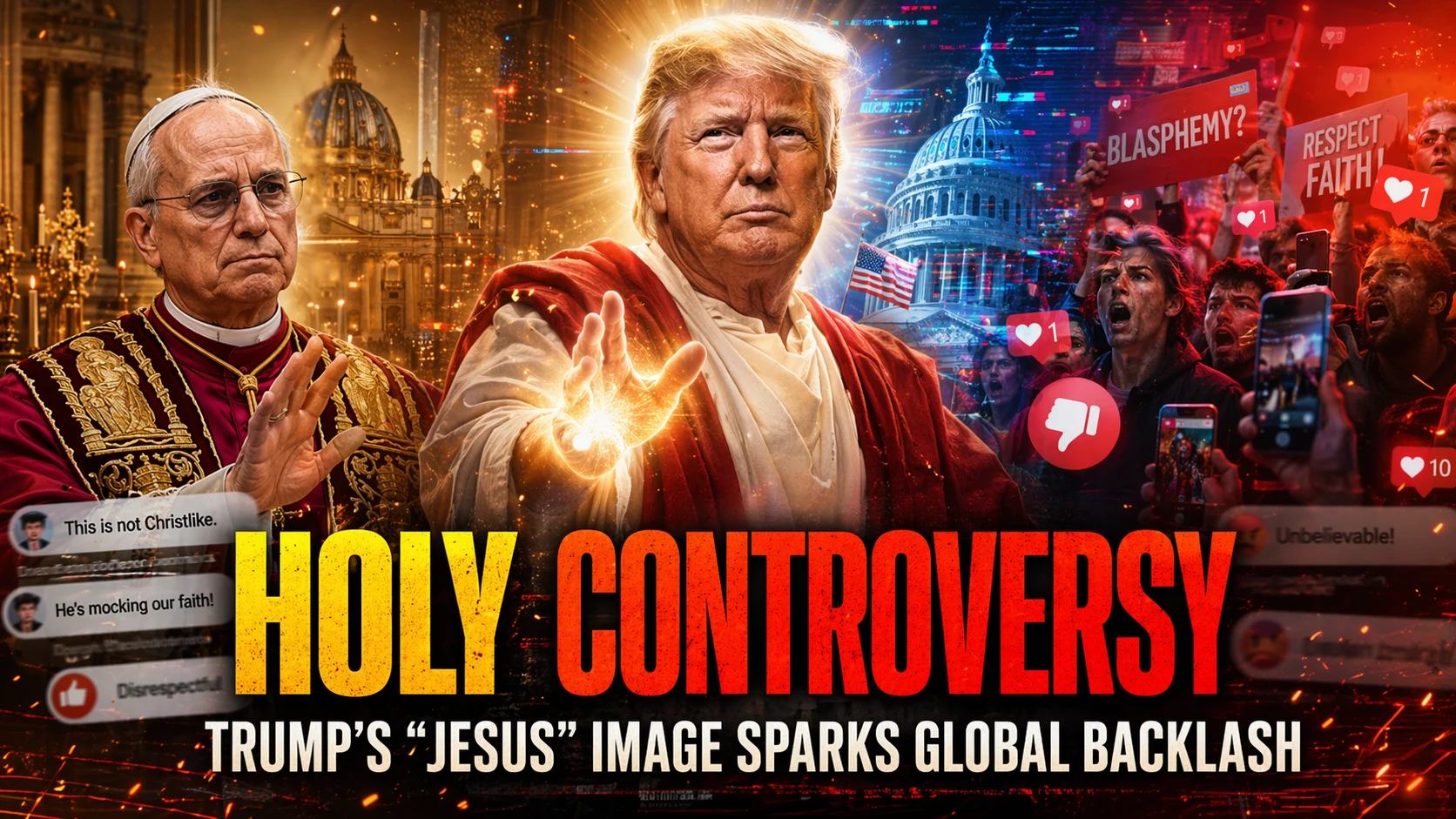
The Trump Jesus AI image controversy has quickly turned into one of the most debated political moments globally.
Donald Trump shared an AI-generated image portraying himself in a manner widely interpreted as resembling Jesus Christ—appearing to heal people with glowing hands.
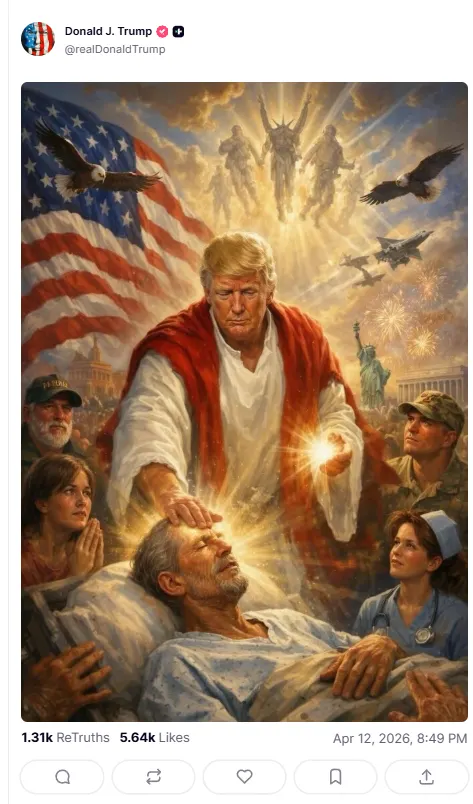
Screenshot of Truth Social Post by Donald Trump(@realDonaldTrump) – Post Deleted
Within hours, backlash erupted.
And not just from critics—but from his own supporters.
That detail matters.
Because this was not a routine political disagreement.
This crossed into religion, identity, and leadership perception.
Sources: Reuters
What Was the AI Image Controversy
The image showed Trump:
- Wearing attire similar to traditional depictions of Jesus
- Placing hands on individuals as if performing healing
- Surrounded by a visual aura often associated with divine imagery
No ambiguity.
This was deliberate visual symbolism.
And the public response reflected that.
Many observers argued:
- This was not a political message
- This was a religious projection of leadership
That distinction triggered the backlash.
Global Backlash and Media Reaction
Global media—including BBC and CNN—reported on the controversy.
But more importantly:
- Trump’s own supporters objected
- Religious communities expressed concern
- Political commentators questioned intent
The message from supporters was clear:
“You are a political leader, not a divine figure.”
This was unusual.
Because internal criticism often signals deeper dissatisfaction.
And soon after the backlash intensified, the post was deleted.
Trump vs Pope Conflict Escalates
The controversy did not stop there.
Donald Trump also criticized Pope Leo—one of the most influential figures in Christianity.
His criticisms included:
- Calling the Pope weak on crime
- Criticizing his foreign policy stance
- Questioning his leadership
This escalated the issue from controversy… to conflict.
Because the Pope is not just a religious figure—he is also the head of Vatican City.
That changes the equation.
And this is where things took an unexpected turn.
Giorgia Meloni, Prime Minister of Italy—who has often aligned politically with Trump—publicly criticized his remarks.
This was significant.
Because Italy hosts Vatican City within its capital, Rome, making the defense of the Pope not just religious—but also political and national.
That shift matters.
When even aligned leaders begin to distance themselves, it signals growing diplomatic discomfort.
And then came an even more unexpected development.
Iran publicly defended Pope Leo against Trump’s remarks.
That alignment is geopolitically unusual.
A Middle Eastern government defending a Catholic religious leader against a US President?
This was not coincidence.
This was narrative positioning.
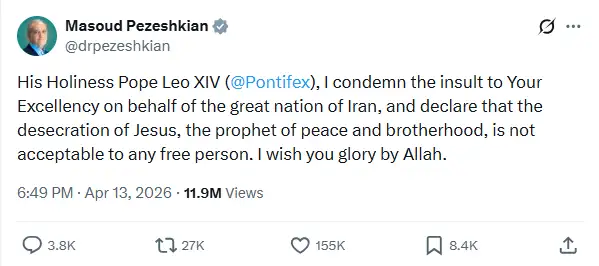
Screenshot of X Post by Iran President Masoud Pezeshkian
Sources: CNN, Anadolu Agency, BBC
Conflicting Explanations: Joke or Serious?
Here’s where confusion deepens.
Trump’s explanation:
- He claimed the image represented a doctor or Red Cross worker
- He said, “I make people better”
President Trump claims the viral image that was posted on Truth was not a depiction of him as Jesus Christ but was him being depicted as a doctor.
— Collin Rugg (@CollinRugg) April 13, 2026
Reporter: Did you post that picture of yourself depicted as Jesus Christ?
Trump: I did post it, and I thought it was me as a doctor… pic.twitter.com/4pfSRFPdrp
But then comes JD Vance with a different version:
- It was just a joke
- People misunderstood Trump’s humor
JD Vance on Trump posting himself as Jesus:
— NV Intel™ (@nvintel) April 14, 2026
I think Trump was posting a joke and, of course, he took it down because he recognized that a lot of people weren’t understanding his humor in that case. pic.twitter.com/ISpOuuBcHw
So which is it?
A symbolic message?
A joke?
A misinterpretation?
That inconsistency matters.
Because leadership communication relies on clarity.
And here, clarity was missing.
Political Impact on Trump
The controversy comes at a sensitive time.
- Approval ratings are hovering around 40%
- Public criticism is increasing
- Midterm elections in November 2026 are approaching
This is not isolated.
This is part of a trend.
When political messaging begins to blur into symbolic or exaggerated imagery, public perception shifts.
And not always in a favorable direction.
This could have electoral consequences.
Sources: The Conversation
Geopolitical Context: Iran War Pressure
Now look at the timing.
This controversy unfolds while:
- US–Iran tensions remain unresolved
- The Strait of Hormuz situation remains unstable
- Global credibility of US actions is being questioned
At the same time:
- Reports suggest Chinese ships passed through Hormuz despite US claims
- Iran mocked US enforcement capability
This is where things connect.
When geopolitical pressure rises, leaders often attempt to reshape narratives.
This may be one such attempt.
But it backfired.
Sources: Independent
Final Analysis
The Trump Jesus AI image controversy is not just about a viral post.
It reflects three deeper dynamics:
- Leadership perception is shifting
- Religious symbolism in politics remains highly sensitive
- Geopolitical pressure is influencing communication strategy
This was not just a mistake.
This was a signal.
A signal of frustration, narrative control attempts, and political risk.
And the reaction was equally telling.
Because when supporters push back, it indicates something deeper is changing.
The bigger question now is:
Will this remain a one-time controversy…
or a sign of a broader shift in political messaging?
FAQs
Why did Trump post the AI image resembling Jesus?
Trump claimed it represented a doctor or healer figure. However, many interpreted it as a religious portrayal, leading to backlash.
Why was there backlash from supporters?
Supporters felt the image crossed a line by portraying a political leader as Jesus a divine or religious figure.
What did JD Vance say about the controversy?
JD Vance stated that the image was intended as a joke and that people misunderstood Trump’s humor.
Why did Trump criticize the Pope?
Trump criticized Pope Leo’s stance on crime and foreign policy, particularly related to the Iran war.
What is the political impact of this controversy?
It may affect Trump’s approval ratings and influence voter perception ahead of the 2026 midterm elections.
What Does This Controversy Really Signal?
Do you think the Trump Jesus AI image controversy was just a misjudged post—or a deeper shift in political messaging?
- Is this about leadership image control?
- Or a reaction to growing geopolitical pressure?
Because sometimes, a single image reveals far more than a speech ever could.
Explore more about World Affairs.