Table of Contents
The First-Ever Sea Attack That Changed the Narrative
The Baloch Liberation Army naval attack has marked a decisive shift in South Asian geopolitics.
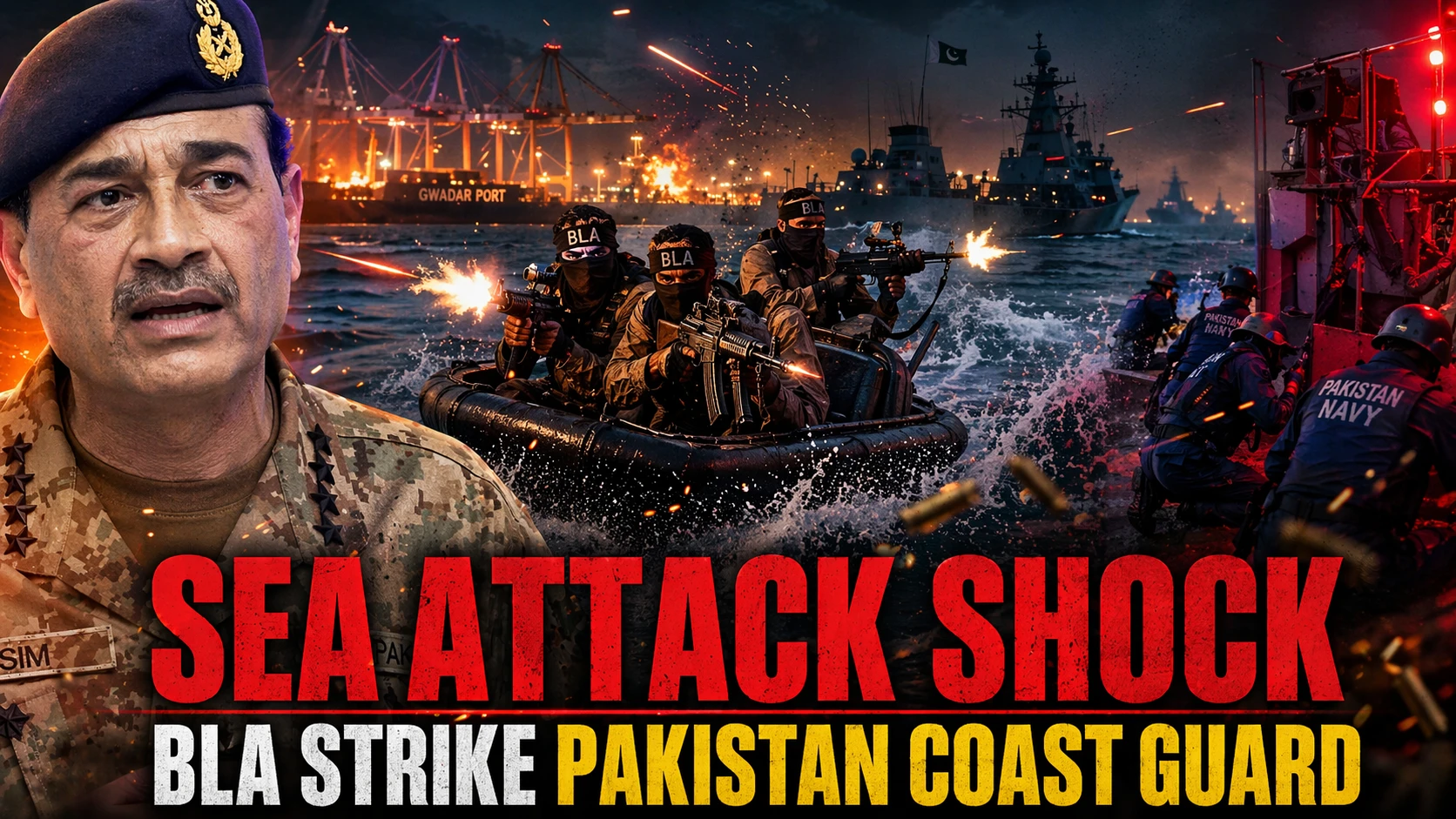
For the first time, the Baloch Liberation Army (BLA) has carried out a naval operation against Pakistan’s security forces near Gwadar Port.
This was not just another insurgent strike.
This was a message.
And the timing matters.
Sources: India Today, Republic
What Happened Near Gwadar
The attack took place near the coastal town of Jiwani, a region already known for weak military control.
BLA militants reportedly opened fire on Pakistani coast guard personnel stationed at sea.
This was accompanied by visual evidence showing:
- Armed militants engaging targets at sea
- Pakistani forces attempting to retreat
- Casualties among Pakistani personnel
BLA Releases Footage of First-Ever Naval Attack on Pakistani Forces
— Aamaj News English (@aamajnews_EN) April 13, 2026
The Baloch Liberation Army (BLA) has released video footage showing its fighters carrying out what it claims to be its first-ever naval operation. According to the group’s media wing, the attack took place on… pic.twitter.com/38cdqp5jby
This was not symbolic.
It was operational.
And it exposed a vulnerability that had not been tested before.
Why This Attack Is Historic
Until now, the Baloch Liberation Army had focused on land-based attacks.
These included:
- Railway attacks such as the Jaffar Express incident
- Military convoy ambushes
- Infrastructure sabotage
But this changes everything.
This was the first clear shift from land insurgency → maritime insurgency.
That shift is structural.
Because once insurgency enters the sea domain, containment becomes significantly harder.
Pakistan’s Coastal Security Under Pressure
This development puts massive pressure on Pakistan’s military structure.
Now, the Pakistan Navy is no longer just focused on external threats like India.
It must now:
- Defend its coastline from internal insurgency
- Allocate resources across land and sea
- Secure vulnerable ports simultaneously
That spreads capacity thin.
And that’s exactly what insurgent groups aim to achieve.
The Geopolitical Timing Behind the Attack
The timing of this Baloch Liberation Army naval attack is not accidental.
It comes at a moment when Donald Trump and the United States are actively engaging Pakistan diplomatically.
Recent developments include:
- Pakistan hosting US-Iran discussions in Islamabad
- Continued public praise from US leadership toward figures like Asim Munir and Shehbaz Sharif
- Plans to continue diplomatic engagement in Pakistan despite failed talks
But here’s the contradiction.
While Pakistan is being projected as a stable diplomatic hub, this attack exposes internal instability.
That contrast matters.
Sources: NDTV
Gwadar’s Strategic Importance in Global Politics
Gwadar Port is not just any port.
It is central to:
- Regional trade routes
- Strategic maritime positioning
- Long-term geopolitical infrastructure
Instability here is not local.
It is global in implication.
Because any disruption in Gwadar affects broader strategic calculations across the region.
Rising Baloch Insurgency Pattern
The BLA has been gradually escalating its operations over the years.
The pattern is clear:
- Target infrastructure
- Target military convoys
- Expand geographic reach
- Now—target maritime assets
This is not random escalation.
This is progression.
And progression suggests intent.
What Comes Next for Pakistan
The implications are significant.
First, Pakistan faces increasing multi-front pressure:
- Internal insurgency
- External geopolitical expectations
- Security demands for international diplomacy
Second, security concerns are already affecting diplomatic operations.
During recent talks in Islamabad:
- High-level security protocols were activated
- Delegations reportedly expressed safety concerns
- Movement restrictions were imposed
That’s not a stable environment.
And if attacks continue, future diplomatic engagements could be directly impacted.
Third, there is a larger regional risk.
Pakistan’s involvement with Saudi Arabia under a mutual defense pact adds another layer of complexity.
But the situation goes deeper.
A leaked security assessment indicates that the 2025 defense agreement between Saudi Arabia and Pakistan has already been activated.
Under this framework, any threat to Saudi Arabia is effectively treated as a threat to Pakistan.
And the implications are already visible.
Pakistani military aircraft have reportedly been deployed to Saudi bases, including near King Abdulaziz Air Base, to boost operational readiness.
This is not symbolic cooperation.
This is active military alignment.
At the same time, United Arab Emirates has increased financial pressure by demanding the repayment of approximately $3.5 billion from Pakistan.
That timing is not random.
It creates a dual-pressure environment.
One side reinforcing military coordination…
The other tightening financial constraints.
This is where the broader pattern becomes visible.
Saudi Arabia and United Arab Emirates appear to be operating in a coordinated manner—
one acting as a strategic stabilizer,
the other as a pressure lever.
That balance is deliberate.
And in this equation, Pakistan is not fully controlling the pace.
Now add insurgency into that equation.
This becomes volatile.
Very quickly.
Sources: Times of India, India Today
Final Analysis: A Shift That Cannot Be Ignored
The Baloch Liberation Army naval attack is not just a one-off incident.
It signals a new phase of insurgency.
One that extends beyond land into strategic maritime zones.
At the same time, it exposes a deeper contradiction:
A country being positioned as a diplomatic facilitator…
while struggling with internal security fragmentation.
That gap matters.
Because in geopolitics, perception and reality cannot diverge for long.
If instability continues to rise, Pakistan may not just face internal challenges—
It may lose strategic credibility on the global stage.
FAQs
What is the Baloch Liberation Army naval attack?
The Baloch Liberation Army naval attack refers to the first known maritime assault by BLA militants targeting Pakistani coast guard forces near Gwadar. It marks a shift from land-based insurgency to sea-based operations.
Why is the Gwadar attack significant?
Gwadar is a strategically important port. Any attack near it signals vulnerability in a key geopolitical location, affecting both regional stability and international trade perceptions.
Is Pakistan losing control over Balochistan?
The increasing frequency and sophistication of attacks suggest growing challenges in maintaining full control, especially in remote and coastal areas.
How does this impact regional geopolitics?
The attack complicates Pakistan’s role in diplomacy, especially as a host for international talks, while also raising concerns about stability in South Asia.
Final Thought
Baloch Liberation Army naval attack on Pakistan is not just an attack.
It is a signal.
And signals like these—when ignored—often become turning points.
Explore more about Defense & Security and World Affairs.