Table of Contents
Why the “US Preparing for Major War 2026” Narrative Is Growing
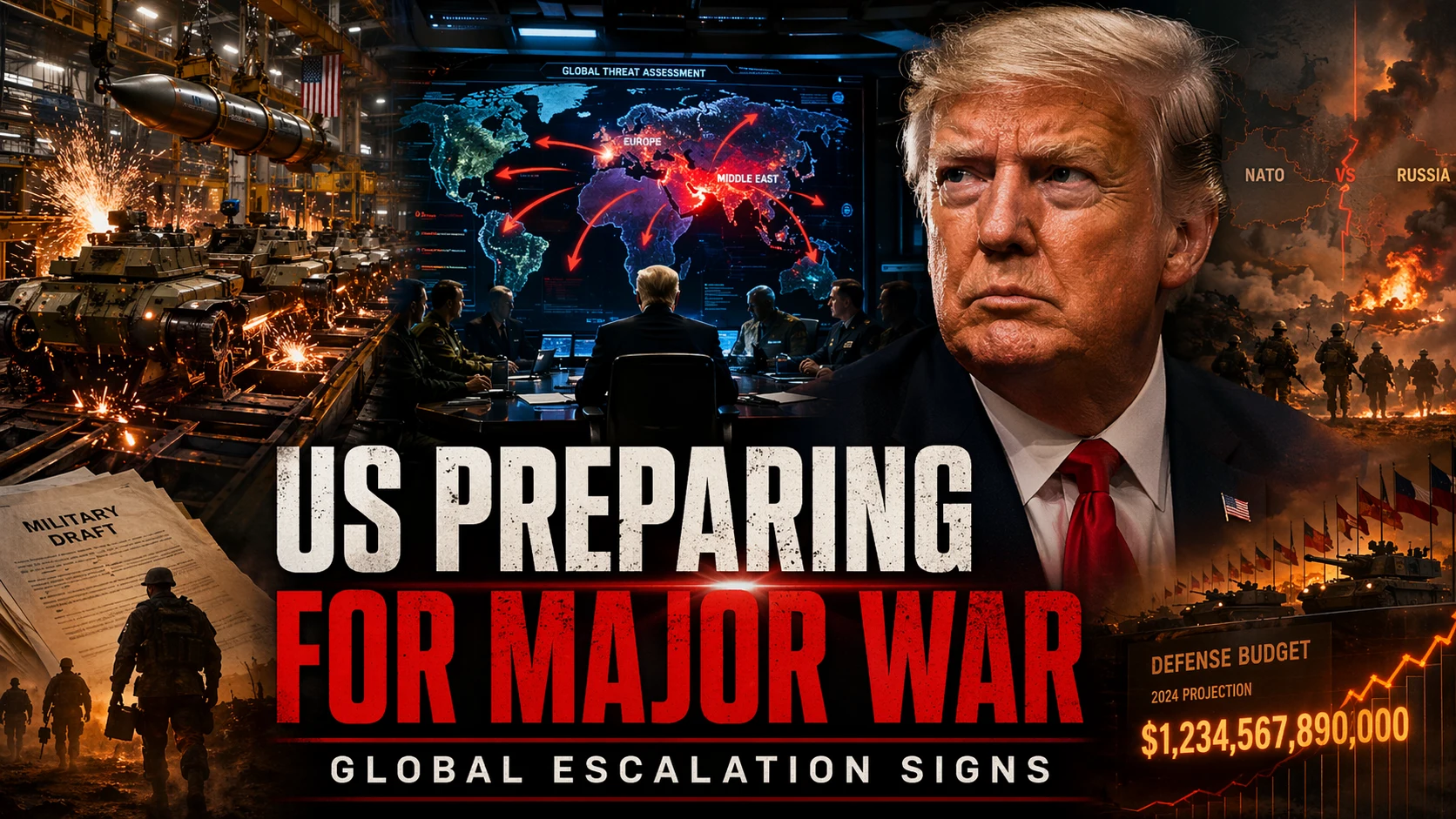
Is the United States preparing for a major war in 2026?
That question is no longer speculative.
It is being actively discussed across global media after a major report by The Wall Street Journal revealed that the Pentagon has approached private companies for weapons production.
Here’s what that means.
This is not routine.
This is structural.
Pentagon’s Move Toward a War Economy
Senior defense officials have reportedly contacted major US automakers like Ford and General Motors.
The question was direct:
Can production lines shift toward large-scale weapons manufacturing?
More importantly, these were not informal conversations.
Pentagon officials held high-level talks with top executives from both companies to assess real production capacity for military systems.
At the same time, the US military budget is projected to rise toward a historic $1.5 trillion, aimed at rapidly expanding weapons and military equipment production.
This combination—industrial coordination plus massive budget expansion—signals something deeper than routine replenishment.
Because historically, the US only made such a move during World War II—when the country transformed into a full-scale war economy.
Factories stopped producing civilian goods.
Everything shifted to tanks, ammunition, and military systems.
That shift is now being discussed again.
That is not normal.
Sources: Independent, Anadolu Agency
A Signal or a Strategy? Understanding the Intent
So why now?
There are two competing explanations.
1. Resource Depletion
The US has supplied significant military aid to Ukraine and used weapons in ongoing Middle East operations.
Stockpiles are under pressure.
Replenishment is expected.
2. Strategic Messaging
This could also be psychological.
A signal.
A message to rivals like Iran and others:
The US is preparing for escalation.
And that message alone could act as deterrence.
So which one is true?
That’s where the uncertainty lies.
UK and Europe Enter War Readiness Mode
This is not just about the United States.
The United Kingdom is also preparing.
According to Sky News, the UK is reviving its war-readiness framework.
Air Chief Marshal Sir Richard Knighton confirmed that the country is preparing both military forces and civilians for potential conflict scenarios.
Defense spending is set to rise:
From 2% → toward 3.5% of GDP.
This includes:
- Expanding troop numbers
- Increasing military readiness
- Preparing the public for shortages
That shift is structural.
Sources: BBC
Europe’s Military Expansion and Russia’s Reaction
Across the European Union, defense spending has surged—increasing by nearly 60% in a short span.
This is not incremental growth.
This is acceleration.
And it has triggered a sharp response from Russia.
Moscow has openly warned that the European Union is preparing for a major war against Russia.
That warning matters.
Because in geopolitics, perception often drives action.
If one side believes war is coming, it prepares.
And when preparation increases across multiple nations simultaneously…
The risk of escalation rises.
This was not isolated.
Sources: Anadolu Agency
Military Draft Changes and Civilian Preparation
Another key signal comes from within the United States itself.
Recent legislative changes mean that automatic registration for the US military draft will begin in December 2026.
The US military draft—is a mechanism that allows the government to compulsorily recruit civilians into the armed forces during a national emergency.
This marks a structural shift—from voluntary compliance to system-driven enrollment.
That detail matters.
Because it indicates preparation not just at the military level—but at the population level.
This is not theoretical planning.
This is operational readiness.
And it is not limited to the United States.
Across Western nations, governments are preparing societies—not just armed forces—for potential conflict scenarios.
That shift is deeper than headlines.
Sources: WION
Iran, Israel, and the Ground Invasion Question
Now we come to the core geopolitical flashpoint.
The tension involving United States, Iran, and Israel.
While diplomatic talks continue, statements from Israeli leadership suggest readiness for extended conflict.
Benjamin Netanyahu has indicated that objectives in Iran are not yet complete.
At the same time:
- The US is deploying additional troops to the Middle East
- Weapons production discussions are increasing
- Talks are ongoing—but uncertain
This raises a critical question:
Are negotiations genuine… or just buying time?
Sources: Times of Israel
Russia’s Warning: “Time-Buying Strategy”
Russia has offered a clear interpretation.
According to Moscow, ongoing negotiations between the US and Iran are not aimed at peace.
They are a delay tactic.
A way to:
- Deploy more troops
- Build operational readiness
- Prepare for potential ground invasion
If that assessment is correct…
Then current diplomacy may only be a prelude.
Sources: Türkiye Today
Global Pattern: A Coordinated Shift?
Step back and look at the bigger picture.
- US → engaging private sector for weapons production
- UK → preparing civilians for war scenarios
- EU → massively increasing defense spending
- Russia → warning of escalation
- Middle East → active conflict zone
Individually, each move can be explained.
Together?
They form a pattern.
A pattern of preparation.
This was deliberate.
Final Analysis
The signals are not isolated.
They are converging.
Industrial mobilization.
Civilian readiness.
Military expansion.
Geopolitical tension.
All moving in the same direction.
Toward escalation.
But here’s the key uncertainty:
Is this preparation meant to prevent war…
Or to fight one?
That distinction will define the coming months.
And the real question now is:
Are these moves creating deterrence—or quietly making a large-scale conflict inevitable?
FAQs
Is the US really preparing for a major war in 2026?
There are strong indicators such as weapons production discussions and troop deployments, but it is unclear whether this is preparation for conflict or strategic deterrence.
Why did the Pentagon approach automakers?
To assess whether civilian manufacturing capacity can be shifted toward weapons production if required.
What is the UK “War Book”?
It is a framework used to prepare the country—military and civilians—for wartime conditions, including shortages and emergency measures.
Is there going to be a US ground invasion of Iran?
There is no official confirmation, but increased troop deployments and geopolitical signals suggest it is being considered.
Why is Europe increasing defense spending?
Primarily due to concerns about Russia and broader geopolitical instability.
What Do You Think?
The signals are clear—but the intent is still uncertain.
Are these moves by the United States and its allies a strategy to prevent a larger war through deterrence…
Or are they quietly laying the groundwork for a conflict that may already be unavoidable?
Do you believe the world is heading toward a major war in the next few years—or is this just strategic pressure playing out on the global stage?
Explore more about Defense & Security and World Affairs.