Table of Contents
A “Once-in-a-Generation” Deal—But Why Now?
The phrase “once-in-a-generation” is often overused in global trade. But in this case, it reflects something deeper: India is no longer waiting for one big global deal—it is building its trade network country by country.
The long-discussed trade deal with the United States is currently stuck. Even American media is questioning its future timeline, especially after court rulings on tariffs and shifting geopolitical priorities. No one can clearly say when it will be finalized.
In contrast, India’s approach elsewhere has been far more structured. Terms are being negotiated in advance—what India gets, what the partner country gets—and then agreements are signed based on those conditions.
That is exactly what has happened with New Zealand.
Here is what that means: India is no longer dependent on one geopolitical axis. It is diversifying aggressively.
And that changes the entire conversation around global trade power.
Sources: South China Morning Post
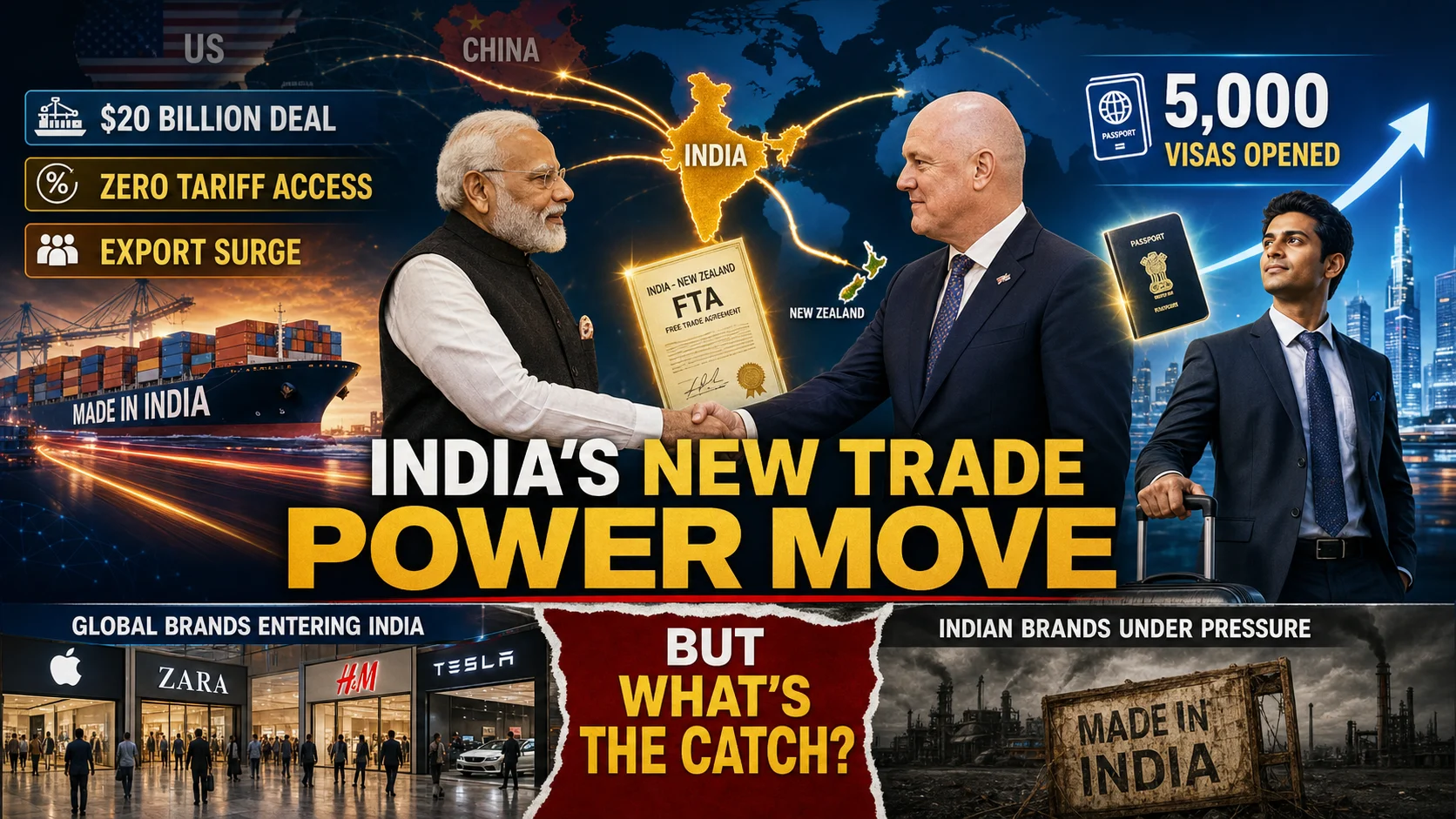
The Real India New Zealand FTA Benefits Explained
At a surface level, the India New Zealand FTA benefits look straightforward—but their implications are deeper.
First, tariffs on Indian exports like textiles, leather, footwear, engineering goods, plastics, and electronics drop to zero. Earlier, some of these products faced tariffs up to 10%. That barrier is now gone.
Second, a 5,000-visa quota opens a direct pathway for Indian professionals. This is not symbolic—it creates structured mobility for skilled workers.
Third, a $20 billion investment commitment signals long-term economic engagement, not just trade.
Fourth, bilateral trade is expected to grow to $5 billion in the next five years, marking a significant expansion from current levels.
But the strategic context matters just as much.
New Zealand is part of the Five Eyes intelligence grouping and remains deeply integrated into the Western economic and strategic ecosystem. So access to this market is not just about trade—it is about positioning.
And there is another layer to watch closely.
The real test will come over the next five years—when bilateral trade reaches $5 billion, the key question will be simple: which country is actually selling more in the other’s market?
Why the US Deal Is Stuck While Others Move Ahead
If India is moving so quickly on FTAs, why is the US deal stalled?
The answer lies in instability on the American side.
Recent court rulings on tariffs and shifting geopolitical priorities have created uncertainty. Even American media is asking: when will this deal actually happen?
No one has a clear timeline.
Meanwhile, India has continued signing agreements with other countries where negotiation terms were already aligned.
This contrast is important.
It shows that while one major deal remains uncertain, India is not pausing its broader trade expansion.
Sources: CNBC
India vs USA vs China: The Trade Map Reality
There is a common assumption that countries like the United States or China dominate global trade agreements.
But the map tells a different story.
The US has FTAs with a limited number of countries—Canada, Mexico, Australia, and a few others. Its global coverage is not as extensive as many assume.
China’s agreements are also selective, though supported by larger frameworks that extend its market access.
India, on the other hand, is building a wide network:
- Agreements with ASEAN countries
- Agreements with Japan (which now requires revision) and South Korea (which is also due for an upgrade)
- A signed agreement with the European Union, expected to come into effect in 2027
- Agreements already in place with Australia and New Zealand
- Ongoing negotiations with countries like Chile, South Africa, and Saudi Arabia
India also operates under a SAARC free trade framework, covering countries like Nepal, Bangladesh, and Sri Lanka—giving it a regional trade base that often gets overlooked.
This layered structure shows how India is expanding its trade presence across multiple regions simultaneously.
Sources: European Commission, DD News, ASEAN
The Russia Problem No One Can Ignore
Despite progress elsewhere, one major gap remains: Russia.
Trade between India and Russia is heavily imbalanced:
- India imports around $60 billion
- Russia imports only $3–4 billion from India
This gap is massive and creates a structural challenge.
Even basic trade is complicated due to geopolitical constraints, especially around crude oil.
A future agreement may involve a broader regional framework including countries like Kazakhstan and Belarus. But for now, the situation remains structurally uneven.
And that raises a key question: what is the point of an FTA if the trade balance itself is broken?
Sources:
The Hidden Risk: India’s Global Image Crisis
This is where the conversation becomes uncomfortable—but necessary.
India is signing ambitious trade deals. But its global image is being shaped elsewhere—often negatively.
On platforms like Instagram and TikTok, negative and often racist content about India is being widely circulated. These narratives are not accidental—they are amplified because they influence perception.
And perception directly impacts trade.
If global consumers associate a country with negative imagery, it affects how they view its products.
Self-criticism is necessary for growth—but when it turns into self-hate, it begins to damage how a country is perceived globally.
Why “Made in India” Still Doesn’t Mean What It Should
Think about this:
When you see “Made in Japan,” you think precision.
When you see “Made in Germany,” you think quality.
But when you see “Made in India,” that same level of automatic trust is not always there.
That gap is the real challenge.
And it has two causes:
- Weak global branding
- Corporate mindset issues
This is not just about consumers abroad—it is also about mindset within India.
Many Indian companies still operate with short-term thinking—focused on quick profits rather than building long-term legacy brands.
The comparison is clear: brands like Tata or Reliance represent what is possible when companies think beyond immediate gains.
But that mindset is not widespread enough.
Until that mindset shifts toward building institutions that last—brands that carry national identity—free trade agreements alone will not deliver their full potential.
India Section: What This Actually Means for India’s Future
The India New Zealand FTA benefits will not automatically translate into long-term gains for India—and that is the most important takeaway.
India is entering a phase where foreign brands will compete directly with Indian brands in the domestic market. With agreements like the EU FTA coming into effect in 2027, Indian consumers will increasingly see global products on platforms like Amazon and Flipkart.
At the same time, Indian companies will gain access to foreign markets.
This creates a dual reality.
On one side, Indian firms must compete globally. On the other, they must defend their position at home.
But one thing is clear: these agreements will only deliver real benefits if Indian companies change how they think.
If Indian companies continue prioritizing short-term profit over long-term brand building, they will lose out—even with tariff advantages.
Similarly, if India fails to improve its global image, its exports will struggle to gain premium positioning.
This is not theoretical.
Global consumers associate product quality with national identity. Japan and Germany built that perception over decades. India has not.
So even if tariffs drop to zero, perception can still act as a hidden barrier.
Another key implication is workforce mobility. The 5,000-visa quota opens opportunities for Indian professionals abroad. But it also highlights a reality: India is exporting talent while still struggling to fully capitalize on domestic manufacturing strength.
That creates a dual challenge:
- Retain high-value talent domestically
- Build industries that can compete globally
Finally, there is a strategic dimension. By signing multiple FTAs, India is reducing dependence on any single country—including the United States.
But this diversification only works if India can convert access into advantage.
Otherwise, these agreements risk becoming one-sided.
Sources: The Times of India
Conclusion
India’s trade strategy is evolving rapidly.
The India New Zealand FTA benefits—zero tariffs, visa access, and investment commitments—represent a major step forward. Combined with agreements with Australia, ASEAN, and the upcoming EU deal, India is expanding its global trade footprint.
But trade agreements are only one part of the equation.
Their success depends on how effectively India uses them.
Without stronger global branding, without a shift toward legacy-building companies, and without addressing its image problem, India risks underutilizing the very access it is negotiating so aggressively.
This is not just an economic issue. It is a strategic one.
Because in global trade, perception can matter as much as policy.
FAQs
What are the benefits of the India-New Zealand FTA?
The agreement eliminates tariffs on key Indian exports like textiles, leather, and engineering goods, giving them direct price competitiveness. It also includes a 5,000-visa quota for professionals and a $20 billion investment commitment. These benefits combine market access with workforce mobility, making it both an economic and career opportunity.
How many visas will New Zealand give to Indians?
The deal includes a quota of 5,000 visas for Indian professionals. This creates a structured pathway for skilled workers to access opportunities in New Zealand’s economy, especially in sectors like engineering, healthcare, and services.
When will the India-EU FTA come into effect?
The India-EU FTA is expected to come into force in 2027. Once implemented, Indian consumers will start seeing more European brands in the domestic market, increasing competition for local companies.
What is India’s trade deficit with Russia?
India imports around $60 billion worth of goods from Russia while exporting only $3–4 billion. This large imbalance makes any future trade agreement complex and strategically sensitive.
Does India have an FTA with Russia?
No, India does not currently have a free trade agreement with Russia. Any future deal is likely to involve a broader regional framework including neighboring countries.
Closing Question
If India continues signing high-value trade agreements but fails to fix its global image and brand perception, will zero tariffs actually translate into global dominance—or just easier access for foreign competitors into India’s own market?
Share Your Views in the Comments below.
Explore more about World Affairs and Indian Affairs.