Table of Contents
Why the Barakah Nuclear Plant Drone Strike Changed the War
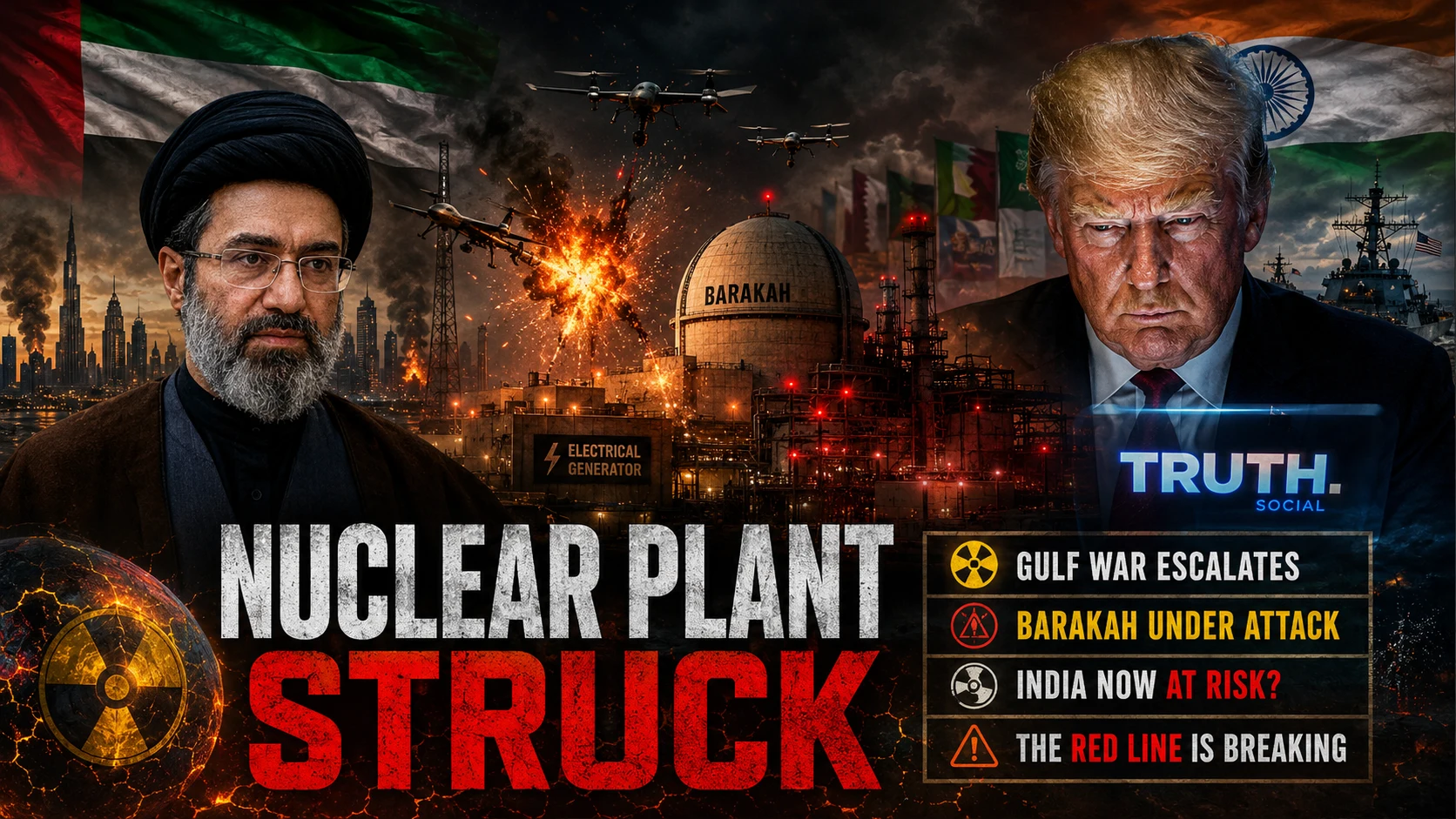
The Barakah nuclear plant drone strike immediately transformed a regional conflict into a global nuclear safety emergency. On Sunday, May 17, 2026, a drone attack caused a fire at an electrical generator outside the Barakah Nuclear Power Plant in Abu Dhabi, while emergency systems were activated to stabilize operations. The International Atomic Energy Agency quickly acknowledged the incident, and global media outlets across the US and Middle East began treating it as a major geopolitical crisis.
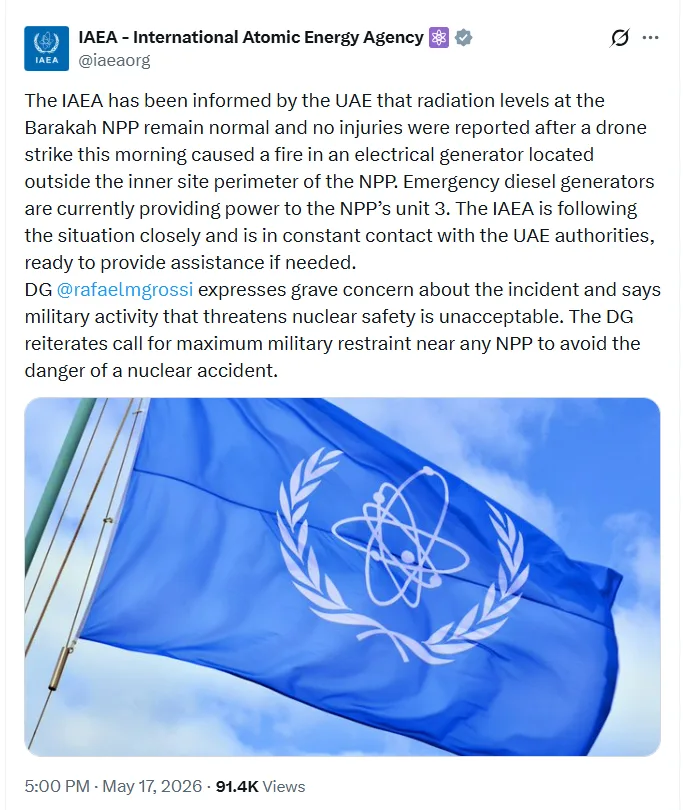
Screenshot of X Post by IAEA (@iaeaorg)
What made the timing even more alarming was Donald Trump’s cryptic social media post just hours earlier. Trump wrote, “the calm before the storm,” alongside imagery connected to the US Navy and Iranian flags. The implication was sharper than a normal warning. The post suggested the United States may already have been preparing for escalation and was waiting for a major Iranian move that could become the trigger point for wider action.

Screenshot of Truth Social Post by Donald Trump(@realDonaldTrump)
The discussion around the attack also raised another possibility: if Iran was behind the drone strike on the UAE’s nuclear infrastructure, the United Arab Emirates itself could eventually launch direct military retaliation against Iran. That possibility alone dramatically raises the risk of a wider Gulf war. And the most dangerous part is that the strike did not even target the reactor itself.
Sources: Al Jazeera, The Tribune
The Generator Attack That Sent a Different Message
The most important detail in the Barakah attack is that the drones bypassed the reactor domes and struck an auxiliary electrical generator instead.
That changes the meaning of the entire operation.
The attack demonstrated that a nuclear facility can be pushed into crisis without directly breaching the reactor containment structure. After the strike, emergency diesel generators were reportedly used to support operations at the plant. The message was clear: even peripheral systems connected to nuclear infrastructure can become pressure points during wartime.
This was deliberate.
The Barakah facility is one of the UAE’s most important strategic projects. Built with South Korean support through Korea Electric Power Corporation, the $20 billion plant supplies roughly 25 percent of the UAE’s electricity demand. The UAE also operates the project under the strict “123 Agreement” with the United States, under which Abu Dhabi agreed not to enrich uranium domestically and instead rely on imported fuel.
That is why the attack carried a much larger geopolitical signal. It was not only about damage. It was about proving that Gulf infrastructure itself is vulnerable during a regional conflict. And once nuclear-linked infrastructure starts entering the battlefield narrative, countries far beyond the Gulf begin facing consequences.
Why India Cannot Treat This as a Distant Gulf Crisis
India is far more exposed to this conflict than many people realize. Until now, many Indians viewed the Iran conflict mainly through inflation, petrol prices, diesel costs, or expensive gold. But the argument emerging after the Barakah strike is far darker: the real long-term danger may not be fuel prices, but the possibility of nuclear fallout entering the regional equation.
The concern being discussed is tied directly to regional wind patterns. According to the explanation surrounding the attack, high-altitude winds from Iran and the Persian Gulf move eastward through Afghanistan and Pakistan before reaching North India, including Delhi. If a major strike ever causes a genuine radiological release at an active nuclear facility, the fear is that fallout may not remain limited to the Gulf region.
The fear is not limited to radiation exposure alone. The discussion surrounding the attack raised concerns about acid rain, damage to Indian agriculture, and even the possibility that people in affected regions could eventually be advised to remain indoors if fallout conditions worsen. The long-term impact of nuclear fallout on the human body also remains uncertain.
At the same time, India’s energy system is already under pressure from the Strait of Hormuz crisis. India’s crude inventories reportedly dropped from 107 million barrels to 91 million barrels after disruptions linked to the US-Iran conflict. LPG prices have risen, Oil Marketing Companies are absorbing major losses, and Operation Sankalp has placed the Indian Navy on standby to escort tankers through Gulf waters.
The crisis is no longer only about economics. India now has strategic, environmental, and public health reasons to fear a wider escalation. But diplomacy itself now appears trapped by demands neither side wants to abandon.
Sources: WION
Why Trump and Iran Now Look Impossible to Reconcile
The negotiations between Washington and Tehran increasingly look incompatible.
Donald Trump recently indicated that the United States could accept a 20-year suspension of Iran’s nuclear program if there was a “real commitment.” But Iran’s position has simultaneously expanded. Tehran is demanding sanctions relief, compensation for war damage, release of frozen assets, recognition of sovereignty over the Strait of Hormuz, and ceasefire guarantees across multiple fronts including Lebanon.
Washington has rejected most of these conditions.
At the same time, the United States wants Iran’s enriched uranium transferred out of the country, tighter restrictions on nuclear infrastructure, and no compensation payments. The argument being made is that Trump would eventually have to answer to his own voters if the United States accepted Iran’s demands while giving up leverage on sanctions, uranium controls, and frozen assets.
India also appears unwilling to play a major mediation role because the gap between American and Iranian demands now looks extremely difficult to bridge. The discussion also argued that mediation itself may be ineffective because this war will not end until Israel wants it to end.
Publicly, leaders continue talking about diplomacy and ceasefires. But the actual demands now coming from both sides suggest that no real understanding is developing between them. And when diplomacy stops moving, escalation usually starts moving faster.
Sources: India Today, NDTV
Why Nuclear Facilities Are Becoming the Most Dangerous Targets
The attacks on nuclear-linked facilities in both Iran and the UAE reveal a dangerous shift in the conflict.
Earlier in 2026, the International Atomic Energy Agency reported a projectile incident near Iran’s Bushehr Nuclear Power Plant. Now the Barakah strike has shown that Gulf nuclear infrastructure itself is vulnerable. The repeated targeting of nuclear-linked infrastructure has also created a growing fear that something much bigger could happen across the Middle East in the coming days.
The fear is not necessarily immediate nuclear catastrophe. The greater fear is that attacks around active nuclear facilities may slowly become normalized during regional warfare. One successful strike on a sensitive support system during a larger missile exchange could trigger panic across the Gulf.
Cities like Dubai and Abu Dhabi, heavily promoted as global business and tourism hubs, could see conditions deteriorate overnight if radiation fears spread across the region. The discussion surrounding the attack also warned about possible acid rain, agricultural disruption, and long-term health uncertainty if fallout conditions ever emerge.
The attacks on nuclear power plants must stop immediately because even a limited escalation around active facilities could cause devastating damage across the wider region. But the conflict is now moving in the opposite direction.
What Happens If the Middle East Crosses This Line?
The central danger now is that every future strike risks triggering retaliation against even more sensitive infrastructure.
Iran has reportedly launched thousands of drones and missiles since the broader conflict escalated earlier this year, while the UAE, Israel, and the United States continue strengthening military coordination. At the same time, the Strait of Hormuz remains one of the world’s most critical energy chokepoints, carrying a massive share of global petroleum trade. Any escalation involving nuclear infrastructure automatically increases the risk of wider economic panic.
What makes this moment especially unstable is that no side appears politically prepared to compromise. The United States wants strategic concessions. Iran wants sanctions relief and recognition. Israel remains central to the military balance. Gulf states fear vulnerability. India fears both energy disruption and the possibility of fallout risks spreading beyond the Middle East.
The Barakah nuclear plant drone strike was not just another regional attack. It was a warning about how modern wars can threaten entire civilian systems without directly destroying them. And if attacks on nuclear-linked infrastructure continue, the fear across the region may no longer be limited to oil prices or inflation.
It may become fear of what happens when a war begins moving dangerously close to active nuclear facilities.
FAQs
Which country built the Barakah Nuclear Power Plant?
The Barakah Nuclear Power Plant was developed by the United Arab Emirates with major technical support from South Korea’s Korea Electric Power Corporation (KEPCO). The facility became operational in 2020 and supplies roughly 25 percent of the UAE’s electricity demand. Its strategic importance is one reason the recent drone strike triggered global concern.
Did the Barakah drone strike cause radiation leakage?
No confirmed radiation leak was reported after the attack. According to official statements and IAEA reporting, the fire occurred at an electrical generator outside the inner perimeter of the facility. Emergency diesel systems were activated to maintain operations, and authorities stated radiation levels remained under control.
Why is India worried about the Barakah nuclear plant drone strike?
India’s concerns go beyond diplomacy. The conflict threatens India’s oil imports, LPG supplies, shipping routes, and broader energy security due to tensions around the Strait of Hormuz. There are also fears that if attacks on nuclear facilities escalate into a radiological event, atmospheric wind patterns could carry fallout toward parts of the Indian subcontinent.
What is the US-UAE 123 Agreement?
The “123 Agreement” refers to the nuclear cooperation framework between the United States and the UAE. Under this arrangement, the UAE agreed not to enrich uranium domestically or reprocess spent fuel, relying instead on imported nuclear material. The agreement was designed to present the UAE’s nuclear program as a civilian energy project with strict non-proliferation commitments.
Closing Question
If attacks on Gulf nuclear infrastructure continue, how long can India remain only an observer before the consequences become impossible to contain domestically?
Share Your Views in the Comments below.
Explore more about Defense & Security and World Affairs.