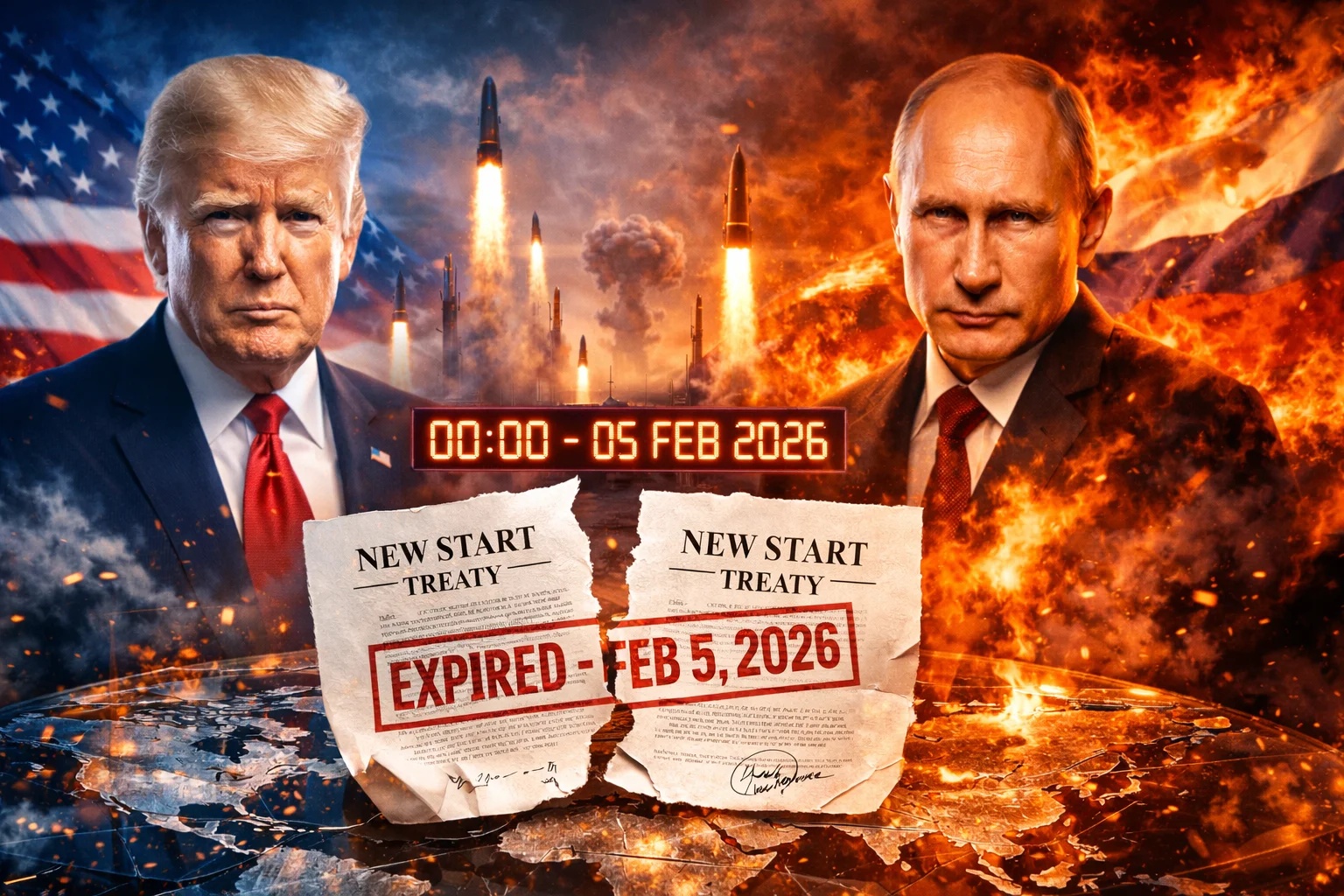
The New START treaty expiry 2026 has quietly removed the last limits on US and Russian nuclear weapons—leaving the world more exposed than at any time since 1972. What happens next?
Table of Contents
Introduction: The Day Nuclear Restraints Officially Ended
5 February 2026 will not be remembered for a speech, a summit, or a declaration of war. Yet historians may one day mark it as the moment the world entered its most unstable nuclear era since the Cold War.
On this day, the New START treaty expiry 2026 became official. With it ended the last remaining nuclear arms control agreement between the United States and Russia. For the first time in more than five decades, there is no treaty anywhere that limits, monitors, or verifies the world’s largest nuclear arsenals.
No limits.
No inspections.
No mandatory transparency.
And when nuclear weapons exist without rules, fear replaces trust.
Image credit: AI-generated using ChatGPT by OpenAI
“Nuclear Winter Is Coming”: Dmitry Medvedev’s Warning
The first alarm did not come from Western analysts or think tanks. It came from Moscow.
Former Russian President and Prime Minister Dmitry Medvedev issued a public warning on the day the treaty expired. His words were unambiguous. He said that for the first time since 1972, the world has entered an era with no treaty restricting nuclear weapons.
To drive the point home, Medvedev shared a stark cultural reference alongside his message:
“Winter is coming.”
Then he made the meaning explicit — “Nuclear winter is coming.”
This was not rhetoric for shock value. It was a factual statement about what had just changed. With the New START treaty expiry 2026, there is now nothing legally preventing the unlimited deployment of nuclear weapons by the world’s two largest nuclear powers.
When Even Obama Agrees: A Rare Alarm From Both Sides
What makes this moment extraordinary is not just Russia’s warning.
A former US president, Barack Obama, also publicly cautioned that the expiration of nuclear arms control agreements would make the world “less safe.” Obama urged US lawmakers to act, stressing that once such treaties disappear, rebuilding trust becomes vastly more difficult.
This alignment is rare.
A former Russian president and a former American president — from rival systems and opposing geopolitical camps — are warning about the same danger.
That convergence alone signals how serious the New START treaty expiry 2026 truly is.
What Exactly Was the New START Treaty?
To understand why its expiry matters, we need to understand what New START actually did.
Signed in 2011 and extended to February 2026, the treaty placed firm caps on:
- Deployed intercontinental ballistic missiles
- Submarine-launched ballistic missiles
- Strategic nuclear bombers
- Deployed nuclear warheads
Each side was limited to:
- 700 deployed strategic launchers
- 1,550 deployed nuclear warheads
Even these numbers were enough to destroy civilization many times over. But the true value of New START lay elsewhere.
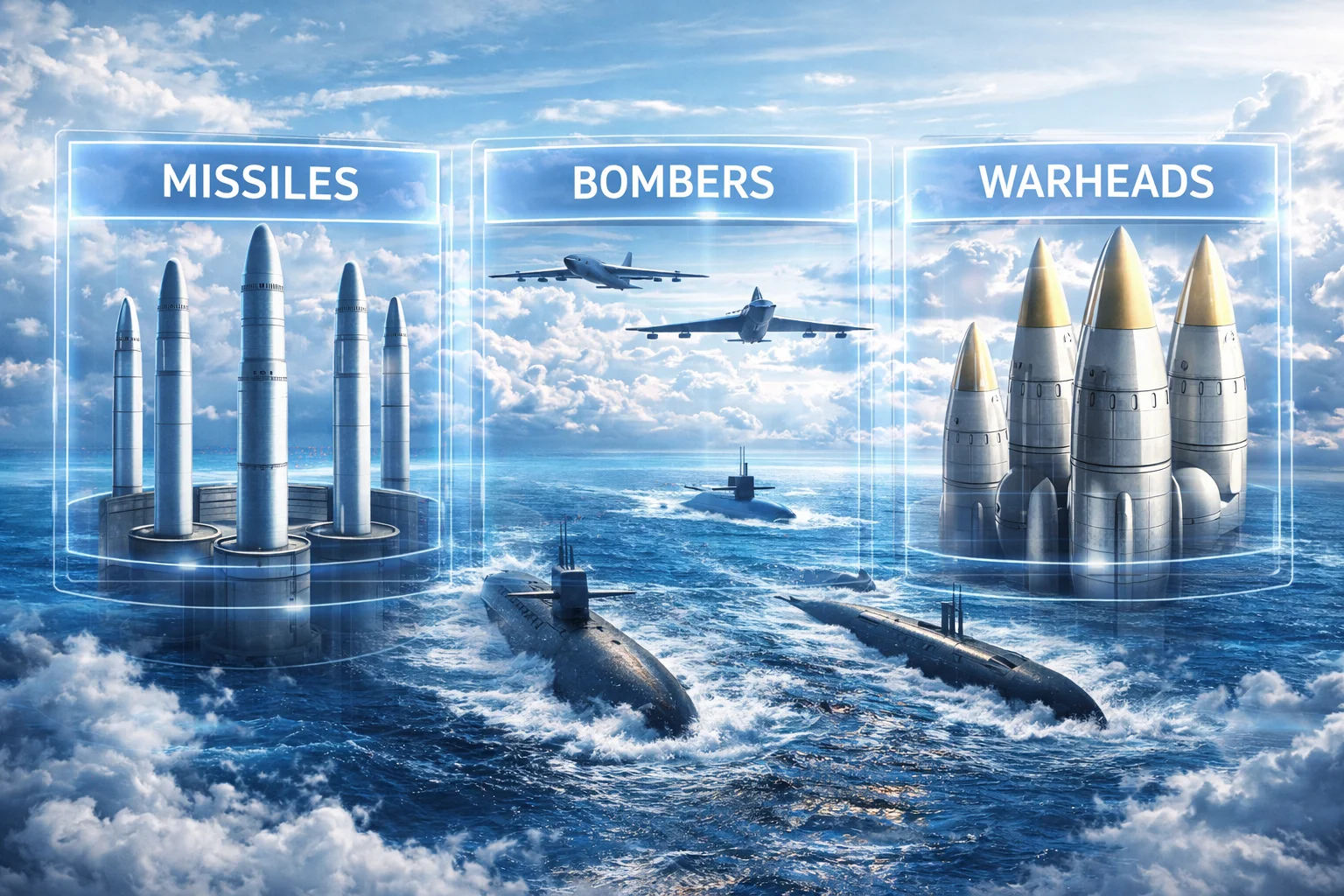
Image credit: AI-generated using ChatGPT by OpenAI
Why Transparency Mattered More Than Numbers
The most critical feature of New START was transparency.
The treaty allowed:
- On-site inspections of nuclear facilities
- Regular, biannual data exchanges
- Advance notification of missile movements
US officials could physically inspect Russian nuclear sites. Russian officials could do the same in the US. Satellite systems backed this process, making deception difficult.
These mechanisms prevented panic.
Because nuclear war is rarely caused by intent. It is caused by misunderstanding.
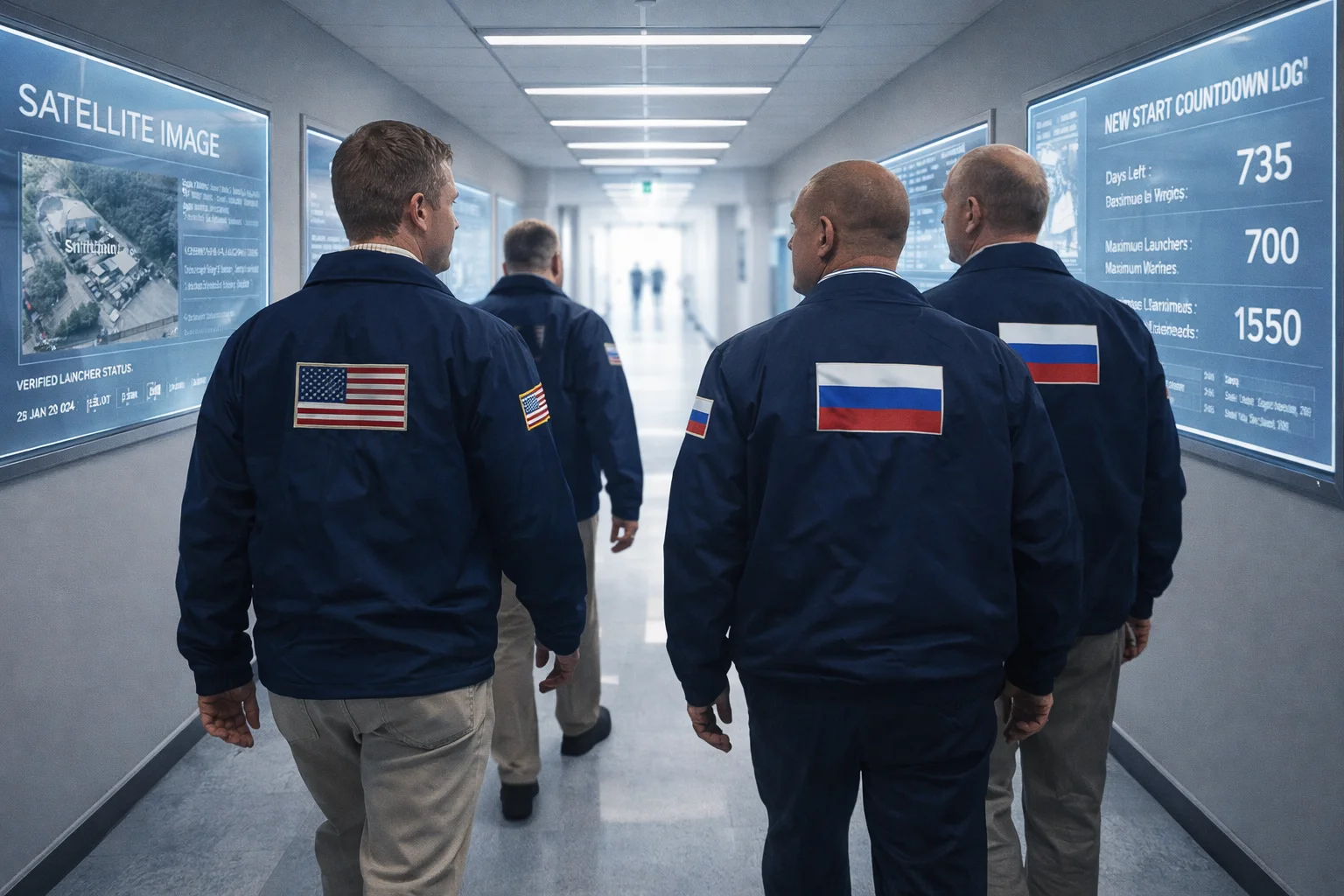
Image credit: AI-generated using ChatGPT by OpenAI
For the First Time Since 1972, Nothing Exists
Since 1972, some form of arms control always existed between Washington and Moscow. SALT, START, INF, or New START — there was always a framework.
The New START treaty expiry 2026 ends that 54-year continuity.
For the first time since the Cold War began:
- No inspections are required
- No deployment data must be shared
- No advance warnings are mandated
This is not a theoretical change. It is a structural one.
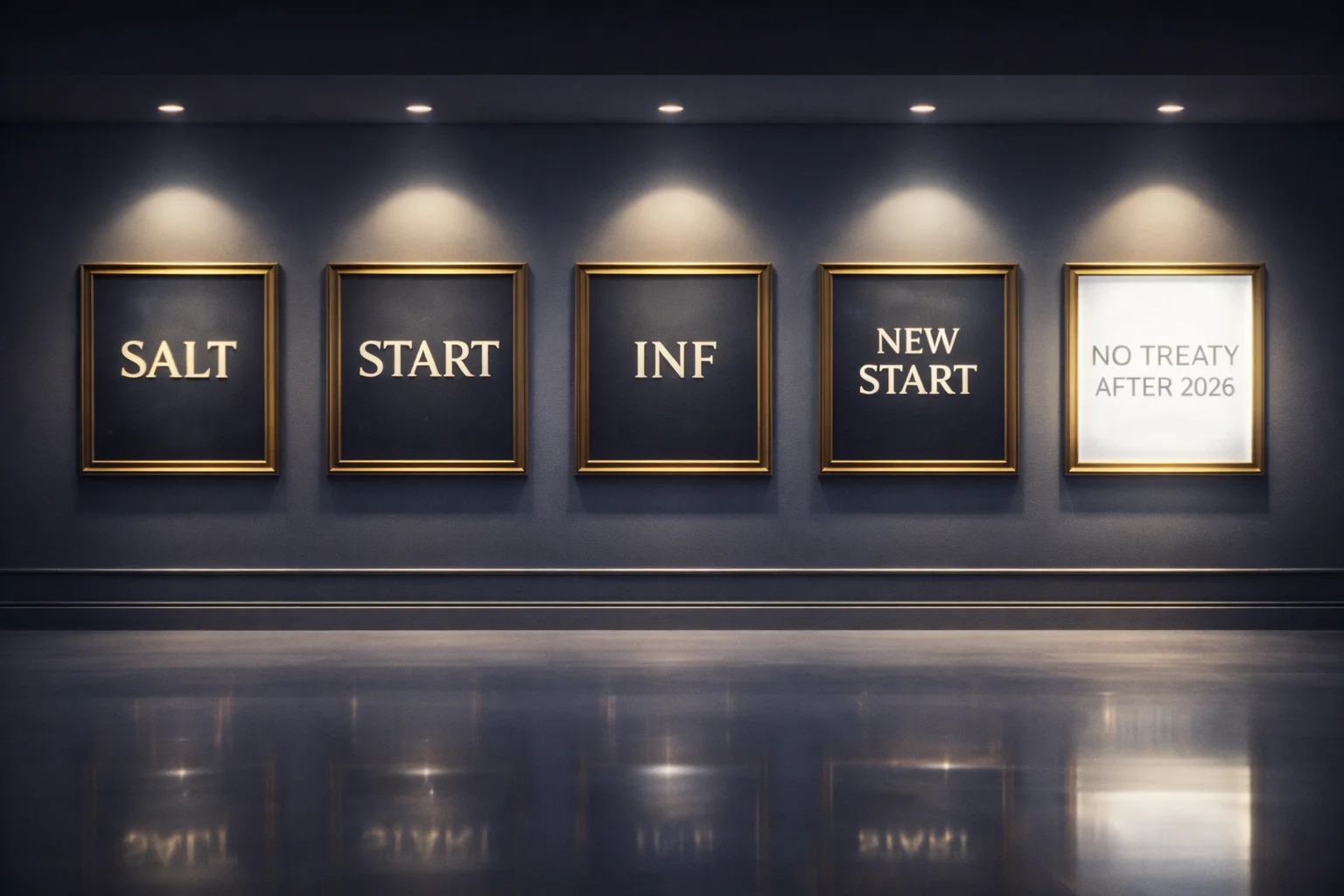
Image credit: AI-generated using ChatGPT by OpenAI
What Changes After the New START Treaty Expiry 2026
From now on:
- Russia can deploy nuclear weapons without notifying the US
- The US can do the same
- Missile movements can be concealed
- Warhead counts can rise without verification
This creates a feedback loop of suspicion.
If one side suspects buildup, it prepares for the worst. The other side reacts. Escalation becomes automatic.
Why Nuclear War Risk Rises Without Intent
The greatest danger today is not aggression.
It is fear.
When leaders believe the other side might strike first, pressure builds to act preemptively. History is filled with near-misses caused by radar errors, satellite glitches, and false alarms.
Arms control treaties reduced those risks by forcing transparency.
With the New START treaty expiry 2026, that safety net is gone.
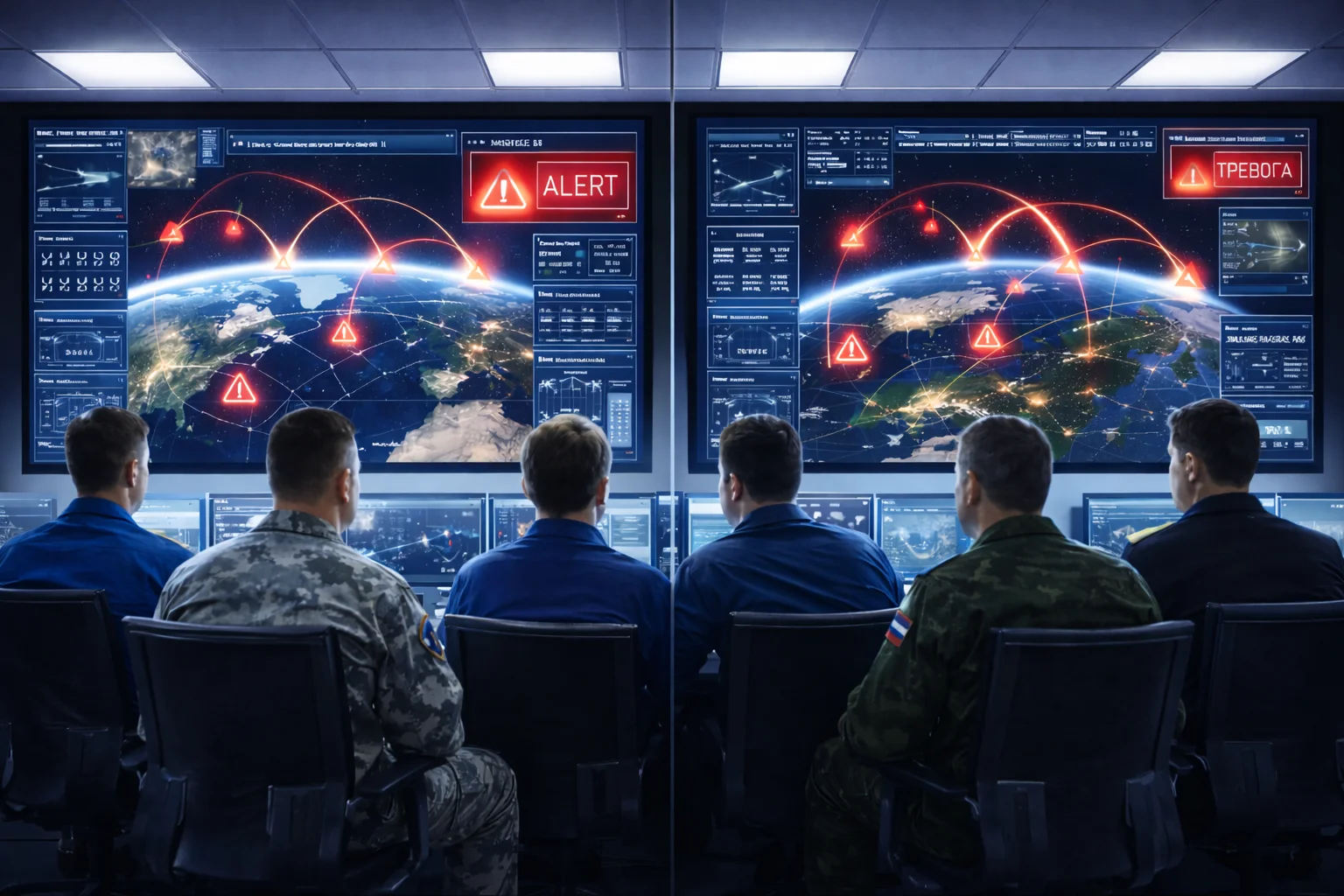
Image credit: AI-generated using ChatGPT by OpenAI
Japan’s Protests and the Memory of 1945
In Japan, the treaty’s expiry triggered immediate protests.
Families of Hiroshima and Nagasaki victims — people whose relatives died in the only nuclear attacks in history — took to the streets. Their message was clear: this fear is not paranoia.
It is memory.
They understand that when mistrust replaces transparency, nuclear weapons stop being abstract and start becoming real again.
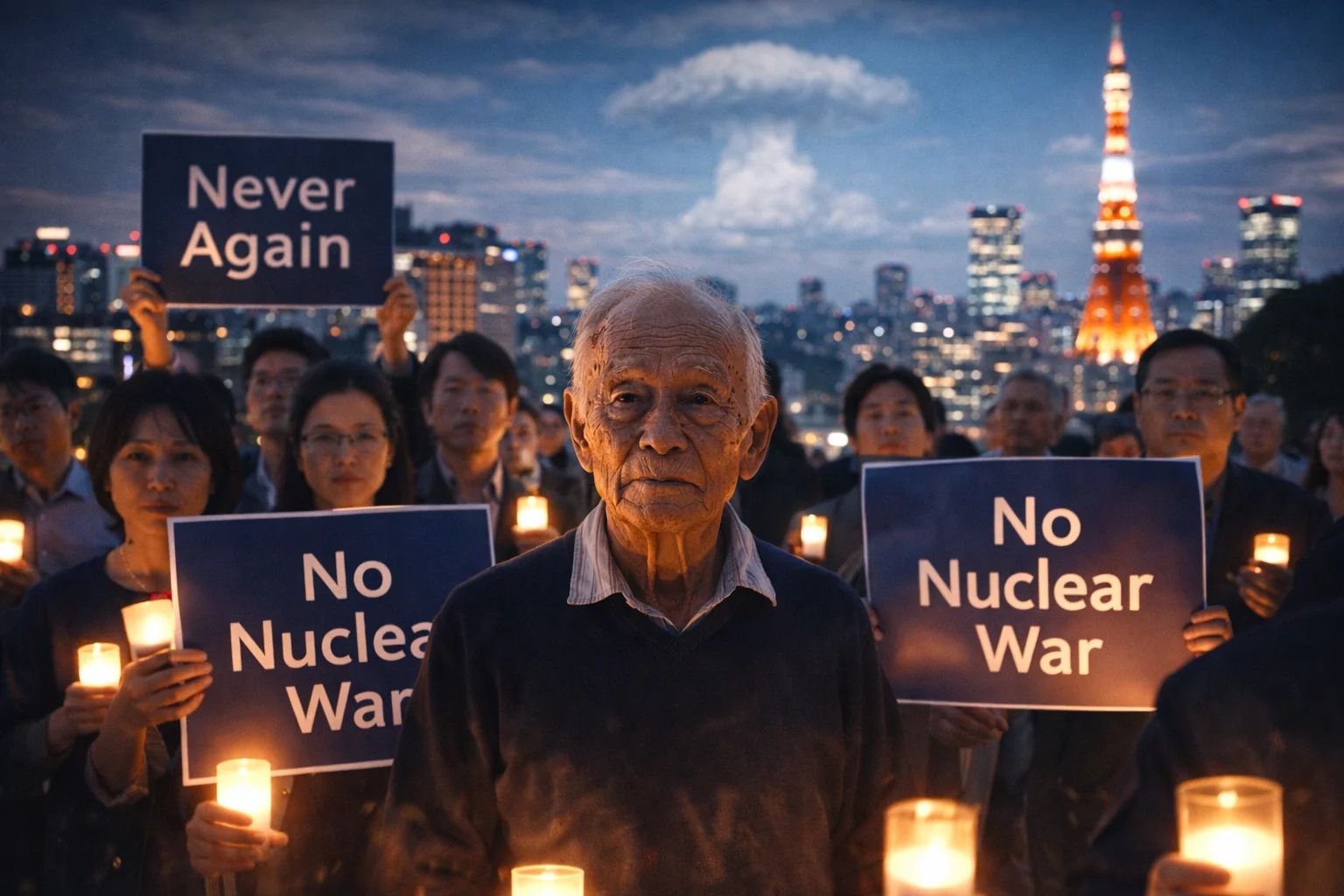
Image credit: AI-generated using ChatGPT by OpenAI
The US Argument: No Treaty Without China
The US position is blunt.
Washington argues that any new nuclear arms treaty is pointless unless China is included. China’s arsenal is expanding, and excluding Beijing, US officials say, would be strategically irresponsible.
On paper, the logic is sound.
In reality, it creates a deadlock.
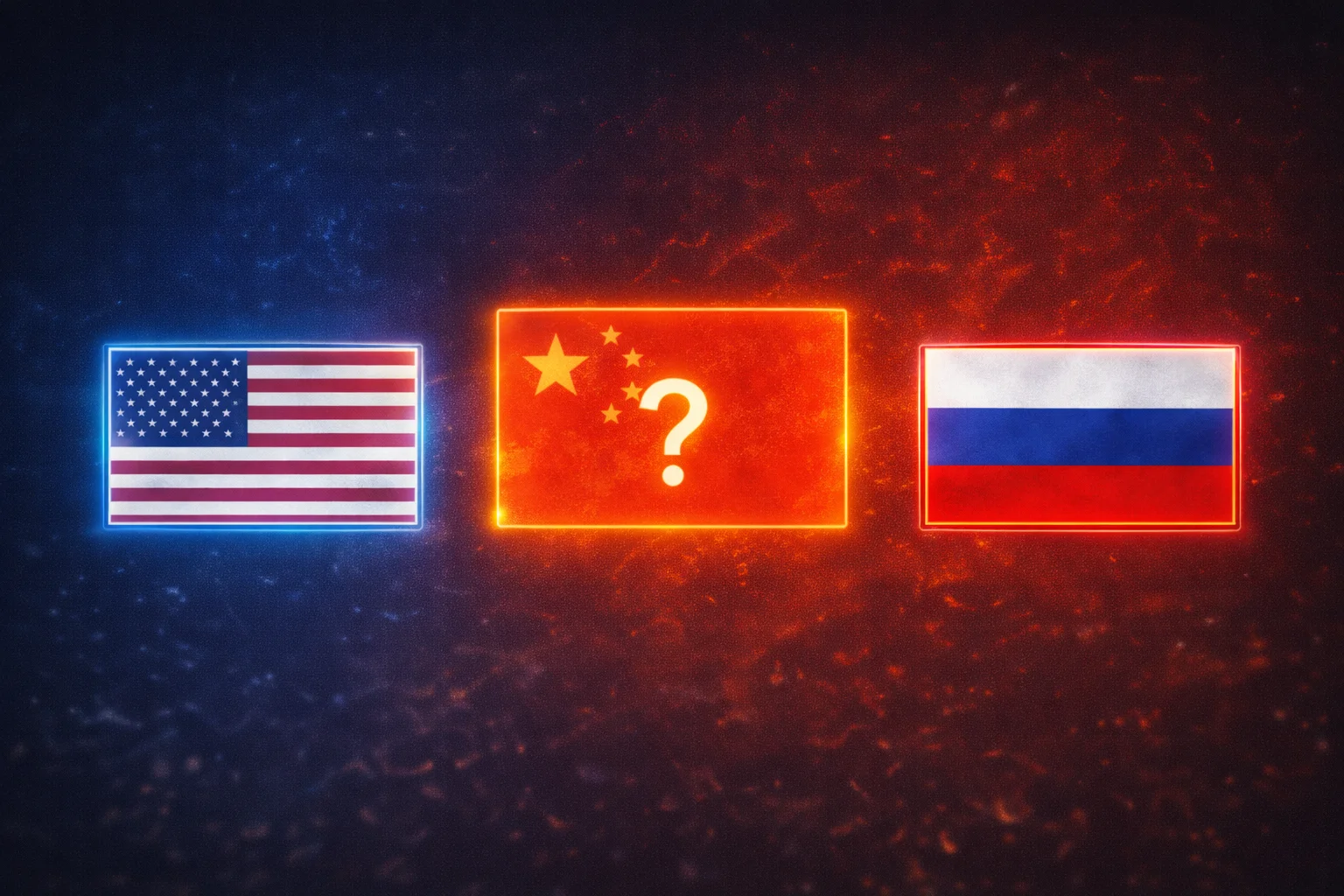
Image credit: AI-generated using ChatGPT by OpenAI
Why the China Condition Creates a Deadlock
China has far fewer nuclear weapons than the US or Russia. Joining a treaty designed for superpowers would lock China into permanent strategic inferiority.
Beijing has no incentive to agree.
And if China is included, another question follows immediately.
What about India?
From China to India: The Domino Problem
If China joins, pressure mounts to include India.
If India joins, Pakistan follows.
Then Israel.
Then North Korea.
Very quickly, arms control stops being a treaty and becomes an unmanageable global negotiation.
This is why the people are pessimistic. Not because arms control is unnecessary — but because getting universal agreement may be impossible.
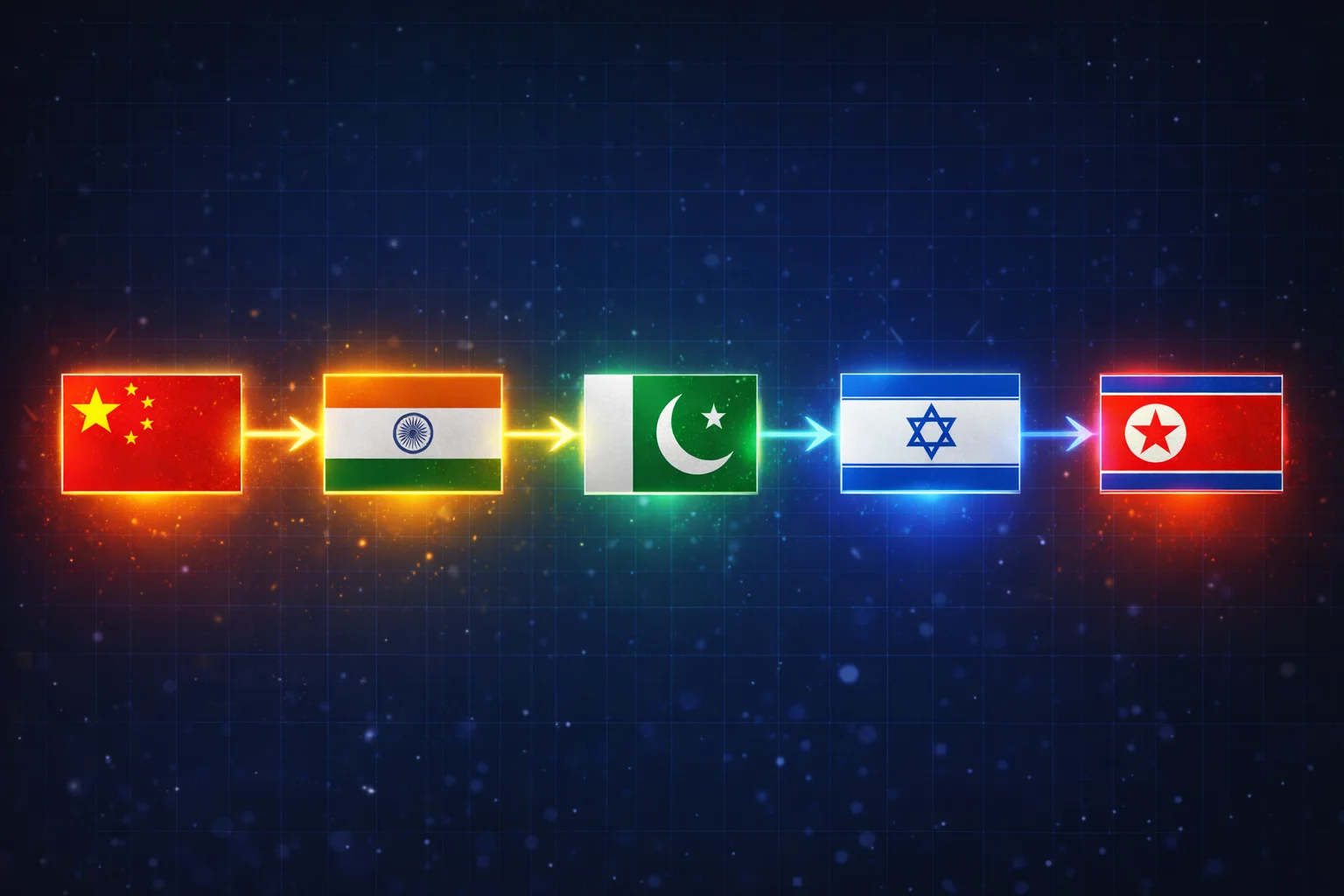
Image credit: AI-generated using ChatGPT by OpenAI
Why a Global Nuclear Treaty Is Nearly Impossible
A single global treaty would require:
- Agreement on warhead limits
- Universal verification
- Sovereignty compromises
- Mutual trust in a fractured world
In today’s geopolitical climate, that level of cooperation is unrealistic.
Which leaves the world exposed.
How Miscalculation Turns Fear Into Catastrophe
Without treaties, everything depends on judgment.
And judgment fails under pressure.
A misread military exercise.
A faulty radar signal.
A delayed clarification.
These are the moments when nuclear war becomes possible — not by choice, but by mistake.
Is the World Truly Less Safe Today?
Objectively, yes.
The New START treaty expiry 2026 removed:
- Transparency
- Predictability
- Restraint
Even if no country wants nuclear war, the system now allows one to start accidentally.
That is what makes this era uniquely dangerous.
Final Verdict: A Dangerous Vacuum With No Easy Exit
This is not about blaming one country.
It is about recognizing reality.
The world has entered a nuclear vacuum — one without rules, inspections, or trust. Replacing New START will be difficult. Expanding it may be impossible.
But history shows that imperfect restraint is better than none at all.
For the first time since 1972, the world is learning that lesson the hard way.
Image credit: AI-generated using ChatGPT by OpenAI
FAQs
What is the New START treaty expiry 2026?
It marks the end of the last nuclear arms control agreement between the US and Russia.
Why is this dangerous?
Because there are no longer limits or inspections on nuclear weapons deployment.
Can a new treaty be signed?
Possibly, but disagreements over China and other nuclear powers make it extremely difficult.
Is nuclear war more likely now?
The risk of miscalculation has increased significantly.
Share Your Thoughts
If a new nuclear arms treaty is created in the future, should countries like India be included — or should arms control remain limited to superpowers?
Share your view. Because decisions made now will shape global security for decades.
Explore deeper analyses in our World Affairs, Strategic Depth and Defense & Security sections.