Table of Contents
Why Russia Says Only Four Sovereign Countries Exist
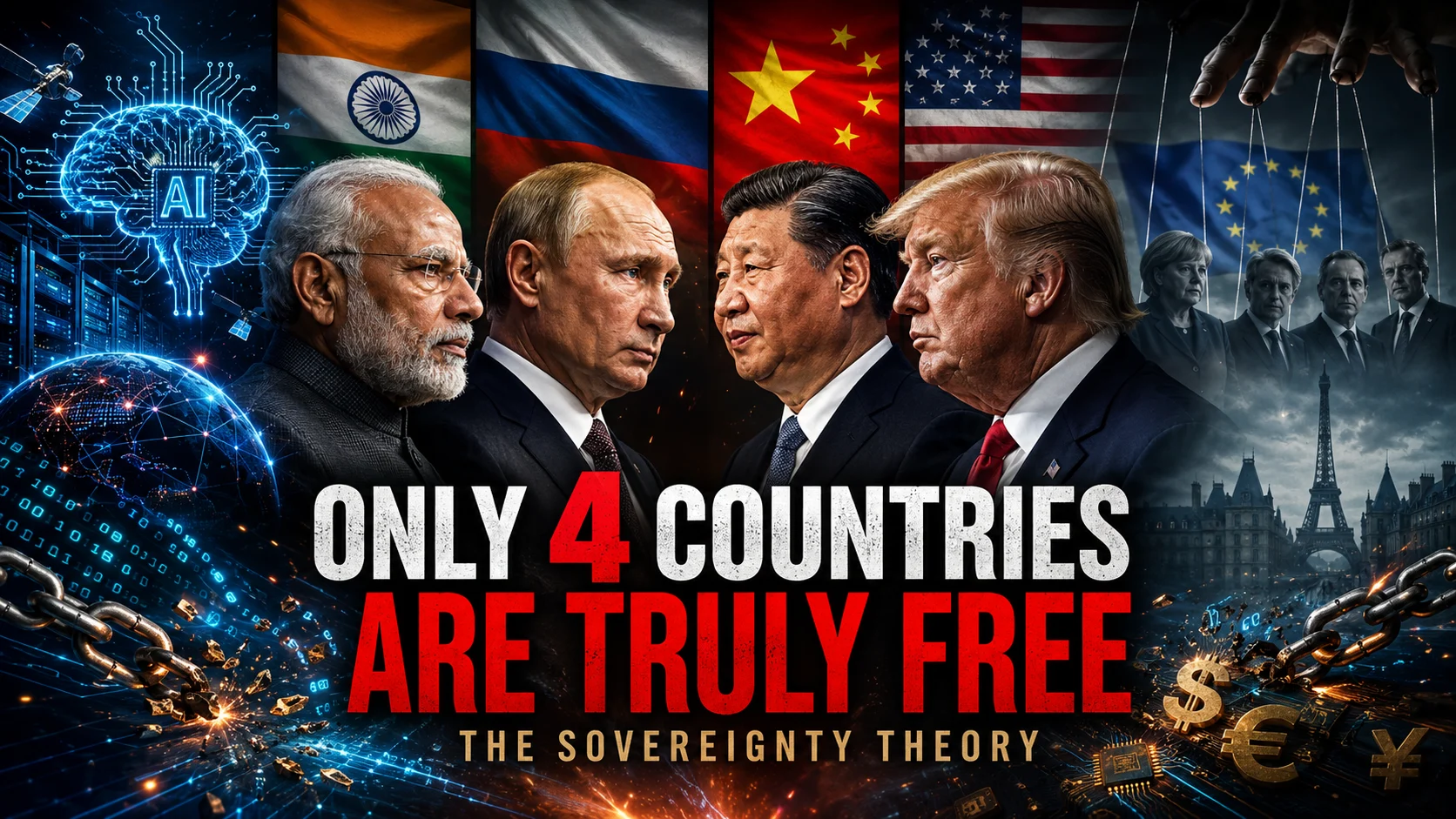
A recent geopolitical argument from senior Russian official Maxim Oreshkin closely associated with Russian President, Vladimir Putin has triggered intense debate across strategic circles: only four sovereign countries in the world today — India, Russia, China, and the United States.
“India, China, America and Russia are now forming the four global poles of political and economy sovereignty. I won’t include Europe because it is so dependent on America,” says senior Russian official Maxim Oreshkin pic.twitter.com/XR9FuldqWt
— Shashank Mattoo (@MattooShashank) April 29, 2026
The claim sounds provocative at first because sovereignty is normally treated as a basic feature of every nation-state. But Oreshkin’s framework does not define sovereignty merely as having a flag, elections, or international recognition. His argument goes much deeper. According to his view, true sovereignty means having the ability to independently control your foreign policy, defense strategy, economic system, cultural identity, and technological infrastructure without external pressure deciding your national direction.
That is where the distinction begins.
Most countries may appear independent formally, but their strategic choices are heavily shaped by another power. In some cases, this dependence is military. In others, it is financial, technological, cultural, or economic.
This is the core of the Oreshkin theory.
And within that framework, India occupies a remarkably important position because Russia now publicly places India in the same sovereign category as the US, China, and Russia itself.
That is not symbolic praise. It is a geopolitical classification.
The Three Levels of Sovereignty Explained
Oreshkin’s framework divides sovereignty into three separate layers: state sovereignty, social sovereignty, and socio-economic sovereignty.
The first is state sovereignty. This determines whether a country genuinely governs itself or whether another power indirectly controls its strategic decisions.The core question is simple: are your defense policy, foreign policy, and strategic decisions made inside your own capital, or are they indirectly controlled elsewhere?
Under this framework, if another country effectively determines your geopolitical behavior, then formal independence becomes secondary. These arrangements are described as “puppet governments.”
Venezuela is an example of a country allegedly influenced by the United States and Pakistan as another example of a state described as “controlled.” These examples are blunt because the framework itself is blunt. The argument is not about diplomacy or politeness. It is about where actual decision-making power exists.
The second level is social sovereignty. This refers to cultural identity and civilizational confidence. Does a nation still possess its own cultural center of gravity, or has it become socially absorbed by another power?
India is presented as sovereign under this category because despite strong Western influence, it continues to preserve and export its own identity. Indian cinema, music, cuisine, and cultural traditions remain globally recognizable. Western films are watched in India, Japanese anime is popular, and global influences exist, but India has not lost its own civilizational personality.
That distinction matters.
The third layer is socio-economic sovereignty. This focuses on whether a country’s economy can survive independently or whether it remains dangerously dependent on external systems. According to the framework, a sovereign economy must possess internal resilience strong enough to absorb external shocks.
India qualifies as sovereign here because its economy is internally strong enough to continue functioning even during major global disruptions. India’s domestic consumption base is so large that even if exports collapsed, the country would still continue growing.
This is where the sovereignty debate moves beyond ideology and into hard economics.
Sources: The National Center RUSSIA
Why Europe Is Considered “Dependent”
The sharpest and most controversial part concerns Europe.
According to the framework, the European Union compromised portions of its sovereignty in exchange for prosperity, welfare systems, and long-term security guarantees from the United States. Europe became heavily dependent on the US for defense, economically tied to American influence, and culturally shaped through large-scale Americanization.
The claim is not that Europe lacks wealth or technological sophistication. The claim is that Europe lacks strategic independence.
The important point here is that Europeans are fully aware of this arrangement.
Many Europeans understand this trade-off better than outsiders do. Europe knowingly exchanged portions of its sovereignty for stability, comfort, and decades of relatively peaceful prosperity under the American security umbrella.
For many years, that arrangement appeared successful.
Universities became affordable or free in several countries. Infrastructure improved significantly. Welfare systems expanded. Life expectancy rose. Airports, roads, and public systems became highly developed. Europeans enjoyed a high standard of living for decades.
Now that Russia has returned military conflict to Europe through the Russia-Ukraine war, that model is under pressure.
The concern is not only military dependence. It goes further by warning that long periods of comfort can produce “soft” societies — populations with little understanding of military preparedness or the realities of war. If defense responsibilities are outsourced for generations, strategic readiness begins declining slowly over time.
That warning sits at the center of the sovereignty debate.
What happens when a society becomes prosperous but strategically fragile? What happens if defense budgets remain weak while external threats suddenly increase?
These are the questions driving the larger argument.
That concern explains why sovereignty has returned as a central geopolitical concept.
Technological Sovereignty Is the Real Battlefield
The most important insight in the entire framework is not military power. It is technological sovereignty.
True sovereignty in the modern world is impossible without control over digital systems, data infrastructure, and national technological space. A country that depends entirely on foreign-controlled digital systems can never remain fully independent strategically.
This was deliberate.
It is repeatedly emphasized that countries must possess their own digital spaces, their own databases, and technological systems that cannot be controlled externally. The warning is clear: if another country controls your digital architecture, then your sovereignty can be weakened without firing a single shot.
That changes the meaning of power in the 21st century.
Russia’s message to other countries is equally important. Russia is now offering technological alternatives to countries that want greater sovereignty. This includes data localization systems and independent technological ecosystems designed to reduce dependence on Western-controlled digital structures.
This matters because modern geopolitical power increasingly operates through sanctions, payment systems, software ecosystems, cloud infrastructure, semiconductors, AI systems, and digital networks.
A country whose financial systems, communication platforms, or databases can be “switched off/controlled” externally does not possess full strategic independence.
That is the underlying logic of the sovereignty framework.
In this framework, technology stops being merely economic policy. It becomes a sovereignty issue.
That is why Russia’s conversations around AI, digital systems, and technological cooperation with countries like India carry geopolitical significance far beyond ordinary trade discussions.
India’s Economic Model Changes the Debate
India occupies a special place in this framework because Russia does not describe India as merely an important country. It describes India as one of the very few genuinely sovereign powers remaining in the world.
India possesses a unique combination of scale, cultural continuity, and economic resilience. Unlike economies that depend overwhelmingly on exports, India possesses a massive domestic consumption base. This internal market provides strategic resilience because economic growth can continue even during major global disruptions.
That creates a very different kind of geopolitical flexibility.
Countries heavily dependent on external trade routes or foreign markets can face enormous pressure during sanctions, trade wars, or geopolitical crises.. But if domestic demand remains large enough, the country retains strategic flexibility. This internal strength is one of the main reasons Russia considers India sovereign.
Sovereignty is connected to strategic autonomy in foreign policy. Russia publicly praises India because New Delhi has refused to fully align with any single geopolitical bloc. India continues engaging simultaneously with Russia, the United States, Europe, and other powers while attempting to preserve decision-making independence.
That approach has become one of India’s defining diplomatic characteristics.
Russia clearly sees value in that posture because it demonstrates resistance to bloc politics during an increasingly polarized global environment.
Why Russia Publicly Praises India’s Strategic Autonomy
Russian leaders, including Vladimir Putin himself has publicly stated that India under Prime Minister Narendra Modi is pursuing an independent and sovereign policy. Russia believes India is seeing positive results from maintaining this approach.
That statement becomes more significant when viewed alongside the broader sovereignty framework because Russia reserves the label of “fully sovereign” for only four countries.
Russia increasingly sees sovereignty as the defining geopolitical issue of the coming era. Discussions around technology, AI, digital infrastructure, and strategic independence are all being tied together into one larger worldview.
India fits naturally into that vision because it combines:
- a large domestic economy,
- an independent foreign policy,
- strong cultural continuity,
- and strategic flexibility between competing global powers.
Very few countries possess all four simultaneously.
The timing also matters. Russian officials have increasingly emphasized sovereignty while simultaneously promoting alternatives to Western technological and financial systems.
This reflects a wider geopolitical transition.
Countries are no longer competing only through armies or trade volumes. They are competing through data control, AI capabilities, digital infrastructure, payment systems, semiconductor ecosystems, and technological standards.
Under this framework, sovereignty is no longer only territorial. It is digital.
Why India matters to Russia strategically? India is large enough to act independently, economically resilient enough to absorb pressure, culturally confident enough to resist homogenization, and diplomatically flexible enough to maintain relations across rival power centers.
That is the central geopolitical logic behind the praise.
Sources: ANI News
The Dangerous Trade Between Comfort and Sovereignty
Many countries voluntarily traded sovereignty for comfort.
Many societies knowingly traded strategic independence for stability, prosperity, and welfare guarantees. For decades, that arrangement appeared successful. But geopolitical shocks expose vulnerabilities that remained hidden during peaceful periods.
The concern is not simply military weakness.
The deeper concern is psychological and institutional dependence. Societies can gradually lose strategic awareness when they assume another country will permanently guarantee their security. Over time, war preparedness weakens, military culture declines, and economic systems become optimized primarily for stability and comfort.
Then a crisis arrives.
The Russia-Ukraine war serves as proof that great-power competition never disappeared entirely. Military conflict between sovereign powers remains possible, especially when major countries refuse external control and compete for influence simultaneously.
That is why the sovereignty debate is returning globally.
War, Power, and the Return of Hard Geopolitics
Albert Einstein once argued that as long as sovereign nations continue to possess great power, war will remain inevitable.
The logic behind that statement is straightforward. Powerful countries resist being controlled by rival powers. When multiple major powers exist simultaneously, competition and confrontation never disappear completely.
Sovereignty itself is not the problem. The real danger arises when wars are allowed to continue for too long without timely intervention, turning conflicts into large-scale catastrophes.
The Russia-Ukraine war is the clearest modern example. Long wars create enormous damage not only militarily but also economically and socially across multiple regions.
At the same time, many countries today no longer prioritize sovereignty strongly enough because they have become accustomed to external protection or economic dependence.
That changing mindset is exactly what Russia claims to be challenging through this framework.
What This Means for India
For India, the implications of this theory are extremely significant because the country is being treated not as a secondary regional power, but as one of the world’s central sovereign actors.
That changes how both allies and rivals perceive India.
India’s sovereignty is tied directly to technological independence and domestic economic resilience. This means India cannot simply become a manufacturing appendage of another major power while still claiming strategic autonomy. If digital infrastructure, databases, AI systems, financial rails, or technological ecosystems remain externally dependent, then sovereignty becomes vulnerable even if military strength grows.
This is why discussions around digital infrastructure and localized databases become geopolitically important rather than merely technical or economic.
India’s refusal to fully align with Western sanctions frameworks, its continued engagement with Russia, and its simultaneous partnerships with the US and Europe are not contradictions under this model. They are examples of sovereignty preservation.
Russia’s praise for India is therefore not sentimental diplomacy. It reflects Moscow’s belief that India still retains the ability to make independent strategic choices despite global pressure from competing blocs.
At the same time, the broader message is also a warning for India against becoming strategically complacent. Europe’s experience is presented as a cautionary example of how long periods of prosperity and comfort can gradually weaken a nation’s strategic preparedness over time.
India’s challenge will be maintaining economic growth and technological advancement without surrendering independent control over national decision-making.
Conclusion
The Oreshkin sovereignty theory is controversial because it forces a harsh distinction between formal independence and actual strategic autonomy. According to this framework, sovereignty is not measured by flags or constitutions alone. It is measured by whether a nation truly controls its defense posture, economic system, technological infrastructure, and cultural identity without external supervision.
Under that definition, Russia places only four countries in the sovereign category: India, the United States, China, and Russia itself.
The most significant aspect of the theory is its emphasis on technological sovereignty. Military power still matters, but control over digital systems, data infrastructure, and technological ecosystems may now determine whether a country can remain strategically independent in the future.
For India, this discussion goes beyond praise from Russian officials. It raises a deeper question about the country’s long-term path. Can India continue building economic power, technological capability, and global influence while preserving the strategic autonomy that now defines its geopolitical identity?
If technological dependence becomes the modern form of geopolitical control, how long can any country remain truly sovereign without owning its own digital ecosystem?
FAQs
Which 4 countries are fully sovereign according to Russia?
According to Maxim Oreshkin’s framework, the four fully sovereign countries are India, Russia, China, and the United States. This is based on three categories of sovereignty: state sovereignty, social sovereignty, and socio-economic sovereignty. Russia’s position is that these four countries retain independent decision-making power across defense, economics, culture, and strategic policy without being dominated externally.
Who is Maxim Oreshkin and what is his role?
Maxim Oreshkin is a senior aide to Vladimir Putin and an influential Russian policymaker closely associated with discussions around sovereignty and multipolarity. He has represented Russia at major forums in India and is seen as someone articulating Russia’s long-term geopolitical worldview. His sovereignty framework has gained attention because it publicly categorizes India as one of the few genuinely sovereign powers.
What does socio-economic sovereignty mean for India?
Socio-economic sovereignty refers to whether a country can sustain itself economically without excessive external dependence. India is described as sovereign because its economy is driven heavily by domestic consumption rather than only exports. India could continue growing even during major global disruptions because of the scale of its internal market.
How is India’s economy independent of global exports?
India’s economic structure is internally resilient due to domestic demand. Unlike economies heavily dependent on exports, India’s growth is linked strongly to consumption within the country itself. This internal demand base is presented as a strategic advantage because it reduces vulnerability to global trade disruptions or external pressure.
Why does Europe lacks sovereignty?
Europe became heavily dependent on the United States for defense and gradually accepted reduced strategic autonomy in exchange for prosperity, welfare systems, and long-term stability. Many Europeans themselves recognize this trade-off and are now confronting its geopolitical consequences during periods of rising instability.
Closing Question
If technological platforms and digital infrastructure now define real sovereignty, can India maintain strategic autonomy in the future without building fully independent AI, semiconductor, and data ecosystems of its own?
Share Your Views in the Comments below.
Explore more about Strategic Depth and World Affairs.