Table of Contents
The Warning That Changes Everything
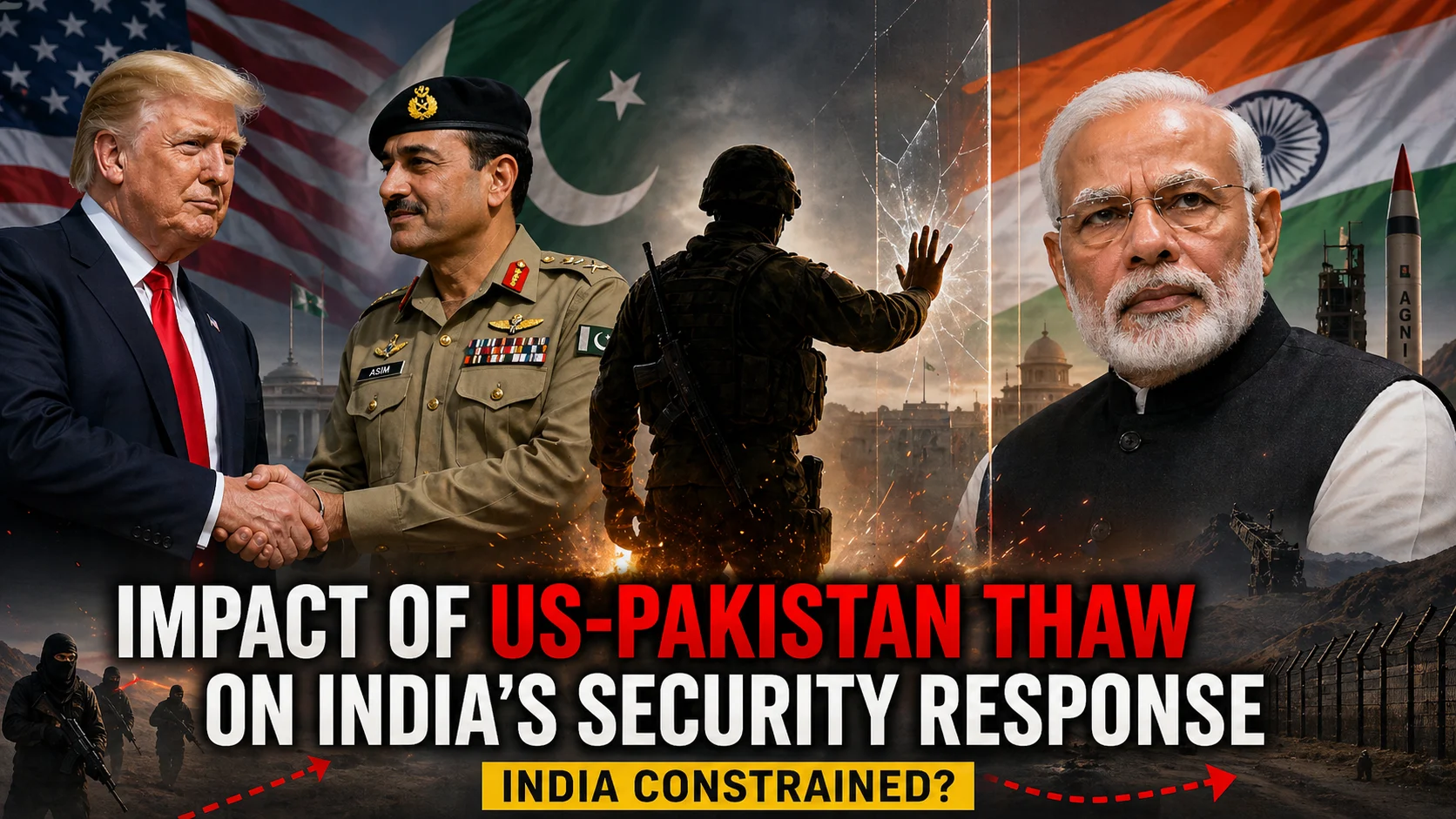
At a recent address at the Hudson Institute, former US Ambassador Kenneth Juster delivered a statement that fundamentally reframes the Impact of US Pakistan thaw on India security response.
He acknowledged India’s rise under Narendra Modi as a “civilisational power.” But the real message was a warning: if another major terrorist attack happens, India may not be able to respond with the same scale and intensity as it did during Operation Sindoor.
This was not framed as advice. It was a geopolitical reality check.
Here is what that means: the constraints on India are no longer just military or regional—they are now deeply tied to shifting global alignments.
Sources: ANI News
Operation Sindoor May Not Be Repeatable
Operation Sindoor marked a turning point in India’s counter-terror doctrine. Compared to earlier responses like Pulwama and Balakot, this was a far more aggressive, large-scale military action.
But Juster’s core point is unsettling:
India itself now doubts whether the United States would support such a “muscular response” again.
Kenneth Juster (Former US Ambassador to India): Pakistan's warm relations with the United States may cause India to limit its response to the next significant cross-border terrorist incident…….India may have doubts as to whether the United States will support a muscular… pic.twitter.com/V1Ft0gY8n9
— Incognito (@Incognito_qfs) April 24, 2026
That changes the entire strategic equation.
If the previous assumption was that India could escalate militarily after major attacks, the new assumption is uncertainty—especially if Washington intervenes to stabilize Pakistan.
The warning goes even further. The concern is not just that the United States may refuse to support India—it is that Washington could actively step in to strengthen Pakistan’s defensive position during such a crisis. That means if India attempts another large-scale strike, the geopolitical environment may no longer remain neutral; it could tilt in Pakistan’s favor in real time.
This is where the Impact of US Pakistan thaw on India’s security response becomes operational, not theoretical.
Sources: The Print
The Surprise Factor: US-Pakistan Alignment
Even seasoned observers did not expect this shift.
Juster himself admitted that the strengthening of US-Pakistan ties came as a surprise. For nearly two decades, no US President had visited Pakistan. Now suddenly, Donald Trump is willing to engage, even planning visits tied to diplomatic deals.
But this alignment is not symbolic—it is functional. Pakistan is positioning itself as a useful intermediary for the United States, including in sensitive geopolitical spaces like mediation involving Iran. At a time when global energy routes such as the Strait of Hormuz are under stress, this role makes Pakistan strategically valuable. And once a country becomes useful to a superpower’s core objectives, that utility begins to influence how conflicts involving that country are handled.
Another factor enabling this rapid alignment is Pakistan’s internal political environment. With opposition leader Imran Khan in jail, there is limited domestic resistance to foreign policy decisions. This gives Pakistan’s leadership unusual freedom to align closely with US expectations without internal political friction.
Terror Calculus: Why Risk May Increase
The most dangerous implication is not diplomatic—it is psychological.
Terrorist groups operating from Pakistan are likely to interpret this shift in a very specific way:
India’s ability to launch large-scale retaliatory strikes has become uncertain.
And that perception alone can change behavior.
If adversaries believe that “Operation Sindoor 2” is unlikely, the deterrence value of past actions weakens. Ambitions to carry out attacks could increase—not because capabilities improved, but because perceived consequences declined.
This was deliberate.
Civilisational Power: More Than a Label
The term “civilisational power” is not just symbolic.
It distinguishes countries with deep historical continuity—thousands of years of cultural evolution—from relatively newer nation-states. India belongs to the former category.
The contrast is fundamental. Countries like the United States are powerful modern states, but their historical continuity spans only a few centuries. India, by comparison, represents a civilisation that has existed for thousands of years, absorbing upheavals and still retaining continuity.
But why does this matter strategically?
Because civilisational identity can be weaponised—not militarily, but narratively.
This is not theoretical. Israel has operationalised this approach effectively. Whenever it faces attacks, it frames them not merely as security incidents but as attacks on an ancient civilisation and identity.
That framing consistently builds global sympathy and legitimacy.
India has the same civilisational depth—but has not deployed it with the same strategic clarity.
Sources: WION
Narrative Warfare vs Military Power
India possesses advanced military capabilities—Agni-5, S-400, Barak-8.
But the point is: military strength alone is insufficient if the global narrative is lost.
Narrative warfare refers to shaping how the world interprets events.
The deeper issue is that narrative warfare is still not treated as a priority. It is neither fully understood by the broader public nor pursued aggressively at the policy level. This gap allows adversaries to dominate perception even when India holds the factual advantage.
If India conducts a strike but fails to control the narrative, even a smaller country can dominate perception. That perception then influences diplomatic reactions, media framing, and international pressure.
So the real battlefield is not just physical—it is informational.
And right now, India is not fully engaging in it.
India’s Missing Global Projection
India contributes significantly on the global stage:
- Food aid to Afghanistan
- Infrastructure development in Sri Lanka
- Support to Maldives
- Development projects in Nepal
Yet, these efforts rarely translate into narrative advantage.
Why?
The reason is simple: they are not projected effectively in international discourse.
This creates a mismatch. India behaves like a responsible power but is not consistently perceived as one. And in geopolitics, perception often determines legitimacy.
If the world does not see India’s contributions, it becomes harder to justify strong responses during crises.
Sources: The Times of India, News on AIR, The Hindu, Moneycontrol
The Religion Trap and Pakistan’s Narrative
One of Pakistan’s most effective strategies has been narrative framing.
It portrays India’s actions as anti-Muslim or religiously motivated.
India’s challenge is to dismantle this framing clearly and consistently.
Any future operation—whether Sindoor 2, 3, or 4—must be positioned as:
- Counter-terror action
- Not religious conflict
- Targeted at terrorist infrastructure
Without this clarity, global perception can shift against India, regardless of facts.
And once that perception sets in, reversing it becomes extremely difficult.
Diaspora as a Strategic Tool
India’s global diaspora—especially in the US and Europe—is a powerful but underutilized asset.
Engaging this network can amplify India’s narrative in:
- Policy circles
- Media discussions
- Public opinion
This is not about propaganda. It is about ensuring India’s perspective is heard where decisions are influenced.
Countries that succeed in narrative warfare do not rely solely on governments—they mobilize networks.
India has that network—but has not fully leveraged it.
India’s Strategic Reality: Limited Option
The strategic reality is harsher than it appears. India does not have many options in this scenario. If Washington has aligned its priorities with Pakistan’s leadership, there is very little India can do to directly change that equation.
If Asim Munir becomes a preferred partner in US calculations, India must operate within that constraint.
There are no easy countermeasures.
India cannot dictate US foreign policy. It cannot reverse alliances overnight.
So the strategy shifts from control to adaptation.
India must carve out space within constraints—not eliminate them.
Impact of US Pakistan thaw on India Security Response: What this means
The Impact of US-Pakistan thaw on India’s security response forces India into a difficult transition.
First, large-scale military responses are no longer purely a question of capability. They are shaped by international reactions that may not favor India.
Second, adversaries may begin to test limits if they believe India’s response options are constrained.
Third, India must actively build global legitimacy. Without it, even justified actions may face resistance.
Fourth, narrative warfare becomes central. India must ensure that any future conflict is understood globally as a response to terrorism, not misrepresented as something else.
And finally, India must recognise that its identity as a civilisational power is not just historical—it is strategic. It must be used deliberately to shape perception and support.
Conclusion
The shift in US-Pakistan relations is not just another diplomatic development—it is a structural change in India’s strategic environment.
India’s past success with Operation Sindoor established a new normal in counter-terrorism. But that normal is now under pressure.
The emerging reality is clear: future responses will not be judged only by their effectiveness, but by how they are perceived globally.
Military strength built India’s capability. Narrative strength will determine whether it can use it.
FAQs
What is the civilisational power of India?
India is described as a civilisational power because of its continuous history spanning thousands of years. This identity allows it to frame conflicts not just as national issues but as challenges to an ancient, pluralistic civilisation. That framing can strengthen global legitimacy.
What was Operation Sindoor in 2025?
Operation Sindoor was a major Indian military response to terrorism originating from Pakistan. It went beyond previous actions like Balakot in scale and intensity, establishing a new benchmark for India’s counter-terror doctrine.
Why did Pakistan nominate Trump for the Nobel Prize?
Pakistan aligned closely with Donald Trump and supported his diplomatic initiatives, including mediation roles. The nomination reflected this strategic alignment and willingness to strengthen ties.
Will the US support India’s next strike on Pakistan?
According to Kenneth Juster, there is uncertainty. The improving US-Pakistan relationship may lead Washington to temper or limit support for large-scale Indian military responses.
Who is Field Marshal Asim Munir?
Asim Munir is Pakistan’s military chief and a central figure in its strategic alignment with the United States. His growing importance increases Pakistan’s geopolitical relevance.
Closing Question
If future terrorist groups believe India is diplomatically constrained from responding at scale, does India risk losing deterrence faster than it can rebuild global narrative support?
Share Your Views in the Comments below.
Explore more about Defense & Security and Indian Affairs.