Table of Contents
The Killing That Fits a Pattern
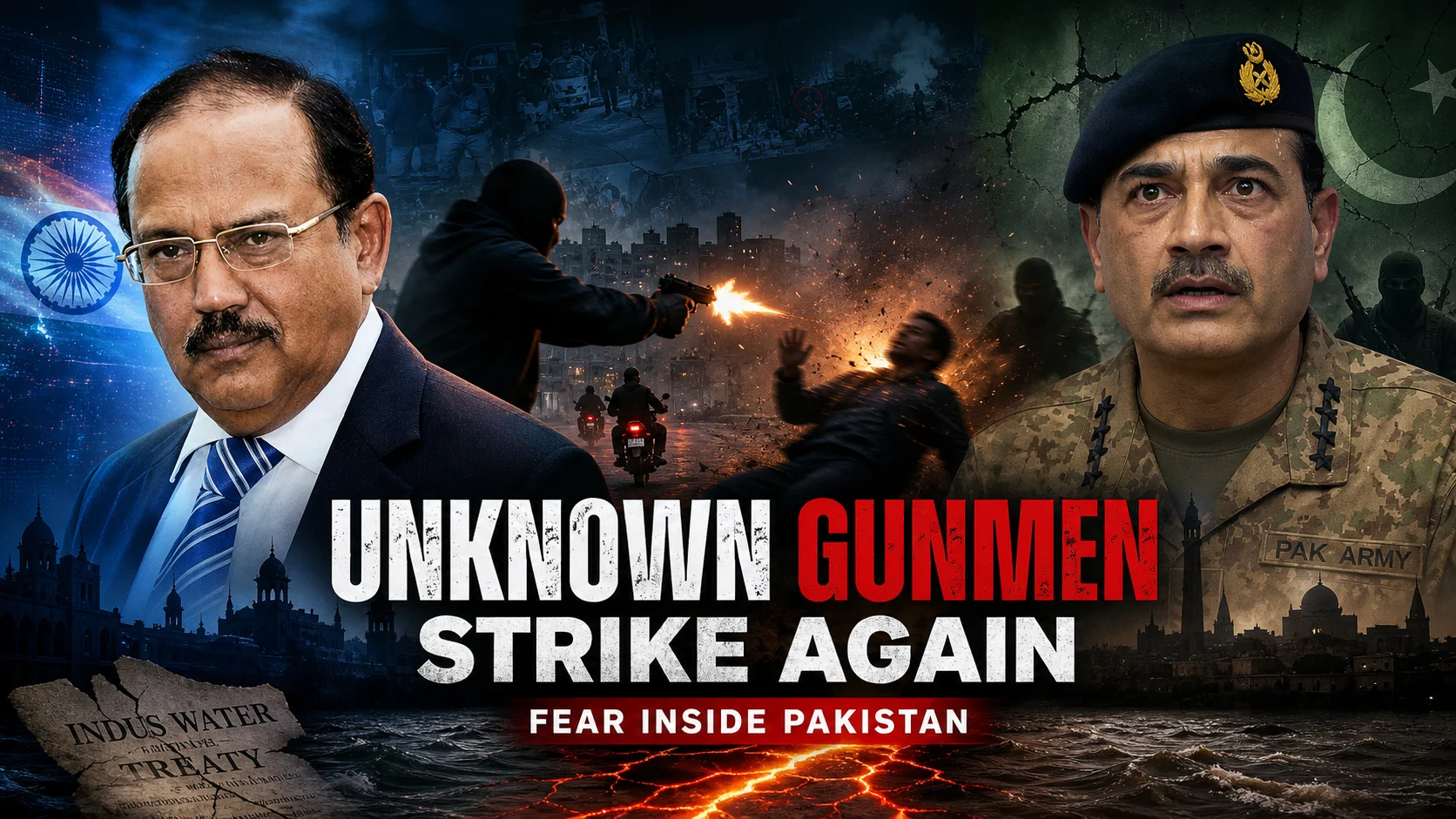
The elimination of Sheikh Yusuf Afridi was not just another assassination inside Pakistan. It followed a now-familiar script: a high-value terror operative walks outside his home, unknown attackers arrive, fire at close range, and disappear without a trace. No arrests. No claim of responsibility. No clarity.
Afridi was not a symbolic figure. He was deeply embedded in the recruitment machinery of Lashkar-e-Taiba and worked closely with Hafiz Saeed. His role involved identifying vulnerable individuals in tribal and impoverished regions and manipulating them into joining terror networks.
This matters because removing a recruiter is not just removing a soldier—it disrupts the supply chain of future militants.
And yet, the most striking detail is not who was killed. It is how consistently this is happening.
The Expanding List of Unknown Gunmen in Pakistan
Afridi’s killing is part of a growing pattern often described as the “unknown gunmen in Pakistan” phenomenon. Over the past few years, multiple individuals linked to terror operations against India have been eliminated in similar fashion.
Names include:
- Mistry Zahoor Ibrahim – killed in Karachi
- Lal Mohammad – an ISI-linked operative and one of the biggest suppliers of fake Indian currency, killed in Nepal
- Shahid Latif – shot outside a mosque in Pakistan
- Bashir Ahmad Peer
- Faisal Nadeem
- Maulana Rahman
Across different locations—Karachi, Punjab, Nepal—the method remains consistent: close-range targeting, rapid execution, and complete disappearance of attackers.
This is not random violence. It is targeted.
The consistency of these operations suggests intent, not coincidence.
Sources: NDTV, India Today, The Hindu
Why Lashkar and Jaish Are the Primary Targets
A clear pattern emerges when examining who is being targeted. Most of these individuals are linked to either Lashkar-e-Taiba or Jaish-e-Mohammed.
These are not minor groups. Historically, they were capable of executing large-scale attacks across India—bomb blasts in Delhi, Mumbai, and other cities that defined an era of constant fear.
Today, that capability has significantly declined.
The removal of key operatives—recruiters, planners, coordinators—has hollowed out their operational strength. When leadership layers are repeatedly eliminated, coordination collapses. Recruitment slows. Planning becomes fragmented.
Because of this, These organizations have become very weak internally and are no longer able to function at the scale they once did.
The Shift: Fear Moves Across the Border
Fifteen years ago, the psychological landscape was very different. Indian cities experienced repeated attacks, and public fear was widespread.
Today, that fear has shifted.
Ordinary Indians feel relatively less threatened, while terrorists inside Pakistan now live with constant anxiety. The threat is no longer distant—it is immediate, unpredictable, and internal.
They are unsure when an unknown gunman might appear.
This reversal of fear is not incidental. It reflects a deeper structural change in how security pressure is being applied.
The focus of fear has shifted—from Indian cities to Pakistani militant networks.
The Strategic Pivot to “Water Terrorism”
As these militant networks weaken, another shift becomes visible—not on the battlefield, but in narrative.
Pakistan has begun aggressively pushing the idea that India is engaging in “water terrorism,” particularly around the Indus Waters Treaty. Ministers and officials have publicly argued that India is allegedly restricting water flow, weaponizing rivers, and violating agreements.
Pakistan crying for water while supporting terrorists
— ExtraOrdinary (@Extreo_) April 27, 2026
Pakistan’s minister just accused India of “water terrorism” and warned of a big response if they block river water.
Red line crossed, he says.
pic.twitter.com/5nZomf3kDD
But the timing is not accidental.
Pakistan continues to receive water. However, with rising heatwaves and anticipated shortages across the subcontinent, water stress is becoming a politically exploitable issue. Pakistan is preparing to frame itself as the victim.
The strategy includes:
- Amplifying claims through Turkish and Chinese media
- Launching coordinated narrative campaigns
- Using visual propaganda—even rudimentary tools—to push messaging
- Attempting to internationalize the dispute
This is not about water alone. It is about replacing a failing lever of influence.
Source: Moneycontrol, The Free Press Journal
The Trump Variable in Narrative Warfare
An unpredictable element in this narrative battle is Donald Trump.
There is a sharp distinction: Official U.S. government positions often differ from Trump’s personal statements. While formal reports label Pakistan as a hub for terrorist groups, Trump has publicly praised Pakistan and made controversial remarks.
Pakistan appears to be betting on this unpredictability.
The expectation is that leaders like Asim Munir and Shehbaz Sharif may attempt to push Trump into publicly supporting Pakistan’s water claims. Even a single statement or tweet could shift global perception.
And perception, in narrative warfare, is leverage.
Sources: Open Magazine
What This Means for India
For India, two strategic priorities emerge clearly.
First, internationalizing the threat of Pakistan-based terror groups. References to U.S. Congressional reports identifying Pakistan as a long-standing hub for such groups highlight the importance of building global consensus. The objective is to ensure that multiple international platforms—whether in the UN, Europe, or elsewhere—recognize and document this threat formally.
This is about shaping global consensus—not reacting to isolated events.
Second, countering the “water terrorism” narrative before it gains traction. Pakistan’s strategy is not reactive—it is preemptive. Pakistan is preparing for a narrative confrontation, not merely reacting to events. By positioning itself as a victim in advance, it aims to influence international perception early. India, therefore, must respond not only with policy but also with messaging.
India, therefore, faces a dual challenge: maintain pressure on weakened terror networks while simultaneously fighting a perception battle on water.
This makes one thing clear—India is no longer operating from a defensive mindset. It is less willing to show unilateral generosity, especially when resources and security concerns intersect.
At the same time, the risk is real. If global narratives begin to shift—even partially—India could face diplomatic pressure despite holding a stronger strategic position on the ground.
This is where the two threads connect.
The weakening of Lashkar and Jaish has not ended the conflict—it has transformed it.
Conclusion
The killing of Sheikh Yusuf Afridi is not an isolated event. It is part of a sustained pattern targeting the operational backbone of Pakistan-based militant groups. Recruiters, planners, and handlers are being removed with precision, and the result is visible: these organizations are no longer capable of executing attacks at the scale seen a decade ago.
The trajectory suggests that this pattern of targeted eliminations is not temporary—it is expected to continue in the coming period.
As proxy warfare loses effectiveness, Pakistan is pivoting toward narrative warfare—specifically through the “water terrorism” claim tied to the Indus Waters Treaty. This shift is strategic, not emotional. It is designed to regain leverage through global perception rather than ground operations.
At the same time, variables like Donald Trump introduce unpredictability into the equation, making narrative influence a critical battleground.
The broader implication is clear: the conflict is evolving from bombs and recruits to narratives and resources.
And India must now operate effectively in both arenas.
FAQs
Who is Sheikh Yusuf Afridi in Lashkar-e-Taiba?
Sheikh Yusuf Afridi was a key recruitment and coordination figure within Lashkar-e-Taiba. His role involved identifying individuals in vulnerable regions and guiding them into the group’s network. His elimination disrupts recruitment pipelines, which are critical for sustaining long-term militant operations.
What is the unknown gunmen phenomenon in Pakistan?
It refers to a pattern where high-profile terrorists are killed by unidentified attackers who escape without being caught. These operations are precise, repeated, and largely unclaimed, creating fear within militant circles and disrupting organizational structures.
Why was the Indus Waters Treaty suspended or challenged?
The treaty has come under strain due to rising tensions and security concerns. While Pakistan claims India is restricting water, evidence suggests that water continues to flow, and the dispute is increasingly being framed as a narrative strategy rather than purely a legal issue.
How did unknown gunmen kill Shahid Latif?
Shahid Latif, linked to the Pathankot attack, was shot outside a mosque by multiple attackers. The method—close-range shooting followed by escape—matches the broader pattern seen in similar eliminations across Pakistan.
What role could Donald Trump play in this issue?
Trump’s public statements, which sometimes differ from official U.S. positions, could influence global narratives. Pakistan appears to be seeking his support to amplify its claims about water disputes, which could complicate India’s diplomatic position.
Closing Question
If Pakistan’s shift from proxy terror to water-based narrative warfare gains international traction—especially with unpredictable external voices like Trump—can India maintain its strategic advantage without conceding ground in the global perception battle?
Share Your Views in the Comments below.
Explore more about Defense & Security and Indian Affairs.