Table of Contents
Trump White House Shooting: Shots Fired, Power Exposed
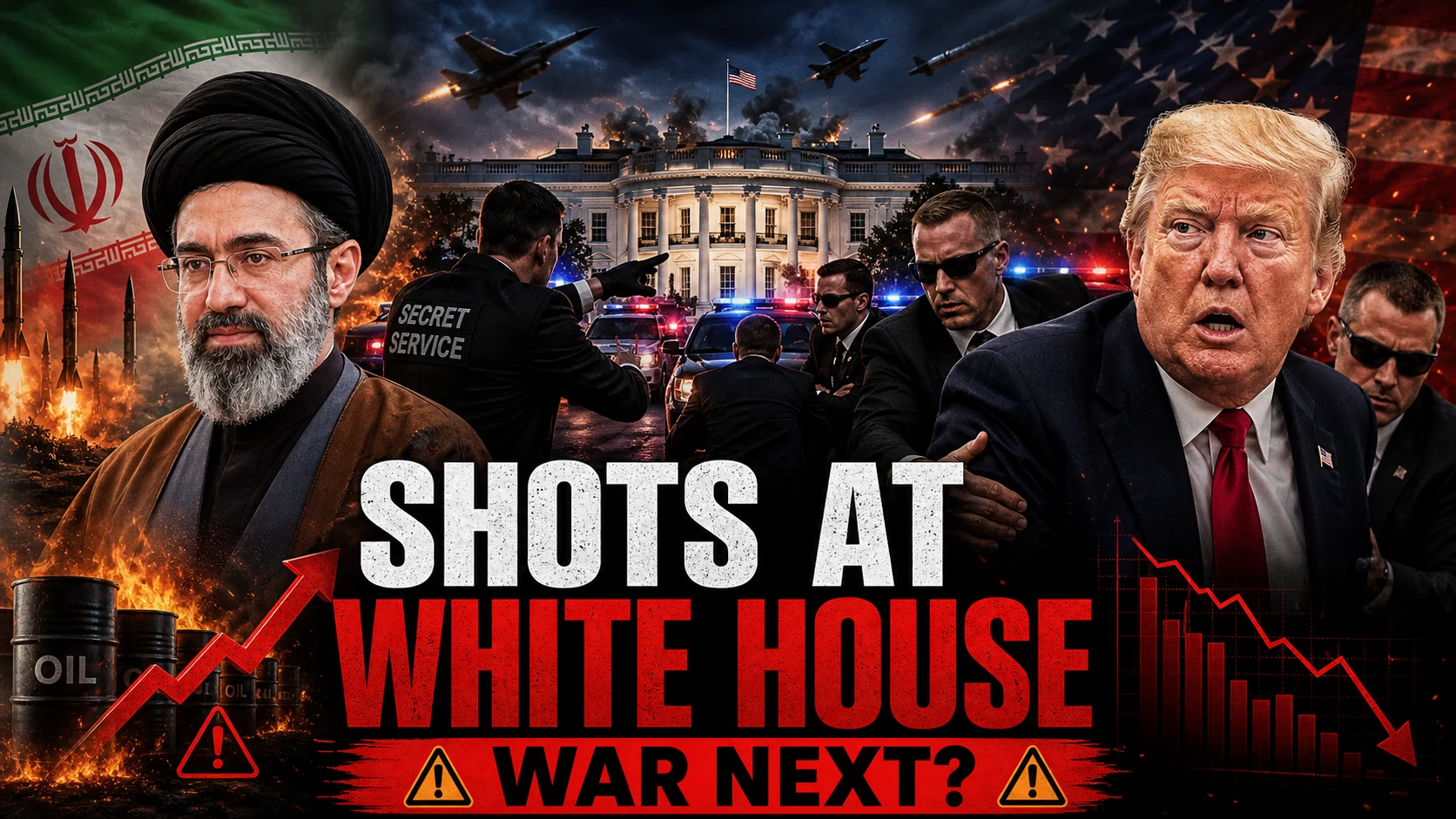
At the height of a global crisis between the United States and Iran, gunshots rang out near the White House during a high-profile dinner attended by Donald Trump and Melania Trump.
Within seconds, the illusion of control collapsed.
Secret Service agents rushed in, surrounded Trump, and evacuated him immediately. They didn’t just extract the President—they cleared the entire leadership circle. J.D. Vance, Vice President of US was also rushed out. Senior officials, family members, and guests were forced to take cover under tables. The event was abruptly canceled. No one knew where the threat was coming from or whether more shots would follow.
🇺🇸⚡️An ATTACK was attempted on TRUMP at the Washington Hilton Hotel,
— War Flash (@WarFlash_2630) April 26, 2026
The attacker was killed by the security forces later.—CNN
The attacker was arrested —FOX news pic.twitter.com/elJkoYQJMR
This wasn’t just a security scare. It was a moment that exposed how fragile the situation had become—both inside America and globally.
Trump is not just another political figure. He is deeply polarizing. If something had happened to him, the fallout would not have been limited to Washington—it could have triggered internal unrest across the United States, with political factions clashing openly.
Trump has already faced a direct assassination attempt in the past. During his campaign, a bullet grazed his ear. That history is not incidental—it reinforces why every security breach around him is treated as potentially catastrophic, and why escalation rhetoric tied to his personal safety carries real global consequences.
The attacker was quickly apprehended and taken into custody, bringing the immediate threat under control—but not the larger uncertainty surrounding motive and implications.
And there’s a far more dangerous layer to this.
Trump has already stated that if he is assassinated, the United States should retaliate by wiping Iran “off the face of earth.” The implication is clear: a retaliatory strike of massive, possibly nuclear scale..
One incident outside a dinner venue suddenly carries the risk of global escalation.
Sources: India Today, Anadolu Agency
The Real Trigger Was Not the Gunfire
The shooting itself is dramatic—but it may not be the most important part of this story.
The critical shift happened just before it.
Trump publicly announced that he was canceling a diplomatic mission to Pakistan, where his representatives were supposed to engage with Iranian officials. His reasoning was blunt: Iranian leadership was too divided, full of infighting, and not worth negotiating with.
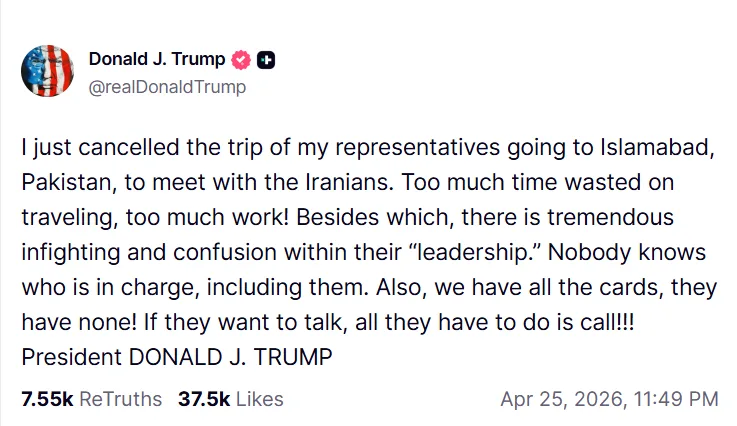
Screenshot of Truth Social Post by Donald Trump (@realDonaldTrump)
That explanation sounds tactical—but it masks something deeper.
President Trump is strategically using claims of Iranian leadership “infighting” to shut down diplomacy, likely buying time for a major US ground invasion once military readiness is complete.
This changes how the entire crisis should be understood.
The cancellation of talks wasn’t a failure—it was a decision.
Diplomacy Collapses in Plain Sight
Trump’s message was direct: if Iran wants to talk, it should call him personally.
No intermediaries. No third-party negotiations. No structured diplomacy.
This effectively eliminates any role for countries like Pakistan in mediation. It also signals that the United States is no longer interested in slow, negotiated outcomes.
Here is what that means.
Diplomatic frameworks exist to delay conflict, manage escalation, and create space for compromise. By rejecting them, Trump is accelerating the timeline toward confrontation.
At the same time, he is framing Iran as disorganized and weak—“they don’t even know who is in charge.”
That narrative serves a purpose. It justifies disengagement from talks while maintaining public support for stronger action.
But it also raises a serious question: if diplomacy is intentionally sidelined, what replaces it?
This clearly toward one answer—military escalation.
The Economic Pressure Cooker Inside America
While global tensions rise, the domestic situation inside the United States is deteriorating.
Trump came into power promising to reduce inflation, stabilize the economy, and lower the cost of living. Instead, the opposite is happening.
Prices are rising across the board. The biggest driver is crude oil.
As oil prices climb, everything becomes more expensive—transport, food, manufacturing, daily essentials. This creates widespread frustration among American voters.
And this frustration is measurable.
Trump’s approval ratings have dropped into the 30–40% range, with some polls placing him as low as 33%. That means a majority of Americans are dissatisfied with his leadership.
The contradiction is stark:
- A president facing declining domestic support
- An economy under inflationary pressure
- A foreign policy becoming more aggressive
This combination is unstable.
It creates a scenario where external conflict and internal dissatisfaction feed into each other.
Sources: Business Today
A President Losing Support While Escalating War
Trump’s political identity was built on promises—reduce wars, fix the economy, bring stability.
But voters are now seeing a different version of him.
The ongoing conflict involving Iran, the unresolved war involving Russia and Ukraine, and rising costs have created a perception that Trump has “changed” after becoming president.
This perception matters.
When public trust declines, leaders often double down on decisive action to project strength. In this case, that strength is being expressed through military posture and aggressive rhetoric.
At the same time, Trump’s statements—especially the threat of total destruction of Iran if he is harmed—raise the stakes to an extreme level.
This is not standard geopolitical signaling.
It is escalation with no visible ceiling.
Why Direct Talks Are Being Avoided
Trump insists that the only way to end the war is through direct, face-to-face talks—no intermediaries, no third parties.
On the surface, this sounds logical.
But this suggests something else.
This explicitly aligns with a theory often associated with Russia—that Trump may be buying time.
By rejecting mediated talks and insisting on direct engagement under US terms, Trump is effectively setting a condition that is unlikely to be met quickly.
This delays negotiations.
And delay, in this context, serves a purpose.
It gives the US military time to prepare.
It is been explicitly suggested that once the United States is confident in its readiness for a major land operation, diplomacy will be dropped entirely. At that point, the focus shifts directly to Tehran.
This is not a negotiation strategy.
It is a transition phase before escalation.
India’s Strategic Tightrope in a War It Didn’t Choose
For India, this crisis is not distant—it is immediate and consequential.
India depends heavily on global oil markets. Rising crude prices directly impact fuel costs, inflation, and economic stability. When tensions between the US and Iran push oil prices upward, Indian households feel it almost instantly.
But the challenge goes beyond economics.
India has relationships with both sides.
On one hand, it has strategic and defense ties with the United States. On the other, it maintains important regional and economic connections involving Iran. This creates a balancing act that becomes harder as tensions escalate.
If the conflict intensifies—especially if it moves toward a ground invasion or broader regional war—India faces multiple risks:
- Energy supply disruptions
- Higher import costs
- Pressure to take a diplomatic position
- Instability affecting Indian interests in the region
This also highlights something more subtle.
India is effectively watching how this conflict unfolds to understand modern warfare dynamics. The suggestion that powerful militaries may still struggle despite their advantages is not lost on Indian policymakers.
There is also a strategic warning embedded here.
If diplomacy is sidelined globally in favor of direct confrontation, countries like India—who rely on multi-alignment and balanced relationships—lose space to maneuver.
And that space is critical to India’s foreign policy.
So India is not just observing this crisis.
It is learning from it, adapting to it, and quietly preparing for a world where great power conflicts are less predictable and far more dangerous.
Conclusion
The Trump White House shooting is not an isolated incident. It is a flashpoint in a much larger geopolitical crisis.
A security breach near the most protected political figure in the world exposed how volatile the situation has become. But the deeper story lies in the strategic decisions surrounding it.
Trump’s cancellation of diplomatic talks, his framing of Iranian leadership, and his insistence on direct negotiation all point toward a calculated shift away from diplomacy and toward escalation.
At the same time, rising inflation and falling approval ratings create domestic pressure that complicates every decision.
This is a moment where internal instability and external aggression are feeding into each other.
The consequences will not remain confined to the United States or Iran.
They will ripple outward—economically, politically, and strategically—affecting countries like India that are deeply connected to global systems.
The real question is not whether tensions will rise further.
It is how far this trajectory goes before something irreversible happens.
FAQs
Was anyone injured in the White House shooting in April 2026?
Shots were fired and the attacker was apprehended, but no injuries were detailed. What stands out instead is the rapid response of the Secret Service and the immediate evacuation of the President, highlighting how seriously the threat was treated.
Why did Donald Trump cancel the Iran peace talks in Pakistan?
Trump stated that Iranian leadership was too divided and confused to negotiate effectively. However, the deeper implication is strategic—canceling talks may be a way to delay diplomacy while preparing for stronger military action.
How high are crude oil prices during the US-Iran war?
Rising crude oil prices are directly linked to inflation in the United States. Prices have gone up to $126 per barrel and Sustained high prices are shown to be driving economic pressure and public dissatisfaction.
What is Trump’s current approval rating according to Morning Consult?
Some polls place Trump’s approval around 44%, while others show it dropping to the mid-30s. The key takeaway is the downward trend and growing dissatisfaction among voters.
What is the current status of diplomacy between the US and Iran?
Diplomatic efforts are effectively stalled. Trump has rejected mediated talks and insists on direct communication, which reduces the chances of immediate negotiation and increases the likelihood of escalation.
Closing Question
If Trump continues to block mediated diplomacy while preparing for direct confrontation, how long can India maintain its strategic neutrality before it is forced to choose sides in a conflict that directly impacts its economy?
Share Your Views in the Comments below.
Explore more about World Affairs and Defense & Security.