Table of Contents
A Pattern the US Has Never Faced Before
The mysterious deaths of US and Chinese scientists are no longer isolated incidents—they are forming a pattern that is deeply unsettling, especially for the United States.
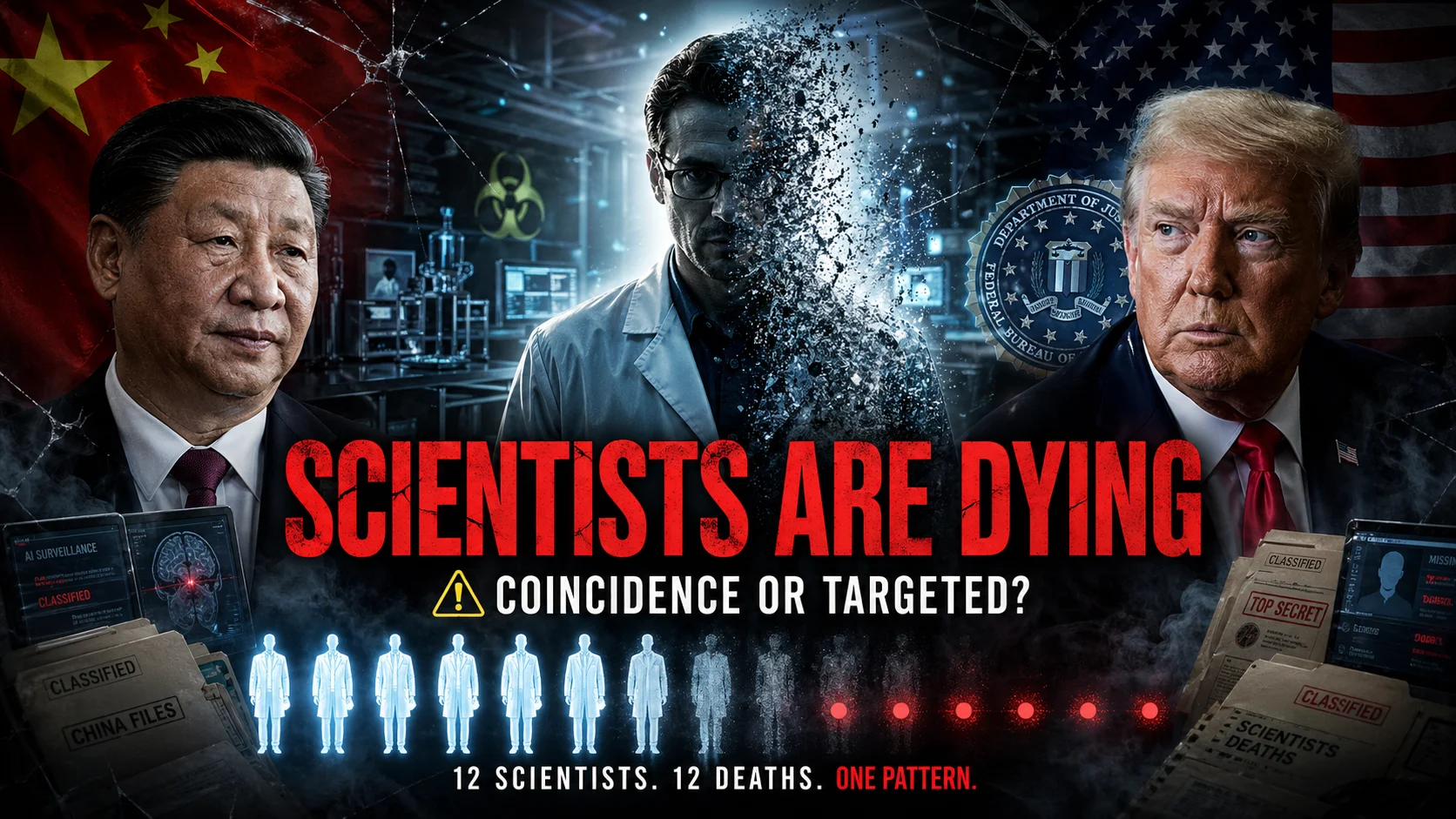
Over the past few months, around 12 top-level scientists in the United States—linked to military-related and advanced research—have either disappeared or been found dead. These are not ordinary researchers working in universities. These are individuals associated with sensitive work tied to national security.
American media itself is highlighting this shift. Journalists are openly asking whether it is a coincidence that one after another, scientists are being killed—something that has never happened in this way before in US history.
Earlier, such incidents were mostly seen in countries considered adversaries of the United States. Now, for the first time, Americans are experiencing the same pattern within their own borders.
And that changes the nature of the problem—from isolated incidents to a possible systemic threat.
The Most Disturbing Detail Nobody Can Ignore
Several of the missing or deceased U.S. scientists had posted messages beforehand explicitly stating they would never commit suicide—and that any such claim should be treated as evidence of murder.
This detail fundamentally changes how these deaths are interpreted.
Reports indicate that some scientists had communicated to friends or posted publicly that if they were ever found dead, especially under suspicious circumstances, it should not be assumed to be suicide.
In another case, a senior military-linked scientist suddenly left his home—without taking his phone or even his glasses, despite needing them. He took only his gun and then simply disappeared, leaving behind a situation that raises more questions than answers.
🚨Top US scientists keep vanishing or dying in bizarre circumstances — now 11 cases.
— Don Keith (@RealDonKeith) April 20, 2026
One general left home without his phone or glasses… but took his gun.
“He’s saying ‘I’m not wanting to be tracked right now.’” pic.twitter.com/MQkxvQqe2u
These are not random or routine patterns.
They suggest fear, anticipation, and the possibility that these individuals believed they were being targeted.
This was deliberate.
When the Same Pattern Appears in China
What makes the mysterious deaths of US scientists even more significant is that a similar pattern is visible in China.
Around the same period, several Chinese scientists—especially those working in advanced defense-related fields—have also died suddenly.
In one case, a top missile scientist excelling in hypersonics developed a mysterious illness and died within days. In another, a scientist died in a car accident.
Individually, these incidents may appear unrelated.
But when viewed alongside the US situation, a pattern begins to emerge—top scientists in both countries are dying suddenly, under unclear circumstances.
This is why the situation is increasingly being described as a “war against scientists.”
Why Targeting Scientists Is Strategic Warfare
To understand the seriousness of this situation, it is important to understand the value of a top scientist.
Only a very small percentage of the population can reach that level. It takes decades of training and experience. Most scientists deliver their best work between the ages of 40 and 60.
Their peak contribution window is limited—often around 15 to 20 years.
If such individuals are removed, the loss is massive.
You are not just losing a person—you are losing years of expertise, ongoing work, and future breakthroughs.
Even today, many in India believe that if Homi Jehangir Bhabha, Indian nuclear theoretical physicist who is widely credited as the “father of the Indian nuclear programme” had lived longer, he could have taken the country’s scientific progress much further.
That is the scale of loss involved. And inside America, that scale is now becoming visible.
The Psychological Shock Inside America
What is happening in the United States is not just concern—it is visible alarm.
This issue has entered mainstream media and political discussion.
Laura Ingraham, Senior Journalist at Fox News, publicly highlighted that 12 US scientists had mysteriously died or gone missing. What stood out was the tone—alarm signals and strong wording, something rarely seen unless the situation is genuinely serious.
The issue was raised with a US Congressman.
His response was direct: the situation is “highly suspicious,” and the loss of these scientists would weaken the United States.
🚨 12 U.S. SCIENTISTS MYSTERIOUSLY DEAD OR MISSING.@RepEricBurlison raises serious concerns:
— Laura Ingraham (@IngrahamAngle) April 23, 2026
A growing list tied to critical tech and national security—
and the pattern doesn’t add up.
“This is really suspicious… our nation is weaker because of this.” pic.twitter.com/nK3c3kX4T2
That statement matters.
Because it confirms two things:
- This is not being treated as coincidence
- The impact is strategic and national
American journalists are also asking whether this number will stop at 12—or continue to rise.
For a country that has never experienced such a pattern internally, this represents a major psychological shift.
India Has Seen This Before — And Paid the Price
For India, this situation is not entirely new.
India has already experienced similar patterns in the past.
The most well-known case is that of Homi Jehangir Bhabha, who died in a plane crash under circumstances that remain unclear to this day. Many have speculated about possible external/foreign involvement.
But this was not an isolated event.
In the 1950s and 60s, several Indian scientists died under unusual circumstances. More recently, between 2011 and 2015, around 11 Indian nuclear scientists died unnatural deaths within just four years.
This was a huge setback for India.
Since then, there has been some level of control over such incidents. However, the scale currently being seen in the United States has not been observed in India in recent years.
This creates a striking comparison.
The pain and uncertainty that India experienced in the past—the United States is now feeling it for the first time.
Sources: NDTV, IndiaChronicle
What Happens Next If the US Names a Culprit
At this stage, investigations are ongoing.
The White House has stated that these cases will be reviewed with agencies like the FBI to determine what is happening and who might be responsible.
Key questions remain unanswered:
- Is this the work of a foreign power?
- Could it involve countries like Russia, China, or Iran?
- Or is there another force at play?
The answers will be critical.
Because if the United States officially identifies a responsible actor, the geopolitical situation could become far more intense.
An aggressive response would likely follow.
For now, the world is waiting.
Sources: The Times of India
Conclusion
The mysterious deaths of US and Chinese scientists are not just a series of unfortunate events—they are forming a pattern that raises serious strategic questions.
When top scientists connected to military and advanced research begin to disappear or die under unclear circumstances, the issue goes beyond coincidence.
It becomes geopolitical.
The United States is now confronting a reality that countries like India have already faced—the vulnerability of their most valuable intellectual assets.
If this pattern continues, it will not just affect individual countries. It will reshape how nations think about security, talent protection, and covert conflict.
FAQs
Which US scientists have gone missing in recent years?
Around 12 scientists linked to military and advanced research sectors have either disappeared or been found dead. The concern is driven by the pattern of multiple incidents happening in a short time frame.
What is happening with Chinese scientists?
China has also seen several of its top scientists die suddenly, including those working in missile and advanced defense-related fields. The similarity with US cases has raised broader concerns.
Is the US government investigating these deaths?
Yes, the White House has stated that agencies like the FBI will review these cases to determine what is happening and who might be responsible.
How many Indian scientists died between 2011 and 2015?
Around 11 Indian nuclear scientists died unnatural deaths during that period, which was considered a major setback.
Why are scientists considered strategic assets?
Because they take decades to develop and contribute their best work within a limited time. Losing them results in a major loss of expertise and national capability.
Closing Question
If the United States is now experiencing the same kind of scientific losses that India faced in the past, what specific steps should India take today to ensure its top scientists are not exposed to similar risks in the future?
Share Your views in the Comments below.
Explore more about Defense & Security and World Affairs.