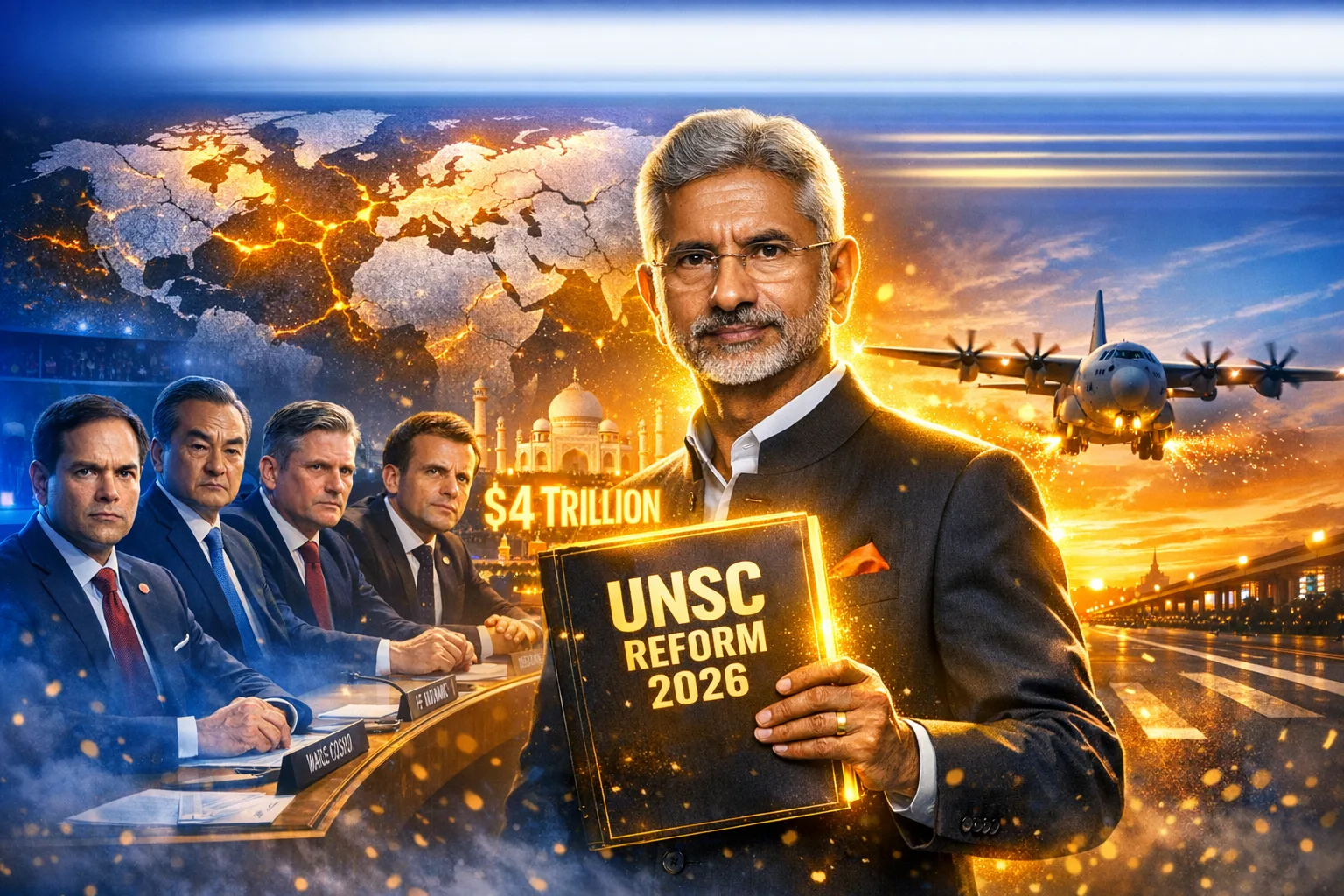
Discover why G4 UN Security Council Reform is inevitable in 2026. India’s $4 trillion surge, the Munich security shift, and the death of the 1945 order revealed.
Table of Contents
The Death of the Post-1945 World: Marco Rubio’s Admission
Imagine a world frozen in 1945. The technology, the borders, and the economies of that era are gone, yet the highest decision-making body on Earth—the UN Security Council—remains trapped in that timeline. For decades, this was a “polite” diplomatic disagreement. In 2026, it has become a terminal crisis.
The most startling admission came from U.S. Secretary of State Marco Rubio . He openly admitted that the world order he was born into no longer exists. The power balance has shifted. Superpowers are no longer the only players; “Middle Powers” have emerged with such strategic weight that they can no longer be ignored. This admission effectively signaled the start of a new “Golden Age” of American realism, but it also opened the floodgates for G4 UN Security Council Reform.
.@SecRubio: "The world is changing very fast right in front of us. The old world is gone … We live in a new era in geopolitics, and it's going to require all of us to sort of re-examine what that looks like and what our role is going to be." pic.twitter.com/wgPrl2xJZC
— Department of State (@StateDept) February 13, 2026
Munich 2026: The Secret Dinner that Changed Everything
While the world watched the main stages of the 62nd Munich Security Conference (MSC), held from February 13 to 15, 2026 , the real history was made behind closed doors. For the first time ever, a formal G4 Ministerial meeting took place on the sidelines of this Western-centric event.
On Saturday night, February 14, 2026, a 50-minute working dinner brought together India’s Dr. S. Jaishankar and his counterparts from Germany, Japan, and Brazil. Their goal? To restore global confidence in a UN that has become a bystander in modern conflicts.
A G-4 meeting of India, Germany, Japan and Brazil to discuss reformed multilateralism. Held on the sidelines of the @MunSecConf for the first time.
— Dr. S. Jaishankar (@DrSJaishankar) February 14, 2026
🇮🇳 🇩🇪 🇯🇵 🇧🇷 pic.twitter.com/qg0UnTxl5m
German Foreign Minister Johann Wadephul noted that Europe has finally realized that grouping India and Brazil solely with “competitors” like Russia and China was a strategic mistake that led to “alienation” .
German Foreign Minister Wadephul:
— Clash Report (@clashreport) February 15, 2026
We were wrong to alienate countries simply because they were part of BRICS.
Why not focus on those shared interests and shared values? pic.twitter.com/7mKucINavg
Sources: Economic Times, Ministry of Foreign Affairs of Japan
G4 vs. P5: Why the 1945 Winners’ Club is Obsolete
The core of the G4 UN Security Council Reform lies in a simple, uncomfortable comparison found on the G4’s own Wikipedia data . When you compare the P5 (China, France, Russia, UK, USA) with the G4 (India, Germany, Japan, Brazil), the “merit” of the current permanent members begins to crumble.
We are forced to ask: Who has the larger economy? Who provides more UN funding? Who has the most advanced military technology?
- Economic Reality: G4 nations now command three of the top five global GDP slots.
- Military Weight: The comparison includes active nuclear arsenals and aircraft carrier projects, where India’s capabilities now match or exceed several P5 members.
- The Funding Gap: Japan and Germany remain the 3rd and 4th largest contributors to the UN budget, yet they have no permanent say in how those funds are used to manage global security.
Sources: Wikipedia
The Rotation Model: A Strategic Compromise?
A provocative idea has emerged in the 2026 negotiations: The Rotation Model. If the P5 refuses to add four new individual seats, could the G4 share one or two permanent seats?
Under this model, India, Germany, Japan, and Brazil would rotate a permanent seat (and its veto power). While this isn’t the “full seat” India deserves, it would break the 80-year monopoly of the 1945 victors. It serves as a pragmatic “Pattern Interrupt” to the current deadlock, moving India from a “responsible stakeholder” to a “global rule-maker.”
The $4 Trillion Milestone: India’s Economic Leverage
Numbers don’t lie, and in 2026, India’s numbers are deafening. India has officially become a $4 trillion economy, surpassing Japan to secure the rank of the world’s 4th largest economy.
According to 2026 IMF projections, the hierarchy is undeniable:
- USA: $30.50 trillion
- China: $19.23 trillion
- Germany: $4.74 trillion
- India: $4.19 trillion
- Japan: $4.19 trillion
India’s nominal GDP has grown by 105% in just a decade—it has doubled since 2014. Excluding such a massive, high-growth engine from the permanent UNSC table is no longer just a “diplomatic oversight”; it is a systemic risk to the UN’s own relevance.
Sources: IMF
Hard Power on the Highway: The Moran ELF Message
India isn’t just asking for a seat; it is demonstrating its right to one through hard power. On February 14, 2026, while the G4 met in Munich, Prime Minister Narendra Modi sent a message to the world from the borderlands of Assam.
He inaugurated Northeast India’s first Emergency Landing Facility (ELF) on the Moran Bypass of National Highway 37 . Built for Rs 100 crore, this 4.2-km reinforced highway is designed to double as a runway for fighter jets up to 40 tonnes (like the Su-30MKI and Rafale) and heavy cargo planes up to 74 tonnes. By landing a C-130J aircraft directly on a highway, India proved its “Integrated Civil-Military” readiness—a critical credential for any nation aspiring to manage global security.
It is a matter of immense pride that the Northeast gets an Emergency Landing Facility. From a strategic point of view and during times of natural disasters, this facility is of great importance. pic.twitter.com/eGaJIcptrf
— Narendra Modi (@narendramodi) February 14, 2026
The “Coffee Club” and the Wall of Status Quo
Why hasn’t the G4 UN Security Council Reform happened yet? Meet the “Uniting for Consensus” group, famously known as the “Coffee Club” . This group of 12 nations, including Pakistan and Italy, works tirelessly to block G4 progress. They fear their regional rivals (like India or Brazil) will become “too powerful,” so they advocate for expanding only the temporary seats.
This is coupled with China’s “Cartographic Anxiety,” where they release new “standard maps” to trigger regional tension whenever reform discussions peak. However, with the India-Middle East-Europe Economic Corridor (IMEC) crossing $180 billion in trade, India is building a new world order outside the UN, effectively telling the status-quoists: “Reform or be bypassed.”
Sources: News on Air
Conclusion: From Stakeholder to Rule-Maker
The legacy of leaders like Sushma Swaraj, who aggressively pushed the G4 agenda between 2015 and 2018, is finally bearing fruit. The world of 1945 is dead. A new world—driven by a $4 trillion India and a multipolar G4—is being born. The G4 UN Security Council Reform is the only way to ensure the United Nations survives the transition.
As India builds runways on its highways and trade corridors across continents, the message is clear: India is no longer waiting for a seat. It is building the table.
Sources: Ministry of Foreign Affairs of Japan, MEA India.
FAQs
What is the primary objective of G4 UN Security Council Reform?
The objective of G4 UN Security Council Reform is to expand the permanent and non-permanent seats of the UNSC to reflect the contemporary geopolitical realities of the 21st century, ensuring nations like India have a permanent “rule-maker” status.
Why is 2026 a significant year for this reform?
In 2026, India officially surpassed Japan to become the world’s 4th largest economy, and the U.S. has admitted the post-WWII order is effectively over, creating a vacuum for institutional change.
What is the “Coffee Club” and who leads it?
The “Uniting for Consensus” or Coffee Club is led by Italy and includes nations like Pakistan and Canada. They oppose adding new permanent members to protect their own regional standing.
How does the Moran ELF in Assam support India’s UNSC bid?
The Moran ELF demonstrates India’s high-tech, dual-use infrastructure and its military readiness in sensitive border areas, proving India is a capable “security provider” for the region.
Share Your Views
The era of the 1945 victors’ club is coming to an end. Is the “Rotation Model” a fair compromise for India, or should we demand nothing less than a full, independent permanent seat with veto power?
Think deeper about the G4 UN Security Council Reform and the strategic shifts of 2026 and join the debate on India’s global future.
Explore more about World Affairs , Indian Affairs and Strategic Depth.