Table of Contents
The End of the Post-1945 Order
The Ray Dalio Big Cycle theory argues that the global order established after World War II is breaking down.
According to American Billionaire and founder of Bridgewater Associates, Ray Dalio, the system created in 1945—led by the United States and its European allies—has reached its final stage. This was the period when the United States emerged victorious after World War II and built a new global structure defined by institutions, rules, financial dominance, and military leadership.
For decades, that system delivered stability and prosperity.
But now, the shift has begun.
It’s official: The current world order has broken down.
— Ray Dalio (@RayDalio) February 18, 2026
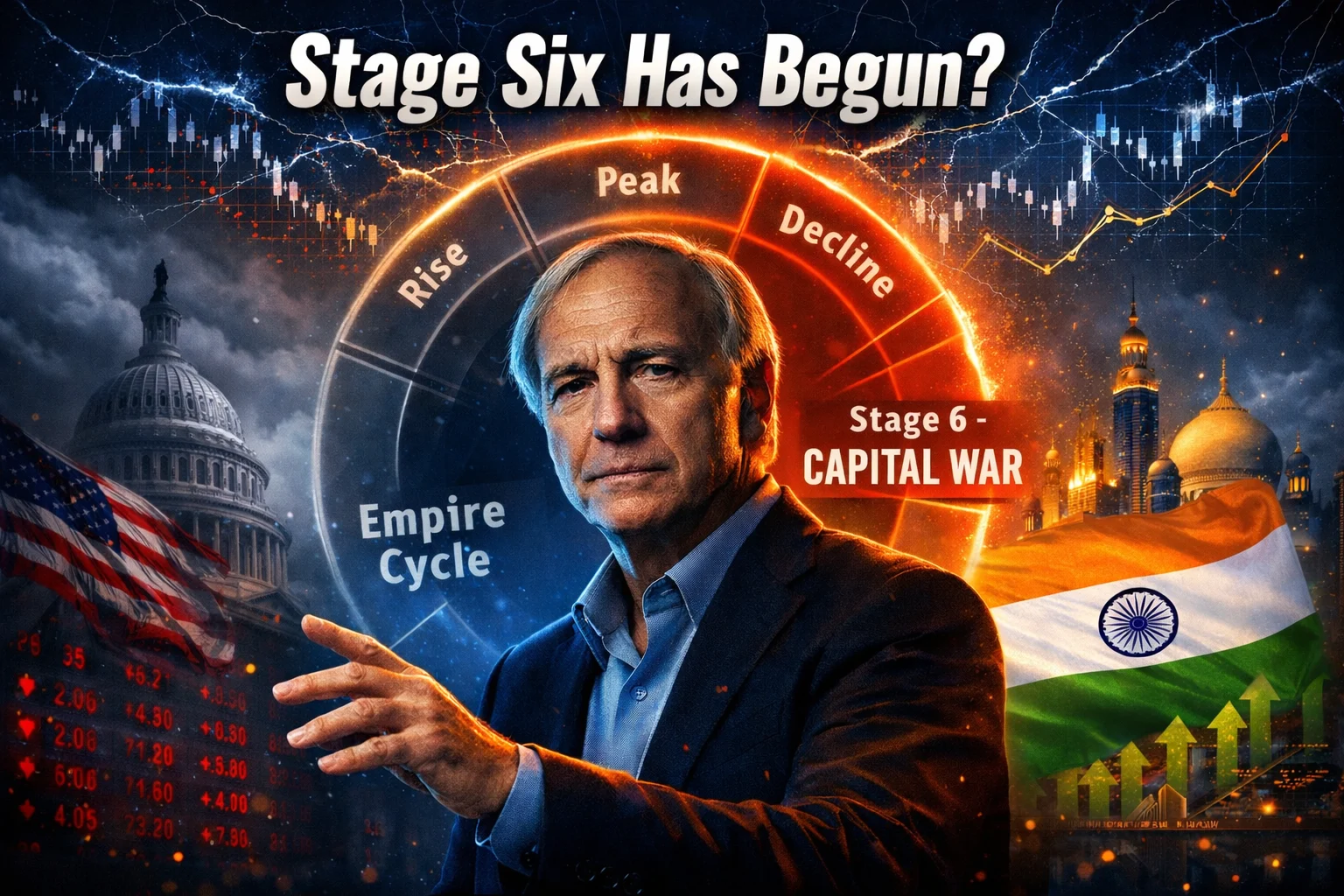
In my parlance, we are in the Stage 6 part of the Big Cycle in which there is great disorder arising from being in a period in which there are no rules, might is right, and there is a clash of great powers.
How Stage 6… pic.twitter.com/vriEiDZIob
Even senior American political leaders such as Marco Rubio have acknowledged that the post-1945 order is no longer intact. That admission matters.
Because when the dominant order weakens, transitions follow.
.@SecRubio: "The world is changing very fast right in front of us. The old world is gone … We live in a new era in geopolitics, and it's going to require all of us to sort of re-examine what that looks like and what our role is going to be." pic.twitter.com/wgPrl2xJZC
— Department of State (@StateDept) February 13, 2026
Sources: The Nation, U.S. Department of State
Understanding Ray Dalio’s Six Stages of Empire
Dalio’s framework suggests that great powers follow a repeating six-stage cycle.
Stage 1: Post-War Reset
A major war ends. A new order is established. Institutions are built. Leadership is strong.
After 1945, the United States entered exactly this phase.
Stage 2: Rise to Prosperity
Productivity increases. Education improves. Innovation accelerates. Major corporations grow.
This describes the 1960s through the 1980s in America—rapid growth, technological progress, and expanding global influence.
Stage 3: Peak Power
Economic and geopolitical dominance reaches its height.
The United States likely peaked in the 1990s or early 2000s—financially, militarily, and technologically.
Stage 4: Financial Weakness Emerges
Debt rises. Inequality grows. The system shows internal cracks.
The 2008 global financial crisis marked this turning point. Dalio had warned of the systemic vulnerability before it unfolded.
Stage 5: Internal Conflict
Political polarization intensifies. Ideological battles dominate public life. Trust in institutions weakens.
In the United States today, ideological divisions between left and right have widened significantly. Several states openly challenge federal authority on certain issues. The cohesion of the system is visibly strained.
Stage 6: Collapse of the Old Order
Dalio now argues we have entered this phase.
This is where the old system falls—and a new one begins to form.
The shift is structural.
https://t.co/JaHLk1Lhad pic.twitter.com/Gs7jgdiXrO
— Photon Capital (@PhotonCap) February 16, 2026
Why Stage Six Changes Everything
Stage Six is not just economic decline.
It involves:
- Wealth redistribution
- Political instability
- International confrontation
- Rising aggression from declining powers
Historically, when empires approach decline, they often become more assertive. They project military power more aggressively. They attempt to reassert dominance before losing it.
Dalio illustrated this pattern by comparing major empires: American, Chinese, British, Dutch, Russian, Japanese, and Indian. On average, he argues, major empires dominate for roughly 250 years, followed by a volatile 10–20 year decline window.
Consider the Dutch Empire before Britain. It was powerful enough to defeat the British navy multiple times before eventually losing dominance. Similarly, the final decades of the British Empire were marked by conflict and violent transitions.
History does not repeat perfectly.
But patterns recur.
And Dalio believes the United States is entering its volatile window.
Source: Business Today
From Trade War to Capital War
Here’s where the argument becomes sharper.
Dalio warns not just of trade wars—but of a capital war.
What does that mean?
It does not refer to cities fighting. It refers to capital as financial assets—money, debt, investment flows.
In a capital war:
- Governments restrict where money can move.
- Capital flows between countries are deliberately blocked.
- Debt markets tighten.
- Financial retaliation replaces tariffs.
The United States has already engaged in tariff wars and trade disputes. But Dalio suggests the next escalation could involve restricting money itself—especially flows between the US and China.
That changes the system entirely.
Sources: CNBC, CoinCentral
AI, Debt, and the Risk of a Liquidity Shock
Modern technology companies—especially AI firms—require enormous funding.
OpenAI has publicly indicated that future operations may require funding in the range of hundreds of billions of dollars over time. Much of this funding typically comes from debt markets.
Now imagine a scenario where global capital becomes scarce.
If countries stop purchasing US bonds…
If liquidity tightens…
If debt becomes harder to access…
AI companies dependent on borrowing could face funding stress.
And if major sectors lose access to capital, stock markets could react sharply.
Dalio’s warning is clear: a capital war could trigger a stock market crash.
This is not speculation in isolation. He previously warned of systemic risk before the 2008 crisis—warnings that many ignored at the time.
The pattern, he argues, is calculative. Not emotional.
Sources: India Today
Where Does India Stand?
Now comes the crucial question.
What does this mean for India?
India’s military position is relatively secure. A full-scale external war against India is highly unlikely due to strategic deterrence capabilities and nuclear balance. There is no immediate geopolitical incentive for large-scale aggression.
But the economic front is different.
If a capital war begins and global money seeks stability, investors will look for:
- Political predictability
- Institutional stability
- Growth potential
India could benefit significantly if it is perceived as stable during turbulence.
Capital does not wait for invitation. It moves toward opportunity.
However, if India fails to maintain economic resilience during a global liquidity shock, it could also experience stress alongside other emerging markets.
This is where leadership becomes decisive.
The coming two to three years may determine whether India experiences:
- Capital inflow surge
- Stock market outperformance
- Industrial acceleration
Or faces temporary financial strain.
These are make-or-break years.
The Make-or-Break Years Ahead
Transitions between global orders are rarely smooth.
Dalio’s argument is not that collapse is guaranteed tomorrow. Rather, we are entering a volatile window where:
- US-China financial friction intensifies
- Capital controls become policy tools
- Debt markets tighten
- Asset volatility increases
Some nations will rise during this reshuffling.
Others will stagnate.
India’s trajectory depends on how it navigates global capital movement during instability.
Will it emerge as a preferred destination for capital?
Or struggle alongside others in a liquidity squeeze?
The answer will shape decades—not just years.
Big things may be about to happen.
FAQs
What is Ray Dalio Big Cycle theory?
Ray Dalio Big Cycle theory explains how great powers rise and fall through predictable stages. It includes post-war rebuilding, prosperity, peak dominance, financial weakness, internal conflict, and eventual collapse of the old order. He argues that the United States is currently in Stage Six.
What does Stage Six mean in Dalio’s model?
Stage Six represents the breakdown of the existing global order. It involves wealth redistribution, geopolitical aggression, capital restrictions, and systemic restructuring. It is typically the most volatile phase in the empire cycle.
What is a capital war?
A capital war refers to governments restricting financial flows between countries. Instead of tariffs, nations weaponize debt markets, investment access, and capital movement. It can reduce liquidity and trigger financial instability.
Is Ray Dalio predicting a stock market crash?
Dalio warns that a capital war could reduce liquidity in debt markets. If major sectors like AI depend on borrowing and that borrowing dries up, stock markets could face sharp corrections.
Is the US empire declining?
According to Dalio’s framework, the United States has entered a late-stage phase of the empire cycle. Rising debt, polarization, and global competition suggest structural transition rather than immediate collapse.
How could a capital war impact India?
India could attract capital if it remains stable during global volatility. However, if liquidity dries up globally, India could also face temporary financial strain. Much depends on economic policy and investor confidence.
What happened in 2008 that Dalio predicted?
Dalio warned of systemic financial weaknesses before the 2008 crisis. When the crisis unfolded, it validated his debt-cycle analysis and increased global attention to his macroeconomic framework.
Conclusion
The post-1945 order shaped nearly eight decades of global stability. But transitions between world systems are rarely peaceful.
If Dalio’s analysis is correct, we are entering a decisive era defined by capital conflict, strategic realignment, and shifting power centers.
For India—and for the world—the next few years will not be ordinary.
They will define the next cycle.
The real question is: which nations will adapt to this shift—and which will be overwhelmed by it?
Share Your Views in the comments below.
Explore more about World Affairs , Indian Affairs and Strategic Depth.