Table of Contents
A Landmark 6–3 Ruling That Changes Trade Politics
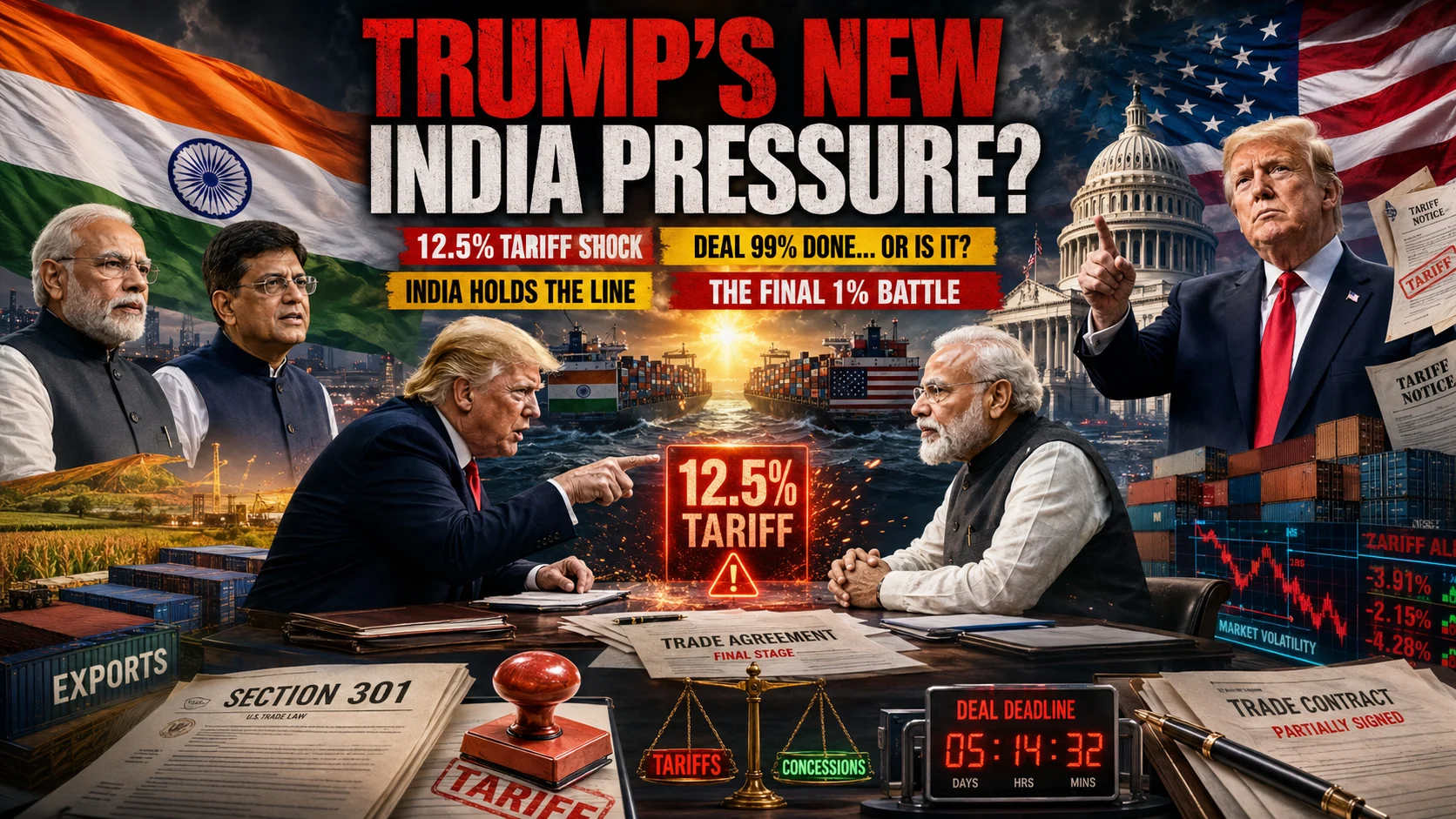
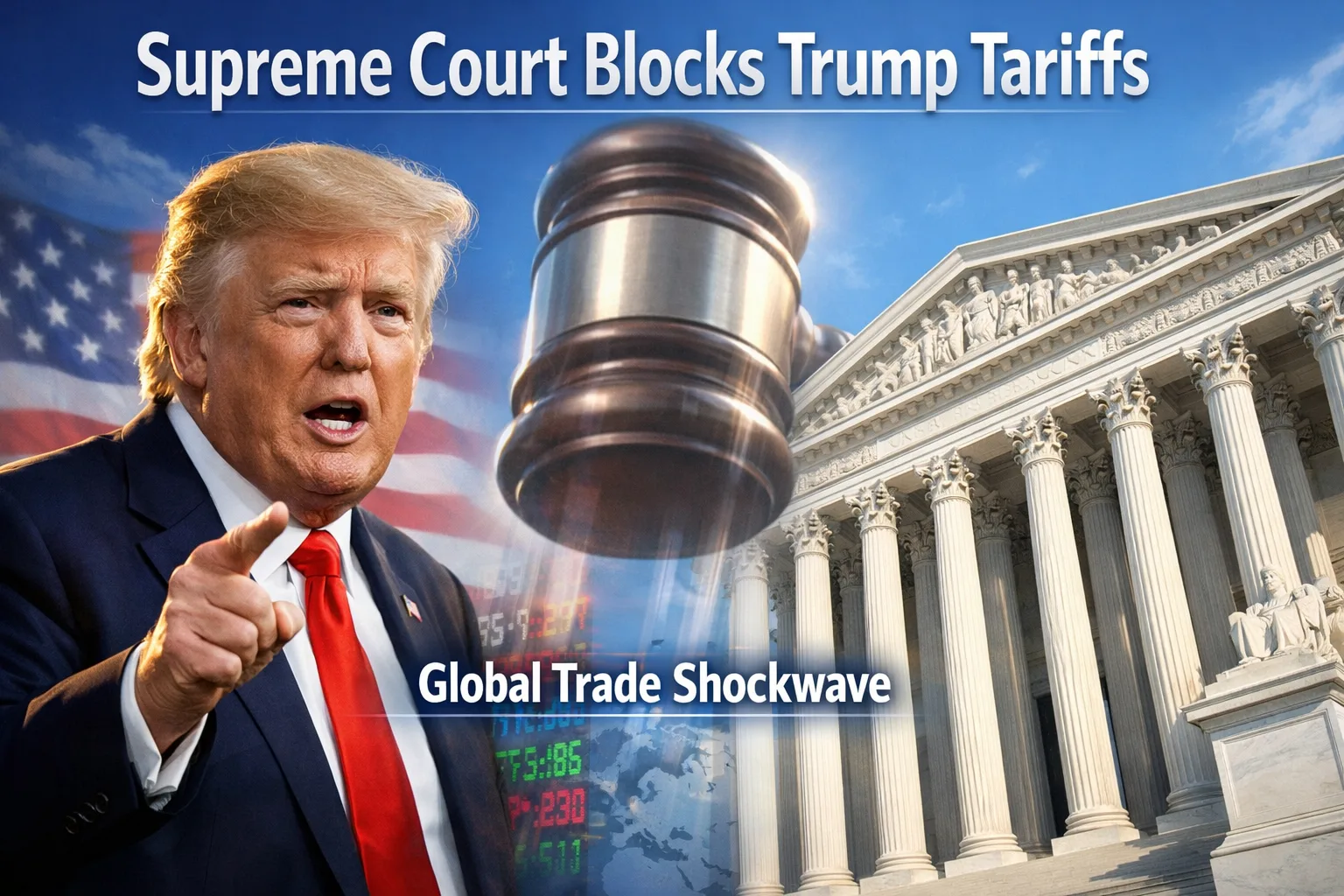
The US Supreme Court blocks Trump tariffs in a decision that could reshape global trade negotiations. In a 6–3 ruling, the Court declared that President Donald Trump did not possess authority under the International Emergency Economic Powers Act (IEEPA) to impose sweeping global tariffs.
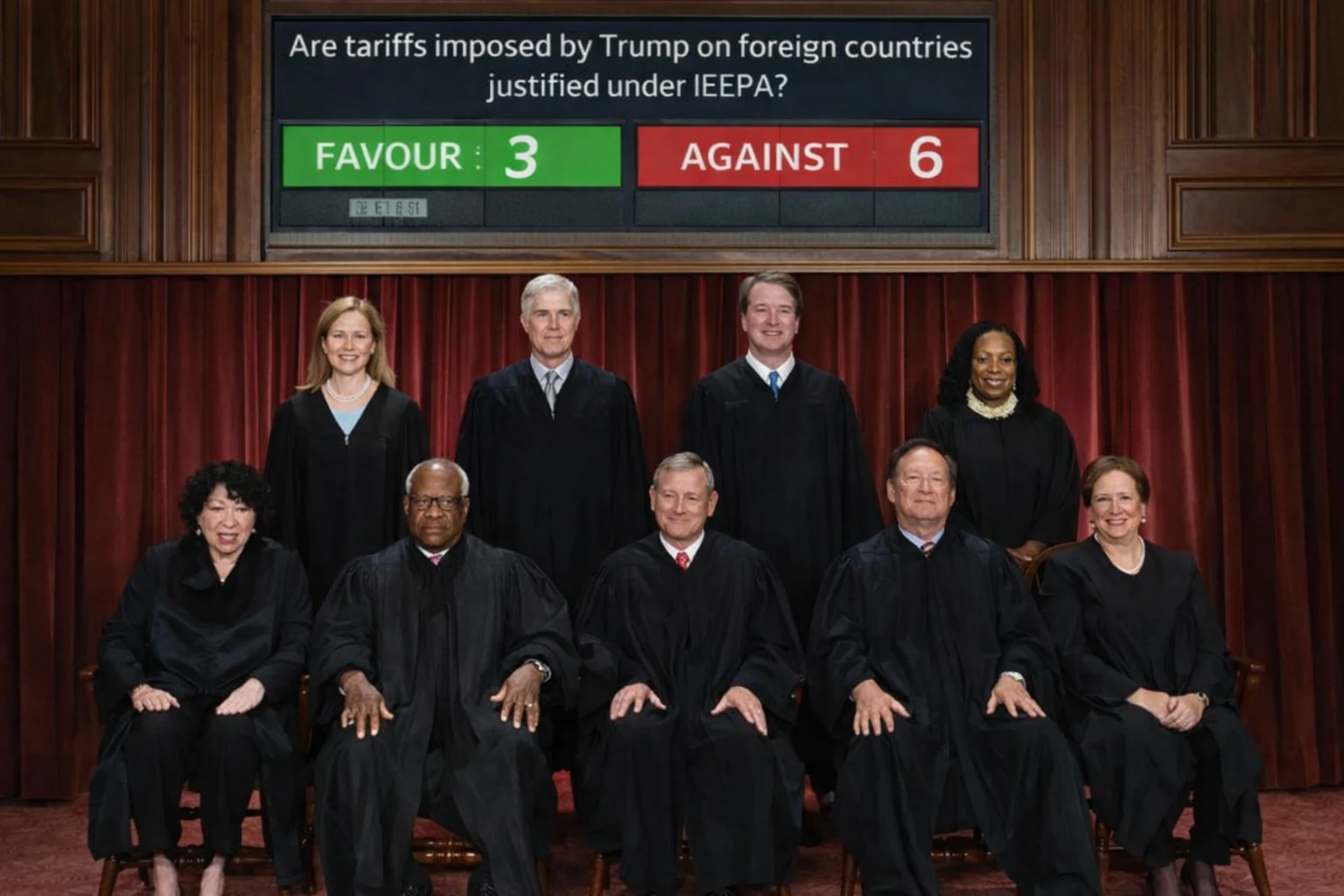
Image credit: AI-generated using ChatGPT by OpenAI
This was not a minor technical correction.
It strikes at the legal foundation of how those tariffs were introduced in the first place.
The administration had justified global tariffs — including measures affecting India — by invoking emergency economic powers. Now the Court has ruled that this path was not legally valid for tariff imposition.
That changes everything.
Because once the authority collapses, every trade negotiation built around those tariffs becomes unstable.
Sources: Justia – U.S. Supreme Court, CNN, NBC News
Why the Court Rejected the IEEPA Route
At the heart of the case lies the International Emergency Economic Powers Act (IEEPA) — a law designed to address national emergencies involving foreign threats.
The administration used IEEPA as the legal basis to impose tariffs across multiple countries. The Supreme Court’s interpretation was clear: IEEPA does not grant blanket authority to impose sweeping global tariffs.
Six justices ruled the tariffs invalid under this framework. Three dissented.
This is significant because the majority of the Court is widely perceived as aligned with Republican legal philosophy. Yet even within that composition, the executive interpretation did not hold.
That detail matters.
The ruling does not eliminate presidential trade power entirely. It specifically limits the use of IEEPA for tariff imposition.
And that distinction opens the next question.
Sources: New York Times, Congress.gov
The $900 Billion Question: What Happens to Tariff Revenue?
During public statements, Trump claimed the tariff measures would generate up to $900 billion in revenue.
The logic was simple:
If an exporter sells a $100 product and a 50% tariff applies, $50 goes directly to the US government. The consumer ultimately pays more. Government revenue rises.
Trump: "Next year, $900 BILLION DOLLARS in tariffs! Unless the Supreme Court says you can't do it, can you believe it?!"
— Jacktron (@jacktronprime) February 20, 2026
The Supreme Court just struck it down. Clarence Thomas, Sam Alito and Brett Kavanaugh were the three justices that voted against it.
Barrett and Gorsuch are… pic.twitter.com/iJRxFQEWwG
But if the Supreme Court invalidates the legal basis for those tariffs, what happens to that collected revenue?
Will companies demand refunds?
Will states pressure the federal government to return what some have labeled “illegal tax” collections?
There are already voices — including several US governors — calling for immediate refund mechanisms for American citizens.
Issue an immediate refund to all Americans for your illegal tax. Now. https://t.co/v5pUv2u6qN
— Gavin Newsom (@GavinNewsom) February 20, 2026
However, issuing refunds at that scale would create massive fiscal disruption. If billions are withdrawn from federal accounts, budget stability comes into question.
This is not a symbolic issue.
It is structural.
Can Trump Reimpose Tariffs Using Another Legal Path?
Despite the setback, Trump’s options are not fully exhausted.
The Supreme Court ruling specifically addressed the IEEPA route. It did not permanently ban tariffs.
That leaves room for alternative justifications.
One potential argument could involve national security grounds — asserting that foreign tariff structures themselves constitute economic threats to the United States.
A former Supreme Court judge has suggested that alternative legal avenues remain available.
But here is the challenge:
Legal justification will now face far stricter scrutiny.
And public explanation becomes harder.
If tariffs are reimposed under a different legal doctrine, further court challenges are almost guaranteed.
So the real question becomes:
Will the Supreme Court block a second attempt as well?
That uncertainty now shadows every trade negotiation underway.
India–US Interim Trade Pact: A Strategic Opening?
India has not yet signed a finalized trade agreement with the United States.
Earlier announcements confirmed only a framework for an interim trade pact — not a completed deal. Officials from both sides are scheduled for three days of negotiations beginning February 23 to finalize legal text.
This timing is crucial.
Because if the US Supreme Court blocks Trump tariffs under IEEPA, America’s leverage weakens in ongoing discussions.
India was previously facing tariff pressures that escalated as high as 50% before being adjusted to 18% following framework discussions.
Now those very tariffs face legal uncertainty.
That strengthens India’s negotiating posture.
India can engage more assertively, knowing the legal foundation of tariff pressure has been challenged.
This is an opportunity window.
Not confrontation — but leverage.
And in trade negotiations, leverage defines outcomes.
Sources: Hindustan Times, Times of India
South Korea and the Global Confusion Factor
The ripple effects are not limited to India.
South Korea has already signed a trade agreement with the United States. Yet uncertainty is spreading there as well.
Articles in Korean media question whether the tariff removals are permanent. Can they be reimposed? Will the legal instability affect existing agreements?
This is where things shift.
When a major power’s trade policy foundation becomes legally unstable, global partners hesitate.
Countries that already signed deals are unsure whether the terms will hold.
Countries that have not signed may delay further commitments.
The result?
Global trade uncertainty.
And potentially, negotiation paralysis.
Sources: Korea JoongAng Daily
What Happens Before the US Midterms?
Another variable looms: US midterm elections.
If Trump’s political position strengthens after midterms, renewed tariff initiatives become more plausible.
If not, congressional resistance may increase.
Either way, the Supreme Court’s 6–3 ruling ensures that executive trade authority will now operate under closer judicial supervision.
Trump himself has previously warned that blocking these tariffs could create a “life and death” situation for the US economy.
Whether that claim holds economically is debatable.
But politically, the ruling is undeniably a major setback.
One step taken before stabilizing the first — that strategy now faces consequences.
Risk levels have increased.
For trade deals already signed.
For deals under negotiation.
For global supply chains.
Sources: India TV
The Broader Geopolitical Signal
The decision signals something larger than tariff policy.
It reinforces judicial limits on executive economic power.
It signals to global partners that US trade actions can face internal legal reversals.
And it forces countries like India to recalibrate their approach to US trade diplomacy.
Will tariffs return?
Possibly.
Will they return under IEEPA?
Unlikely.
Will global uncertainty persist?
Almost certainly — at least in the short term.
The shift is structural.
Source: The Guardian
Conclusion: A System Reset in Motion
The US Supreme Court blocks Trump tariffs under IEEPA — and in doing so, reshapes the architecture of American trade authority.
The immediate consequences include uncertainty over tariff revenue, legal challenges ahead, and weakened US leverage in ongoing negotiations.
For India, this opens strategic space in interim trade talks.
For countries like South Korea, it creates confusion.
For the United States, it introduces constitutional friction into economic statecraft.
Trade policy has entered a more contested phase.
And once judicial oversight tightens around executive authority, future trade battles will not be fought only in negotiation rooms — but in courtrooms as well.
The global trading system just became more unpredictable.
And that unpredictability will define the next phase of economic diplomacy.
FAQs
Did the Supreme Court rule Trump tariffs illegal?
Yes. The Court ruled 6–3 that the tariffs imposed under IEEPA exceeded presidential authority. The decision specifically addressed the legal route used, not the concept of tariffs altogether.
What is IEEPA and how does it work?
IEEPA stands for International Emergency Economic Powers Act. It allows the US President to regulate commerce after declaring a national emergency linked to foreign threats. The Court ruled it does not authorize sweeping global tariffs.
Can a US President impose tariffs without Congress?
Presidents do have certain delegated trade authorities. However, those powers depend on specific statutes. The ruling limits the use of IEEPA for tariff purposes.
Will the US refund tariff revenue?
That remains unclear. Some governors have demanded refunds, but no official refund mechanism has been finalized. The fiscal implications would be significant.
How does this affect India’s trade negotiations?
India has not finalized its interim trade pact. The ruling weakens US tariff leverage, potentially strengthening India’s negotiating position.
Can Trump bypass the Supreme Court ruling?
He cannot bypass it directly. However, he may attempt to use alternative legal frameworks, such as national security justifications. Any such move would likely face new court challenges.
What happens to countries that already signed trade deals?
Countries like South Korea face uncertainty. If tariffs are removed or legally restructured, signed agreements may require adjustment or clarification.
Stay Ahead of the Next Trade Shock
Global trade policy is entering a volatile phase.
Courtrooms are shaping tariffs. Negotiations are shifting leverage. Political timelines are colliding with economic strategy.
If you are tracking India–US relations, executive power limits, or global trade uncertainty — this is not the moment to look away.
Follow upcoming developments closely.
Watch the February negotiation outcomes.
Monitor whether new legal routes are tested.
Because the next move — whether from the White House, the Supreme Court, or negotiating partners like India — could redefine trade strategy again.
The story is not over.
It has just entered its most unpredictable chapter.
Share Your Views in the Comments below.
If you want more deep geopolitical breakdowns, explore Economy & Trade, World Affairs and Indian-Affairs — where every document tells a bigger story than it appears to.