Table of Contents
From Courtroom Setback to Policy Reset
The story did not end when the US Supreme Court struck down earlier tariff measures.
Instead, it shifted direction.
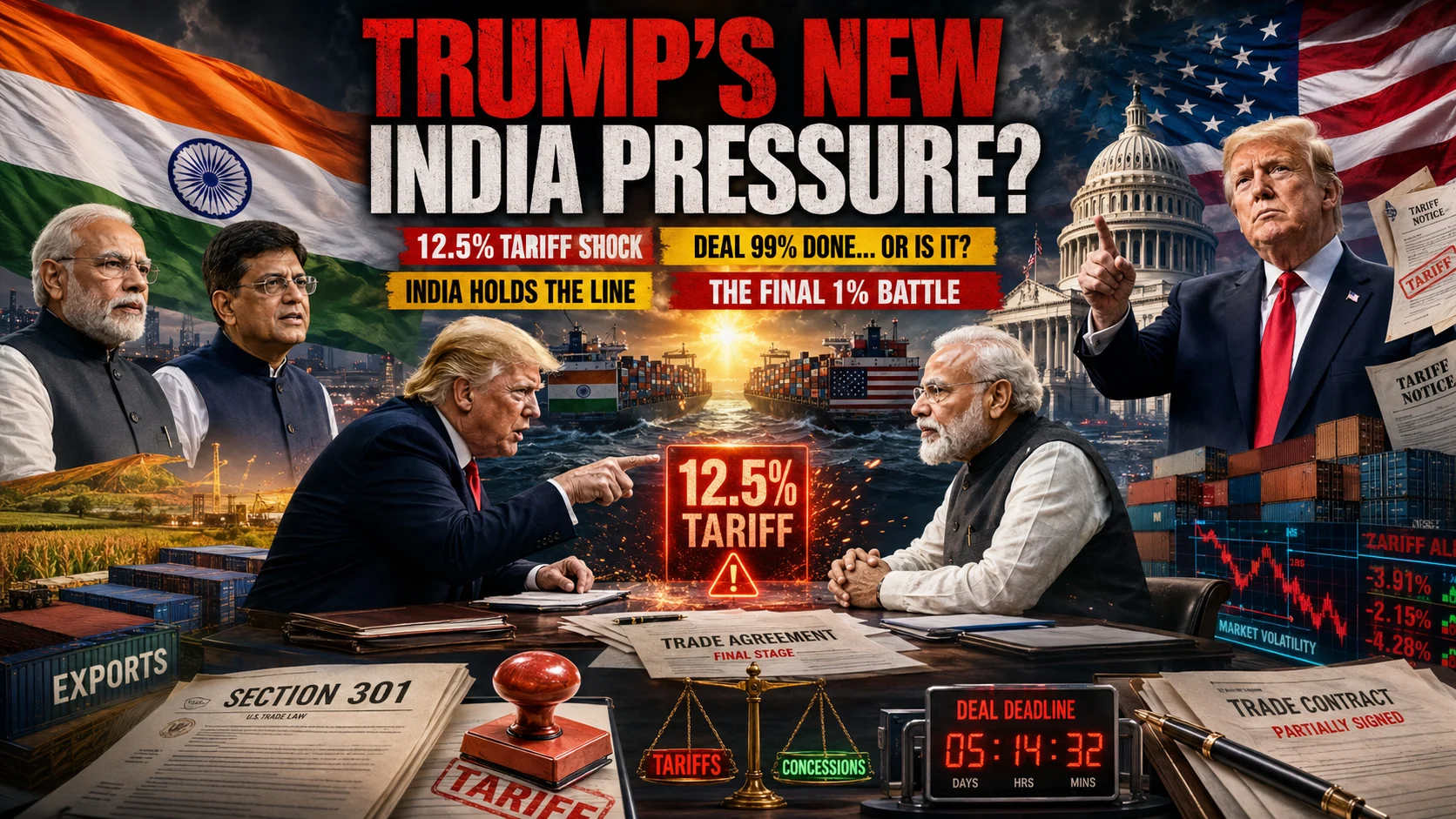
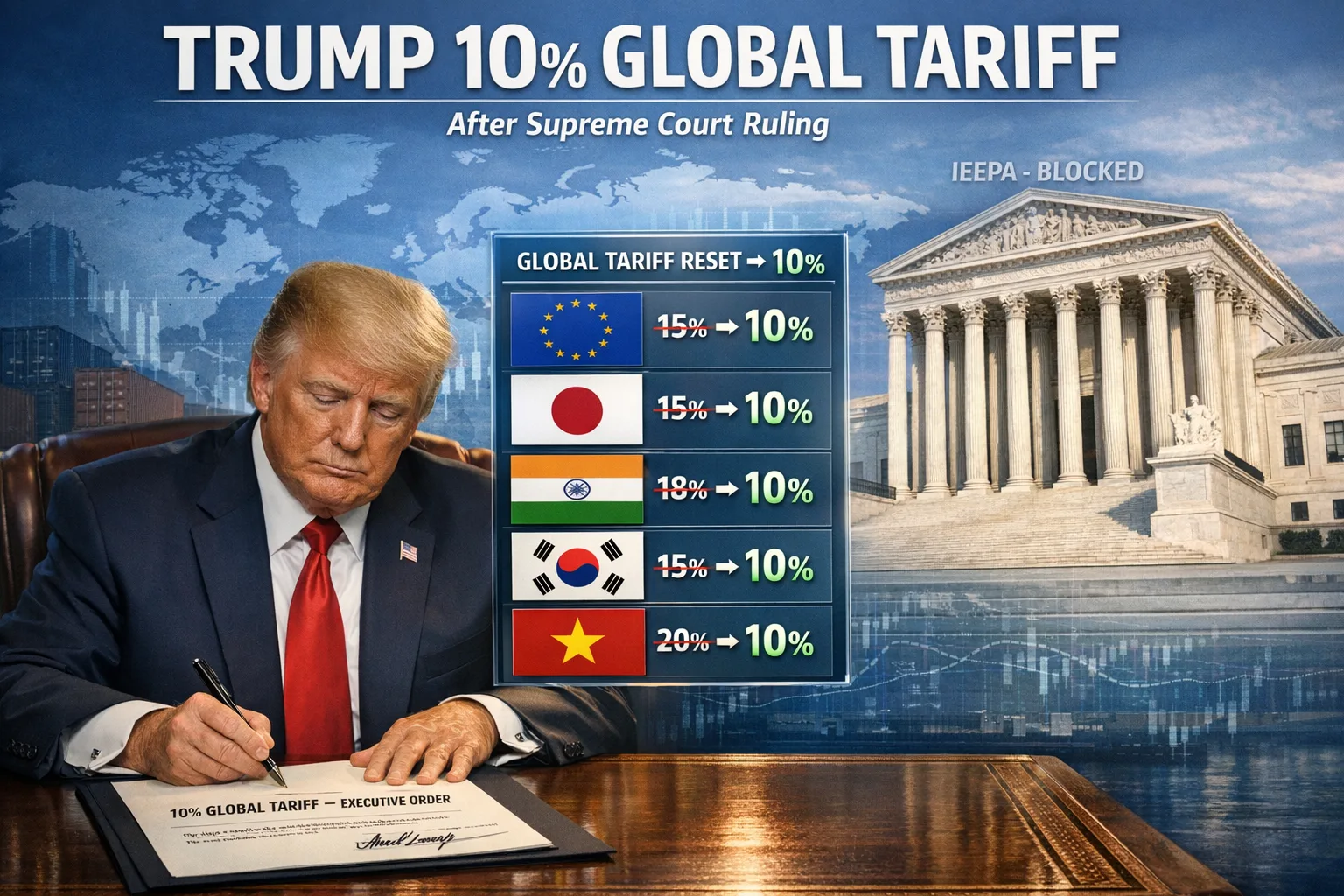
After the Court ruled that previous tariff actions were illegal under the chosen legal pathway, President Donald Trump responded with a new move: a uniform Trump 10% global tariff applied across countries.
It is my Great Honor to have just signed, from the Oval Office, a Global 10% Tariff on all Countries, which will be effective almost immediately. Thank you for your attention to this matter! PRESIDENT DONALD J. TRUMP
— Commentary: Trump Truth Social Posts On X (@TrumpTruthOnX) February 20, 2026
(TS: 20 Feb 18:39 ET)…
Source: Donald Trump – Truth Social
This is important.
Tariffs did not disappear.
They were restructured.
And that restructuring now defines the next phase of global trade negotiations — especially for countries like India.
Sources: Reuters, The White House
What Exactly Is the Trump 10% Global Tariff?
Following the judicial ruling, the administration introduced a new executive order imposing a flat 10% tariff on imports from all countries.
This policy will take effect from February 24 and remain in place for 150 days.
Previously, tariff discussions around India involved figures like 18%. In some cases, other countries faced rates of 15%, 18%, or even 20%.
Now, under the reset:
- European Union: from 15% to 10%
- Japan: from 15% to 10%
- India: from 18% to 10%
- South Korea: from 15% to 10%
- Vietnam: from 20% to 10%
Breaking: White House officials clarify that India's tariff rate falls from 18% to 10%
— Shashank Mattoo (@MattooShashank) February 21, 2026
This explains Trump's new 10% "global tariff" pic.twitter.com/CGFA5X7a6o
The reset is uniform.
That simplicity is deliberate.
Instead of country-specific escalations, the administration has chosen a global baseline.
But the big question remains:
Is this temporary stabilization or another transitional step?
Sources: Supreme Court of United States, NDTV
Are India’s Tariffs Now 28%? Clearing the Confusion
There has been confusion suggesting India’s tariffs rose by an additional 10%, pushing them to 28%.
That is incorrect.
India’s exposure has reduced from the previously discussed 18% level to 10%.
This clarification matters because misinformation can distort market expectations.
India is not facing 28%.
It is facing 10%.
And that changes export calculations significantly.
The 150-Day Window: Temporary Fix or Strategic Pause?
The new tariff framework is set for 150 days.
That timeframe suggests this is not a permanent settlement but an interim arrangement.
It provides breathing space.
For the White House.
For trade partners.
For legal recalibration.
But it also creates uncertainty.
US President Donald Trump moved quickly to replace tariffs invalidated by the Supreme Court, announcing a temporary 10% global import duty for 150 days while launching new investigations under other statutes that could pave the way for fresh trade levies.
— Hindustan Times (@htTweets) February 21, 2026
More details 🔗… pic.twitter.com/ak4iQ37kYE
What happens after 150 days?
Will tariffs increase again?
Will Congress be involved?
Will a new legal structure replace executive action?
The administration has described this phase as an “adjustment process.”
That phrase signals transition.
Not finality.
Sources: Economic Times
Has India Signed a Trade Deal With the US?
No.
This is a critical clarification.
There is no officially signed India–US trade agreement yet.
Only a framework for an interim agreement has been discussed. Officials from both sides are scheduled to meet for three days to negotiate detailed provisions.
Even the interim pact is not signed.
Only the structure has been outlined.
That distinction protects India from being locked into commitments under a legally unstable tariff environment.
It also means India enters negotiations under improved circumstances.
Because 10% is structurally better than 18%.
Source: Times of India
Institutional Friction: Executive Power vs Judicial Oversight
The episode also exposes tension inside the US governance structure.
The Supreme Court declared the earlier tariffs illegal. The administration responded by using a different executive route to impose a uniform tariff.
Public statements from Trump criticizing the Court and certain justices indicate visible institutional friction.
This is sensitive territory.
When executive authority openly challenges judicial decisions, concerns about balance of power intensify.
Every constitutional system relies on institutional respect.
If that weakens, long-term governance stability is affected.
This dimension goes beyond tariffs.
It touches democratic norms.
Those members of the Supreme Court who voted against our very acceptable and proper method of TARIFFS should be ashamed of themselves. Their decision was ridiculous but, now the adjustment process begins, and we will do everything possible to take in even more money than we were…
— Commentary: Trump Truth Social Posts On X (@TrumpTruthOnX) February 21, 2026
Source: Donald Trump – Truth Social
What Changes for India’s Exports?
In the short term, India benefits.
Lower tariffs improve price competitiveness.
An Indian exporter sending goods to the US now faces a 10% duty instead of 18%.
That difference can influence margins.
However, there is a counterpoint.
Other countries that previously faced higher tariffs — like Vietnam at 20% — also drop to 10%.
So relative advantage narrows.
India gains relief.
But so do competitors.
Therefore, the outcome depends not just on tariff percentage, but on final trade agreement terms.
Market access.
Regulatory concessions.
Sector-specific exemptions.
Those negotiations are still ahead.
And this time, India negotiates without the pressure of an 18% tariff structure hanging over the table.
Broader Implications: Organized Strategy or Reactive Governance?
Observers have noted that the sequence of events — tariff imposition, judicial strike-down, rapid executive reset — reflects reactive policymaking.
Trade policy ideally involves:
- Legislative consultation
- Institutional coordination
- Strategic sequencing
Instead, rapid reversals have introduced volatility.
For global markets, unpredictability increases risk premiums.
For trade partners, it encourages caution.
For domestic industries, it complicates planning.
And that is the real cost of volatility.
Not just percentage points.
But predictability.
Conclusion: A Reset With Consequences
The Trump 10% global tariff marks a clear reset after judicial intervention.
India’s tariff exposure has dropped from 18% to 10%.
No formal India–US trade deal has been signed.
The 150-day window provides temporary stability but leaves long-term direction uncertain.
Executive authority has been tested.
Judicial oversight has asserted itself.
And global trade diplomacy now enters a recalibration phase.
The next developments will depend on:
- Congressional positioning
- Midterm political outcomes
- India–US negotiation outcomes
- Potential further legal challenges
For now, the system has stabilized at 10%.
But stability built on temporary executive action always carries an expiration date.
The real test begins when that clock runs out.
FAQs
Did the US Supreme Court cancel Trump tariffs?
Yes, the Court ruled earlier tariff measures illegal under the specific legal authority used. However, Trump 10% global tariff has since been introduced through a different executive order.
What is the Trump 10% Global Tariff?
Trump 10% Global Tariff is a uniform tariff applied to imports from all countries for 150 days. It replaces higher country-specific rates that existed previously.
Are India tariffs now 10%?
Yes. The previously discussed 18% level has effectively been reduced to 10% under the new uniform structure.
Has India signed a trade deal with the US?
No. Only a framework for an interim agreement exists. Detailed negotiations are still pending.
How long will the new US tariffs last?
The policy is announced for 150 days. Future changes depend on political and legal developments.
Can a US president impose tariffs without Congress?
Presidents can use delegated authorities under certain laws. However, such actions can face judicial review, as seen in this case.
Is this a win for India?
In the short term, yes — because tariff exposure is reduced. Long-term gains depend on final trade agreement terms.
Track the Next 150 Days Carefully
The 10% global tariff is not a final chapter — it is a temporary reset.
Over the next 150 days, watch three things closely:
- Whether Congress steps into the tariff debate
- How India–US trade negotiations evolve
- Whether new legal challenges emerge
Trade policy is no longer just about economics. It is about institutions, executive power, and global positioning.
If you follow international relations, export markets, or policy shifts, this is a critical moment to stay informed.
The reset has happened.
What comes after it will define the real outcome. Share Your views in the Comments below about Trump 10% Global Tariff.
Explore more about Economy & Trade, World Affairs and Indian Affairs.