Table of Contents
A Hostage Crisis That Shook Pakistan’s Security Narrative
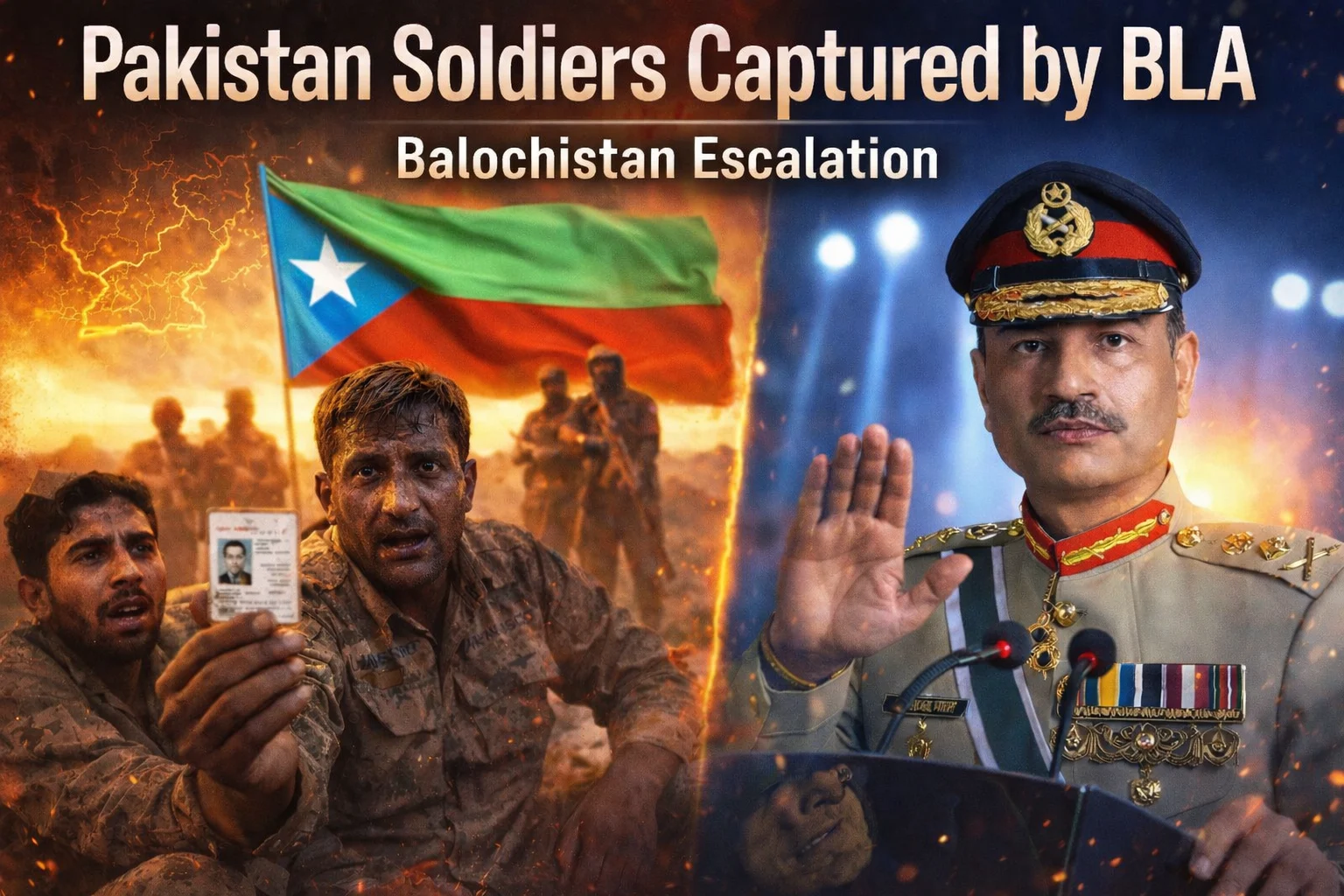
The issue gained traction after reports emerged that Pakistan soldiers captured by BLA had become part of a high-stakes hostage situation in Balochistan.
According to claims attributed to the Balochistan Liberation Army, 17 Pakistani soldiers were taken captive. Ten were reportedly released, while seven remained hostages under conditional demands.
Initially, Pakistani authorities denied that any soldiers were in BLA custody.
But the narrative shifted.
And that shift matters.
Because once denial meets visual evidence, institutional credibility is tested.
Sources: India Today
Who Is Behind the Operation?
The BLA is a separatist militant organization operating primarily in Balochistan. Its stated objective is an independent Baloch state, separate from Pakistan.
The group reportedly demanded the release of Baloch detainees from Pakistani prisons in exchange for the captured soldiers.
The deadline set by the group intensified the crisis.
Hostage situations are not just tactical moves.
They are psychological operations.
And this one appears designed to challenge the authority of the Pakistani state directly.
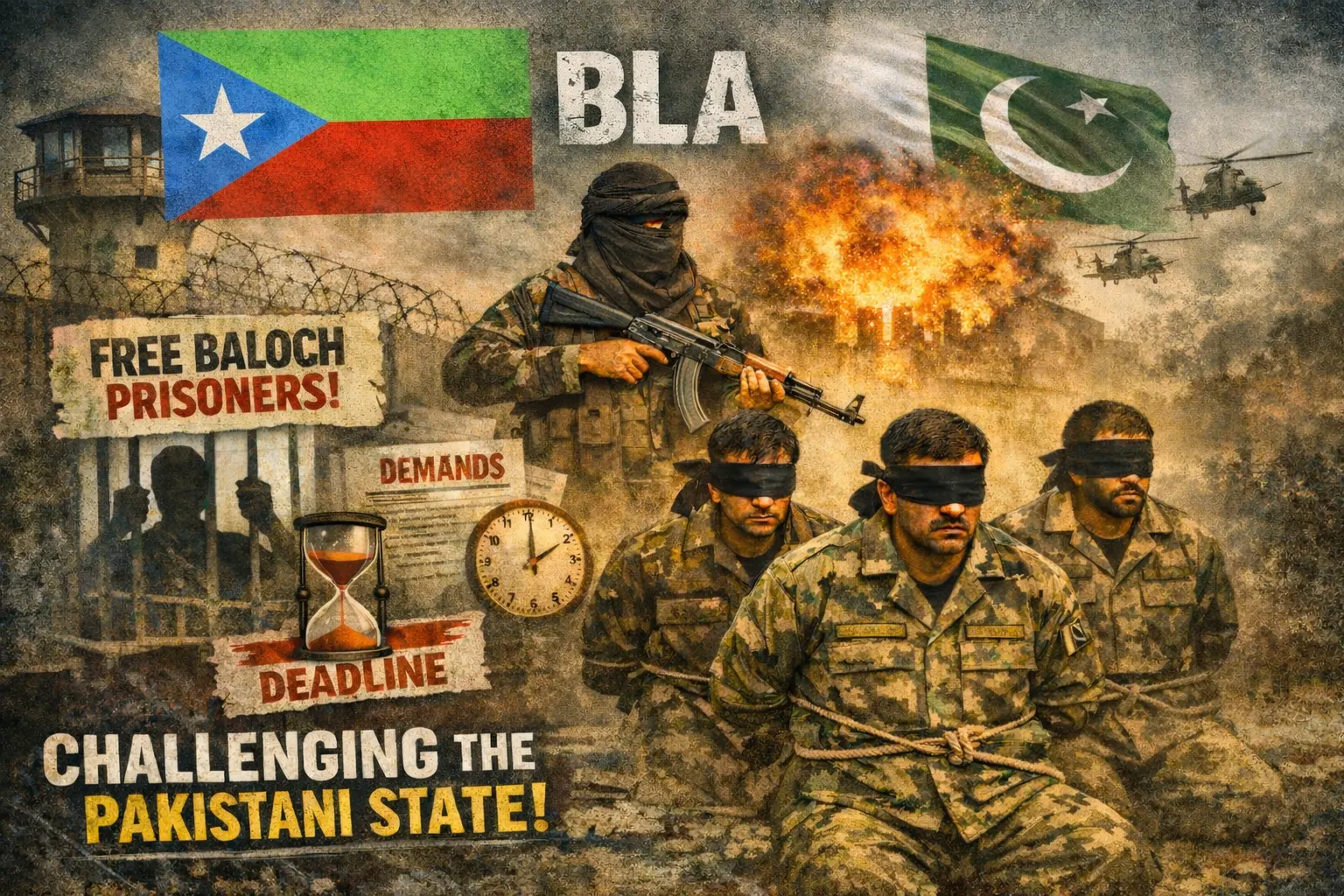
Image credit: AI-generated using ChatGPT by OpenAI
The Videos That Changed the Story
After initial denial by the state, videos surfaced allegedly showing captured soldiers.
In those clips, individuals identified themselves by name, district, rank, and unit number. Identification cards were displayed. Army numbers were spoken aloud.
That level of detail is intended to eliminate ambiguity.
Once those videos circulated, official silence followed.
Pakistani media coverage reportedly reduced significantly on the issue.
In conflict zones, silence can be as strategic as speech.
But inside military ranks, information spreads quickly.
And that is where the deeper impact lies.
3 Days Left
— Bàhot باھوٹ (@bahott_baloch) February 19, 2026
With three days remaining in the seven-day deadline set for a prisoner exchange, this footage shows Pakistani Army personnel currently in BLA custody.
As the exchange window narrows, the evidence shown here stands in direct contradiction to official denials. pic.twitter.com/NTrnI7sUH6
Military Morale: The Invisible Battlefield
There is a famous line attributed to Calvin Coolidge, 30th President of United States:
“The nation which forgets its defenders will itself be forgotten.”
Image credit: AI-generated using ChatGPT by OpenAI
Whether applied to soldiers, intelligence operatives, or covert agents — the principle is the same.
If personnel believe that capture leads to abandonment, morale suffers.
This is not theoretical.
Military psychology shows that confidence in institutional backing strengthens operational courage. Conversely, perceived abandonment produces hesitation.
In counterinsurgency operations — where risks are already high — morale is decisive.
If even a perception spreads that the state may deny or distance itself from captured personnel, long-term operational effectiveness weakens.
That risk now hangs over the Pakistan Army.
Reports of Civilian Casualties and Extrajudicial Actions
Parallel to the hostage crisis are allegations emerging from Balochistan regarding civilian harm.
The Baloch Yakjehti Committee (BYC) reportedly documented at least 19 deaths in a single month, warning that the actual number could be higher.
Some reports allege that among the deceased were minors and students. One claim referenced a three-year-old child allegedly killed in a drone strike and a 12-year-old reportedly shot dead.
Such allegations, if verified, intensify grievances.
Counterinsurgency that harms civilians often strengthens insurgency recruitment.
That cycle is difficult to break.
𝗕𝗹𝗼𝗼𝗱𝘀𝗵𝗲𝗱 𝗪𝗶𝘁𝗵𝗼𝘂𝘁 𝗔𝗰𝗰𝗼𝘂𝗻𝘁𝗮𝗯𝗶𝗹𝗶𝘁𝘆: 𝗦𝘂𝗿𝗴𝗲 𝗶𝗻 𝗘𝘅𝘁𝗿𝗮𝗷𝘂𝗱𝗶𝗰𝗶𝗮𝗹 𝗞𝗶𝗹𝗹𝗶𝗻𝗴𝘀 𝗼𝗳 𝗕𝗮𝗹𝗼𝗰𝗵 𝗶𝗻 𝗙𝗲𝗯𝗿𝘂𝗮𝗿𝘆 𝟮𝟬𝟮𝟲
— Baloch Yakjehti Committee (@BalochYakjehtiC) February 19, 2026
𝘽𝙖𝙡𝙤𝙘𝙝 𝙔𝙖𝙠𝙟𝙚𝙝𝙩𝙞 𝘾𝙤𝙢𝙢𝙞𝙩𝙩𝙚𝙚
The Baloch Yakjehti Committee (BYC) strongly condemns… pic.twitter.com/72w7RyhAzs
Sources: The Tribune
Poverty, Resources, and the Balochistan Question
The instability cannot be separated from economic conditions.
Pakistan’s poverty rate has reportedly surged to 29%, with around 70 million people in extreme poverty. A significant portion of affected populations are located in Balochistan.
This is critical.
Because Balochistan accounts for over 40% of Pakistan’s geographic territory and holds substantial mineral and rare earth resources.
Yet local communities reportedly see limited benefit from extraction initiatives.
When resource-rich regions remain economically deprived, separatist narratives gain traction.
The issue is not only security.
It is structural inequality.
Sources: Times of India
Pakistan’s Likely Military Escalation
Pakistan’s defense minister Khwaja Asif has acknowledged the geographic difficulty of controlling Balochistan. The province’s vast size makes continuous surveillance challenging.
Massive troop deployment is now being discussed as a possible response.
Additional recruitment and redeployment from other borders may follow.
But here is the dilemma:
Large-scale military presence can suppress insurgent activity temporarily.
It does not automatically resolve underlying political grievances.
If the objective is long-term stability, force alone rarely delivers it.
“Balochistan is too huge. It is impossible for the Pakistan army to manage it. Besides, the Baloch has very advanced weapons which our forces don’t have.”
— Abhijit Majumder (@abhijitmajumder) February 3, 2026
~ Pakistani 🇵🇰 defence minister Khawaja Asif sounds defeated. pic.twitter.com/B5r09CQDNZ
Sources: NDTV
Strategic Contrast: Internal Stability and Governance
There is also a regional contrast worth noting.
While Pakistan faces escalating insurgency in Balochistan, India has recently declared states such as Bihar free from Naxal activity after prolonged counterinsurgency efforts.
The reduction of the Red Corridor footprint reflects improved internal security outcomes.
Economic development, governance reform, and security operations worked in parallel.
This comparative dynamic reinforces a broader lesson:
Security stability and economic development are interconnected.
Where poverty declines and governance strengthens, insurgency weakens.
Where inequality deepens, instability expands.
Sources: News on Air, PIB
Conclusion: A Province at the Center of a National Test
The episode involving Pakistan soldiers captured by BLA is more than a hostage crisis.
It reflects:
- Rising separatist momentum
- Institutional credibility challenges
- Civilian casualty allegations
- Economic distress
- Potential large-scale military escalation
Balochistan is not just a peripheral province.
It is central to Pakistan’s geographic integrity and resource strategy.
If morale weakens inside the military and grievances deepen among civilians, the conflict risks intensifying.
The coming months will reveal whether Pakistan pursues purely force-based stabilization — or whether structural political and economic reforms enter the equation.
Because history shows one consistent pattern:
Insurgencies rooted in identity and inequality cannot be resolved by silence or denial.
They demand strategy.
FAQs
Who is the Balochistan Liberation Army?
The BLA is a separatist militant organization advocating for an independent Balochistan. It has carried out multiple attacks targeting Pakistani security forces and infrastructure.
Why is Balochistan unstable?
Instability stems from a combination of separatist sentiment, economic grievances, allegations of political marginalization, and heavy security presence.
Did BLA capture Pakistani soldiers?
According to claims attributed to the group, 17 soldiers were captured, with 10 reportedly released. Official confirmations remain limited.
What is the Baloch independence movement?
It is a long-running political and militant movement seeking separation from Pakistan, citing resource control and governance concerns.
How strong is Pakistan’s control over Balochistan?
While the state maintains administrative control, large geographic spread, insurgent activity, and local grievances complicate full operational dominance.
What impact does insurgency have on military morale?
Sustained insurgency, especially involving hostage situations, can affect morale if personnel perceive institutional uncertainty or abandonment.
Is Pakistan deploying more troops to Balochistan?
Statements from defense leadership suggest increased military deployment is likely, though operational specifics remain evolving.
Watch Balochistan Closely — The Next Phase Could Be Decisive
The hostage episode is not an isolated incident.
It is a signal.
If Pakistan proceeds with large-scale military deployment, the province could enter a new escalation cycle. If economic grievances remain unaddressed, separatist momentum may grow stronger. And if morale inside security forces weakens, operational effectiveness could suffer.
Balochistan now sits at the center of Pakistan’s internal stability test.
Track troop movements.
Track poverty trends.
Track political messaging from both the state and separatist groups.
Because what unfolds in Balochistan will not remain confined to one province — it will shape the strategic balance of South Asia in the years ahead.
Share Your Views in the Comments below.
Explore more about Defense & Security, World Affairs and Indian Affairs.