Table of Contents
The Court Shock That Changed Trade Politics
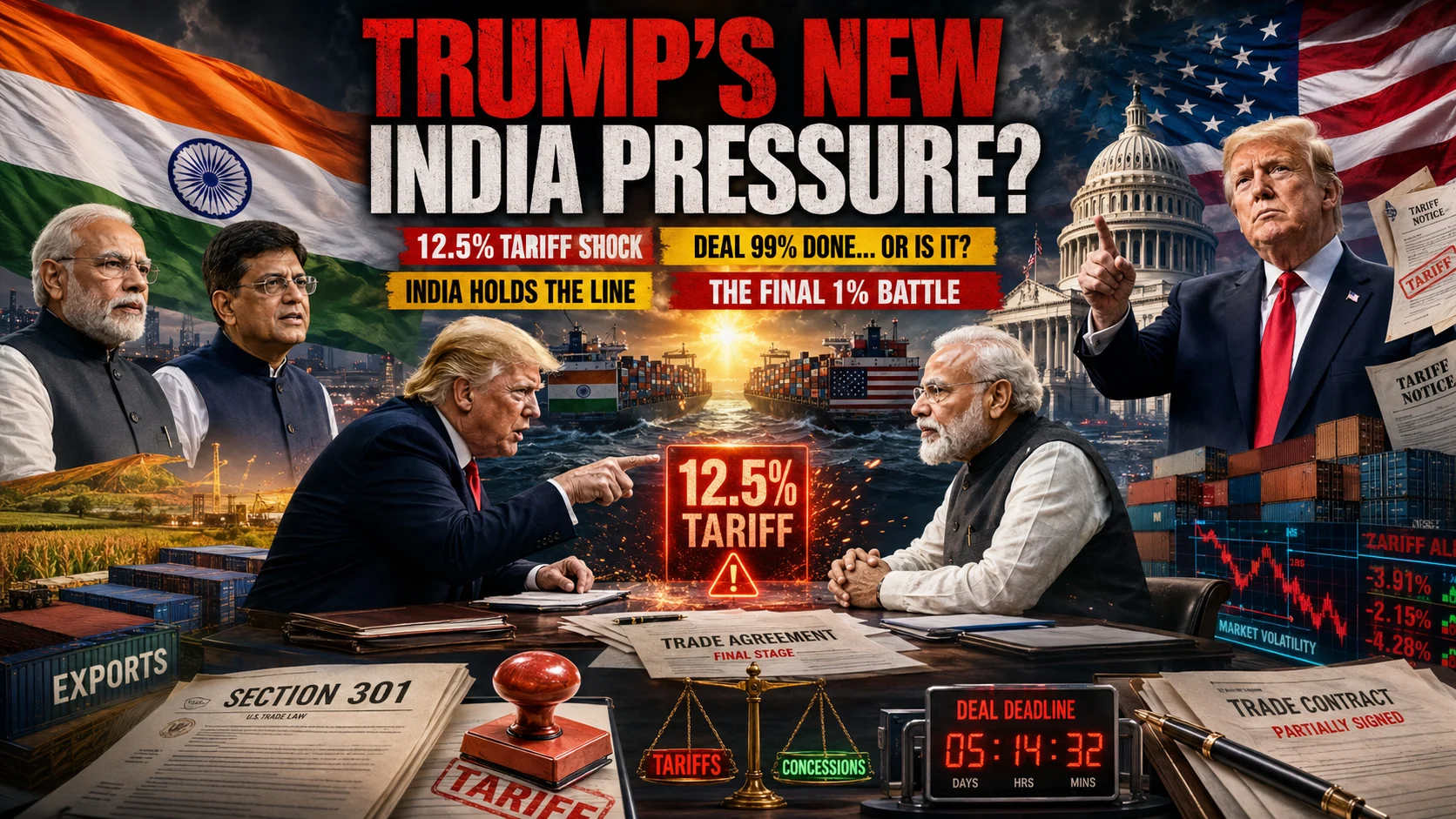
The Trump tariff reversal impact is now being openly debated in American media.
After the US Supreme Court blocked the earlier tariff framework, the political and economic landscape shifted overnight. What was projected as a strong tariff strategy has now turned into a legal and diplomatic challenge.
President Donald Trump has responded with frustration, arguing that while a President can impose sweeping trade restrictions or even take military action, imposing tariffs under certain legal frameworks was restricted by the Court.
This is not just a policy adjustment.
It is a power struggle between executive authority and judicial oversight.
And global markets are watching.
Sources: Bloomberg
Why American Media Calls India and China “Winners”
A recent analysis published by Bloomberg suggested that the tariff reversal unexpectedly benefits countries like India and China.
Interestingly, the framing referred to India and China as “rivals” — even though government-level partnerships often describe India–US ties differently.
Under the new uniform 15% tariff structure:
- Countries previously facing higher effective tariffs see relief.
- India’s exposure is reduced compared to earlier escalation scenarios.
- China’s effective tariff burden also declines from earlier elevated levels.
In relative terms, that positions both India and China as short-term beneficiaries.
This was not necessarily the intention.
But in trade policy, outcomes matter more than intent.
Sources: Bloomberg, Times of India
UK and Europe: From Deal to Disappointment
United Kingdom appears to be among the biggest losers in this recalibration.
Earlier understandings suggested a 10% tariff structure for the UK. Now, under the broader 15% reset, London faces higher-than-expected duties.
European partners are equally frustrated.
If every country now faces 15%, what advantage did early negotiations secure?
The European Union is reportedly reconsidering aspects of its trade engagement with Washington.
When uniform tariffs replace negotiated concessions, trust erodes.
And trade diplomacy depends heavily on trust.
Sources: The Hindu, Bloomberg, CNBC
India Pauses Trade Talks — Strategic Patience or Signal?
Reports suggest that India has paused ongoing trade negotiations with the United States.
Meetings were postponed. Discussions are frozen for now.
Why?
Because legal uncertainty remains.
If lawyers who challenged the tariff framework argue that even the new 15% structure may face judicial hurdles, entering into binding agreements now could be premature.
India appears to be adopting a wait-and-watch approach.
Strategic patience.
Instead of rushing into a deal under legal instability, New Delhi may prefer clarity between the White House and the Supreme Court.
That is calculated positioning.
Sources: The Hindu Business Line
Trump’s Frustration and the $2000 Check Promise
In public remarks, Trump expressed visible frustration with the Court’s interpretation of tariff authority.
He argued that while a President can take severe economic or military actions, charging tariff fees under certain legal interpretations has been restricted.
Trump: "I am allowed to cut off any and all trade…I can destroy the trade, I can destroy the country, I'm even allowed to impose a foreign country destroying embargo…I can do anything I want to do to them…I'm allowed to destroy the country, but I can't charge a little fee." pic.twitter.com/LZQLJQueuI
— The Bulwark (@BulwarkOnline) February 20, 2026
At the same time, he floated the idea of distributing $2000 checks to middle-class Americans using tariff revenue.
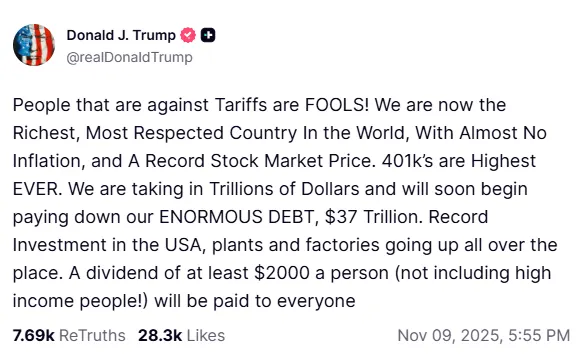
Source: Screenshot from Donald Trump’s Truth Social account (Public Post)
This proposal remains rhetorical at this stage.
Whether such redistribution is fiscally feasible or legally structured remains uncertain.
But politically, it signals an attempt to defend the tariff strategy as beneficial to American citizens.
Still, the underlying issue remains:
The legal foundation of tariff authority is under question.
Who Actually Benefits From the 15% Reset?
Under the 15% global tariff model:
Relative Winners
- Brazil (previously facing much higher rates)
- China (effective rate reduced)
- India
- Canada
- Mexico
- Vietnam
Relative Losers
- Japan
- Germany
- South Korea
- France
- UK
- European Union members expecting preferential terms
When tariffs become uniform, previous escalations lose leverage value.
This reshuffles diplomatic equations.
And that reshuffle explains why American media describes India and China as beneficiaries.
Donald Trump’s new 15% global tariff will most greatly benefit countries he has singled out for heavy criticism, including China and Brazil. Long-standing US allies including the UK, the EU and Japan will suffer the largest hit from the new levy. https://t.co/pc8NuchWea pic.twitter.com/h6ZpbPrOr6
— Financial Times (@FT) February 22, 2026
The Real Casualty: Global Trade Stability
Amid all this, one actor loses clearly.
Global trade itself.
Exporters face confusion.
Should they ship goods now or wait?
Will rates change again?
Will courts intervene again?
Supply chains rely on predictability.
Policy volatility increases risk premiums.
When tariff frameworks shift rapidly — first escalation, then reversal, then reset — confidence declines.
And once confidence declines, investment slows.
This is the structural cost.
What Happens If the Court Strikes Again?
Lawyers who challenged the earlier tariff structure suggest the new 15% framework may also face scrutiny.
If courts intervene again, the reset could collapse.
In that scenario:
- India and China remain relative winners.
- Trade negotiations restart from scratch.
- US credibility faces further strain.
Another variable looms large:
US midterm elections.
If political dynamics shift, tariff authority and trade strategy could change again.
Timing now matters as much as policy.
Conclusion: Strategy, Patience, and Uncertainty
The Trump tariff reversal impact extends far beyond percentage numbers.
It has:
- Benefited some emerging and Asian economies
- Hurt traditional US allies
- Frozen India–US trade talks
- Increased legal uncertainty
- Shaken global trade confidence
India’s decision to pause negotiations reflects strategic caution.
China gains relative relief.
Europe recalculates.
And exporters worldwide face unpredictability.
When executive ambition meets judicial limitation, the outcome reshapes more than policy — it reshapes diplomacy.
The coming weeks will determine whether this is a temporary recalibration or a deeper restructuring of US trade authority.
Until then, global trade operates under a cloud of uncertainty.
FAQs
Did the US Supreme Court stop Trump’s tariffs?
The Court intervened against earlier tariff mechanisms. The administration introduced a revised 15% global structure, which may also face legal scrutiny.
Why is India seen as a winner in tariff reversal?
Because India’s effective tariff exposure declined compared to earlier elevated scenarios, improving relative competitiveness.
Is India US trade deal cancelled?
Not cancelled, but reportedly paused. India appears to be waiting for legal clarity before proceeding.
How do tariffs affect global trade?
Tariffs raise import costs, distort supply chains, and influence diplomatic negotiations. Uncertainty around tariffs disrupts exporter planning.
Why is the UK upset with new US tariffs?
Earlier expectations suggested a 10% rate. A uniform 15% structure reduces the advantage the UK expected from negotiations.
What happens if Trump loses tariff powers?
If courts restrict executive tariff authority further, trade negotiations may restart under congressional or alternative legal frameworks.
Will tariffs return after US elections?
Future tariff policy depends heavily on election outcomes and legal interpretations of executive authority.
Share Your View: Should India Wait or Sign?
This moment demands strategic thinking.
Should India:
- Sign a trade deal now while tariffs are lower?
- Or wait for US midterm clarity and legal resolution?
Share your perspective in the Comments below.
Do you believe strategic patience is the smarter move?
Or should India secure gains before political winds shift again?
Your insights matter in shaping the debate around India’s next trade decision.
Read more about the US Court Order that stunned Trump. Explore more about Economy & Trade, World Affairs and Indian Affairs.