Table of Contents
Iran Reacts to India’s Budget Move
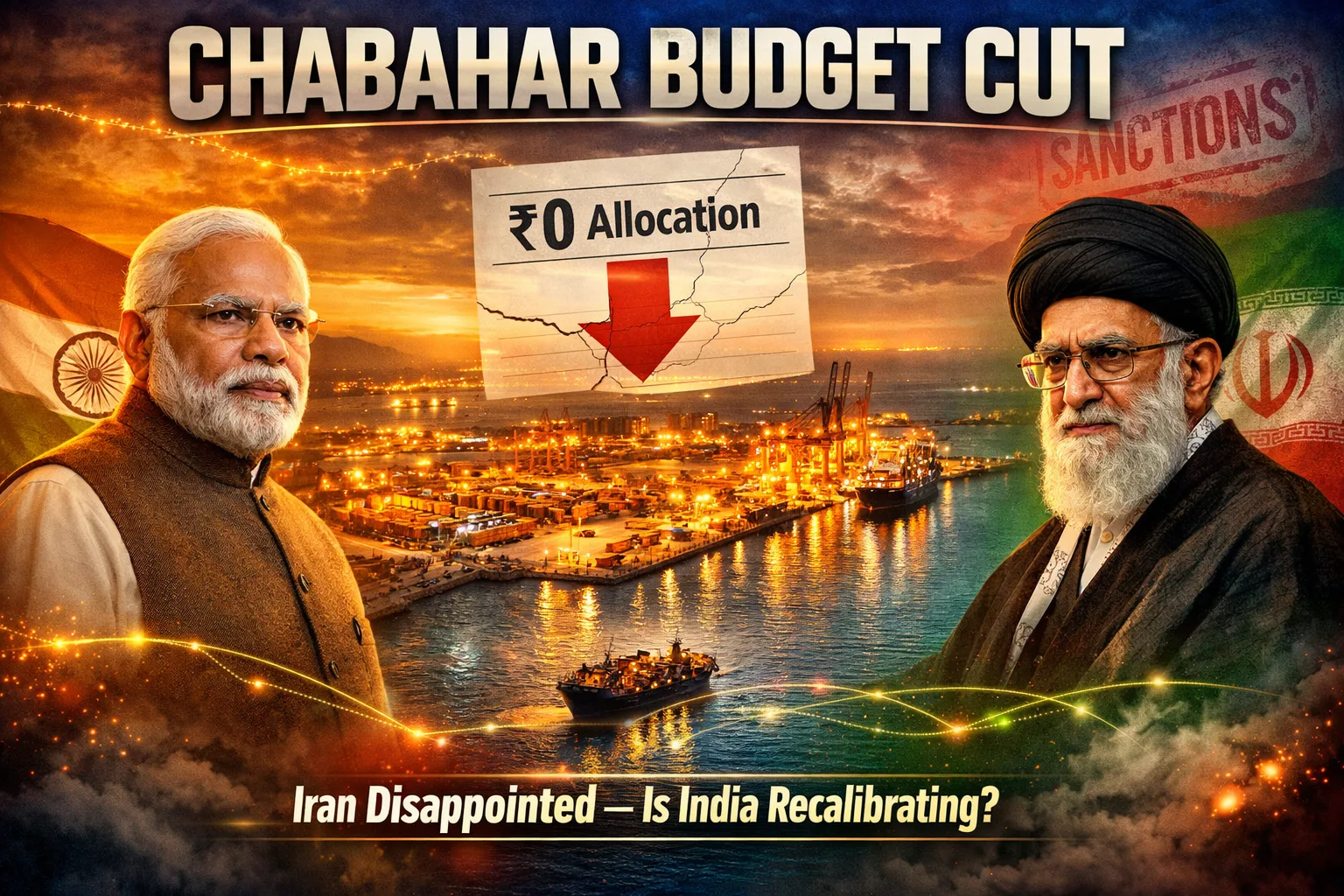
The India Chabahar port budget cut has triggered visible disappointment in Tehran. Iran’s Foreign Minister publicly described the zero allocation for Chabahar in India’s 2026 budget as “disappointing,” signaling concern over the future of a project long considered strategically vital for both nations.
The issue was also raised in India by Shashi Tharoor, who questioned whether the government was yielding to geopolitical pressure by reducing the allocation to zero.
This is not a minor technical adjustment.
It touches the core of India–Iran strategic connectivity.
Sources: News18, News Arena India
Why the India Chabahar Port Budget Cut Matters
In previous budgets, India had announced allocations—₹100 crore initially, later revised upward to ₹400 crore. This year, however, the allocation stands at zero.
Does that mean India is abandoning the project?
Not officially.
India Ports Global Limited continues to operate Chabahar under an agreement with Iran. There has been no formal withdrawal announcement.
But budgets send signals.
And signals shape perception.
Where Is Chabahar and Why Is It Strategic?
Chabahar Port lies in southeastern Iran, near the Gulf of Oman.
For India, its importance is straightforward:
- It bypasses Pakistan for access to Afghanistan
- It opens routes toward Central Asia
- It potentially connects onward to Russia
When Pakistan blocks land access to Afghanistan, India has used Chabahar to ship wheat and medical supplies via sea and onward land routes.
On paper, this is a strategic masterstroke.
In reality, geopolitics complicates everything.
Sources: Times of India
US Sanctions and the Waiver Puzzle
The largest constraint is not logistical.
It is sanctions.
The United States has imposed extensive sanctions on Iran. However, India previously secured a special waiver from Washington allowing limited engagement at Chabahar due to its role in Afghanistan’s economic stability.
That waiver still matters.
Without it, Indian companies operating in Iran could face secondary sanctions.
This creates hesitation.
If escalation occurs between Washington and Tehran, even waivers may come under review.
And that uncertainty affects investment decisions.
Sources: Firstpost
Shashi Tharoor’s Warning: Surrender to Pressure?
Shashi Tharoor publicly questioned whether the zero allocation reflects a surrender to external geopolitical pressure.
He acknowledged that practical obstacles may exist, especially under sanctions. But he argued that symbolic funding—even ₹10 or ₹50 crore—would have signaled continued commitment.
His core concern:
If everything is sanctioned, how does India spend money safely?
And if Indian companies fear Western penalties, will they even participate?.
It is a valid debate.
#WATCH | On the #UnionBudget2026, Congress MP Shashi Tharoor says, "… Last year they had announced Rs 100 crores for the Chabahar port in the budget estimates. Then that went up to Rs 400 crores in the revised estimates, and this year's budget is zero, which looks like we're… pic.twitter.com/xRWSgjkD7Y
— ANI (@ANI) February 1, 2026
Sources: ANI News, The Statesman
Chabahar vs IMEC: Is India Shifting Corridors?
Another factor complicating the India Chabahar port budget cut is the rise of the India–Middle East–Europe Economic Corridor (IMEC).
The IMEC plan connects India to Europe via the Middle East, with Israel positioned as a central transit hub.
Some analysts argue that as IMEC gains momentum, Chabahar’s relative importance may decline.
If India can access Europe through the Arabian Peninsula and Mediterranean routes, the incentive to push aggressively on Iranian infrastructure may reduce.
This is not abandonment.
It is recalibration.
The US–Iran Escalation Factor
The broader geopolitical backdrop cannot be ignored.
Tensions between Washington and Tehran remain high. Additional sanctions have been discussed over Iran’s missile program. Negotiations remain fragile.
There is always the risk of military escalation.
If a major US–Iran confrontation occurs, infrastructure investments in Iran could face direct risk.
From New Delhi’s perspective, this is not about preference.
It is about exposure.
Sources: DD News
Wait and Watch: India’s Calculated Pause
India has not announced withdrawal from Chabahar.
Operations continue.
But new capital infusion appears paused.
This suggests a “wait and watch” posture:
- Monitor US–Iran trajectory
- Assess sanctions durability
- Evaluate IMEC progress
- Avoid unnecessary financial exposure
In high-risk geopolitical environments, patience can be strategic.
Still, Iran’s disappointment signals expectations that India should demonstrate visible commitment regardless of pressure.
That divergence matters.
Sources: The Diplomat
Conclusion: Strategic Pause or Strategic Retreat?
The India Chabahar port budget cut raises difficult questions.
Is this a temporary pause amid uncertainty?
Or the beginning of a long-term strategic shift toward IMEC?
India faces competing realities:
- Sanctions risk
- Escalation uncertainty
- Alternative connectivity corridors
- Long-term Central Asia ambitions
Abandonment has not been declared.
But momentum has slowed.
In geopolitics, sometimes slowing down is not weakness.
It is risk management.
The next phase of US–Iran relations will likely determine Chabahar’s future trajectory.
FAQs
Why is Chabahar port important for India?
Chabahar allows India to bypass Pakistan and access Afghanistan and Central Asia through Iran, expanding trade and strategic reach.
Did India stop funding Chabahar port?
India has not withdrawn from the project, but Budget 2026 shows zero new allocation for the port.
What did Iran say about the budget decision?
Iran’s Foreign Minister described the move as disappointing, signaling concern over India’s long-term commitment.
Does US sanction India for Chabahar?
The US previously issued a waiver allowing limited Chabahar operations, but broader Iran sanctions remain in place.
Who operates Chabahar port?
India Ports Global Limited operates the port under agreement with Iran.
Share Your View
Should India continue allocating funds to Chabahar despite sanctions risks?
Or is a temporary pause the wiser strategic move?
Write your assessment below in the Comments— this debate reflects the future direction of India’s West Asia policy.
Explore more about World Affairs, Indian Affairs and Strategic Depth.