
Table of Contents
Taliban Drone Strike Pakistan: What Happened
The Taliban drone strike Pakistan episode has reopened serious questions about regional air defense credibility.
Afghanistan’s Taliban government claimed it conducted coordinated aerial operations targeting key Pakistani military installations. Among the reported targets was Nur Khan Airbase in Rawalpindi — one of Pakistan’s most sensitive military facilities.
بِسْمِ اللَّهِ الرَّحْمَنِ الرَّحِيمِ
— د ملي دفاع وزارت – وزارت دفاع ملی (@MoDAfghanistan2) March 1, 2026
فَمَنِ اعْتَدَىٰ عَلَيْكُمْ فَاعْتَدُوا عَلَيْهِ بِمِثْلِ مَا اعْتَدَىٰ عَلَيْكُمْ
Today, the Air Force of the Ministry of National Defense conducted precise and coordinated aerial operations against key military installations in Pakistan.. pic.twitter.com/i9ctZPxjgK
According to statements attributed to Afghanistan’s Ministry of National Defense, the strikes were retaliation for repeated Pakistani airspace violations.
This is not a minor border skirmish.
It is cross-border drone warfare.
Sources: Times of India
Nur Khan Airbase Under Attack Again
Nur Khan Airbase has strategic value. It has previously been associated with major military operations and logistics.
Now, Taliban-released visuals claim successful drone penetration of Pakistani defenses at this location.
بِسْمِ اللَّهِ الرَّحْمَنِ الرَّحِيمِ
— د ملي دفاع وزارت – وزارت دفاع ملی (@MoDAfghanistan2) March 1, 2026
فَمَنِ اعْتَدَىٰ عَلَيْكُمْ فَاعْتَدُوا عَلَيْهِ بِمِثْلِ مَا اعْتَدَىٰ عَلَيْكُمْ
د ملي دفاع وزارت هوايي ځواکونو نن ورځ یوځل بیا د پاکستان راولپنډۍ نورخان اډه، بلوچستان کوټه ۱۲نمبر قول اردو، خیبر پښتونخوا مهمندو ایجنسي خویزو کمپ او… pic.twitter.com/tNGKTOECC2
If accurate, this would mark a second high-profile strike on the same installation within months.
The symbolism matters.
Because when a high-value military base is repeatedly targeted, it signals vulnerability.
Sources: The Sunday Guardian
How Low-Cost Drones Bypassed Air Defenses
The Taliban’s messaging emphasized drone usage.
This highlights a broader military trend: inexpensive unmanned systems can now threaten expensive conventional platforms.
Even if Pakistan operates F-16s and JF-17 aircraft, those assets are not designed to counter every low-altitude drone.
That asymmetry is strategic.
A $2,000 drone damaging high-value infrastructure shifts the cost equation dramatically.
And it raises a larger question:
Are traditional air defense systems fully adapted to drone-era warfare?
The HQ-9 Air Defense System Under Scrutiny
HQ-9 has long been marketed as a capable long-range air defense system.
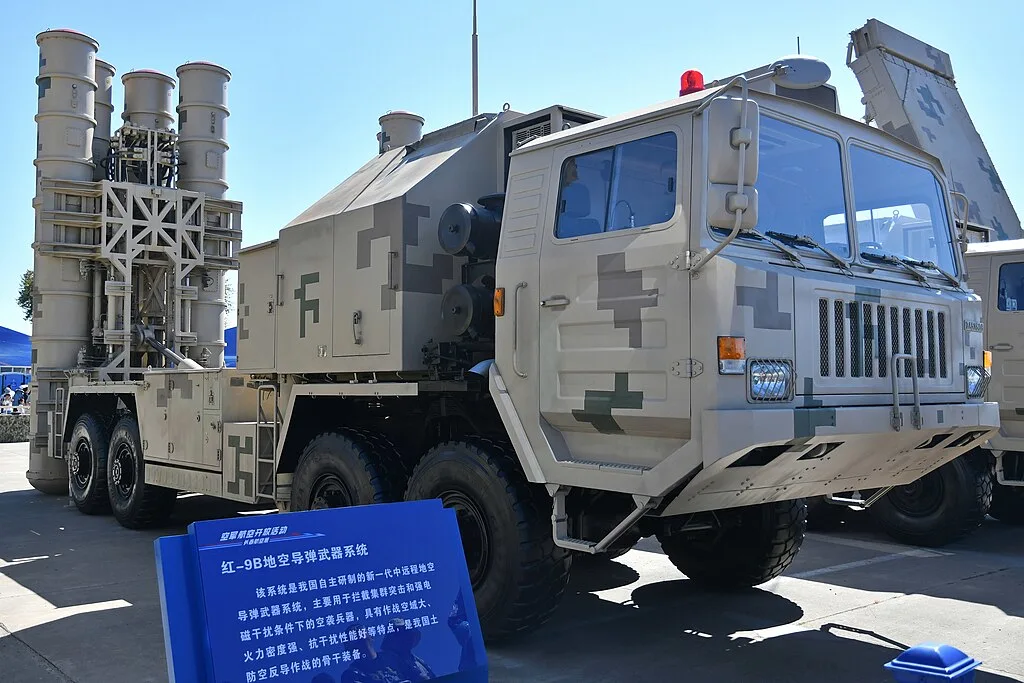
Image Credit: 颐园居, CC BY-SA 4.0, via Wikimedia Commons
Image used for Illustrative purpose only.
Pakistan deploys it as a key layer in its air defense architecture.
Criticism has grown following repeated penetrations — whether by state-level actors or non-state actors using drones despite presence of China’s HQ-9B Air Defense Missile System be it in Iran, Venezuela and Pakistan.
Earlier analytical commentary in outlets like The National Interest questioned the HQ-9’s combat reliability even before recent events.
From Iran to Venezuela, the Chinese HQ-9B air defense system is facing mounting criticism after reportedly failing during US–Israel strikes and struggling against drone attacks in Pakistan—raising doubts about its battlefield reliability.
Additionally, China itself has reportedly acquired Russia’s S-400 for high-priority defense needs.
That detail often fuels debate:
If HQ-9 is fully reliable as claimed by China, why procure S-400?
However, battlefield performance assessments require caution. Air defense systems are layered, and failures may result from operational gaps rather than pure hardware weakness.
Still, repeated penetrations create perception problems.
And perception in defense markets matters.
Sources: The National Interest, Economic Times, Money Control, Economic Times
China’s Narrative vs Battlefield Reality
On Chinese social media platforms, strong nationalist narratives have circulated claiming dramatic Iranian and allied successes — including unverified claims about aircraft shot down or political leaders captured.
Platforms such as Weibo have reportedly trended exaggerated battlefield stories.
Chinese TikTok comments discussing how Iran captured Israeli PM Netanyahu using Chinese Quantum radars 😭
— RealInsight (@real_insight_1) March 1, 2026
China is another world lol https://t.co/26aqNKrsxK pic.twitter.com/iclvoAntQn
This reflects a controlled media ecosystem where external verification is limited.
The contrast is striking.
In India, criticism of domestic defense capability is common. In China, state narratives often dominate information flow.
Information environments shape perception.
And perception shapes policy pressure.
Pilot Capture Claims: Fact or Psychological Warfare?
The Taliban also claimed that a Pakistani fighter jet was shot down and that its pilot was captured alive near Jalalabad.
Pakistan has denied these claims.
At present, independent confirmation is lacking.
If proven true, the psychological impact on Pakistan’s military credibility would be significant.
If false, the episode still demonstrates effective information warfare.
Modern conflict is fought in two arenas:
The battlefield.
And the narrative space.
What This Means for Pakistan’s Military Standing
Pakistan’s military ranking has already seen fluctuations in global assessments.
Repeated air defense penetrations — whether by India previously or now by the Taliban — amplify questions about readiness and systems integration.
This does not automatically mean systemic collapse.
But it does create:
- Credibility strain
- Export reputation risk for Chinese systems
- Domestic pressure on Pakistani leadership
And when credibility erodes, deterrence weakens.
Sources: India Today
India’s Strategic Position: Why Staying Out Matters
India is not directly involved in the Taliban–Pakistan escalation.
From a strategic perspective, restraint serves Indian interests.
India’s priorities include:
- Sustained economic growth
- Managing current account stability
- Maintaining debt-to-GDP discipline
Engaging militarily would introduce unnecessary volatility.
Moreover, prolonged Pakistan–Afghanistan friction could keep pressure away from India’s western border.
Sometimes strategic advantage comes from patience.
Not participation.
Conclusion: The Drone Era Is Reshaping Power
The Taliban drone strike Pakistan narrative is about more than one airbase.
It is about:
- Low-cost warfare challenging high-cost systems
- Chinese military export credibility under pressure
- Psychological competition in information space
- Pakistan’s evolving security environment
Whether the HQ-9 ultimately proves adaptable or vulnerable will depend on operational reforms.
But one reality is clear:
Drone warfare has permanently altered the air defense equation.
And South Asia is now part of that testing ground.
FAQs
Did Taliban attack Nur Khan Airbase?
The Taliban claims it conducted drone strikes targeting Nur Khan Airbase. Independent confirmation remains essential.
What is the HQ-9 air defense system?
HQ-9 is a Chinese long-range surface-to-air missile system designed to intercept aircraft and missile threats.
Is HQ-9 comparable to S-400?
HQ-9 is often compared to Russia’s S-400, but operational performance differences remain debated among defense analysts.
Did Taliban capture a Pakistani pilot?
The Taliban claims so, but Pakistan has denied the report. No independent verification is available.
How effective are low-cost drones in warfare?
Modern conflicts show that inexpensive drones can bypass or overwhelm traditional air defenses under certain conditions.
Is Drone Warfare Redefining Regional Power?
The Taliban drone strike Pakistan episode raises a deeper strategic question.
If low-cost drones can repeatedly penetrate layered air defenses, how should militaries adapt?
Are expensive missile systems enough in the drone era?
And what does this mean for South Asia’s future balance of power?
Should Pakistan rethink its dependence on Chinese systems?
Should regional powers accelerate counter-drone investments?
Share your strategic view in the Comments below.
Because the next phase of warfare may not be decided by fighter jets — but by who adapts fastest to the drone revolution.
Read about the Global Firepower Index 2026 India and Pakistan Rankings. Explore more about Defense & Security and World Affairs.