Table of Contents
India Russian Oil Purchase and the Global Energy Debate
The phrase India Russian oil purchase has become central to global energy discussions as tensions rise across the Middle East and the global oil market faces uncertainty.
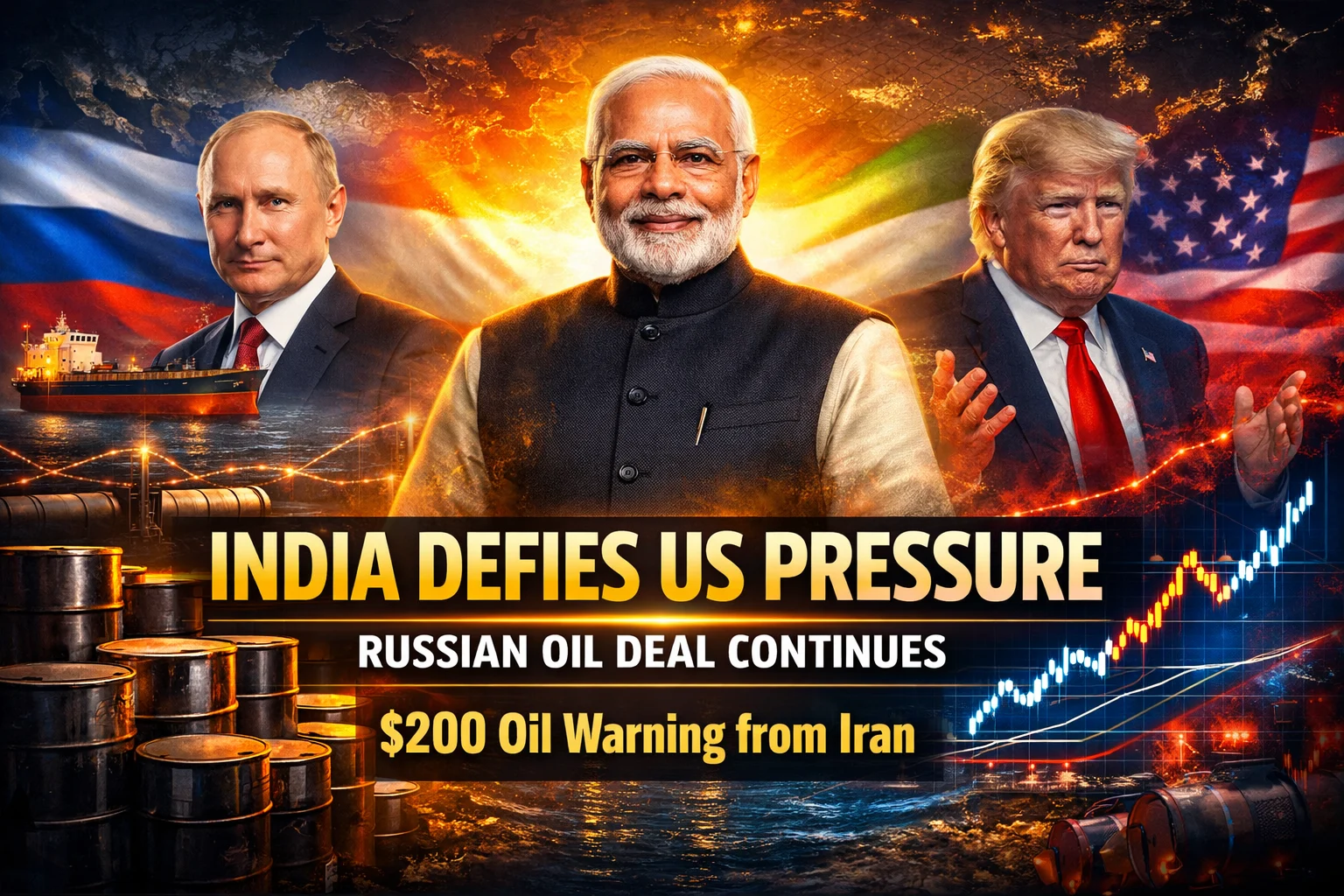
Indian government officials have recently clarified a key position: India does not require permission from any country to purchase Russian oil.
The statement comes amid growing international scrutiny over India’s energy imports from Russia, especially as geopolitical tensions intensify involving the United States and Iran.
At the same time, oil prices are rising globally. And a new warning from Iran has added another layer of concern.
According to Iranian military officials, escalating conflict could potentially push crude oil prices as high as $200 per barrel.
That possibility has triggered fears of a major global energy shock.
Sources: The Wall Street Journal
Why India Says It Does Not Need Permission to Buy Russian Oil
Indian officials have repeatedly emphasized that India’s energy policy is guided by national interest and energy security, not external approval.
According to statements from India’s energy authorities, the country has never required permission from another nation to purchase Russian oil.
This clarification comes after claims that a 30-day waiver from Washington allowed India to resume buying Russian crude.
President Trump’s energy agenda has resulted in oil and gas production reaching the highest levels ever recorded.
— Treasury Secretary Scott Bessent (@SecScottBessent) March 6, 2026
To enable oil to keep flowing into the global market, the Treasury Department is issuing a temporary 30-day waiver to allow Indian refiners to purchase Russian oil.…
But the reality is more nuanced.
India had never fully stopped purchasing Russian oil. Instead, some private refiners had reduced purchases temporarily because discounts on Russian crude had started shrinking.
However, state-owned energy companies continued imports.
For India, the core issue remains simple:
Affordable energy supply.
India imports more than 85% of its crude oil, making energy diversification critical to maintaining economic stability.
Sources: Times of India, The Economic Times
The US Policy Shift on Russian Energy
The US position on Russian oil has also evolved.
Initially, US President Donald Trump claimed that pressure from Washington had significantly reduced India’s purchases of Russian crude.
Later, the narrative shifted.
The United States began discussing temporary waivers allowing countries to continue purchasing Russian oil under certain conditions.
Now another shift appears to be emerging.
There are indications that some sanctions related to Russian energy exports could potentially be reconsidered as global supply risks increase.
Why the sudden change?
Because the global energy market is facing a new threat.
Sources: The Guardian
Iran’s $200 Oil Warning and Global Market Fears
Iran has issued a stark warning.
If military escalation continues in the region, oil prices could reach $200 per barrel.
Iran Warns Oil Could Top $200/Barrel if Gulf Doesn’t Rein in U.S. and Israel
— Washington Eye (@washington_EY) March 9, 2026
An IRGC spokesman cautions neighboring governments that continued strikes on Iranian infrastructure risk driving crude above $200 amid escalating Middle East conflict and supply disruptions… pic.twitter.com/DkUZuLD0lb
The reasoning behind the threat is strategic.
Iran’s military leadership suggested that attacks on oil infrastructure across the Middle East could dramatically disrupt global supply.
Potential targets could include facilities in countries such as:
- Saudi Arabia
- United Arab Emirates
- Kuwait
Damage to oil refineries or export terminals in these countries could quickly create a global supply shock.
Even the fear of disruption can drive prices upward.
Oil markets are extremely sensitive to geopolitical risk.
And once panic spreads among traders, price spikes can escalate rapidly.
Why Russia Could Benefit From the Oil Price Surge
Amid this turbulence, one country stands to benefit significantly.
Russia.
If oil prices rise sharply, Russia would no longer need to offer large discounts on crude exports.
Demand for Russian oil would increase globally, especially among major importers like:
- India
- China
- Japan
In fact, data from the Centre for Research on Energy and Clean Air (CREA) shows that India remains one of the largest buyers of Russian energy products.
But rising prices could also reduce the economic advantage India previously gained from discounted crude.
Some estimates suggest that reduced discounts could add roughly $4 billion to India’s import bill.
That increase would have ripple effects across the broader economy.
Sources: Money Control, Business Today
What Rising Oil Prices Mean for India and the Global Economy
Oil prices influence almost every sector of the global economy.
Higher crude prices affect:
- fuel costs
- transportation expenses
- food prices
- industrial production
- inflation levels
For India, rising oil prices can widen the current account deficit and increase inflationary pressure.
Globally, the risk is even larger.
Some economists fear that a prolonged energy shock could resemble the economic turmoil seen during the 2008 Global Financial Crisis.
When asked about rising oil prices, Donald Trump suggested that the increase may be temporary and linked to the broader objective of addressing Iran’s nuclear threat.
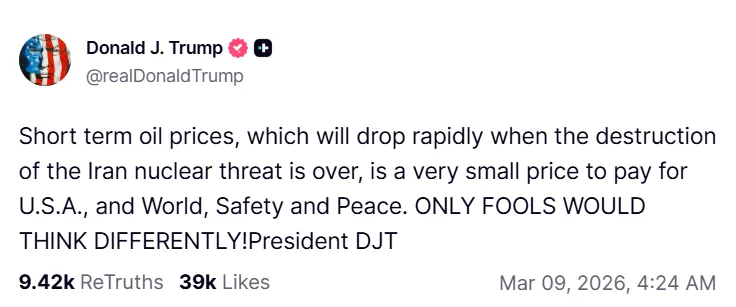
Screenshot of a Truth Social post by Donald Trump
But the timeline remains uncertain.
Short-term disruptions in oil markets can quickly turn into long-term economic challenges.
And no one knows exactly how long the current conflict could last.
Conclusion
The debate surrounding India Russian oil purchase reflects the complex intersection of geopolitics, energy security, and global economic stability.
India has made its position clear: energy procurement decisions will be driven by national interest rather than external approval.
At the same time, escalating tensions involving Iran and the United States are creating uncertainty across global energy markets.
If oil prices surge toward the levels warned by Iranian officials, the consequences could extend far beyond energy politics.
Inflation, trade balances, and global economic stability could all be affected.
For now, governments, markets, and consumers across the world are watching closely.
Because when oil prices move, the entire global economy feels the impact.
FAQs
Why does India buy oil from Russia?
India buys Russian oil primarily because it has often been available at discounted prices compared to other suppliers. Affordable energy is essential for India’s growing economy.
Can India legally purchase Russian oil?
Yes. India is not legally prohibited from buying Russian oil under international law. Decisions about energy imports are based on national policy.
Why are oil prices rising globally?
Oil prices rise due to supply disruptions in the Strait of Hormuz, geopolitical tensions between Iran , US and Israel , and market expectations. Conflicts in major oil-producing regions often trigger price spikes.
What happens if oil reaches $200 per barrel?
Extremely high oil prices could increase inflation worldwide, raise fuel costs, and potentially trigger economic slowdowns or recessions.
How dependent is India on imported oil?
India imports more than 85% of its crude oil, making energy diversification and strategic purchasing essential for economic stability.
What Does This Energy Crisis Mean for the World?
The debate over India Russian oil purchase raises broader questions about global energy politics.
If geopolitical conflicts continue to disrupt supply chains, energy security could become one of the most defining challenges of the decade.
Consider these questions:
- Could rising oil prices trigger another global economic crisis?
- Will countries increasingly prioritize national energy security over geopolitical pressure?
- And how will global power dynamics change if energy markets remain unstable?
Share Your Perspective in the Comments below.
Because in geopolitics, energy decisions often reshape the balance of power.
Read more about US giving India 30 days wavier and India’s response. Explore more about Economy & Trade, Indian Affairs and World Affairs.