Table of Contents
Pakistan Afghanistan Conflict 2026: A Shock That Changed the Narrative
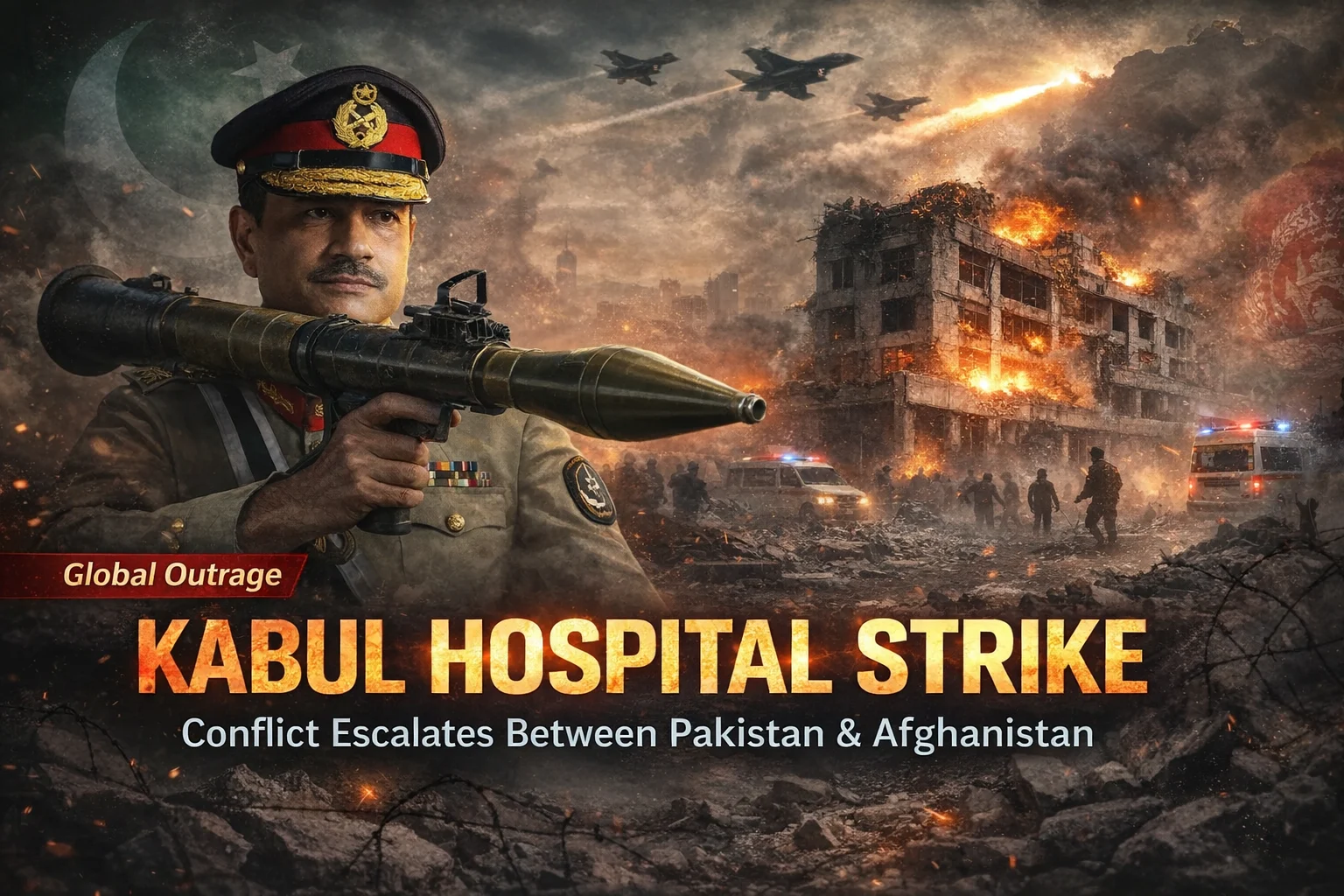
The Pakistan Afghanistan conflict 2026 has entered a far more dangerous phase after reports of a devastating airstrike in Kabul.
At a time when global attention is focused on conflicts involving United States, Iran, and Israel, another war has been quietly intensifying in South Asia.
And this time, the scale of civilian damage has forced it into the spotlight.
This changes the conversation.
What Happened in Kabul That Night
According to reports, Pakistan carried out airstrikes in Kabul, targeting what has been described as a large addiction treatment hospital.
Pakistan airstrike on a Kabul hospital killed 400 patients and their family members. Once again, the terrorist nation has exposed its true face. pic.twitter.com/BTlXkL5eWW
— Tajinder Bagga (@TajinderBagga) March 17, 2026
The casualty figures are severe:
- Over 400 people reportedly killed
- Many of them civilians
- A 2000-bed facility severely damaged
The attack reportedly took place during the holy month of Ramadan.
That detail matters.
Because it amplifies both the humanitarian and symbolic impact of the strike.
This was not just another military operation.
It was a moment that triggered outrage.
Sources: Bloomberg, The Guardian
Pakistan’s Denial vs Ground Reality
Islamabad has denied responsibility.
But visuals, images, and reports emerging from the ground suggest otherwise.
This creates a familiar pattern in modern conflicts:
Strike → Denial → Information warfare
Some narratives circulating online claim that the facility may have contained explosives or militant activity.
But these claims lack verified evidence.
And that distinction is critical.
Because targeting a hospital cannot be justified without clear and credible proof of military use.
Otherwise, it becomes something else.
A different category entirely.
Sources: CNN
Why This Conflict Is Escalating Now
The Pakistan Afghanistan conflict 2026 is not a sudden development.
It has been building over weeks.
But recent events suggest a shift in strategy.
The strikes are no longer limited.
They are expanding.
And more importantly, they are targeting infrastructure.
This suggests a broader objective:
Pressure.
Destabilization.
Control of outcomes inside Afghanistan.
This was not random.
India’s Response and Strategic Position
India has issued a strong condemnation of the strike.
The language used is significant.
The attack was described as:
- “Cowardly”
- “Unconscionable”
- A direct violation of humanitarian norms
India also emphasized that no justification exists for targeting civilian medical facilities.
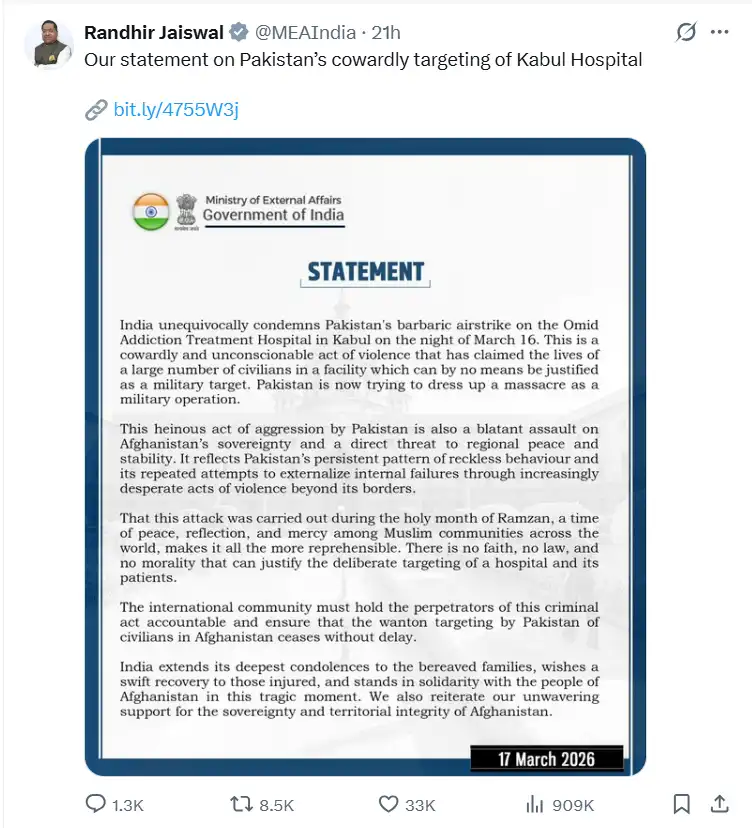
Screenshot of a X post by Randhir Jaiswal , Official Spokesperson, MEA
This positions India as one of the few countries openly addressing the issue.
And that stands out.
Because many others have remained silent.
Sources: News on AIR, MEA Government of India
Global Silence and What It Reveals
One of the most striking aspects of this crisis is not just the attack itself.
It is the response—or lack of it.
Major global powers, including:
- United States
- China
- European nations
have not issued strong reactions.
Why?
Because global attention is elsewhere.
Conflicts involving oil routes, major alliances, and strategic chokepoints dominate headlines.
And in that environment, smaller—or less strategically prioritized—conflicts risk being overlooked.
That silence matters.
The Bagram Airbase Factor
To understand the deeper strategy, one must look at the Bagram Airbase.
This site holds significant geopolitical value.
Reports indicate that Pakistan has conducted multiple strikes targeting this area.
Satellite imagery suggests damage to infrastructure.
New reporting with @ElianPeltier and @jacoob1994. This weekend, as the world looked at Iran, Pakistan bombed Bagram Air Base, north of Kabul, Afghanistan, at sunrise on Sunday. Satellite imagery we obtained via @airbus shows at least one hangar and two warehouses were flattened. https://t.co/m6RvRA5Hbh pic.twitter.com/oXualGHiOs
— Christiaan Triebert (@trbrtc) March 2, 2026
At the same time, there have been discussions about the future of Bagram and its potential strategic control.
This introduces a new layer to the conflict.
Because now, the objective may not just be pressure.
It may be positioning.
Sources: Times of India, The Guardian
What Happens Next: Risk of Ground War
The situation is evolving.
Airstrikes may not remain the only tool.
There is growing speculation that Pakistan could consider ground operations inside Afghanistan.
If that happens, the conflict would escalate dramatically.
And here is the critical issue:
There appears to be no strong external deterrent.
With multiple global conflicts already underway, international capacity to intervene is limited.
That creates space for escalation.
Conclusion
The Pakistan Afghanistan conflict 2026 is no longer a peripheral issue.
It is a developing crisis with serious humanitarian and geopolitical implications.
The Kabul hospital strike represents a turning point.
Not just because of the casualties.
But because of what it signals:
Escalation without restraint.
Limited global response.
And increasing instability in South Asia.
The coming months will determine whether this remains a contained conflict—or evolves into something far larger.
FAQs
What is Pakistan Afghanistan conflict 2026?
It refers to escalating tensions and military actions between Pakistan and Afghanistan, including airstrikes and potential ground operations.
Did Pakistan attack Kabul?
Reports and visuals suggest that Pakistan conducted airstrikes in Kabul, although official denial has been issued.
Why is the Kabul hospital strike significant?
Because it involved civilian casualties and targeted a medical facility, raising serious humanitarian concerns.
What is Bagram Airbase’s role in this conflict?
Bagram is a strategically important military base, and recent strikes suggest it may be a key objective in the conflict.
Will this conflict escalate further?
There is a strong possibility of escalation, including potential ground operations, if current trends continue.
What Should the World Do Now?
The Pakistan Afghanistan conflict 2026 raises urgent questions for the international community.
- Should global powers intervene diplomatically?
- Can accountability mechanisms be enforced in such conflicts?
- Or will geopolitical priorities continue to override humanitarian concerns?
Share Your Perspective in the Comments below.
Because in today’s world, the conflicts that are ignored often become the most dangerous ones.
Explore more about Defense & Security and World Affairs.