Table of Contents
Why Russia Tipped India About Matthew VanDyke Matters
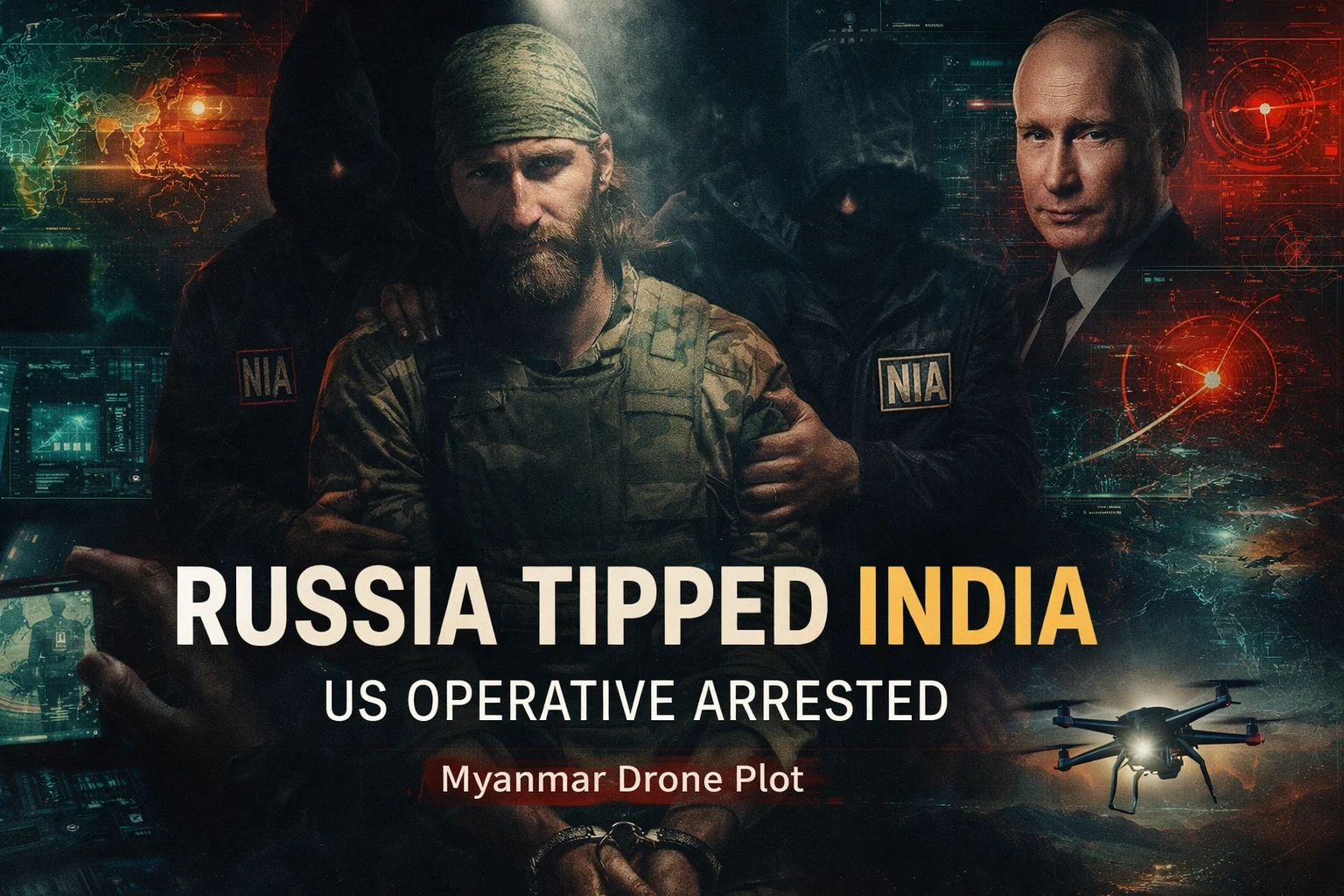
The revelation that Russia tipped India about Matthew VanDyke has transformed what looked like a routine arrest into a major geopolitical story.
An American national, along with six Ukrainian citizens, was detained by India’s National Investigation Agency (NIA) for allegedly attempting to support insurgent groups in Myanmar.
But here’s the key shift.
This operation was not uncovered domestically.
It was triggered externally—by Russia.
That detail matters.
Because it signals coordination, competition, and strategic surveillance happening across borders.
Sources: Republic
How Russian Intelligence Triggered the Arrest
The turning point came when Russia tipped India about Matthew VanDyke.
Reports suggest that Russian intelligence had been tracking Matthew VanDyke for some time.
Why?
Because of his earlier involvement in Ukraine.
VanDyke had reportedly:
- Supported Ukrainian forces
- Provided training against Russian military interests
This put him directly on Russia’s radar.
When he entered India:
- His movements were monitored
- His link to Myanmar activities was identified
- A tip-off was sent to Indian authorities
That tip led to immediate action.
The NIA intervened and arrested him along with Ukrainian associates.
This was not reactive.
It was pre-emptive.
Sources: Hindustan Times
Who Is Matthew VanDyke Really
Officially, VanDyke is not affiliated with the US government.
- Not part of the Central Intelligence Agency
- Not a US military officer
- Not a formal state representative
But his history suggests something more complex.
He has been active in multiple conflict zones:
- Libya
- Syria
- Ukraine
He also founded Sons of Liberty International in 2014.
This organization:
- Provides military training
- Advises armed groups
- Supports foreign fighters
But the most revealing aspect comes from his own statements.
VanDyke has claimed that he conducted covert operations in Venezuela since 2019.
According to him:
- He worked with rebel commanders
- Participated in intelligence gathering
- Was linked to operations such as Operation Aurora
- Played a role in efforts targeting the government of Nicolás Maduro
I've been running covert operations with a Venezuelan rebel commander since 2019.
— Matthew VanDyke (@Matt_VanDyke) January 10, 2025
You've read about our missions in the media, such as Operation Aurora, but nobody knew who did it.
The Venezuelan team and I agreed to reveal this today.
We'll continue until #Venezuela is free. pic.twitter.com/OMyi0ay6Sm
He also suggested that many of these missions were intentionally hidden for years.
This establishes a clear operational pattern:
Conflict zones → local training → covert support → deniable involvement
That pattern is central to understanding why his presence near Myanmar raised alarms.
Sources: India Today, Matthew VanDyke Website, Wikipedia
Myanmar Conflict: The Real Battlefield Behind the Plot
The core objective of the operation appears linked to Myanmar.
Since 2021:
- Military rule replaced a democratically elected government
- Civil unrest and armed resistance increased
The current regime maintains strong ties with:
- China
- Russia
Meanwhile, the United States has imposed sanctions—but with limited impact.
So alternative methods emerge.
Instead of direct intervention:
- ➡ Support local resistance
- ➡ Train insurgent groups
- ➡ Enable asymmetric warfare
This is where figures like VanDyke fit into the broader picture.
Why Russia Stepped In So Early
Russia’s role was not incidental.
It was strategic.
Myanmar is a key partner for Russia in Southeast Asia.
- Military cooperation agreements
- Technology transfers
- Satellite and space collaboration proposals
- Direct support to the Myanmar military
Maintaining a pro-Russia government in Myanmar is critical.
So any external attempt to destabilize that regime—especially through trained insurgents—becomes a threat.
That explains the early intervention.
Russia acted before the situation escalated.
Sources: The Moscow Times, Reuters, Fulcrum
Drone Warfare Training and Modern Conflict Strategy
At the center of the alleged operation was drone warfare training.
This is not a minor detail.
It reflects how modern conflicts are evolving.
Instead of:
- Large-scale armies
- Direct invasions
We now see:
- Small trained units
- Drone-based attacks
- High-impact, low-cost operations
Training insurgents in drone warfare:
- Increases their effectiveness
- Reduces reliance on traditional weapons
- Creates long-term instability
This is a structural shift in warfare.
India’s Position: Security Over Alignment
India’s response was clear.
Arrest first. Investigate fully.
India is not aligning with any side in this conflict.
Its priority is:
- Border stability
- Northeast security
- Preventing foreign operations on its soil
Mizoram and surrounding regions are sensitive.
Any instability in Myanmar directly impacts India:
- Refugee inflows
- Security challenges
- Cross-border movement
So India’s position is practical, not ideological.
That distinction matters.
What Happens Next
Several uncertainties now shape the future of this case:
- Will the US actively intervene for VanDyke?
- Will Ukraine escalate diplomatic pressure?
- Will India prosecute under domestic law?
There is also speculation about possible exchanges—similar to past cases between Russia and Western countries.
One historical example involved a Russian spy family in Slovenia, later repatriated with direct involvement from Vladimir Putin.
But India-US relations lack such precedent.
So outcomes remain unclear.
This case is still unfolding.
Sources: BBC
FAQs
Who is Matthew VanDyke?
Matthew VanDyke is an American foreign fighter and founder of Sons of Liberty International, involved in conflicts in Libya, Syria, Ukraine, and claiming covert operations in Venezuela.
Why was Matthew VanDyke arrested in India?
He was arrested for allegedly entering restricted areas and being linked to a drone warfare training operation connected to insurgent groups in Myanmar.
Why did Russia tipped India about Matthew VanDyke?
Russia had likely been monitoring Matthew VanDyke’s activities due to his involvement in previous conflicts, including Ukraine. Given Myanmar’s strategic importance and its ties with Russia, sharing this intelligence with India helped prevent potential instability near a sensitive border region.
Is Matthew VanDyke linked to the CIA?
There is no official confirmation. However, analysts speculate he may function as an unofficial asset due to his activities in multiple conflict zones.
What Does This Case Reveal About Global Power Competition?
The moment Russia tipped India about Matthew VanDyke may appear small, but it reveals how deeply interconnected modern conflicts have become.
This incident raises a deeper strategic question.
Are nations now competing through unofficial actors instead of direct confrontation?
- Should India tighten foreign access near sensitive borders?
- How should countries handle unofficial operatives?
- Is Myanmar becoming a proxy battleground?
Share Your Perspective in the Comments below.
Because modern geopolitics is no longer just about nations—
it is about influence, intelligence, and deniable operations.
Explore more about Defense & Security, Indian Affairs and World Affairs.