Table of Contents
The Moment India Drew a Line
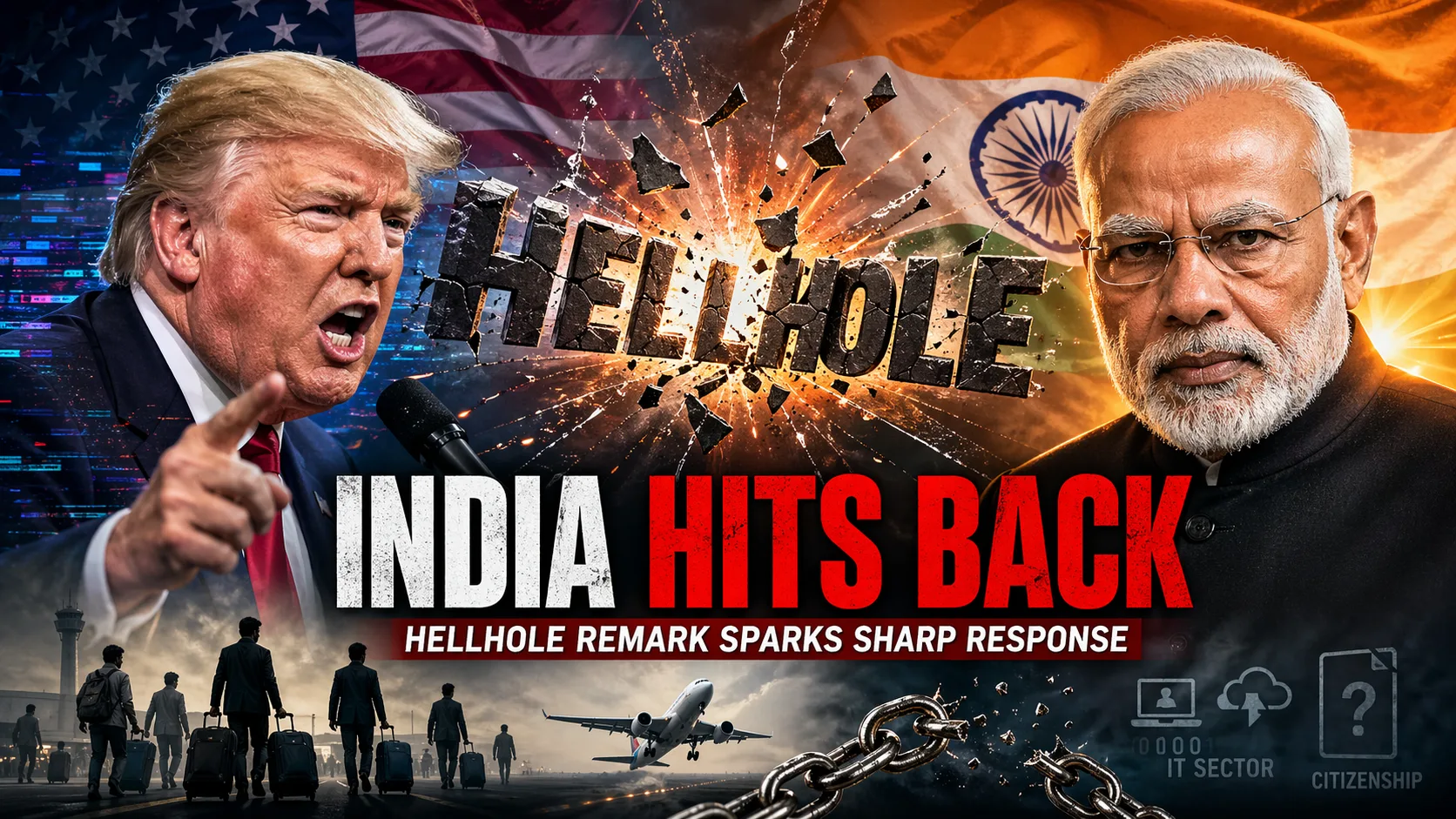
The phrase “India slams Trump hellhole remark” did not emerge from routine diplomatic disagreement—it came after a rare public insult that crossed a line.
When Donald Trump amplified a post describing India and China as “hellhole countries,” it triggered something deeper than outrage. It exposed a growing imbalance in how the relationship is being handled.
India’s official response, delivered through the Ministry of External Affairs and spokesperson Randhir Jaiswal, called the remarks “uninformed, inappropriate, and in poor taste.” That language was deliberate—and unusually sharp.
Our response to media queries regarding a social media post ⬇️
— Randhir Jaiswal (@MEAIndia) April 23, 2026
🔗 https://t.co/m9qhUcH9XP pic.twitter.com/bJJHid8g3i
This wasn’t just about defending national dignity. It was about correcting a perception: that India will tolerate anything to preserve the partnership.
Source: The Hindustan Times, MEA – Government of India
What Triggered the “Hellhole” Remark
The controversy didn’t originate from a policy paper or official briefing. It came from a repost linked to Michael Savage, a famous American podcaster and his show Savage Nation.
The content targeted immigrants—specifically Indians—claiming they exploit US laws like birthright citizenship, enter the system, and then expand their families within it. It even used language like “gangsters with laptops,” directly attacking Indian professionals in tech.
This framing tied into a broader debate in the US: birthright citizenship—the rule that anyone born on US soil automatically becomes a citizen.
But the leap from policy debate to labeling entire countries as “hellholes” was not accidental. It was political messaging aimed at a domestic audience.
And India was collateral damage.
Sources: NDTV
Why This Is Bigger Than Just One Statement
At first glance, this looks like another instance of controversial rhetoric. But that reading misses the deeper shift.
India-US relations have historically been built on two pillars: strategic necessity and mutual respect. Trade, defense cooperation, and geopolitical alignment kept the relationship stable—even during disagreements.
Now, one of those pillars is under stress.
When insults like this go unchecked—or are initially met with a soft response—it signals something dangerous: that respect is optional.
This was deliberate.
The Pattern: Trump vs “Gentleman” Diplomacy
Compare this moment with previous US presidents.
Figures like Joe Biden, Barack Obama, and George W. Bush maintained a consistent tone toward India. Disagreements existed—but they were handled with diplomatic restraint.
Even when tensions rose, the language never crossed into open insult.
With Trump, that pattern breaks.
The inconsistency is striking:
- One day: India is a “great country” and a partner
- Next day: India is labeled a “hellhole”
That volatility matters more than the insult itself. Because diplomacy depends on predictability.
Without it, even strong partnerships begin to erode.
The Real Story: Diaspora Disillusionment Begins
This is where the analysis shifts from headlines to consequences.
A survey by the Carnegie Endowment for International Peace reveals a striking trend: nearly 40% of Indian Americans are considering leaving the United States.
This is the Sharpest Insight—and it changes everything.
For decades, the “American Dream” was a one-way aspiration. Indians moved to the US for opportunity, stability, and upward mobility.
Now, that flow is showing signs of reversal.
Why?
- Rising racism moving from online to real-world experiences
- Uncertainty around visas like H-1B
- Political messaging that increasingly targets non-white immigrants
- Growing dissatisfaction with how the US handles immigration and foreign relations
A deeper data point reinforces this: 71% of Indian Americans disapprove of how Trump is handling key areas like the economy, immigration, and global relations.
This is not a fringe reaction. It’s systemic disillusionment.
Sources: NDTV
Trade vs Tone: A Strategic Contradiction
Here’s where the contradiction becomes impossible to ignore.
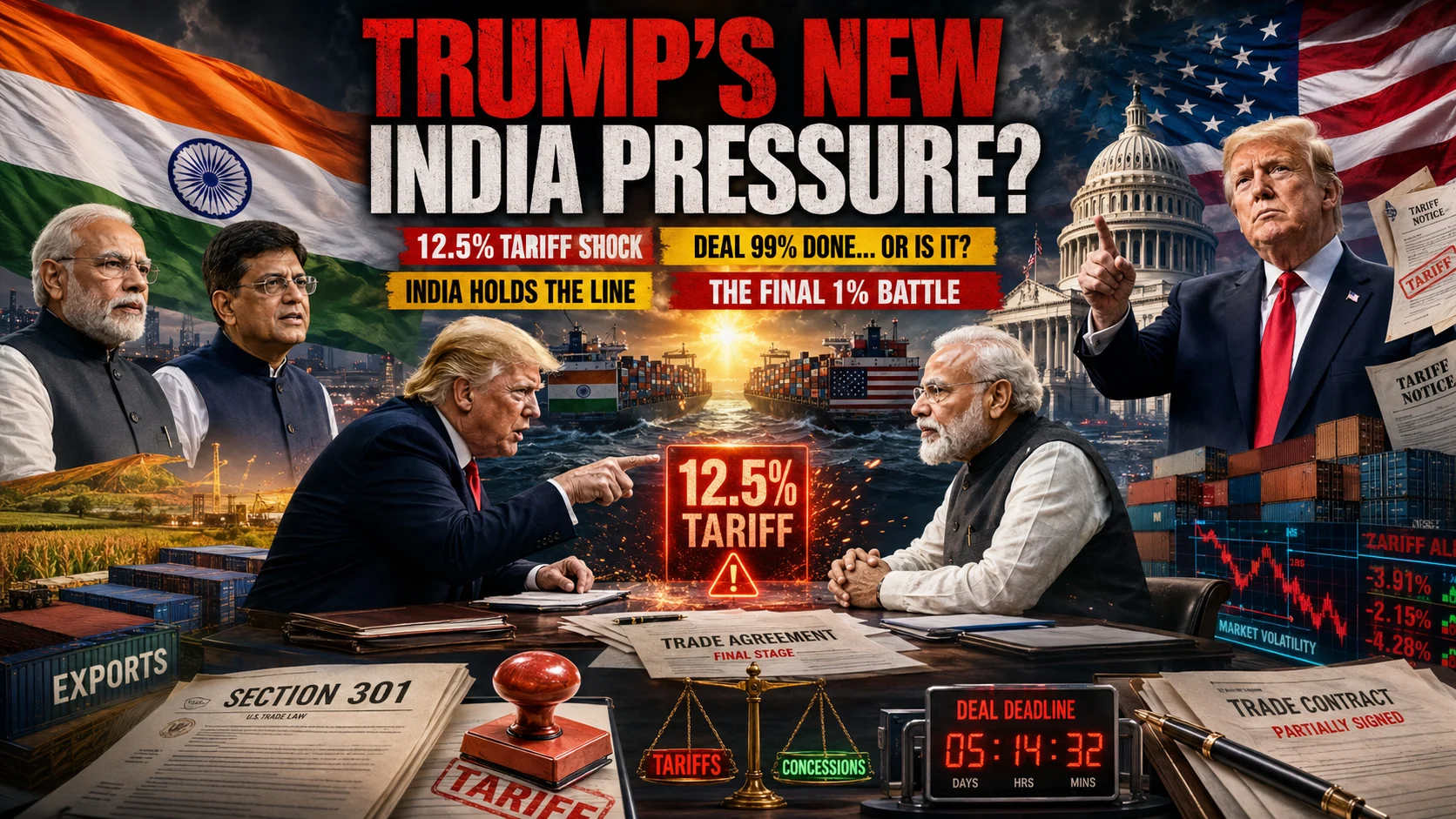
On one hand, the US and India are working toward a massive economic goal: $500 billion in bilateral trade by 2030.
On the other hand, the political messaging undermines the very people and country needed to achieve that goal.
This creates a dual-track relationship:
- Institutional level: Cooperation, trade expansion, strategic alignment
- Leadership rhetoric: Volatility, insults, and policy uncertainty
Meanwhile, US officials—including the embassy in New Delhi—are forced into damage control mode, reiterating that India is a “great country” and emphasizing shared interests.
In effect, one part of the US government builds the relationship while another destabilizes it.
Sources: India Today, Moneycontrol
India’s Response: Late but Necessary
Initially, India’s reaction was cautious—almost restrained.
That triggered visible frustration among observers. Because silence, in this context, risks being interpreted as acceptance.
The eventual strong response corrected that trajectory.
By labeling the remarks as “uninformed” and “in poor taste,” India sent a signal:
- Respect is not negotiable
- Strategic partnerships do not justify public humiliation
This shift matters because it sets a precedent.
If repeated consistently, it forces the US to recalibrate—not just its policies, but its tone.
What This Means for India
This episode reveals a structural reality India can no longer ignore.
India-US relations are not weakening—but they are becoming asymmetrical in behavior.
India continues to treat the partnership as strategic and long-term. The US, at least at the political messaging level, appears increasingly transactional and domestically driven.
That creates three immediate implications for India:
1. Strategic Dependence Needs Rebalancing
India cannot afford to be the only side “managing” the relationship. If the US assumes India will absorb every shock, it reduces India’s negotiating leverage over time.
2. Diaspora Is Becoming a Geopolitical Variable
The potential return of Indian Americans is not just a social trend—it’s an economic and strategic shift. Skilled professionals returning to India could strengthen domestic capacity. But it also signals declining trust in the US system.
3. Economic Opportunity vs Political Risk
Trade is expected to grow significantly. As US companies increasingly rely on India for manufacturing and services, India gains leverage. But that leverage is meaningful only if backed by assertive diplomacy.
But beyond these immediate implications lies a more fundamental strategic reality.
India is currently the most strategically important partner the US has — not because of sentiment, but because its traditional alternatives are exhausted. The UK and France, once the cornerstones of US alliance architecture, are in visible decline phases. They cannot offer what India can: scale, growth, manufacturing capacity, and a billion-plus consumer market. This gives India more leverage in this relationship than it is currently choosing to use.
The question is not whether India matters to the US — it clearly does. The question is whether India will negotiate from that position of strength, or continue absorbing insults to protect a partnership the US needs just as much.
Conclusion
The phrase “India slams Trump hellhole remark” captures a moment—but the real story is the tension beneath it.
A relationship built on shared interests is now being tested by uneven respect. Economic cooperation continues to expand, yet political rhetoric is introducing friction that cannot be ignored.
The most significant shift is not the insult itself—but the reaction it has triggered among Indian Americans. When nearly 40% of a highly successful diaspora begins reconsidering its place in the US, it signals a deeper instability.
India’s stronger response is a step in the right direction. But one response is not enough. If the pattern repeats — insult, soft absorption, eventual pushback, then back to normal — the global perception will solidify into something India cannot afford: that it will trade dignity for economic benefit. That is not strategic patience. That is being taken for granted. A country that is this important to US strategic interests does not need to accept a bully’s terms. It needs to price the disrespect into every negotiation that follows.
FAQs
What was India’s official response to Donald Trump’s “hellhole” comment?
India, through its Ministry of External Affairs, called the remarks “uninformed, inappropriate, and in poor taste.” The statement emphasized that such comments do not reflect the reality of India-US relations, which are based on mutual respect and shared interests. This marked a shift from an initially softer response to a more assertive stance.
Who is Michael Savage and what did he say about India?
Michael Savage is an American radio host whose podcast content was reposted by Trump. In that content, India and China were described as “hellholes,” and Indian immigrants were portrayed negatively, including being labeled “gangsters with laptops.” These remarks formed the basis of the controversy.
Why are 40% of Indian Americans considering leaving the US?
According to survey data, the reasons include rising racism, dissatisfaction with US political leadership, and concerns about immigration policies like H-1B visas and birthright citizenship debates. The shift from online hostility to real-world discrimination has played a significant role in this sentiment.
How much is the India-US trade target for 2030?
The bilateral trade target between India and the United States is set at $500 billion by 2030. This reflects the growing economic interdependence between the two countries, even as political rhetoric creates friction.
What is the debate about birthright citizenship in the US?
Birthright citizenship refers to the policy where anyone born in the US automatically becomes a citizen. Critics argue it is being exploited by immigrants, while supporters see it as a foundational constitutional principle. The debate has increasingly targeted immigrant communities, including Indians.
Closing Question
If the US continues combining economic dependence on India with public political insults, at what point does India stop absorbing the damage—and start pricing it into the relationship?
Share Your Views in the Comments below.
Explore more about World Affairs and Indian Affairs.