Table of Contents
Why a US Ally Suddenly Found Itself Under Threat
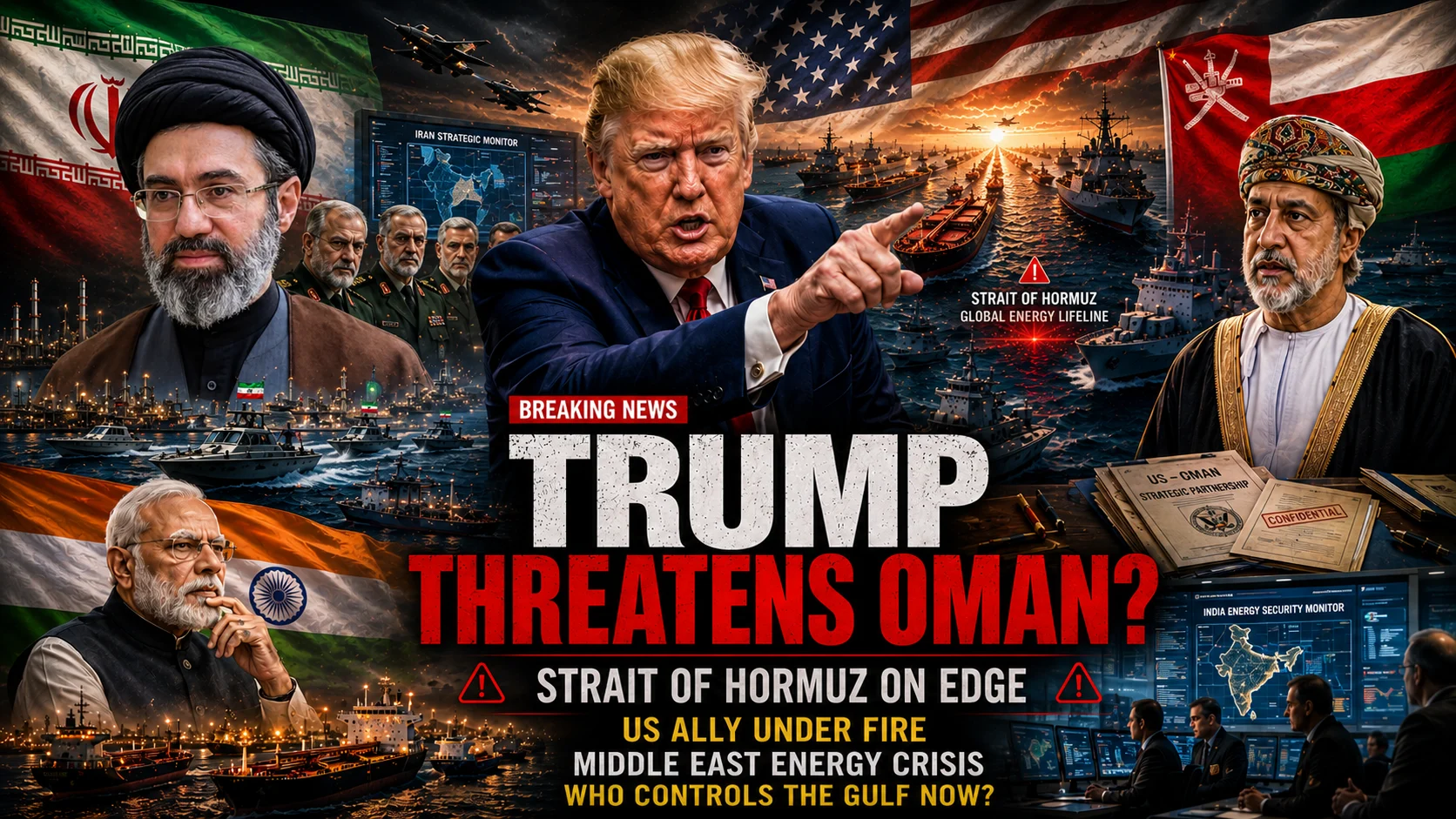
Why did Trump threaten Oman? The question has puzzled observers across the Middle East because Oman is not an enemy of the United States—it is one of its closest partners in the region.
The dispute emerged at a time when the broader US-Iran conflict remains unresolved. Nearly 100 days into the US-Iran war, the United States still has not been able to defeat Iran. Against that backdrop, Donald Trump’s warning to Oman appeared especially unusual because Oman has traditionally been viewed as a friendly country that supports both American and regional security interests.
During a White House cabinet meeting, Trump publicly stated that Oman would have to “behave like everybody else” and that if it did not, “we will blow them up.” The controversy deepened because the statement was not treated as a casual remark or corrected afterward. The US State Department also circulated the comments publicly.
PRESIDENT TRUMP: The Strait is going to be open to everybody. It’s international waters. We’ll watch over it, but nobody’s going to control it.
— Department of State (@StateDept) May 27, 2026
Oman will behave like everybody else or we’ll have to blow them up. They understand that. pic.twitter.com/hCs1tIhZGP
Oman did not publicly support Iran, did not issue anti-American statements, and did not independently announce any plan to challenge Washington. In fact, Oman is described as one of the most pro-US countries in the Middle East and continues to host important American military assets. That is why the threat is portrayed as especially shocking. The central accusation is simple: Oman had said nothing, yet it suddenly found itself being threatened.
The episode evokes Henry Kissinger’s famous observation that being America’s friend can sometimes prove more dangerous than being its enemy.
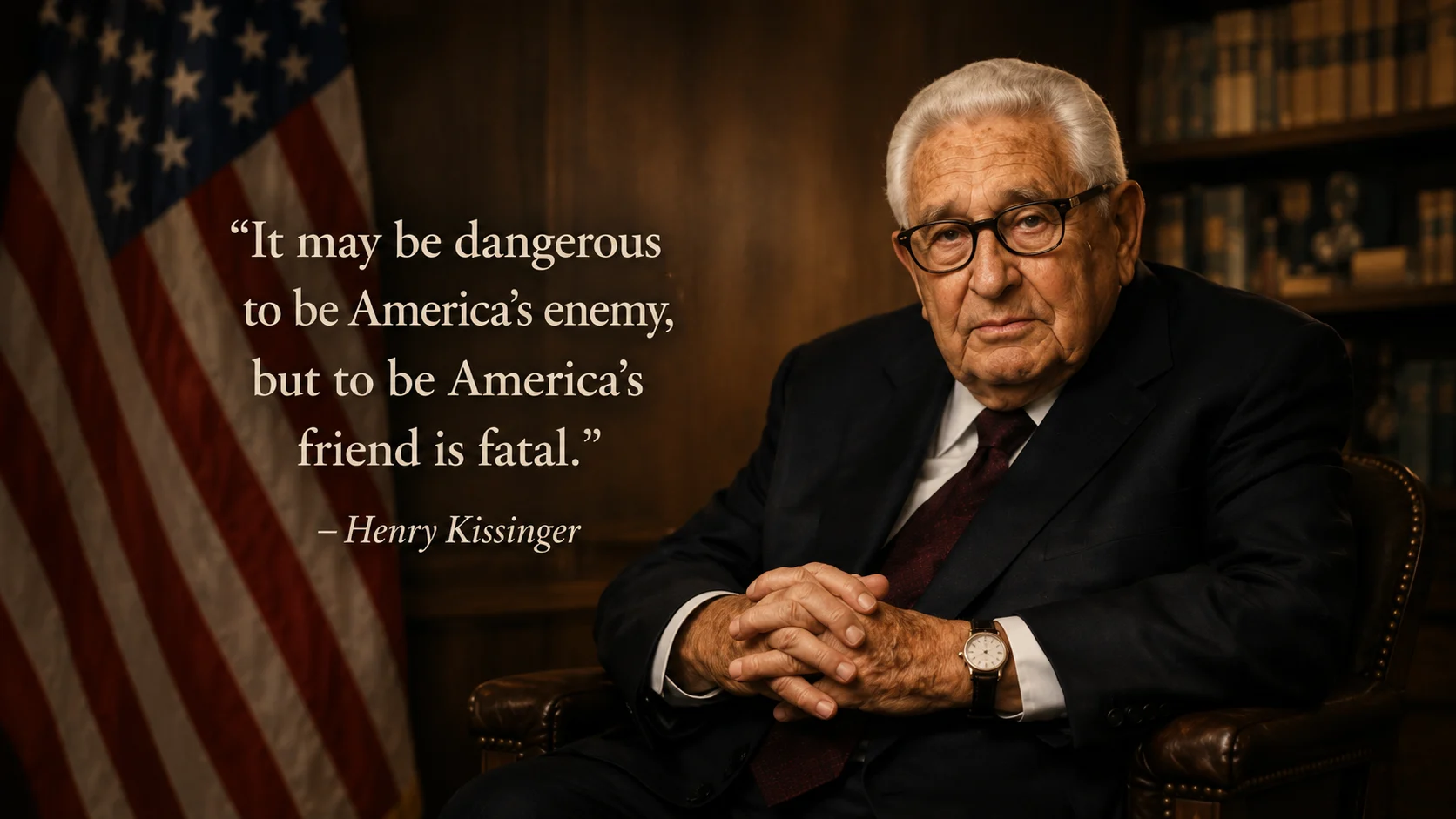
Image credit: AI-generated using ChatGPT by OpenAI
But if Oman had not openly challenged Washington, what exactly triggered such a dramatic response?
Sources: The New York Times, Time Magazine
The Strait of Hormuz Dispute Nobody Is Talking About
The answer lies in reports surrounding the future management of the Strait of Hormuz.
Iranian state media publicized details of what it claimed could be part of a future understanding involving the United States and Iran. Under that reported framework, Iran and Oman would jointly oversee shipping activity through the Strait of Hormuz, one of the world’s most strategically important waterways.
This is the central insight behind the controversy.
Trump’s threat is presented not as a reaction to something Oman actually did, but as a reaction to reports suggesting Oman could become part of a future arrangement involving Iran and the Strait of Hormuz.
Oman itself never publicly endorsed these claims. The Omani government remained largely silent even as Iranian media promoted the narrative. Yet despite that silence, Trump publicly warned that Oman would have to “behave” or face consequences.
The White House later rejected the Iranian reports and described them as fabricated. Even so, the episode sent a powerful message throughout the region. Washington appeared to react not to an Omani action but to an Iranian narrative involving Oman.
That distinction is important because it explains why many observers viewed the warning as unusual. If a friendly country can face public threats despite remaining silent, what message does that send to other partners watching from the sidelines?
Sources: The Times of Israel, India Today, NDTV
Why This Matters More to India Than It Appears
The most important lesson for India is not about Oman alone—it is about how major powers manage relationships with their partners.
One of America’s greatest strengths has traditionally been diplomacy. Across the world, Washington has built networks of countries willing to cooperate with it on security, trade, and regional stability. Public threats against friendly countries can gradually undermine that advantage.
This concern fits into a broader diplomatic pattern. The controversy arrives amid wider questions about recent US outreach efforts and whether Washington is maintaining the trust it once enjoyed among many of its partners. Incidents like these can slowly weaken confidence among countries that have traditionally aligned themselves with the United States.
Oman is specifically described as a country that supports both India and the United States. From that perspective, the controversy becomes more than a dispute over a maritime corridor. It becomes a test of how allies interpret American behavior during periods of geopolitical stress.
Policymakers in Oman now have reason to ask difficult questions. After years of cooperation and support for US objectives, hearing a public threat from the American president could force decision-makers to reconsider the nature of that partnership. Whether such reassessments occur or not, the fact that they are now conceivable is presented as evidence of diplomatic damage.
For India, the significance is strategic. Countries across the Middle East continuously evaluate which international partners offer stability, predictability, and long-term reliability. That is why the Oman episode resonates beyond Oman itself. It raises broader questions about confidence, trust, and the future shape of regional partnerships.
But the Oman controversy did not emerge in isolation. It is part of a wider pattern of frustrations facing the United States.
The Bigger Problem Behind Trump’s Frustration
The Oman episode appears to be one symptom of broader challenges confronting US policy in the Middle East.
One recurring theme is the difficulty of ending the US-Iran conflict. Even if Washington and Tehran reach an understanding, the decisive factor may not be either side alone. Israel remains the key actor because any durable settlement depends on Israeli confidence that Iran can no longer pursue nuclear weapons. Until that condition is met, the conflict is unlikely to end.
At the same time, Trump has pushed to expand the Abraham Accords across the region. Yet progress has stalled. Countries such as Pakistan, Qatar and Saudi Arabia are portrayed as having little interest in normalizing relations with Israel in the near future.
United States Senator, Lindsey Graham has publicly criticized Pakistan while raising concerns about its regional role. This reflects growing frustration within Washington as key diplomatic objectives fail to advance.
It has been apparent to me for quite a while that Pakistan as a mediator is more than problematic. Their animosity towards Israel is long standing.
— Lindsey Graham (@LindseyGrahamSC) May 26, 2026
It is undeniable that Iranian military aircraft are being housed on Pakistani air bases and past rhetoric from the highest… https://t.co/ksLqpw4ZQ4
Watch | Pakistan’s defense minister rejects normalization with Israel amid pressure over Abraham Accords
— Quds News Network (@QudsNen) May 25, 2026
Pakistan’s Defense Minister Khawaja Muhammad Asif rejected the idea of joining any normalization agreement with Israel, saying Pakistan would not accept accords that clash… pic.twitter.com/h8vWq0uzps
The uncertainty has become visible beyond government circles. Even American media outlets such as The New York Times have described the Middle East as confused about Washington’s broader goals. Many countries are struggling to understand exactly what the administration wants to achieve and how far it is prepared to go.
Against that backdrop, the Oman threat appears less like an isolated incident and more like part of a larger pattern.
Sources: The New York Times, Impact on India – Why Pakistan Rejected Abraham Accords
How Iran Turned the Threat Into a Strategic Advantage
The biggest beneficiary of the controversy may not be Oman—it may be Iran.
Iranian officials and media quickly used Trump’s remarks to strengthen their own narrative. The threat against Oman was presented as evidence of American bullying and aggression.
This is precisely the type of statement an adversary wants to see. Rather than putting Iran on the defensive, the remarks provided Tehran with ready-made talking points. Washington was effectively giving its rival material that could be used against it throughout the region.
Another issue is the message sent to international investors. Trump’s comments created the impression that even a friendly partner could suddenly become the target of military threats. For Oman, which had not publicly challenged Washington, this generated uncertainty without any obvious benefit.
The broader concern is not simply about one remark. It is about perception. When allies appear vulnerable and rivals gain propaganda advantages, the strategic costs can extend far beyond the original controversy.
And if those costs continue to accumulate, the consequences may become much larger than a single diplomatic dispute.
What Happens If This Escalation Continues?
The central warning is that the situation appears increasingly difficult to control.
Trump no longer appears fully in control of events, and continued pressure from Israel could pull the United States into a broader Middle Eastern conflict extending beyond Iran itself. Whether that prediction ultimately proves correct remains uncertain, but it reflects the growing concern surrounding the region’s direction.
A broader concern is that repeated incidents of this kind could create long-term damage to American diplomacy. The issue is not merely that relationships are being strained today. It is that repairing those relationships could take multiple future administrations.
The Oman episode therefore matters because it symbolizes something larger than a disagreement over a waterway. It highlights questions about alliance management, diplomatic credibility, and regional trust at a time when the Middle East is already experiencing extraordinary instability.
The conclusion is stark. Threatening a friendly country that has publicly remained silent does not strengthen America’s position. Instead, it risks confusing allies, encouraging adversaries, and creating doubts among countries that have traditionally cooperated with Washington.
FAQs
Why did President Trump threaten to blow up Oman?
The trigger was not a direct action by Oman itself. The controversy emerged after Iranian state media claimed that Iran and Oman could jointly oversee shipping activity in the Strait of Hormuz. Trump reacted strongly to those reports even though Oman had not publicly endorsed them.
Did Trump accidentally mean Iran instead of Oman?
This was not presented as a simple verbal mistake. The statement was delivered publicly and was later circulated by the US State Department rather than corrected. That is why many observers viewed the warning as intentional.
What role does Oman play in the Strait of Hormuz?
Oman is a historically important player in the Strait of Hormuz. Its location and regional relationships give it significant relevance in discussions about maritime security and commercial shipping.
Why is the Strait of Hormuz so important?
The Strait of Hormuz is a critical international waterway. Because of its importance to shipping and regional stability, any proposal involving its future management immediately attracts geopolitical attention.
Closing Question
If countries such as Oman begin questioning the reliability of long-standing partnerships after episodes like this, how might that reshape the strategic calculations of nations across the Middle East—and what could that ultimately mean for India’s interests in the region?
Share Your Views in the Comments below.
Explore more about Defense & Security and World Affairs.