Table of Contents
Why Pakistan Suddenly Faces a Threat From Within
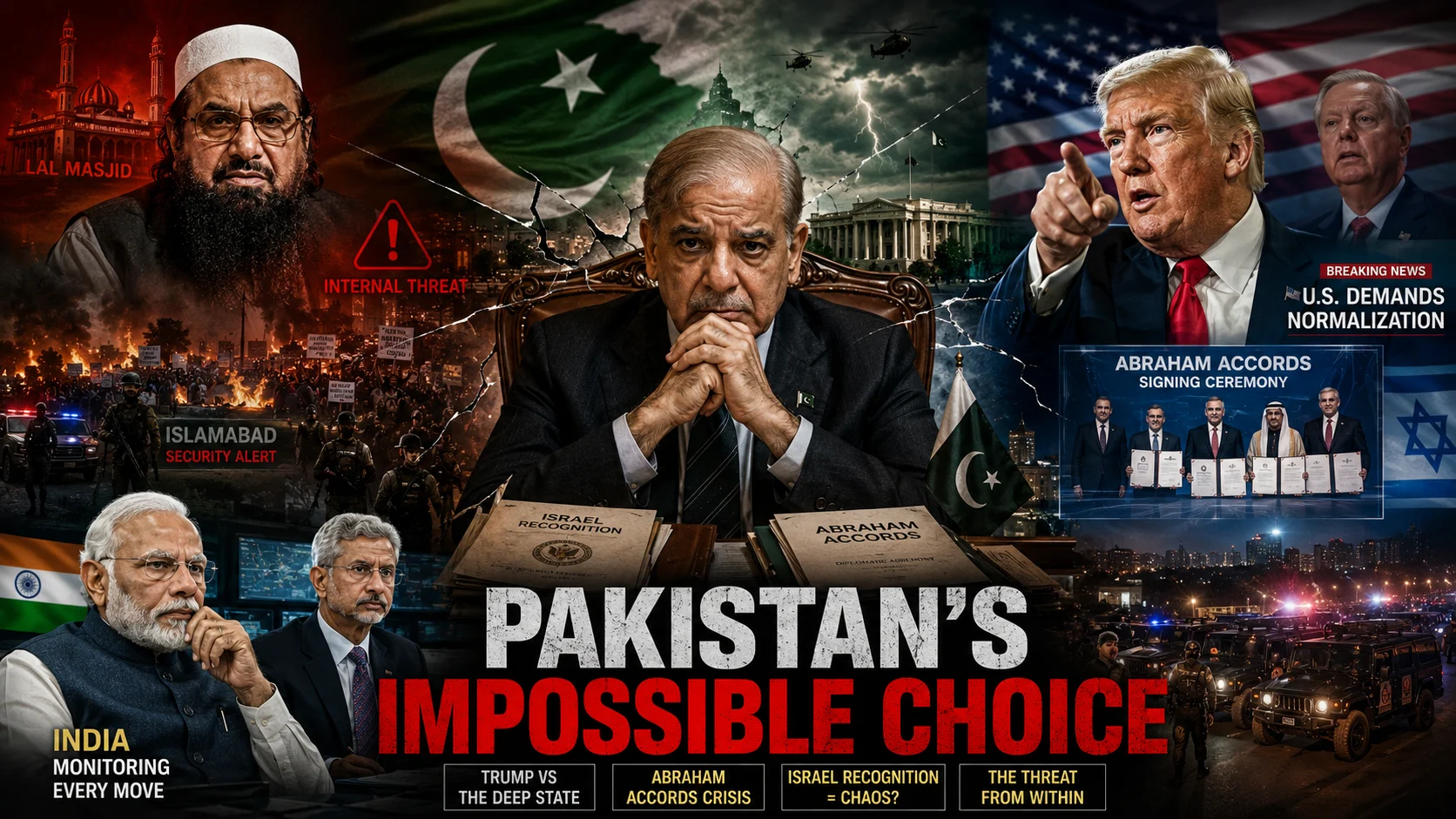
The biggest danger facing Pakistan today may be coming from organizations that Pakistan itself once tolerated. The debate around pakistan abraham accords pressure has intensified after Lashkar-e-Taiba reportedly threatened Pakistan’s leadership and warned that Pakistan itself could be destroyed if the country recognizes Israel through the Abraham Accords.
Reports suggest that the mastermind of the Pahalgam attack threatened to destroy the country if Islamabad moved toward normalization with Israel. This is not simply another foreign policy debate. It is a challenge directed at the Pakistani state itself.
Deputy Chief of Lashkar-e-Taiba Saifullah Kasuri has issued an open threat to Asim Munir and @CMShehbaz, warning that if any Pakistani leader attempts to recognise Israel, they will be “assassinated, destroyed and ruined.”
— Shivank Mishra (@shivank_8mishra) May 27, 2026
This once again exposes how deeply jihadist terror… pic.twitter.com/qOe9QnQ1ot
For years, Lashkar-e-Taiba was associated with attacks outside Pakistan. The irony now is that the same organization is being discussed as a potential threat to Pakistan’s own government and military establishment. If Pakistan chooses to recognize Israel, extremist organizations, sections of the public, and various religious groups could unite against the country’s leadership.
But this is not the first time Pakistan was warned that such a moment might eventually arrive.
The Warning Hillary Clinton Gave Pakistan Years Ago
The current situation closely mirrors a warning delivered to Pakistan more than a decade ago. Former US Secretary of State Hillary Clinton famously told Pakistani officials that if they kept snakes in their backyard, they could not expect those snakes to bite only their neighbors. Eventually, those snakes would bite the people keeping them as well.
This warning resurfaced through comments made by External Affairs Minister S. Jaishankar during a media interaction in New Delhi on 15 December 2022 . Recounting Hillary Clinton’s visit to Islamabad alongside Hina Rabbani Khar, Jaishankar noted that Pakistan had been given clear advice but had never been particularly good at taking good advice. The message was simple: groups cultivated for strategic purposes eventually become a threat to their sponsors.
EAM Jaishankar hits out at Pak MoS Hina Rabbani Khar for linking India with Lahore blast. Recalls Hillary Clinton's advice to Minister Khar that,'snakes in your backyard won't bite only neighbours' but EAM highlights that Pakistan is "not great at taking good advice". pic.twitter.com/nz8C5DuotQ
— Sidhant Sibal (@sidhant) December 15, 2022
Pakistan is now beginning to face exactly what India had warned about for years. Organizations that were once expected to target others are now threatening Pakistan itself. The question is no longer whether the warning was correct. The question is what happens when Pakistan is finally forced to confront the consequences.
That is where the story becomes highly relevant for India.
Why This Crisis Matters Directly to India
The most important implication for India is that Pakistan’s terror infrastructure is increasingly becoming Pakistan’s own problem.
For years, India submitted dossiers and evidence regarding Lashkar-e-Taiba’s activities. India repeatedly pointed to training camps, terrorist networks, and attacks carried out against civilians. Lashkar-e-Taiba was blamed for spreading terrorism and carrying out repeated attacks against India. Countless civilians lost their lives because of these networks.
While these organizations were once able to carry out frequent attacks, they have become far less effective in recent years because of what is referred to as the “unknown man.” Yet the larger point remains unchanged. India consistently argued that militant groups operating from Pakistani territory would eventually become a threat to Pakistan itself.
The argument goes even further. Pakistan may ultimately be forced to dismantle Lashkar-e-Taiba and Jaish-e-Mohammed not because of Indian military pressure, but because those organizations are now openly discussing the destruction of Pakistan. In that sense, the outcome would achieve exactly what India has wanted for years: the dismantling of Pakistan’s terror infrastructure.
The problem for Islamabad is that external pressure is making this confrontation increasingly difficult to avoid.
The Trap Donald Trump Has Created for Islamabad
Pakistan now finds itself trapped between Donald Trump’s pressure from outside and militant organizations inside its own borders. This situation can best be described as being between a rock and a hard place.
Pressure from the United States is growing for Pakistan to recognize Israel and eventually join the Abraham Accords. Donald Trump is presented as a central figure behind that pressure. If Pakistan refuses, it risks angering influential figures in Washington. If it accepts, it risks a major domestic backlash.
A significant part of the story involves Senator Lindsey Graham. Graham has criticized Pakistan’s role as a mediator and insisted that Pakistan eventually answer Trump’s call regarding the Abraham Accords. He has also publicly praised Trump, including remarks suggesting that if Trump expanded the Abraham Accords to countries such as Saudi Arabia and Pakistan, even the Nobel Prize would not be sufficient recognition and the prize itself should be renamed the “Trump Prize.”
Another major issue involves allegations that Iranian military aircraft are being housed at Pakistani air bases. Graham argued that Pakistan’s hostility toward Israel and its connections with Iran raise serious questions about its position. Pakistan is often described as perhaps the most anti-Israel country in the world.
It has been apparent to me for quite a while that Pakistan as a mediator is more than problematic. Their animosity towards Israel is long standing.
— Lindsey Graham (@LindseyGrahamSC) May 26, 2026
It is undeniable that Iranian military aircraft are being housed on Pakistani air bases and past rhetoric from the highest… https://t.co/ksLqpw4ZQ4
This leaves Islamabad with very few options. Accept Israel and face internal resistance. Reject Israel and risk angering powerful actors in Washington.
History suggests that such confrontations can become extremely dangerous inside Pakistan.
Sources: India Today, Impact on India – Why Pakistan Rejected Abraham Accords
Could Pakistan Be Heading Toward Another Lal Masjid Crisis?
The Lal Masjid siege of 2007 remains one of the defining moments in Pakistan’s modern history.
Militants gathered inside Islamabad’s Red Mosque and sought to challenge the authority of the Pakistani state. Pakistan launched an operation against them known as Operation Sunrise, which was initially called Operation Silence. As the confrontation intensified and Pakistani military personnel were killed, the operation became one of the most significant internal security actions in the country’s history.
Reports from the operation stated that 11 Pakistani military personnel were killed. Around 120 militants were killed and roughly 50 were captured. Yet the operation did not end the problem. Instead, a wave of terrorism followed. Bomb blasts and militant attacks spread across Pakistan, leading to the deaths of many innocent people.
The comparison is straightforward. If Pakistan is eventually forced to conduct similar operations against organizations such as Lashkar-e-Taiba or Jaish-e-Mohammed, the consequences could be even more severe than those witnessed after Lal Masjid.
And that leads directly to the deepest irony in the entire story.
Sources: Wikipedia – Siege of Lal Masjid
When Pakistan’s Own Terror Infrastructure Turns Against It
The central irony is that Pakistan may ultimately be forced to dismantle the very organizations it once tolerated.
For decades, debates about regional security focused on Lashkar-e-Taiba and similar groups. Pakistan repeatedly ignored warnings about the long-term consequences of allowing such organizations to operate. Hillary Clinton warned about it. India warned about it. International criticism continued for years.
Now, those same organizations are threatening Pakistan itself. If Donald Trump’s push for a broader Abraham Accords framework continues and Pakistan is forced to make a definitive decision on Israel, the resulting confrontation could trigger a major internal crisis.
The conclusion is clear and uncompromising.
Pakistan’s solution to terrorism may eventually come from being forced to dismantle its own terror infrastructure because those groups have become a direct threat to the state. If that happens, the consequences will not be temporary. The geopolitical effects could be felt for decades, and Pakistan could suffer damage from which it may struggle to recover for a very long time.
FAQs
What is the Pakistan Abraham Accords pressure debate?
The debate centers on growing pressure for Pakistan to recognize Israel and potentially join the Abraham Accords. Such a move could provoke resistance from extremist organizations and trigger major domestic instability.
Why is Lashkar-e-Taiba central to this story?
Lashkar-e-Taiba has threatened Pakistan’s leadership and warned of severe consequences if Pakistan recognizes Israel. This transforms the issue from a foreign policy debate into an internal security challenge.
What was Hillary Clinton’s warning to Pakistan?
Hillary Clinton warned that groups kept for strategic purposes would eventually threaten Pakistan itself. Current developments are widely viewed as reflecting that warning.
Why is the Lal Masjid siege being compared to the current situation?
Lal Masjid serves as an example of what happens when Pakistan confronts militant organizations directly. A future confrontation with larger groups could create even greater instability.
Why is this important for India?
India has long maintained that Pakistan’s militant infrastructure would eventually threaten Pakistan itself. Current developments are being viewed as evidence supporting that argument.
Closing Question
If Pakistan is eventually forced to choose between integrating into the regional order shaped by the Abraham Accords — including recognizing Israel and taking stronger action against groups such as Lashkar-e-Taiba and Jaish-e-Mohammed — or rejecting that path and facing increased confrontation with the United States, which outcome would have the greater long-term impact on India’s security environment?
Share Your Views in the Comments below.
Explore more about Defense & Security and World Affairs.